TEL:+86 132 6656 7067


AI data centers are increasing demand for high-speed optical transceivers, photonic integrated circuits, laser chips, and advanced packaging. As networking moves from 400G to 800G and 1.6T, supply-chain performance increasingly depends on upstream semiconductor capacity, optical component yields, precision assembly, qualification cycles, and coordination across the complete manufacturing ecosystem.
1. Optical Chips as a Critical Part of AI Infrastructure
Large AI clusters require high-bandwidth connections between accelerators, switches, storage systems, and separate computing facilities. These connections carry the data needed for distributed training, inference, model synchronization, and storage access. As the number of high-speed network ports increases, so does the demand for optical components that can deliver the required bandwidth, reach, and reliability.
Optical chips are a critical part of this infrastructure. They convert electrical signals into light, detect incoming optical signals, or guide and manipulate light within a photonic circuit. Depending on the transceiver architecture, the optical engine may include laser devices, modulators, photodetectors, wavelength-selective components, and related electronic circuits.
The supply chain extends well beyond the finished transceiver. It includes semiconductor materials, specialized wafers, epitaxial growth, photonic chip fabrication, laser production, optical and electronic components, precision packaging, transceiver assembly, and system-level validation. A capacity constraint at any one stage can limit output even when downstream factories have sufficient assembly capacity.
This makes optical chip availability an infrastructure-planning concern, rather than simply a component-purchasing issue. Network equipment manufacturers and data center operators need visibility into the materials, production processes, and qualification requirements that determine the availability of complete optical links.
2. The Main Layers of the Optical Chip Supply Chain
The optical chip supply chain consists of several interconnected manufacturing stages. Each stage requires specialized equipment, process control, and technical expertise, and the production capacity at one stage does not automatically translate into finished transceiver capacity.
| Supply Chain Stage | Key Components or Processes | Primary Constraints |
|---|---|---|
| Semiconductor materials | Indium phosphide, gallium arsenide, silicon wafers, and other process-specific materials | Material quality, substrate availability, specialized processing, and supplier concentration |
| Wafer and epitaxial production | Substrate preparation and epitaxial layer growth for photonic devices | Crystal quality, process consistency, yield, and capacity expansion time |
| Optical chip fabrication | Laser chips, modulators, photodetectors, and photonic integrated circuits | Fabrication capacity, design complexity, process maturity, and yield |
| Electronic semiconductors | Drivers, transimpedance amplifiers, DSPs, control ICs, and related devices | Process-node availability, high-speed performance, packaging, and qualification |
| Optical engine assembly | Laser coupling, photonic chip integration, fiber attachment, and electronic interconnection | Alignment accuracy, assembly throughput, reliability, and test coverage |
| Transceiver manufacturing | Optical engine integration, module assembly, firmware or management configuration, and final testing | Component allocation, process yield, thermal design, and interoperability |
| System integration | Switches, optical links, fiber infrastructure, and network qualification | Platform compatibility, installation schedules, link validation, and operating conditions |
Supply-chain visibility across these stages helps manufacturers identify the true bottleneck. Increasing transceiver assembly capacity, for example, may not improve deliveries if the limiting factor is a specialized laser die or a photonic component with a long qualification cycle.
3. InP, GaAs, and Silicon Photonics in Optical Chip Production
Different optical semiconductor technologies serve different functions. Their manufacturing processes and supply constraints are not interchangeable, so evaluating availability requires identifying the actual components used in the selected optical architecture.
Indium phosphide (InP)
Indium phosphide is a compound semiconductor widely used for high-performance lasers and other active photonic devices. It is important in optical communication because it supports light-generating and light-modulating technologies suited to fiber-optic transmission.
InP-based components include laser chips, electro-absorption modulated lasers (EMLs), and photonic devices used in various transceiver architectures. Production requires specialized substrate preparation, epitaxial growth, fabrication, and testing. Increasing capacity can take time because new production lines must meet stringent process and performance requirements.
As AI networks adopt more high-speed optical links, demand for selected InP-based devices can rise faster than available qualified capacity. The extent of the constraint varies by device type, wavelength, output power, data rate, and manufacturer.
Gallium arsenide (GaAs)
Gallium arsenide is used in several optoelectronic applications, including vertical-cavity surface-emitting lasers (VCSELs) commonly found in short-reach optical communication. VCSEL-based technologies are particularly relevant to multimode optical links in suitable data center applications.
The demand profile for GaAs-based devices differs from that of InP-based long-wavelength laser technologies. The required material, manufacturing process, optical architecture, and target reach determine which component supply chain is relevant to a particular transceiver.
Silicon photonics
Silicon photonics integrates optical functions onto a silicon-based photonic integrated circuit. The PIC can contain waveguides, modulators, splitters, and wavelength multiplexing structures, depending on the design.
Silicon photonics can support high levels of optical integration, but conventional silicon photonics does not generally provide the laser light source itself. A compatible laser must be supplied separately or integrated through a hybrid or other supported approach. As a result, silicon photonics does not eliminate demand for laser chips or the manufacturing processes required to produce them.
| Technology | Representative Optical Functions | Supply Chain Considerations |
|---|---|---|
| InP-based devices | Lasers, EMLs, and other active photonic components | Substrate availability, epitaxial production, specialized fabrication, and component yield |
| GaAs-based devices | VCSELs and other optoelectronic components | Wafer processing, laser-array quality, volume requirements, and manufacturing yield |
| Silicon photonics | Waveguides, modulators, multiplexers, and integrated optical circuits | PIC fabrication, coupling efficiency, packaging, and compatible laser integration |
No single technology is appropriate for every optical link. Component selection depends on the required reach, wavelength, modulation format, power budget, architecture, and manufacturing economics.
4. Why AI Data Centers Are Increasing Optical Chip Demand
AI infrastructure is driving higher network bandwidth and more demanding connectivity requirements. As accelerator clusters expand, network designs incorporate more high-capacity switch ports, optical links, and connections between computing facilities.
Several changes contribute to demand for optical chips:
Higher aggregate bandwidth: The transition from 400G to 800G and 1.6T requires transceivers with higher data rates and increasingly demanding optical and electrical components.
More high-speed connections: Large accelerator deployments require substantial connectivity across server racks, switch tiers, and separate network domains.
Higher bandwidth density: Faster optical engines must deliver more bandwidth within a restricted physical footprint and thermal envelope.
New optical architectures: Silicon photonics, linear pluggable optics, near-packaged optics, and co-packaged optics change the distribution and integration of optical components.
Extended-reach requirements: Distributed AI infrastructure and data center interconnects can require additional optical solutions beyond short-reach links.
These changes do not produce uniform demand across all optical chips. A short-reach multimode interface, a single-mode wavelength-multiplexed transceiver, and a coherent data center interconnect module can use very different optical components.
Supply planning must therefore connect the forecast number of transceivers to the precise component mix. Aggregate transceiver demand alone may conceal shortages in a particular laser type, wafer process, PIC design, or high-speed electronic device.
5. Why Optical Chip Capacity Is Difficult to Expand Quickly
Optical semiconductor manufacturing has several constraints that differ from those of standard electronic chip production. A factory can add equipment or increase utilization, but achieving a stable supply of qualified photonic devices also requires process development, yield improvement, packaging capability, and customer validation.
Specialized manufacturing processes
High-performance optical devices require precise control of semiconductor materials, epitaxial layers, device geometry, optical characteristics, and manufacturing conditions. These processes are specialized, and equipment installed for one technology may not be directly suitable for another.
Yield and consistency
A wafer's theoretical output is not the same as its usable output. Defects, performance variation, optical loss, and device reliability can reduce the number of qualified chips available from a production run.
Yield improvement is especially important where products must meet tight performance limits across high-speed lanes, optical power, wavelength, and temperature. A nominal increase in wafer starts may produce a smaller increase in saleable devices if yield remains unstable.
Qualification requirements
Optical chip suppliers and transceiver manufacturers must validate that components meet the required electrical, optical, reliability, and manufacturing criteria. A new source or process change can require additional engineering work and qualification before the component can be used in volume production.
Concentrated supply and long lead times
Some specialized optical components are produced by a relatively limited set of qualified manufacturers. When multiple transceiver makers require similar parts at the same time, capacity can become constrained. Adding a second supplier is not always immediate because the new source must provide the required performance, consistency, and manufacturing documentation.
6. Laser Chips as an Upstream Bottleneck
Laser chips are a critical input for many optical transceivers. Depending on the architecture, a module may use directly modulated lasers, EMLs, or continuous-wave (CW) lasers paired with external modulation. The choice affects optical performance, power, integration, and the component supply chain.
EMLs integrate a laser and electro-absorption modulator in a semiconductor device. They are used in selected high-speed optical links where their performance characteristics suit the required data rate and reach. CW lasers provide an optical carrier that can be modulated elsewhere in the optical path, including in some silicon-photonic architectures.
AI-related demand can place pressure on specific laser categories when high-speed transceiver volumes increase rapidly. Industry reporting in 2026 has highlighted InP-based lasers and EML components as potential upstream constraints, although shortage severity differs across components and suppliers.
Laser supply affects more than the number of chips available. Relevant factors include wavelength, output power, modulation capability, reliability, coupling requirements, operating temperature, and qualification status. A laser that is technically available may not be a drop-in replacement for a different optical engine.
Supply planning should consequently distinguish between the availability of general-purpose laser devices and the availability of the exact laser configuration approved for a specific transceiver.
7. The Role of DSP, Drivers, TIAs, and Other Electronic Chips
Optical engines depend on electronic components as well as photonic chips. High-speed transmitters use driver circuitry to control optical sources or modulators, while receivers use TIAs and related circuitry to amplify electrical signals generated by photodetectors.
DSPs perform supported signal-processing functions such as equalization, timing recovery, channel compensation, and FEC-related processing, depending on the interface and implementation. Other electronic components support power management, monitoring, control, and host communication.
| Component | Function in the Transceiver | Supply or Qualification Concern |
|---|---|---|
| Laser driver | Controls the electrical drive applied to the laser or modulator | Bandwidth, output characteristics, power consumption, and compatibility |
| Transimpedance amplifier | Converts photodetector current into an electrical voltage signal | Noise, bandwidth, linearity, and receiver performance |
| DSP | Processes high-speed signals and compensates for selected channel impairments | Interface support, processing capability, firmware or configuration requirements, and power |
| Clocking and timing circuitry | Supports clock generation, distribution, and recovery functions | Jitter performance, timing compatibility, and system integration |
| Power-management ICs | Regulate and monitor power supplied to module components | Electrical specifications, thermal behavior, and component qualification |
| Control and monitoring ICs | Provide module management, configuration, and diagnostics | Management compatibility, firmware support, and monitoring accuracy |
A supply disruption in an electronic component can limit transceiver output even when the optical chips are available. This is why a complete optical supply assessment should include the bill of materials for the optical engine and the supporting electronics.
Higher data rates can also change component requirements. A driver or TIA qualified for one optical engine may not support a different modulation format, bandwidth, or package interface. Alternative sourcing therefore requires electrical and optical validation rather than simply confirming the component's category.
8. Optical Engine Packaging and Assembly Capacity
Producing qualified chips is only one part of delivering a working optical transceiver. The components must be assembled into an optical engine with precise coupling, electrical interconnection, thermal management, and mechanical stability.
Packaging can become a capacity constraint when production requires specialized alignment equipment, high-precision fiber attachment, advanced bonding, or extensive optical testing. Assembly throughput and final yield depend on how repeatably these operations can be performed.
Optical coupling and alignment
Light must be transferred efficiently between lasers, waveguides, photonic chips, and optical fibers. Misalignment or poor coupling can introduce insertion loss and reduce the optical power available to the receiver. Maintaining alignment during assembly and across environmental conditions is therefore a key manufacturing requirement.
Thermal and mechanical integration
Laser sources and high-speed electronics operate within specified thermal limits. Packaging must provide appropriate heat dissipation while maintaining optical alignment and electrical performance. Higher port density and module power can increase the demands on the assembly process and final system design.
Testing and production yield
Optical engines need tests appropriate to their design, including transmit power, wavelength, receiver performance, lane behavior, electrical characteristics, and other interface-specific measurements. More integrated designs can reduce component count or assembly steps, but may also make component-level fault isolation and repair more complicated.
When planning supply, manufacturers should assess the capacity of packaging and test operations alongside wafer fabrication. A bottleneck at either stage can limit the number of usable optical engines and completed modules.
9. How Silicon Photonics and CPO Are Changing the Supply Chain
Silicon photonics and co-packaged optics are changing where optical functions are located and how photonic components are integrated with switching silicon. These approaches can support greater bandwidth density and shorter electrical paths, but they do not eliminate the need for reliable optical component supply.
In silicon-photonic architectures, optical functions such as modulation, splitting, and wavelength multiplexing can be integrated onto a PIC. A compatible laser source is still required in conventional implementations, whether it is coupled externally, hybrid-integrated, or provided through another supported arrangement.
Co-packaged optics places optical engines close to or alongside the host switch ASIC within a shared or tightly integrated package. The shorter electrical path can reduce some interconnect losses and potentially lower the signal-conditioning burden. The optical engine, laser arrangement, package, cooling system, and host ASIC then become more closely linked.
| Architecture | Supply Chain Impact | New or Increased Requirements |
|---|---|---|
| DSP-based pluggable transceivers | Uses optical engines integrated into replaceable modules | Qualified lasers, photonic components, DSPs, drivers, assembly, and module testing |
| Silicon-photonic transceivers | Increases reliance on PIC fabrication and optical coupling processes alongside laser supply | PIC yield, laser integration, optical alignment, packaging, and thermal control |
| Linear pluggable optics (LPO) | Changes the distribution of processing functions between the module and host | Host-module compatibility, analog performance, electrical channel quality, and system qualification |
| Near-packaged optics (NPO) | Moves optical engines closer to the host ASIC while retaining a separate assembly | Advanced packaging, short-reach electrical interconnects, fiber access, and thermal integration |
| Co-packaged optics (CPO) | Brings optical engine, switching silicon, and package-level integration into a tightly coordinated system | Laser delivery, PIC integration, package reliability, cooling, test access, and servicing strategy |
These architectures should not be regarded as immediate, universal replacements for pluggable transceivers. Their adoption depends on system requirements, implementation maturity, manufacturing yield, interoperability, and the serviceability needs of the network.
For supply-chain planning, the important question is not simply which architecture has the highest theoretical bandwidth density. It is whether the components, packaging methods, and production processes can consistently deliver the required system performance at the intended scale.
10. Optical Chip Supply Constraints and Industry Developments
Optical chip demand has become increasingly linked to the investment cycle for AI computing and data center networking. Market research published in 2026 has identified selected InP-based laser devices and EML components as supply-chain pressure points as demand for 800G-and-higher optical connectivity expands. The constraint is component-specific: it should not be interpreted as a shortage of every type of optical chip or transceiver.
Several structural factors can contribute to tight supply:
Rapid changes in specifications: Customers may shift quickly toward higher-speed interfaces, creating concentrated demand for newer laser, PIC, and electronic component designs.
Long manufacturing cycles: Substrate, epitaxial, fabrication, packaging, and qualification processes take time to expand and stabilize.
Limited qualified alternatives: A technically similar component may require redesign or requalification before it can be used in an existing transceiver.
Yield limitations: Lower-than-target chip or package yield reduces usable output even when nominal production capacity increases.
Capacity competition: Multiple optical module manufacturers may need the same specialized components during the same upgrade cycle.
Changing architecture mix: The transition toward silicon photonics, 1.6T modules, and selected CPO designs shifts demand among lasers, PICs, drivers, receivers, and packaging services.
These conditions can lead to longer procurement lead times, tighter allocation, and greater uncertainty in production schedules. The severity depends on the precise component, approved supplier base, contract arrangements, and the pace at which new capacity becomes qualified.
11. Building a More Resilient Optical Chip Supply Chain
A resilient supply strategy balances procurement commitments, technical qualification, component standardization, inventory planning, and alternative designs. Increasing the number of suppliers can improve flexibility, but only when the alternatives are compatible with the required optical performance and production schedule.
Multi-source qualification
Where practical, qualify more than one source for critical components or transceiver assemblies. The objective is to reduce dependence on a single production line while preserving the required performance, reliability, and management compatibility.
Second-source qualification should begin before supply becomes critical. Changes in laser chips, PICs, drivers, or other components may affect wavelength, power, signal quality, thermal behavior, or package design. Test plans should define which changes require full requalification and which can be verified through a narrower validation process.
Long-term planning and demand visibility
AI network projects often depend on coordinated deliveries of accelerators, switches, cables, transceivers, and power and cooling infrastructure. Optical component requirements should be included early in the deployment forecast rather than added only after the switch platform has been selected.
Share realistic demand forecasts with qualified suppliers and separate confirmed orders from preliminary plans. Where commercially appropriate, supply agreements can define allocation expectations, capacity commitments, lead-time assumptions, and the process for handling changes in the product roadmap.
Component standardization
Reducing unnecessary variations in transceiver types, wavelengths, connectors, and approved component options can simplify sourcing and qualification. Standardization also makes spare-parts planning easier and reduces the number of configurations that must be tested and supported.
However, standardization should not override technical requirements. A short-reach multimode link, an extended-reach single-mode connection, and a coherent DCI link may require fundamentally different optical components.
Inventory and lifecycle management
Inventory policy should reflect supplier lead times, demand variability, product shelf-life or storage requirements where applicable, and the cost of network downtime. Critical spares may be needed for components with long replenishment cycles, but excessive stock can create exposure to product revisions, specification changes, and stranded inventory.
Maintain clear records linking each approved transceiver configuration to its component revision, host platform, firmware requirements, test results, and sourcing options. This documentation helps identify the scope of any requalification when the supply chain changes.
12. Managing Quality and Interoperability Across Alternative Suppliers
An alternative optical chip or transceiver source should be evaluated on technical performance and manufacturing consistency, not just availability or unit price. Subtle differences in photonic structures, electronic characteristics, or assembly processes can influence link behavior.
| Qualification Area | What to Verify | Supply Chain Benefit |
|---|---|---|
| Optical performance | Transmit power, receiver sensitivity, wavelength, insertion loss, and applicable reach requirements | Confirms the component meets the intended optical interface |
| Electrical performance | Signaling compatibility, bandwidth, noise, lane behavior, and supported operating modes | Reduces risk of host incompatibility and unexplained link errors |
| Thermal behavior | Power consumption, temperature limits, heat dissipation, and sustained operation | Helps ensure the alternative fits the intended host cooling system |
| Management compatibility | Module identification, configuration behavior, diagnostics, alarms, and supported management interface | Maintains compatibility with network operations and monitoring |
| Reliability and consistency | Production variation, environmental performance, and test results across representative samples | Reduces risk that a sample performs well but production units vary |
| Traceability | Part number, revision, lot identification, and change-control documentation | Supports root-cause analysis and controlled lifecycle changes |
| Supply continuity | Lead time, production capacity, allocation policy, and product lifecycle plan | Improves procurement planning and contingency readiness |
For high-speed networking, the qualification process should include system-level tests. A component that meets its individual electrical or optical specification may still require integration validation with the intended module, switch, fiber route, and operating configuration.
13. What Optical Chip Suppliers and Transceiver Manufacturers Should Monitor
Supply-chain visibility improves when commercial indicators are linked to engineering and manufacturing data. Monitoring only order volume or factory utilization may fail to reveal a constraint that appears later in the production process.
Useful indicators include:
Material availability: Track substrate, wafer, epitaxial material, and other process-specific inputs needed for the approved product mix.
Production yield: Review usable chip output by process, device type, and production lot, rather than relying solely on wafer-start figures.
Qualified capacity: Distinguish nominal factory capacity from the capacity that consistently meets specifications and customer qualification requirements.
Lead-time variation: Monitor supplier delivery performance, order backlog, allocation changes, and the timing of capacity additions.
Packaging throughput: Review assembly-cycle time, optical alignment yield, test capacity, and rework rates.
Qualification status: Track the maturity of alternative components, pending engineering evaluations, and outstanding platform validations.
Demand mix: Separate forecasts for 400G, 800G, 1.6T, coherent, and other optical products because their bills of materials can differ.
Engineering changes: Monitor changes in chip revisions, packaging design, suppliers, and process conditions that may require customer requalification.
These measures support more accurate production planning and make it easier to identify where investment or supplier development could produce the greatest improvement in finished-module availability.
14. Frequently Asked Questions
14.1 Why are optical chips important to AI data centers?
Optical chips support the conversion, transmission, and detection of optical signals used to connect servers, accelerators, switches, and separate data center facilities. As aggregate network bandwidth increases, demand grows for qualified laser chips, photonic integrated circuits, receivers, and supporting electronic components.
14.2 Which optical components can become supply bottlenecks?
Potential constraints include InP-based lasers, EML devices, VCSELs, silicon-photonic PICs, high-speed drivers and TIAs, DSPs, and precision optical packaging. Which component is constrained depends on the transceiver architecture, demand mix, manufacturing yield, and available qualified capacity.
14.3 Does silicon photonics eliminate the need for laser chips?
No, not in conventional silicon-photonic optical transceivers. Silicon photonics can integrate waveguides, modulators, and other optical functions, but a compatible light source is generally still required. The laser may be externally coupled, hybrid-integrated, or implemented through another supported architecture.
14.4 Why is expanding optical chip production difficult?
Specialized semiconductor materials, epitaxial growth, photonic fabrication, optical alignment, and reliability testing require dedicated processes and manufacturing expertise. New capacity must also achieve acceptable yield and complete qualification before it contributes fully to usable production output.
14.5 Can multi-sourcing solve optical component shortages?
Multi-sourcing can reduce dependence on a single supplier, but it does not automatically resolve an industry-wide capacity shortage. Alternative sources may share upstream dependencies, and technically different components may require additional design work and qualification. Diversification is most effective when pursued before supply becomes critically constrained.
14.6 How do CPO and NPO affect the optical chip supply chain?
NPO and CPO change the location and integration of optical engines relative to the host ASIC. They increase the importance of PIC integration, laser delivery, precision packaging, thermal control, and package-level validation. Their adoption changes the component mix rather than eliminating the need for optical semiconductor production.
14.7 What should buyers evaluate beyond transceiver price?
Buyers should consider qualified supply capacity, lead-time reliability, optical and electrical specifications, host compatibility, thermal requirements, production consistency, diagnostics support, lifecycle planning, and availability of validated alternatives. These factors influence the total cost and continuity of a network deployment.
15. Summary
Optical chip supply chains are becoming more strategically important as AI data centers demand higher network bandwidth and more optical connectivity. The manufacturing ecosystem spans compound semiconductor materials, epitaxial wafers, laser chips, photonic integrated circuits, high-speed electronics, optical engine assembly, and completed transceivers.
Increased demand for 800G and 1.6T connectivity can put pressure on selected upstream components, particularly where manufacturing capacity, yield, or supplier qualification is difficult to expand quickly. Silicon photonics, LPO, NPO, and CPO introduce additional design options, but they also change the required mix of photonic components, electronic devices, packaging processes, and validation methods.
A resilient supply strategy combines qualified alternative sources, demand visibility, realistic lead-time planning, component standardization, controlled engineering changes, and system-level testing. For optical module manufacturers and network operators, managing these factors together is essential to improving production continuity and supporting reliable deployment of next-generation AI data center infrastructure.
Planning high-speed optical connectivity for AI infrastructure?
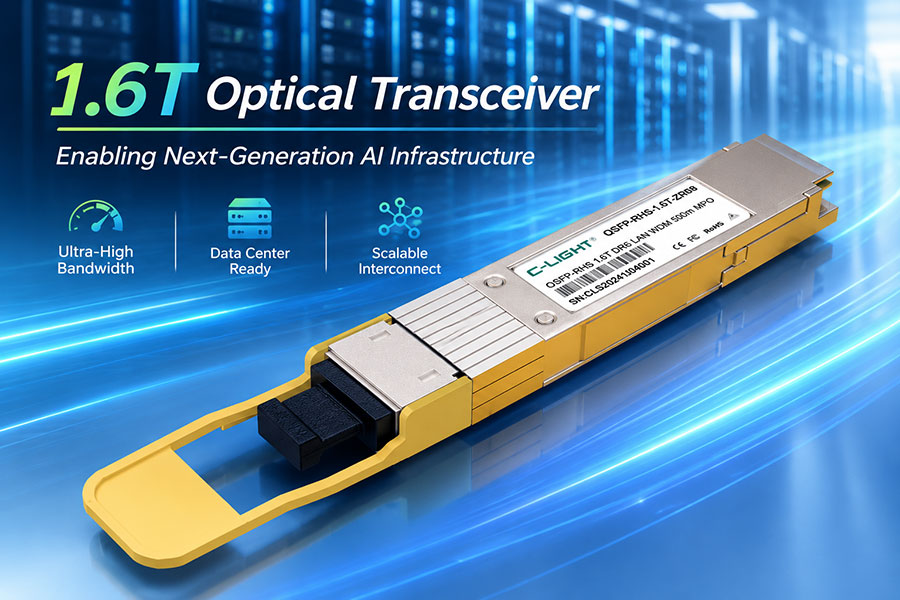
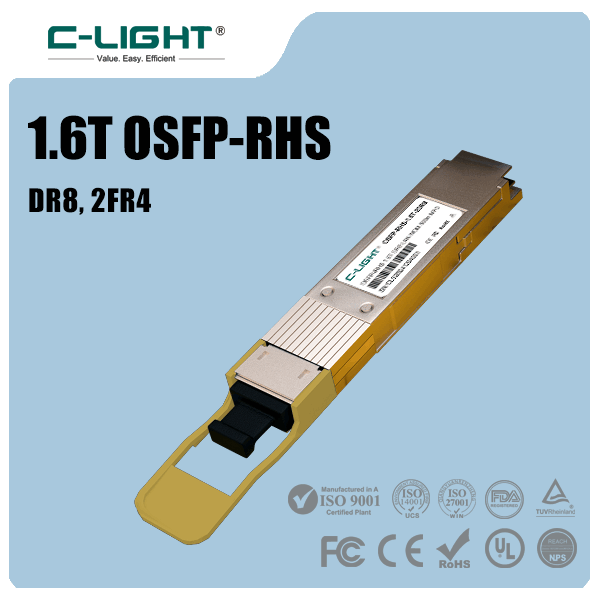
Review the 800G OSFP optical transceiver portfolio and 1.6T OSFP-RHS solutions when evaluating bandwidth, compatibility, and optical deployment requirements.
Contact C-LIGHT >

 >
 >
 >
 >
 >
 >
 >