TEL:+86 132 6656 7067


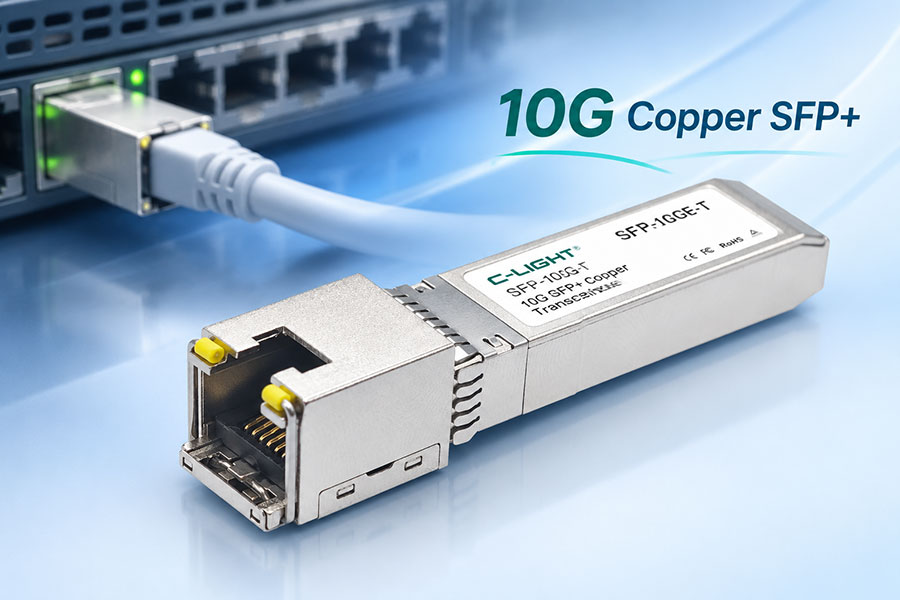
10G copper SFP+ transceivers provide 10 Gigabit Ethernet connectivity through twisted-pair copper cabling. Designed for compatible SFP+ ports, these modules allow switches, servers, and network appliances to connect over RJ45 Ethernet links without requiring a separate fiber-optic connection.
A 10GBASE-T SFP+ module is useful when existing copper infrastructure needs to support 10GbE connectivity. However, copper transceivers have different power, thermal, and distance characteristics from optical SFP+ modules. Selecting the right solution requires checking the host device, cable category, link length, and supported operating conditions.
1. What Is a 10G Copper SFP+ Transceiver?
A 10G copper SFP+ transceiver is a pluggable Ethernet module that converts the host's electrical interface into a 10GBASE-T signal for transmission over balanced twisted-pair copper cabling. The external network connection typically uses an RJ45 port.
Unlike optical SFP+ modules, which transmit data as light over fiber, 10GBASE-T copper modules use electrical signaling over copper cable. The module contains the electronics required for 10GbE transmission and reception, including signal processing and copper-interface circuitry.
Typical characteristics include:
SFP+ form factor for compatible network equipment.
10GBASE-T Ethernet connectivity over twisted-pair copper cable.
RJ45 interface for connection to compatible Ethernet ports.
Support for suitable Cat 6A cabling for links up to 100 meters, subject to the applicable channel requirements.
Power consumption and thermal requirements that may exceed those of many optical SFP+ modules.
2. Typical Technical Specifications
| Parameter | Typical Specification |
|---|---|
| Module type | 10GBASE-T copper SFP+ transceiver |
| Host interface | SFP+ electrical interface |
| Data rate | 10GbE |
| Network connector | RJ45, 8P8C |
| Cable type | Balanced twisted-pair copper Ethernet cable |
| Maximum channel reach | Up to 100 m with suitable Cat 6A cabling and a compliant channel |
| Power consumption | Product-dependent; verify the module datasheet and host-port power limit |
| Host compatibility | Depends on switch or server platform, firmware, module coding, and thermal support |
3. Cable Category and Transmission Distance
10GBASE-T performance depends on the cable category, total channel length, installation quality, and the electromagnetic environment. The transceiver's supported reach should be assessed together with the cabling channel rather than as an isolated module specification.
| Cable Category | Typical 10GBASE-T Considerations | Deployment Guidance |
|---|---|---|
| Cat 5e | Not generally specified for standard 100 m 10GBASE-T operation | Do not assume support; verify the cable and equipment requirements |
| Cat 6 | May support 10GBASE-T over shorter distances, depending on channel conditions and alien crosstalk | Validate the installed channel and the required reach |
| Cat 6A | Designed to support 10GBASE-T up to 100 m in a compliant channel | Preferred option for full-distance 10GbE copper links |
When planning a copper link, include patch cords, patch panels, and other channel components in the total distance. Poor terminations, excessive bends, cable damage, and interference can affect link performance even when the nominal cable category appears suitable.
4. 10G Copper SFP+ vs. 10G Optical SFP+
Copper and optical SFP+ modules both support 10GbE connectivity, but they address different cabling environments. Copper modules can reuse structured Ethernet cabling, while optical modules are often selected for longer distances, electromagnetic isolation, or higher-density deployments with suitable thermal and power characteristics.
| Characteristic | 10G Copper SFP+ | 10G Optical SFP+ |
|---|---|---|
| Network interface | RJ45 | Optical connector, commonly LC duplex |
| Transmission medium | Twisted-pair copper cable | Single-mode or multimode fiber, depending on the module |
| Typical distance | Up to 100 m with suitable Cat 6A cabling and a compliant channel | Depends on the optical type; common examples include 300 m for SR on supported OM3 fiber and 10 km for LR |
| Power and heat | Often relatively high for an SFP+ module | Varies by optical design; many models have lower power requirements than copper modules |
| Existing infrastructure | Useful where RJ45 copper cabling is already installed | Requires compatible fiber and optical connectors |
| Common use | Short server, switch, and equipment-room links | Data center links, structured fiber networks, and longer-distance connections |
The most suitable option depends on the link distance, installed cabling, port density, power budget, and equipment requirements. For short connections between compatible devices, direct-attach copper cables may also be worth considering.
5. Server and Switch Connectivity Applications
Server-to-Switch Connections
A 10G copper SFP+ module can connect a compatible server network adapter or network appliance to an Ethernet switch when both ends support the required 10GBASE-T interface. This arrangement can be useful in server racks that already use RJ45 patching.
Switch-to-Switch Links
For short links between switches, copper SFP+ modules can provide 10GbE connectivity through existing twisted-pair cabling. Confirm that both ports support the module type and that the selected cable channel meets the required performance specifications.
Network Appliance Connectivity
Firewalls, storage appliances, and other network devices may use SFP+ ports for high-speed Ethernet. Copper modules can provide an RJ45 interface where the platform supports 10GBASE-T transceivers and the required power and cooling conditions.
6. Power Consumption and Thermal Considerations
10GBASE-T copper SFP+ modules perform electrical-to-electrical signal conversion and copper-channel processing within a compact module. This can create a higher power and thermal load than many optical SFP+ transceivers.
Port power limit: Check the maximum power permitted by the SFP+ host port.
Thermal design: Verify that the switch or server provides sufficient airflow and supports the module's operating temperature.
Port density: Installing multiple copper modules side by side may increase local heat concentration.
Equipment support: Some platforms restrict copper SFP+ modules or support only specific part numbers.
Continuous operation: Validate link stability under the expected ambient temperature and traffic load.
For densely populated switches, module-level power consumption should be evaluated alongside the host's total power budget and cooling capacity. A physically compatible module may still be unsuitable if it exceeds the platform's thermal or electrical limits.
7. Compatibility and Deployment Checklist
Before installing a 10G copper SFP+ transceiver, verify the following items:
Host port: Confirm that the equipment has an SFP+ port and supports 10GBASE-T copper modules.
Device model: Check the switch, server adapter, or network appliance model and its supported transceiver list.
Cable category: Use a cable channel that meets the required 10GBASE-T distance and performance specifications.
Power and cooling: Confirm the module's maximum power consumption and thermal requirements.
Software support: Verify module recognition, firmware compatibility, and any vendor-specific restrictions.
Link configuration: Check speed settings, autonegotiation requirements, and the configuration at the remote port.
Performance validation: Test link stability, error counters, and operation at the intended distance and temperature.
8. When to Choose a 10G Copper SFP+
A copper SFP+ transceiver is a practical option when a compatible SFP+ host needs to connect to an RJ45 Ethernet interface and the required distance fits the copper channel specification.
It may be suitable when:
Existing Cat 6A copper infrastructure can be reused.
The link is within the supported 10GBASE-T channel distance.
The host platform explicitly supports the module's power and thermal requirements.
An RJ45 connection is required for a server, switch, or network appliance.
An optical SFP+ module or a DAC cable may be preferable when the link design calls for lower power consumption, a different transmission medium, or a short direct connection between compatible devices. The decision should be based on the full system requirements rather than the nominal data rate alone.
9. Frequently Asked Questions
Many 10GBASE-T copper SFP+ modules are designed to support up to 100 m over suitable Cat 6A cabling and a compliant channel. The exact reach depends on the module specification and cabling conditions.
No. Mechanical fit does not guarantee support. The host device must support the module's 10GBASE-T interface, power consumption, thermal characteristics, and compatibility requirements.
Yes. A 10GBASE-T SFP+ module typically provides an RJ45 interface for twisted-pair Ethernet cabling. The cable category and channel length must meet the module's requirements.
Neither is universally better. Copper can reuse existing RJ45 cabling, while optical modules support different fiber types and reach options. Power consumption, thermal constraints, cabling, distance, and equipment compatibility determine the appropriate choice.
Check the host's module support, power limits, airflow, ambient temperature, cable quality, link configuration, and firmware. Compare the measured operating conditions with the module datasheet and the equipment manufacturer's guidance.
10. Conclusion
10G copper SFP+ transceivers provide an RJ45-based option for 10GbE server, switch, and network appliance connectivity. They can be useful for extending 10G Ethernet over existing structured copper cabling, particularly when the link distance and channel specifications are appropriate.
Before deployment, verify the equipment model, 10GBASE-T support, cable category, total channel length, power consumption, and thermal limits. These checks help ensure that the selected transceiver operates reliably within the intended network environment.
10G SFP+ Connectivity Solutions
Need help selecting a 10G copper SFP+ transceiver for a server or switch? Confirm your equipment model, cable type, link distance, and power requirements to identify a suitable option.
Contact C-LIGHT >

 >
 >
 >
 >
 >
 >
 >