400G optical modules deliver high-bandwidth connectivity for data center networks, supporting high-speed switching, AI infrastructure, and scalable optical interconnects.
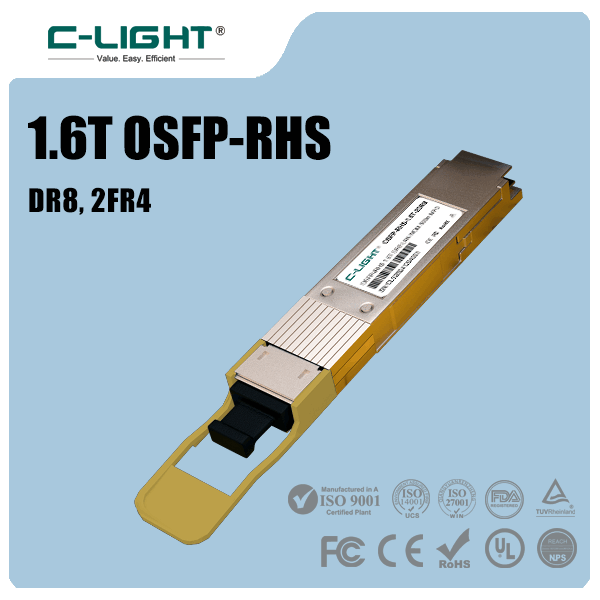
1.6T optical transceivers use high-speed PAM4 signaling, advanced DSP, and parallel or wavelength-multiplexed optics to scale AI data center bandwidth.
Optical connectivity supports scalable AI inference with high-speed 400G and 800G links, low-latency networking, and reliable data transfer between GPUs and servers.
AI cluster performance depends on GPU interconnect bandwidth, network congestion, fabric topology, and optical link capacity. Identify common bottlenecks and practical solutions.
Optical connectivity enables high-bandwidth AI training clusters with 400G and 800G links. Compare transceivers, fiber types, reach, and network design.
400G QSFP-DD to 4x100G QSFP28 breakout cables split one 400G port into four 100G links. DAC handles up to 3m with near-zero power. AOC reaches 100m over multimode fiber. AEC covers the 3–5m gap with retimer-based copper.
Compare VCSEL, DFB, EML, DML, and silicon photonics technologies for 400G, 800G, and 1.6T optical modules, including fiber types, transmission distances, power efficiency, and AI data center applications.
SGMII 1000BASE to 100BASE optical modules enable Gigabit Ethernet equipment to connect with 100BASE-FX fiber networks through integrated rate adaptation, protocol processing, and optical transmission.