TEL:+86 132 6656 7067


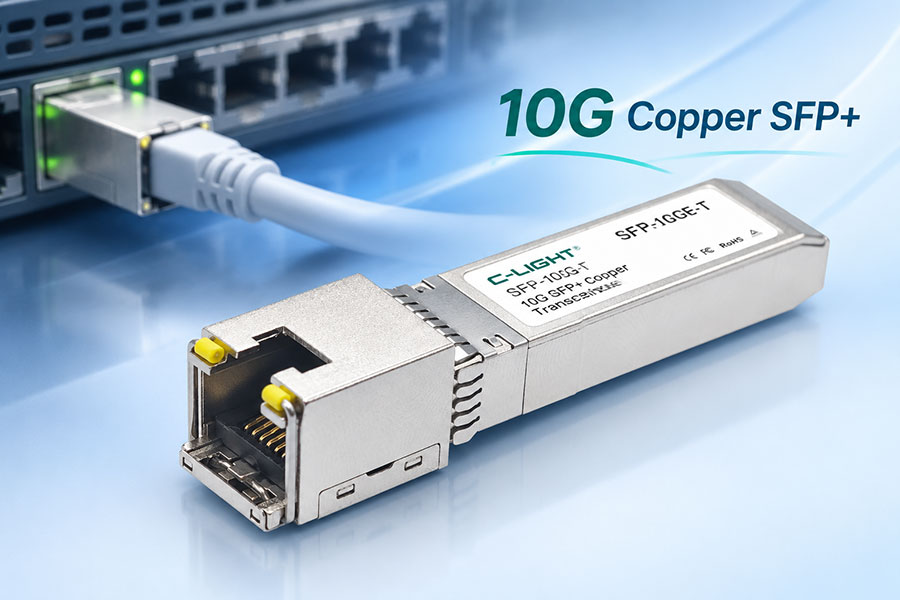
10G Copper SFP+ transceivers provide 10 Gigabit Ethernet connectivity through a compact SFP+ module with an RJ45 interface. They allow compatible switches, routers, and network devices equipped with SFP+ ports to connect to copper Ethernet endpoints using twisted-pair cabling.
In enterprise networks, this approach is useful when existing structured cabling, RJ45 server interfaces, or copper-based access equipment must be integrated into a 10GbE switching environment. Rather than replacing every copper connection with fiber, network teams can use 10GBASE-T SFP+ modules for suitable short-distance links while retaining optical transceivers for longer runs and other applications.
1. How 10G Copper SFP+ Works
A 10GBASE-T SFP+ transceiver combines an SFP+ host interface with copper Ethernet PHY circuitry and an RJ45 connector. On the network side, it transmits and receives Ethernet signals over four pairs of balanced copper conductors. The module performs the physical-layer processing required to establish a 10GBASE-T link with a compatible Ethernet port.
Unlike an optical SFP+ module, which converts electrical signals into optical signals for transmission over fiber, a copper SFP+ module provides a twisted-pair Ethernet interface. The switch still communicates with the module through its SFP+ electrical interface, while the external connection uses a standard RJ45 Ethernet cable.
2. Typical Technical Specifications
| Parameter | Typical 10G Copper SFP+ Characteristics |
|---|---|
| Form factor | SFP+ |
| Ethernet standard | 10GBASE-T |
| Maximum data rate | 10Gbps |
| Connector | RJ45 |
| Transmission medium | Balanced twisted-pair copper cable |
| Recommended cable for 10GbE | Cat6A or better for typical full-distance structured cabling requirements; check the module specification |
| Typical module reach | Up to 30m for many standard 10GBASE-T SFP+ modules |
| Power consumption | Model-dependent; some common 30m modules are rated up to approximately 2.5W |
| Link operation | Full-duplex Ethernet |
| Host compatibility | Requires supported SFP+ port hardware, firmware, and module power capacity |
These values describe a common product category, not a universal specification for every copper SFP+ module. Extended-reach models and multi-rate variants may have different distance limits, supported speeds, power requirements, and host restrictions.
3. Enterprise Ethernet Applications
3.1 Server and Workstation Connectivity
Enterprise servers, workstation systems, and compute appliances may provide 10GBASE-T RJ45 network ports. A 10G Copper SFP+ module can connect a compatible SFP+ switch port to these devices over a short copper link.
This arrangement is useful in server rooms and equipment racks where the switch uses SFP+ interfaces but the endpoint uses RJ45. It can also support incremental network upgrades when existing endpoints are retained rather than replaced.
3.2 Switch-to-Switch Connections
Some enterprise switches provide SFP+ uplink ports but need to connect to a device with native 10GBASE-T ports. A copper SFP+ module can bridge this interface difference over a supported short-distance link.
Before using copper modules for switch interconnection, verify that both switches support the selected link speed, duplex operation, and copper PHY behavior. Cable quality, port configuration, and module interoperability should be checked as part of commissioning.
3.3 Enterprise Wiring Closets
In office buildings, wiring closets often aggregate connections from work areas, wireless access infrastructure, and local servers. Where 10GbE is required over short copper runs, 10GBASE-T SFP+ modules can connect compatible network equipment to RJ45-based devices without introducing a separate fiber termination for every link.
For structured cabling runs beyond the supported reach of the selected module, use a suitable switch with native 10GBASE-T ports, an intermediate switching point, or an optical link designed for the required distance.
3.4 Storage and Compute Infrastructure
Some storage appliances and compute platforms use RJ45 10GbE interfaces for network traffic, management, or storage access. Copper SFP+ connectivity can simplify short connections between these endpoints and an SFP+-based switch.
For latency-sensitive or high-throughput storage networks, validate the complete path—including NIC capabilities, switch buffering, congestion behavior, cabling, and link configuration. The use of a copper module alone does not guarantee a particular end-to-end latency or application performance.
4. Copper SFP+ vs Optical SFP+
| Comparison | 10G Copper SFP+ | 10G Optical SFP+ |
|---|---|---|
| External connector | RJ45 | Typically LC duplex for common duplex optical modules |
| Transmission medium | Twisted-pair copper | Optical fiber |
| Common use case | Short links to RJ45 Ethernet devices | Links between fiber-connected switches, servers, and network equipment |
| Typical reach examples | Up to 30m for many standard 10GBASE-T SFP+ modules | Depends on the optical type; SR is used for short-reach multimode links, while LR supports longer single-mode links |
| Existing cabling | Can reuse suitable installed copper cabling | Requires compatible fiber infrastructure |
| Power and heat | 10GBASE-T processing can create relatively high module power and thermal demands | Varies by optical design, reach, and module generation |
| Distance planning | Bound by copper category, channel quality, and module specifications | Bound by optical standard, fiber loss, and optical power budget |
Copper is often convenient for short RJ45 connections and existing structured cabling. Optical SFP+ modules are generally more suitable when the link requires greater distance, electrical isolation, or a fiber-based infrastructure. The best option depends on distance, installed cabling, host compatibility, and operating cost.
5. Cable Selection and Transmission Distance
Cable selection directly affects 10GBASE-T link performance. Cat6A cabling is a common choice for structured 10GbE installations and supports 10GBASE-T channel distances up to 100m under the applicable cabling standard. However, a standard 10GBASE-T SFP+ transceiver is often specified for a maximum link distance of only 30m.
The maximum reach of the module and the maximum reach of the cabling category are separate limits. A 100m-rated cable channel does not mean that a 30m-rated SFP+ module can operate over 100m.
Check cable category: Use the cable type specified by the transceiver manufacturer.
Confirm channel length: Include patch cords and intermediate connections in the total link length.
Inspect cable condition: Poor terminations, excessive bends, and damaged connectors can affect link stability.
Verify extended-reach products: Modules advertised for 40m, 60m, or 80m must be assessed against their own datasheets and host restrictions.
Test the installed link: Validate the link at the intended speed after installation.
6. Power Consumption, Cooling, and Port Density
10GBASE-T SFP+ modules contain copper PHY circuitry that performs signal processing over twisted-pair cabling. This can result in higher power consumption and heat generation than some optical SFP+ modules. Certain standard 30m modules specify maximum power around 2.5W, although actual limits vary by product.
This difference matters when deploying multiple copper modules in a high-density switch. A switch may support SFP+ optical modules but impose restrictions on the number of higher-power copper modules that can be installed simultaneously.
Before deployment, check the following:
Maximum power supported by each SFP+ port.
Any platform-specific limits on the number of copper modules installed at once.
Switch firmware and transceiver support requirements.
Operating temperature, airflow, and adjacent-port thermal conditions.
Power consumption at the intended cable length and data rate.
7. Compatibility and Deployment Checklist
Compatibility should be confirmed before purchasing or installing a 10G Copper SFP+ transceiver. The physical fit of an SFP+ module is only one part of the requirement.
| Check | What to Verify |
|---|---|
| Host device | Switch, router, or network adapter model and supported port type |
| Firmware | Minimum software version and transceiver support policy |
| Link speed | Support for 10GBASE-T and any required lower-speed modes |
| Cabling | Category, total length, termination quality, and channel compliance |
| Power budget | Module maximum power and any platform-specific port restrictions |
| Operating environment | Temperature range and required cooling |
| Interoperability | Supported module coding, Ethernet PHY behavior, and endpoint compatibility |
Autonegotiation and supported link speeds vary by module and host platform. Do not assume that every copper SFP+ module supports 1G, 2.5G, or 5G Ethernet simply because another product in the same category does. Confirm the exact supported rates and configuration requirements in the datasheet.
8. Frequently Asked Questions
Can a 10G Copper SFP+ module connect to a normal RJ45 Ethernet port?
Yes, if the SFP+ host supports the module and the RJ45 endpoint supports a compatible 10GBASE-T link. The copper cable and total link length must also meet the module specifications.
Can a standard 10G Copper SFP+ module transmit over 100m?
Many standard 10GBASE-T SFP+ modules are rated for up to 30m. Although Cat6A structured cabling can support 10GBASE-T channels up to 100m under the applicable standard, the module itself may have a shorter reach limit. Extended-reach modules require separate verification.
Does a copper SFP+ module consume more power than an optical module?
It can. Copper modules perform 10GBASE-T physical-layer processing and may require more power than some optical alternatives. The actual difference depends on the specific models and operating conditions.
Can a 10G Copper SFP+ module operate at 1Gbps?
Some models support 1GbE or other lower data rates, while others have more limited operating modes. Verify the supported speeds of both the module and the host port before deployment.
When should optical SFP+ be preferred?
Optical SFP+ is often preferable for longer-distance links, fiber-based network infrastructure, or deployments where copper module power and thermal requirements are unsuitable. The appropriate optical type depends on the required distance, fiber type, and link budget.
9.Conclusion
10G Copper SFP+ transceivers provide a practical way to connect SFP+-equipped enterprise network devices to RJ45-based Ethernet endpoints. Common applications include server access, short switch interconnections, wiring closets, and selected storage or compute links.
Successful deployment depends on more than achieving a 10Gbps link rate. Cable category, supported reach, module power, thermal limits, firmware, and platform compatibility all need to be verified. For longer distances or high-density environments with strict power limits, optical SFP+ may be the more suitable solution.
Looking for 10G Copper SFP+ connectivity for your enterprise network?
Confirm the host device, cable length, required link speed, and module compatibility before deployment.
Contact C-LIGHT >

 >
 >
 >
 >
 >
 >
 >