TEL:+86 132 6656 7067


1. Introduction
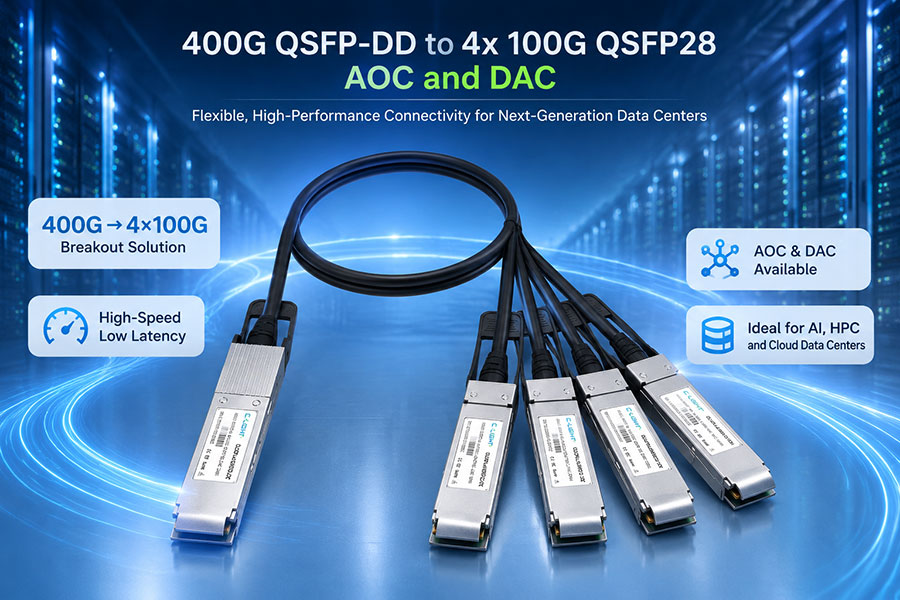
With the explosive growth in demand for AI large model training, high-performance computing clusters, and massive data exchange, data center networks are advancing at an unprecedented pace toward the 800G and even 1.6T era. As the core components of optical network interconnections, the performance and reliability of high-speed optical transceivers directly affect the operational efficiency and stability of the entire data center. C-LIGHT established in 2011, is a manufacturer with 15 years of deep expertise in the field of optical fiber communication transceivers. The company's product portfolio encompasses a full range of high-speed optical transceivers including 800G, 2×400G, 400G, 200G, and 100G, as well as interconnect products such as AOCs, ACCs, and DACs. These products are widely deployed in AI computing clusters, data center networks, telecom carrier networks, and enterprise-level application scenarios.
2. Product Matrix and Technical Architecture
2.1 800G Series Products
C-LIGHT's 800G series optical transceivers are available in two mainstream form factors: OSFP and QSFP-DD. They are fully compliant with IEEE 802.3 series communication protocols, the CMIS Rev5.0 interface protocol, and the corresponding MSA form factor standards. Based on transmission distance and application scenarios, the series includes the following primary specifications:
| Specification | Reach | Fiber Type | Wavelength | Connector | Typical Application |
| SR8 | 100m | MMF | 850nm VCSEL | 2×MPO-12/MPO-16 | Intra-rack / Adjacent-rack interconnect |
| DR8 / 2×DR4 | 500m | SMF | LAN WDM | MPO | Inter-building data center interconnect |
| 2×FR4 | 2km | SMF | LAN WDM | LC/SC | Data center campus interconnect |
| 2×LR4 | 10km | SMF | LAN WDM | LC | Data Center Interconnect (DCI) |
| VR8 | 50m | MMF | 850nm | 2×MPO-12 | AI cluster low-latency interconnect |
| ZR+ | 450km | SMF | DCO | LC | Metro / Long-haul transmission |
OSFP Form Factor: Utilizes an 8-channel electrical interface and employs PAM4 modulation technology to achieve a total transmission bandwidth of 800 Gbps. It is specifically designed for the stringent requirements of ultra-high bandwidth and low latency in AI clusters and hyperscale data center internal and interconnect scenarios.
QSFP-DD Form Factor: Adds a second row of electrical contacts on top of the standard QSFP design, expanding the number of high-speed channels from 4 to 8 to achieve an 800 Gbps total bandwidth. This form factor is physically backward compatible with previous-generation QSFP modules, facilitating seamless upgrades for data centers.
2.2 400G Series Products
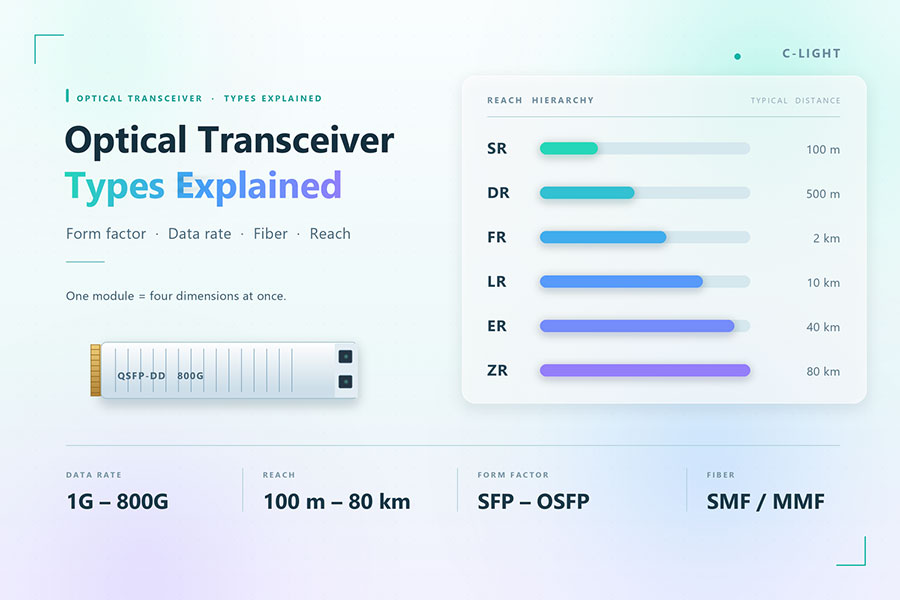
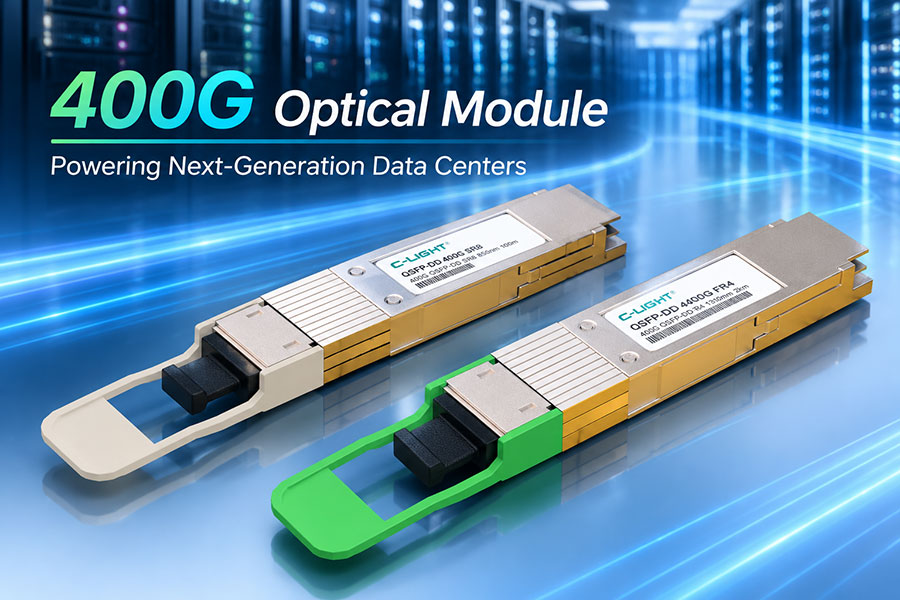
C-LIGHT's 400G series optical transceivers cover QSFP-DD and OSFP form factors, supporting a comprehensive range of scenarios from short-reach multimode to ultra-long-haul coherent transmission, with reach extending from 100 meters to over 500 kilometers.
QSFP-DD Form Factor: Adopts a "double density" design, achieving a 400 Gbps transmission bandwidth through 8 electrical channels, with each channel employing 50G PAM4 modulation. Primary specifications include:
| Specification | Reach | Fiber Type | Modulation | Connector |
| SR8 | 100m | MMF (850nm) | 8×50G PAM4 | MPO-12 / MPO-16 |
| DR4 / DR4+ | 500m | SMF | 4×100G PAM4 | MPO |
| FR4 | 2km | SMF (CWDM) | 4×100G PAM4 | LC |
| LR4 | 10km | SMF (CWDM) | 4×100G PAM4 | LC |
| LR4-20 | 20km | SMF (CWDM) | 4×100G PAM4 | LC |
| ER4 | 40km | SMF (LAN WDM) | 4×100G PAM4 | LC |
| ZR / ZR+ | 120km+ | SMF | Coherent DCO | LC |
OSFP Form Factor: Supports either 8×50G PAM4 or 4×100G PAM4 modulation schemes. An integrated heatsink is included to manage higher power consumption. This form factor is suitable for intra-data center connections and high-performance computing scenarios, covering specifications such as SR4 (100m MMF), DR4 (500m SMF), and FR4 (2km SMF).
3. Performance Testing Framework and Standards
3.1 Testing Standards Framework
C-LIGHT's optical transceiver performance testing adheres to a three-tier system combining "International Standards + Industry Specifications + Corporate Standards" to ensure global interoperability and reliability:
IEEE Standards System: 800G products comply with the IEEE P802.3df series specifications, defining optical interface parameters such as 800GBASE-DR8. 400G products comply with IEEE 802.3bs/cu/ck/cw standards.
MSA Multi-Source Agreements: Form factor and interface protocols conform to OSFP MSA HW, QSFP-DD800 MSA HW, QSFP-DD MSA HW, and Open ZR+ MSA R1.0 specifications.
Domestic Industry Standards: Reference YD/T 6086 series (Technical Requirements for 800G Intensity-Modulation Pluggable Optical Transceiver Modules) and YD/T 3538 series (Technical Requirements for 400G Intensity-Modulation Pluggable Optical Transceiver Modules).
Reliability Standards: Reliability qualification follows Telcordia GR-468-CORE specifications.
3.2 Core Test Items and Methods
C-LIGHT implements a rigorous three-level quality control process: "Initial Testing – Final Testing – Factory Inspection." Every optical transceiver undergoes 100% verification. The main test items encompass the following aspects:
(1) Transmitter Performance Testing
Transmitter performance is foundational to optical transceiver quality. The following parameters are critically evaluated for 800G/400G products:
Average Launch Optical Power: Verifies that the output optical power of each channel falls within the specified range. Excessive power may damage the receiver device, while insufficient power shortens the effective transmission distance. The average launch optical power for mainstream 800G transceivers is typically controlled within the range of -2 dBm to +3 dBm.
Extinction Ratio (ER) : Assesses the quality of the optical signal converted from the electrical signal by the optical transmitter. An insufficient extinction ratio can lead to signal misinterpretation at the receiver end.
Optical Modulation Amplitude (OMA) : Measures the optical power difference between signal "1" and "0" levels.
TDECQ (Transmitter and Dispersion Eye Closure Quaternary) : A mandatory test parameter for high-speed modules like 800G. It quantifies the signal's tolerance to dispersion and is a key metric for evaluating PAM4 signal quality.
Eye Mask Test: Captures the optical signal eye diagram using a high-speed oscilloscope to verify compliance with the eye mask templates defined in IEEE 802.3 specifications. Parameters such as eye height, eye width, and jitter are assessed. For 800G LPO-related testing, TP2 optical eye mask Hit Ratio is required to be ≤1%, with J2 ≤ 0.21 UI and J9 ≤ 0.46 UI.
(2) Receiver Performance Testing
Receiver Sensitivity: Measures the minimum average optical power required at the receiver end under the condition of BER ≤ 1×10⁻¹². Typical receiver sensitivity for 400G DR4 modules is better than -9 dBm.
Overload Optical Power: Verifies the receiver's ability to maintain BER ≤ 1×10⁻¹² under high input optical power conditions.
Receiver Return Loss: Assesses the impact of reflections at the receiver end on signal integrity.
(3) Bit Error Rate (BER) Testing
BER is the core metric for evaluating the overall transmission quality of an optical transceiver. C-LIGHT utilizes BERT (Bit Error Rate Tester) equipment to perform PRBS pattern testing under standard test conditions, requiring BER ≤ 1×10⁻¹² at the specified optical power limits. For 800G LPO modules, stable transmission with BER ≤ 1×10⁻¹² must be maintained across an insertion loss range of 8 dB to 16 dB. A variable optical attenuator is employed during testing to gradually adjust input optical power and precisely determine the sensitivity threshold.
(4) Digital Diagnostic Monitoring (DDM) Function Verification
C-LIGHT's entire series of optical transceivers supports DDM functionality, enabling real-time monitoring of critical parameters such as optical power, temperature, voltage, and bias current. Status information is reported to the system via the I²C interface.
(5) Reliability and Environmental Adaptability Testing
In accordance with Telcordia GR-468-CORE and other standards, products must pass the following reliability tests:
Operating Temperature Range Testing: Performance verification under commercial (0°C to 70°C) and industrial (-40°C to 85°C) temperature conditions.
High-Temperature, High-Humidity Aging Testing.
Hot-Plug Cycle Testing.
Random Vibration and Mechanical Shock Testing.
MTBF (Mean Time Between Failures) Assessment: C-LIGHT 800G AOC products feature an MTBF exceeding 5 million hours.
3.3 Test Platform and Equipment
C-LIGHT's R&D laboratories are equipped with comprehensive testing and validation environments, including professional equipment such as high-speed oscilloscopes, bit error rate analyzers, optical spectrum analyzers, optical power meters, optical attenuators, and thermal forcing units. The test platform supports various form factors, including QSFP-DD, OSFP, and QSFP112, and can perform batch performance validation across high and low-temperature ranges when paired with thermal forcing equipment. Core debugging processes have been automated for production and data management, ensuring test consistency and traceability.
4. Typical Application Scenarios and Performance Characteristics
4.1 AI / GPU Cluster Interconnect
In thousand-card large model training scenarios, the communication bandwidth between GPUs directly impacts training efficiency. C-LIGHT 800G SR8 / VR8 modules deliver ultra-low latency transmission of ≤1 μs, ensuring lossless 800G full-duplex communication and effectively eliminating network bottlenecks within AI clusters.
4.2 Data Center Spine-Leaf Networks
Within data center backbone networks, C-LIGHT's 800G / 400G series modules enable a backbone switching bandwidth of 25.6 Tbps, supporting the efficient forwarding of massive east-west traffic flows.
4.3 Data Center Interconnect (DCI)
The 400G ER4 (40 km), ZR (120 km), and ZR+ (300~500 km+) series products leverage coherent DCO technology to provide a cost-effective solution for long-distance interconnection between data centers.
5. Conclusion
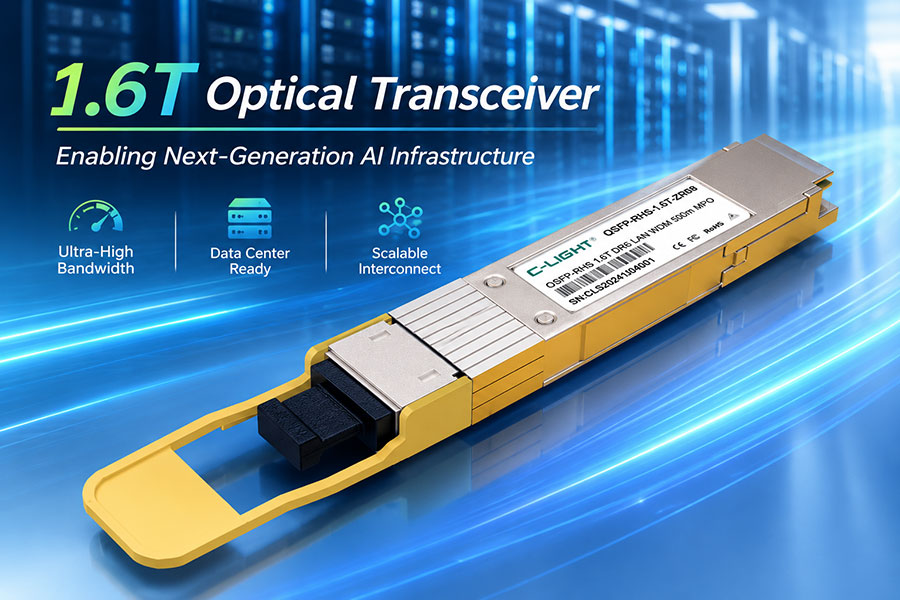
With 15 years of technical expertise and a comprehensive product line layout, C-LIGHT has established a full-scenario coverage capability in the 800G/400G high-speed optical transceiver domain, spanning from short-reach multimode to ultra-long-haul coherent transmission. The company's 100% factory inspection coverage and three-tier quality control system provide a solid guarantee of product reliability. As technologies evolve toward 800G Ethernet and 1.6T, C-LIGHT will continue to meet the demands of the AI era for high bandwidth, low power consumption, and high reliability in optical interconnects through ongoing R&D innovation.
 >
>

 >
>
 >
>
 >
>
 >
>
 >
>
 >
>
 >
>