TEL:+86 132 6656 7067


AI data centers require high-bandwidth connections between GPU servers, network interface cards, DPUs, and switches. Direct Attach Copper (DAC) cables provide a practical solution for short-reach connections where low latency, low power consumption, and compact installation are priorities. As AI infrastructure moves toward 400G and 800G network interfaces, DAC remains an important option for suitable intra-rack links and short equipment connections.
What Is DAC in an AI Data Center?
Direct Attach Copper is a fixed-length cable assembly with high-speed electrical connectors integrated at both ends. It commonly uses shielded twinaxial copper conductors to carry differential electrical signals between compatible host interfaces.
Unlike a fiber-optic link, a passive DAC does not convert electrical signals into optical signals. Its integrated connectors attach directly to equipment ports, eliminating the need for separate optical transceivers and fiber patch cords at each end.
This design is particularly useful when two devices are close enough for the electrical channel to meet the required signal-integrity limits. Passive DAC assemblies contain no powered signal-conditioning electronics, although the connected host equipment still consumes power.
Why AI Data Centers Use DAC Cables
Low Power Consumption
Passive DAC avoids the optical transmitters, receivers, and electrical-to-optical conversion stages required by conventional optical links. Because the cable itself does not require operating power, it can help reduce interconnect energy consumption across large numbers of short links.
Low Latency
A passive copper connection does not introduce the signal-processing latency associated with active retimers or optical module electronics. This makes it attractive for latency-sensitive connections between nearby servers and switches, provided the electrical channel meets the system's requirements.
Cost-Efficient Short-Reach Connectivity
DAC integrates the cable and connector assemblies into one product. For short links, this can reduce component count and installation cost compared with separate transceivers and optical fiber assemblies.
High-Density Rack Deployment
DAC supports direct connections between compatible high-speed ports without additional optical patching components. However, copper cable thickness, bend radius, connector size, and cable bundle density must be considered when designing densely populated AI racks.
Where DAC Fits in an AI Network
AI infrastructure includes multiple communication layers, from connections between accelerators within a server to network links between racks. DAC is most useful where the required connection is short and the electrical interface can support the complete channel.
| Connection Scenario | DAC Suitability | Deployment Considerations |
|---|---|---|
| Server to top-of-rack switch | High for suitable short links | Verify NIC and switch port types, data rate, and cable length. |
| GPU server to network switch | Suitable when the physical reach is short | Confirm supported Ethernet or InfiniBand configuration and port compatibility. |
| DPU or network adapter to switch | Suitable for compatible high-speed interfaces | Check connector type, lane mapping, and host support. |
| Switch to switch within a rack | Suitable if electrical reach requirements are met | Consider port placement, cable routing, and signal integrity. |
| Connections between distant racks | Depends on distance and cable design | Evaluate AEC, AOC, or optical transceivers and fiber when passive copper reach is insufficient. |
DAC does not replace every optical connection in an AI cluster. Accelerator-to-accelerator links, scale-up fabrics, and scale-out networks can use different electrical and optical technologies depending on the system architecture. The appropriate interconnect is determined by the actual interfaces and physical link requirements.
400G and 800G DAC for AI Infrastructure
As AI clusters increase their network capacity, high-speed DAC assemblies are available for selected 400G and 800G applications. Common connector families include QSFP-DD and OSFP-based designs, while other interfaces may be used according to the host platform.
| DAC Category | Typical Application | Key Selection Factors |
|---|---|---|
| 100G DAC | Short connections between compatible 100G ports | QSFP28 interface, supported length, and port configuration |
| 400G DAC | High-bandwidth server and switch connections | QSFP-DD, OSFP, or other supported host interface; electrical reach |
| 800G DAC | Short connections in high-density AI and cloud infrastructure | Supported 800G port type, lane configuration, cable length, and thermal clearance |
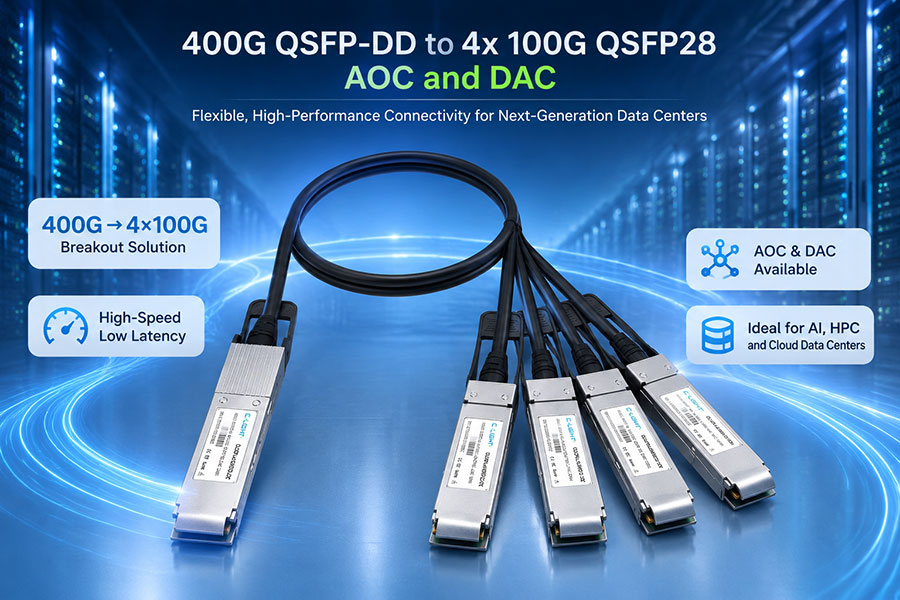
| Breakout DAC | Connecting one higher-speed port to multiple lower-speed ports | Supported lane mapping, breakout mode, connector type, and switch configuration |
For example, an 800G breakout DAC may connect one 800G port to two 400G ports or another supported port arrangement. The exact configuration depends on the cable assembly and host equipment. A breakout cable does not independently convert protocols or guarantee that a switch supports every possible port combination.
Explore the 800G DAC Direct Attach Copper Cable product range for supported connector configurations and short-reach AI data center connectivity options.
DAC vs. AEC vs. AOC
DAC, Active Electrical Cable (AEC), and Active Optical Cable (AOC) address different short- and medium-reach interconnect requirements. Their practical reach varies with data rate, cable design, host interface, and system qualification.
| Characteristic | Passive DAC | AEC | AOC |
|---|---|---|---|
| Transmission medium | Copper | Copper with active signal-conditioning electronics | Optical fiber with integrated optical electronics |
| Cable power | No powered electronics in the cable | Requires power for active circuitry | Requires power for optical electronics |
| Latency | Very low; no active retiming in the cable | Includes active signal-processing latency | Includes optical-electrical conversion and module processing effects |
| Reach | Generally the shortest of the three for high-speed links | Can extend copper reach beyond passive DAC in supported designs | Suitable for longer links than copper when the selected fiber and assembly support the distance |
| Physical considerations | Copper thickness, bend radius, and cable weight | Active connector electronics, power, and thermal requirements | Fiber routing, optical connector handling, and module power |
| Best fit | Very short equipment connections | Short links needing additional electrical signal conditioning | Links where optical reach or cable flexibility is needed |
Passive DAC is often the first option to evaluate for very short links because of its simple architecture and low power consumption. AEC may be appropriate when passive copper cannot meet the required reach, while AOC or separate optical transceivers and fiber are better candidates for longer distances.
Technical Factors for DAC Selection
Data Rate and Electrical Lane Configuration
Confirm the aggregate port rate and the electrical lane rate supported by both devices. A cable intended for one interface generation should not be assumed to work at a different rate simply because the connectors appear similar.
Connector and Form Factor
Check both connector ends, including QSFP28, QSFP-DD, OSFP, or other applicable form factors. For breakout cables, verify the exact host-end and device-end arrangement, lane mapping, and supported breakout mode.
Cable Length and Signal Integrity
Choose the shortest practical cable that meets equipment layout requirements without violating the manufacturer's minimum bend radius. At higher data rates, insertion loss, return loss, crosstalk, and other channel characteristics can limit supported length. Maximum reach must be confirmed for the exact cable and host combination.
Protocol and Equipment Compatibility
Check whether the connection is intended for Ethernet, InfiniBand, or another supported interface. The port configuration, firmware, link training behavior, and vendor qualification can affect whether a cable establishes a stable link. Connector fit alone is not proof of compatibility.
Rack Layout and Thermal Design
Dense AI racks can contain many high-speed cable assemblies. Cable routing should preserve airflow, avoid excessive mechanical strain, maintain access to adjacent ports, and account for the bend radius and connector clearance required by the selected product.
Deployment Challenges in Large AI Clusters
Although DAC simplifies individual short links, large-scale deployment still requires careful network planning. Thousands of connections can create cable-management challenges, and an incorrect breakout configuration or unsupported cable length can cause link failures that are difficult to diagnose without a documented port map.
Standardize cable lengths and connector configurations wherever practical.
Document switch ports, server interfaces, cable identifiers, and breakout mappings.
Validate each cable assembly against the intended host platform and network protocol.
Check electrical performance and link stability under the expected operating conditions.
Use optical alternatives when reach, cable routing, or rack density makes copper impractical.
For large AI installations, the lowest unit price is not the only measure of value. Installation time, troubleshooting effort, cable congestion, power requirements, and long-term replacement needs all contribute to total deployment cost.
Conclusion
DAC remains an important interconnect option for AI data centers because it combines direct electrical transmission, low cable power consumption, very low latency, and cost-efficient short-reach connectivity. It is particularly relevant to compatible server-to-switch and switch-to-switch connections inside densely populated racks.
As 400G and 800G networks expand, choosing the correct DAC requires more than matching connector shapes or nominal data rates. Host compatibility, electrical lane mapping, cable length, signal integrity, thermal clearance, and breakout support must all be verified. AEC and optical interconnects complement DAC where greater reach or different installation characteristics are required.
Review interface types, cable lengths, breakout requirements, and host compatibility before selecting an interconnect solution.
Contact C-LIGHT >

 >
 >
 >
 >
 >
 >
 >