TEL:+86 132 6656 7067


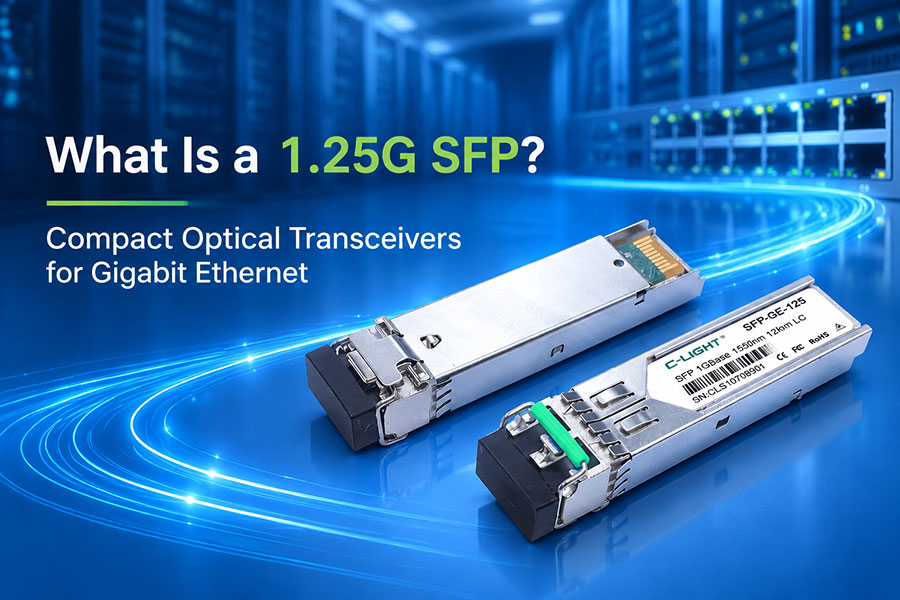
1.25G SFP is a compact, hot-pluggable optical or copper transceiver commonly used for Gigabit Ethernet connectivity in switches, routers, servers, and fiber access equipment. In conventional 1000BASE-X applications, the 1.25 Gbit/s figure refers to the physical serial signaling rate rather than the Ethernet data rate. The module carries a nominal 1 Gbit/s Ethernet data stream using 8b/10b encoding.
Available in different wavelengths, fiber types, and transmission distances, 1.25G SFP transceivers provide a flexible way to establish fiber links without replacing the host equipment. Correct selection depends on the supported Ethernet standard, optical specifications, and host device compatibility.
1. What Does 1.25G SFP Mean?
SFP stands for Small Form-Factor Pluggable. It is a standardized transceiver form factor that allows network equipment to support different optical or electrical interfaces through replaceable modules.
For a conventional Gigabit Ethernet SFP operating under 1000BASE-X, the Ethernet data rate is 1 Gbit/s, while the physical signaling rate is 1.25 Gbit/s. This difference results from 8b/10b encoding, which maps each 8-bit data group to a 10-bit transmission code group.
| Parameter | Typical 1000BASE-X Value |
|---|---|
| Ethernet data rate | 1 Gbit/s |
| Physical signaling rate | 1.25 Gbit/s |
| Encoding | 8b/10b |
| Module form factor | SFP |
| Common Ethernet interfaces | 1000BASE-SX and 1000BASE-LX |
Important distinction: A 1.25G SFP does not necessarily provide 1.25 Gbit/s of usable Ethernet bandwidth. In standard 1000BASE-X applications, it supports a 1 Gbit/s Ethernet link. Always check the specific module's datasheet because the term may be used differently in nonstandard product descriptions.
2. How Does a 1.25G SFP Work?
A 1.25G SFP converts electrical signals from a host device into optical signals for transmission over fiber. At the receiving end, a compatible transceiver converts the optical signal back into an electrical signal for processing by the connected network equipment.
Transmission process
Electrical interface: The host switch or router sends serial data to the transceiver through its electrical interface.
Optical conversion: The transmitter converts the electrical signal into light at the module's specified wavelength.
Fiber transmission: The optical signal travels through a compatible fiber link.
Signal reception: The receiving transceiver detects the optical signal and converts it back into an electrical signal.
Data processing: The receiving host processes the recovered data through its Ethernet interface.
The transmitter and receiver must operate with compatible signaling rates and optical characteristics. For duplex fiber links, the transmit and receive paths generally use separate fibers. Bidirectional single-fiber modules use different wavelengths for the two directions and must be paired according to their specifications.
3. Common 1.25G SFP Types
1.25G SFP modules are available for different fiber media and transmission distances. The optical interface determines the wavelength, supported fiber type, connector, and achievable reach.
1000BASE-SX
Typically operates at 850 nm over multimode fiber. It is commonly used for short-distance connections in enterprise networks, equipment rooms, and data centers.
1000BASE-LX
Typically operates at 1310 nm and is primarily designed for single-mode fiber. It supports building, campus, and other fiber connections within the specified optical budget.
Extended-Reach SFP
Designed for longer links using specified optical components and single-mode fiber. Supported distances vary by product and require verification against the datasheet.
BiDi SFP
Uses wavelength-separated transmission and reception over a single fiber strand. A compatible pair with complementary transmit and receive wavelengths is required.
4. Typical Specifications and Transmission Distance
| Module Type | Typical Wavelength | Fiber Type | Typical Reach | Connector |
|---|---|---|---|---|
| 1000BASE-SX | 850 nm | Multimode fiber | Up to 550 m on supported fiber grades | LC duplex |
| 1000BASE-LX | 1310 nm | Single-mode fiber | Typically up to 10 km | LC duplex |
| Extended-reach 1G SFP | Product-dependent | Usually single-mode fiber | Product-dependent, potentially tens of kilometers | Product-dependent |
| 1G BiDi SFP | Complementary wavelength pair | Single-mode fiber | Product-dependent | Usually simplex LC |
The distances above are representative examples, not universal guarantees. Actual reach depends on fiber grade, insertion loss, connector quality, optical output power, receiver sensitivity, and the specific module design.
5. Compatibility with Switches and Routers
A 1.25G SFP can be used in compatible SFP ports on switches, routers, media converters, and other network devices. However, the presence of an SFP cage alone does not guarantee compatibility. The host port must support the transceiver's signaling rate, Ethernet interface, and optical configuration.
Key compatibility requirements
Port speed: Confirm support for the intended 1G Ethernet interface.
Optical standard: Match the module to the supported interface, such as 1000BASE-SX or 1000BASE-LX.
Wavelength and fiber: Ensure the transmitter and receiver specifications are suitable for the installed fiber.
Connector: Confirm the connector type and whether the link uses duplex or BiDi optics.
Vendor support: Check module coding and compatibility requirements for the target switch or router.
Link configuration: Verify port settings and confirm that both ends operate at the same supported Ethernet rate.
Modules from different vendors can often interoperate when they follow the same Ethernet standard and have matching optical characteristics. Vendor-specific restrictions and equipment configuration may still affect operation.
6. Applications of 1.25G SFP Transceivers
Enterprise and campus networks
1.25G SFP modules provide fiber uplinks between access switches, distribution equipment, and network aggregation devices. Single-mode or multimode variants can be selected according to the required distance and installed cabling.
Fiber access networks
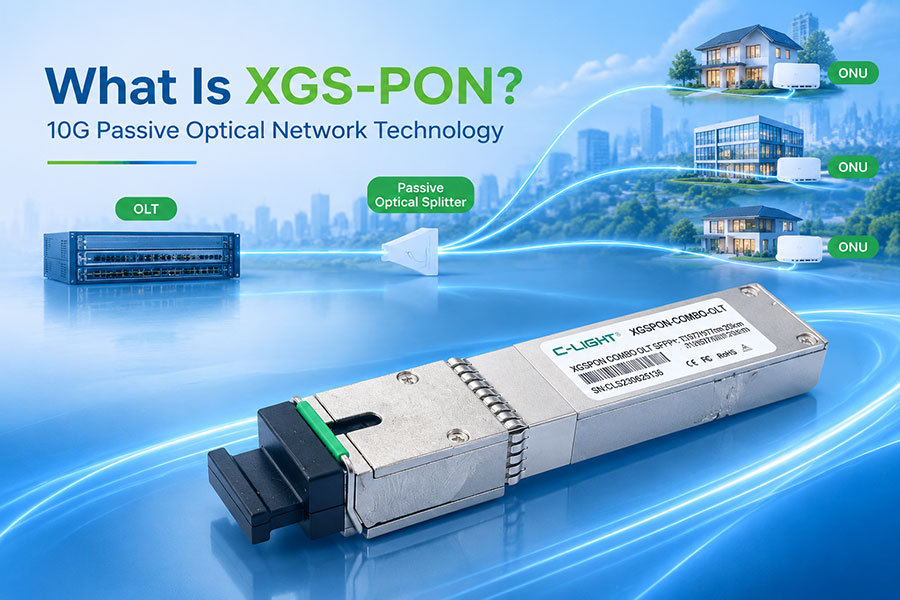
Gigabit Ethernet SFP transceivers are used in Ethernet-based access and aggregation equipment where a standard 1G optical Ethernet interface is required. They should not be confused with GPON or XGS-PON modules, which use PON-specific transmission protocols and wavelength plans.
Industrial and commercial networks
Compatible SFP transceivers can connect industrial switches, surveillance networks, building systems, and other installations that require fiber-based Ethernet connectivity. Environmental ratings and temperature requirements should be verified for industrial deployments.
Network equipment interconnection
1.25G SFP modules support point-to-point fiber connections between switches, routers, servers, and media converters. Choosing the correct optical type helps maintain link reliability and avoid unnecessary changes to existing fiber infrastructure.
7. 1.25G SFP vs Other SFP Data Rates
| Module Category | Typical Application Rate | Common Use |
|---|---|---|
| 1.25G SFP | 1G Ethernet data rate with 1.25 Gbit/s signaling for 1000BASE-X | Gigabit Ethernet links |
| 2.5G SFP | 2.5GbE where supported by the module and host | Compatible multi-gigabit access interfaces |
| 10G SFP+ | 10G Ethernet applications | Higher-capacity switch uplinks and data links |
These categories are not automatically interchangeable. The host port must support the intended interface and signaling rate. A higher-rate transceiver cannot be assumed to operate in a lower-rate port, and a physically compatible module may still be rejected by the host device.
8. Frequently Asked Questions
Q1: What is a 1.25G SFP?
Answer: A 1.25G SFP is commonly a pluggable transceiver for Gigabit Ethernet applications. In standard 1000BASE-X operation, 1.25 Gbit/s is the physical signaling rate used to carry 1 Gbit/s of Ethernet data.
Q2: Is 1.25G SFP the same as 1G SFP?
Answer: In conventional 1000BASE-X product listings, the terms often refer to the same class of transceiver. Verify the Ethernet standard, optical specifications, and device compatibility rather than relying on the label alone.
Q3: What is the maximum distance of a 1.25G SFP?
Answer: Reach depends on the optical variant. Typical 1000BASE-SX modules support short multimode links, while standard 1000BASE-LX modules commonly support up to 10 km over suitable single-mode fiber. Extended-reach models may support longer links.
Q4: Can I use a 1.25G SFP in any switch with an SFP port?
Answer: No. The switch must support the module's operating rate, Ethernet interface, optical characteristics, and vendor compatibility requirements.
Q5: Does a 1.25G SFP support both single-mode and multimode fiber?
Answer: Individual modules are designed for specific fiber types. Multimode variants such as 1000BASE-SX and single-mode variants such as 1000BASE-LX use different optical specifications and should be selected accordingly.
Q6: What should I check before purchasing a 1.25G SFP?
Answer: Confirm the Ethernet standard, wavelength, fiber type, transmission distance, connector, optical budget, temperature range, and compatibility with the target equipment.
9. Conclusion
A 1.25G SFP is commonly used to provide Gigabit Ethernet connectivity through a compact, replaceable transceiver. Its 1.25 Gbit/s physical signaling rate supports a nominal 1 Gbit/s Ethernet data rate in conventional 1000BASE-X applications. Available optical variants support different fiber types and distances, making the form factor suitable for a wide range of network deployments.
For reliable operation, select the module according to the required Ethernet standard, optical interface, transmission distance, and host equipment specifications. Verifying these details before deployment helps ensure interoperability and stable fiber connectivity.
Looking for 1.25G SFP transceivers?
Check optical specifications, transmission distance, and equipment compatibility to identify the right module for your network.
Contact C-LIGHT >

 >
 >
 >
 >
 >
 >
 >