TEL:+86 132 6656 7067


Silicon photonics is used to integrate optical functions into compact photonic integrated circuits, enabling high-speed data transmission, wavelength management, and optical signal processing. Its applications extend from 400G and 800G data center transceivers to coherent optical transport, emerging 1.6T interconnects, and specialized sensing systems. The most suitable implementation depends on optical reach, bandwidth, power consumption, integration density, and the performance requirements of the complete system.
1. Silicon Photonics Applications in High-Speed Optical Communication
Silicon photonics combines semiconductor fabrication techniques with optical waveguides, modulators, photodetectors, and other photonic structures. These components can be integrated on a photonic integrated circuit (PIC), reducing the need to assemble every optical function as a separate device.
In optical communication, the main advantage is the ability to create compact and scalable optical engines for high-bandwidth links. A silicon photonics circuit can route light, encode electrical data onto an optical carrier, separate wavelengths, and convert received optical signals into electrical signals when paired with the appropriate source and electronic components.
Silicon photonics is an integration platform rather than a complete transceiver specification. Data rate, modulation format, wavelength, reach, DSP architecture, and host compatibility depend on the final product design.
2. AI Data Centers and Accelerator Connectivity
AI infrastructure places demanding requirements on network bandwidth, port density, and power efficiency. GPU and accelerator clusters rely on high-speed connections between compute nodes and network switches, while large deployments may also connect storage systems and separate data center facilities.
Silicon photonics can support optical engines used in high-speed transceivers, helping integrate multiple optical functions into a compact package. This is relevant to networks built around 400G, 800G, and emerging 1.6T aggregate interfaces.
Scale-out networking
Scale-out networks connect servers and accelerator nodes through Ethernet or other high-speed fabrics. Optical links are useful when electrical cabling cannot meet the required distance, bandwidth, or routing density. Silicon photonics can support the optical interfaces used in these connections.
High-density switch connectivity
As switch capacity increases, front-panel port density and module power become important system constraints. Integrated photonic circuits can help consolidate optical functions, although total module power still depends on the laser, driver, receiver, DSP, and packaging.
Multi-rack and multi-building deployments
Optical connectivity enables high-speed links across racks and buildings. Silicon photonics can be used in suitable transceivers, but the optical interface must be selected according to the actual distance, fiber type, optical budget, and host platform.
3. Applications in 400G, 800G, and 1.6T Optical Transceivers
High-speed optical transceivers are one of the most important application areas for silicon photonics. Integrating optical functions can support compact module designs as lane rates and aggregate bandwidth increase.
| Capacity Class | Potential Application | Key Design Considerations |
|---|---|---|
| 400G | Data center switch-to-switch and switch-to-server connectivity | Optical lane architecture, wavelength arrangement, reach, and host compatibility |
| 800G | High-density AI and cloud networking | Lane rate, optical loss, module power, thermal management, and signal integrity |
| 1.6T | Emerging next-generation high-bandwidth interconnects | Electrical interface, optical engine design, packaging, and implementation maturity |
Silicon photonics can be used in different module architectures, including wavelength-multiplexed and parallel-optics implementations. The choice depends on the required reach, number of optical lanes, fiber infrastructure, and system cost.
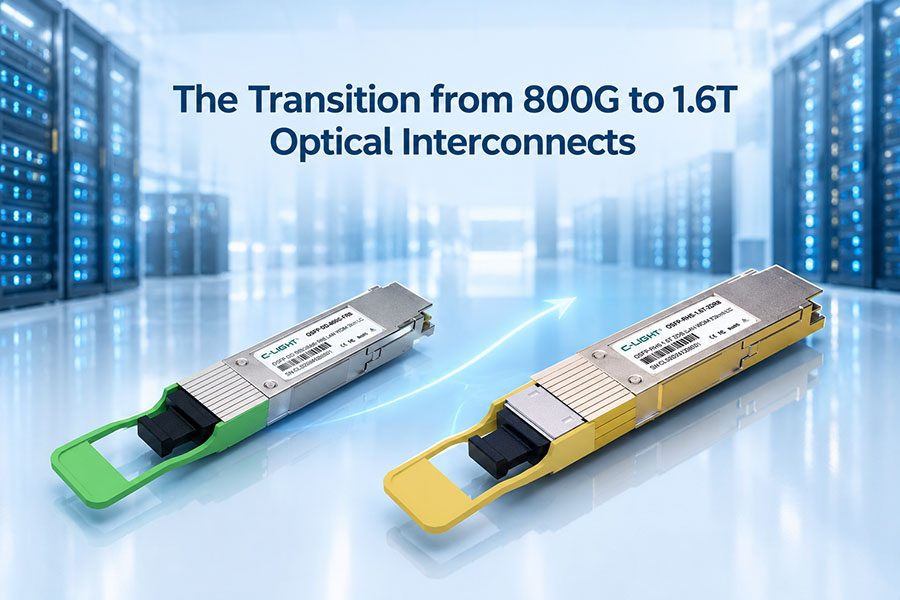
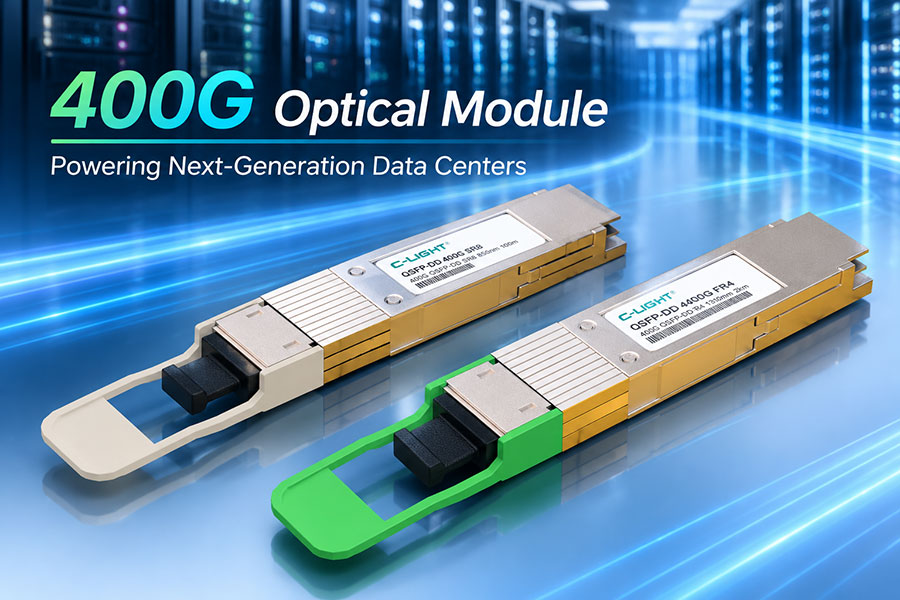
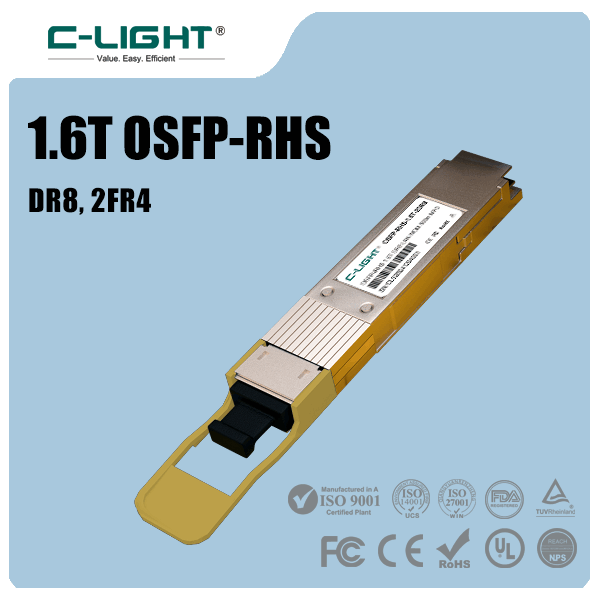
C-LIGHT provides high-speed optical module product families for network design and evaluation. Related product pages include 400G QSFP-DD optical transceivers, 800G QSFP-DD optical transceivers, and 1.6T OSFP-RHS optical transceivers. Confirm the photonic platform and exact specifications for the selected model rather than assuming every product in these categories uses silicon photonics.
4. Data Center Interconnect and DWDM Systems
Data Center Interconnect (DCI) links geographically separated facilities for cloud connectivity, storage replication, disaster recovery, and distributed computing. Depending on the route, a DCI network may use direct optical connections, wavelength-division multiplexing, coherent transmission, or a combination of these technologies.
Silicon photonics can support components used in optical transmitters, receivers, and wavelength-management circuits. In DWDM applications, multiple wavelengths carry separate channels through the same fiber. Optical multiplexers and demultiplexers combine and separate these channels, while the transceiver or transport system handles the required signal conversion.
Silicon photonics may contribute to the optical engine, but it does not replace the complete DWDM line system. Reach and channel capacity depend on wavelength planning, optical signal-to-noise ratio, amplification, fiber loss, modulation format, and system engineering.
Relevant C-LIGHT product categories include DWDM optical transceivers and coherent DWDM products. Verify whether a particular product uses silicon photonics and whether its interface is intended for client connectivity or the optical line side.
5. Coherent Optical Communication
Coherent optical systems encode information in the amplitude and phase of light and use coherent detection and digital signal processing to recover the transmitted data. They are widely used in applications where high spectral efficiency and long-reach transmission are required.
Silicon photonics can contribute to coherent systems through integrated optical components such as modulators, waveguides, and receiver structures. However, coherent transmission can also use other photonic material platforms, including indium phosphide. The appropriate implementation depends on the required optical performance and system architecture.
Coherent applications place demanding requirements on optical loss, phase stability, modulation bandwidth, polarization handling, receiver performance, and packaging. These factors must be evaluated together with the DSP, laser source, and transmission line system.
6. Optical Switching and Photonic Interconnect Fabrics
Optical switching aims to route optical signals between ports or paths using optical components rather than converting every signal into electrical form at each switching stage. Depending on the technology, optical switching can support circuit-based connections, reconfigurable optical paths, or specialized interconnect fabrics.
Silicon photonics can provide compact waveguides, couplers, interferometric structures, and switching elements for selected photonic switching architectures. Potential applications include optical circuit switching, wavelength routing, and integrated optical signal distribution.
Optical switching is not automatically more efficient than electronic switching in every network. Switching speed, insertion loss, port count, wavelength constraints, control complexity, and traffic patterns all affect whether an optical switching architecture is suitable for a particular workload.
7. Co-Packaged Optics and Near-Package Optical Engines
As host ASIC bandwidth increases, the electrical connections between the chip and pluggable optical modules become more challenging. High-speed PCB traces and connectors introduce insertion loss, reflections, and other signal-integrity constraints.
Near-package optics and co-packaged optics place optical engines closer to the host ASIC to shorten the high-speed electrical path. Silicon photonics is one possible platform for these optical engines because it supports integrated optical functions in compact structures.
Pluggable optics: optical modules connect through front-panel cages and can generally be replaced independently of the host ASIC.
Near-package optics: optical engines are positioned close to the ASIC while remaining distinct from a fully co-packaged implementation.
Co-packaged optics: optical engines are integrated within the same package assembly or closely associated package environment as the host ASIC, depending on the design.
These architectures involve different trade-offs in electrical reach, cooling, fiber management, serviceability, manufacturing yield, and repair procedures. Silicon photonics enables some of the optical functions, but does not determine the packaging architecture by itself.
8. Telecom Networks and Metro Optical Transport
Telecom networks use optical technologies to connect access infrastructure, aggregation sites, metro nodes, and regional transport systems. Silicon photonics can be used in selected optical components and transceivers where integration density, manufacturability, or optical functionality is advantageous.
Application requirements vary substantially across telecom systems. Access links may emphasize cost, temperature range, and compatibility with optical distribution networks, while metro transport may require tunable wavelengths, coherent modulation, optical amplification, and advanced monitoring.
Silicon photonics is not a universal replacement for all telecom optical technologies. Laser generation, modulation efficiency, optical power, wavelength stability, and system reach must be considered when selecting a platform.
9. Optical Sensing and Specialized Photonic Systems
Beyond communications, silicon photonics can support optical sensing and measurement systems. Integrated waveguides and interferometric structures can detect changes in phase, intensity, or resonance caused by variations in the surrounding environment.
Biomedical and chemical sensing
Photonic circuits can be designed to detect optical changes associated with specific biological or chemical interactions. Practical systems require appropriate surface functionalization, sample handling, calibration, and signal interpretation.
LiDAR and optical ranging
Selected silicon photonics technologies can support components for light detection and ranging, including beam-routing, modulation, and coherent detection functions. System feasibility depends on optical power, wavelength, scanning method, receiver sensitivity, and eye-safety requirements.
Industrial measurement
Integrated photonic circuits can support compact measurement instruments for applications such as refractive-index sensing, spectroscopy, and precision optical measurements. The photonic design must match the required sensitivity, environmental conditions, and measurement range.
10. Benefits and Engineering Limitations
| Factor | Potential Benefit | Engineering Limitation |
|---|---|---|
| Integration density | Multiple optical functions can share one photonic circuit. | Layout, coupling, and optical loss become increasingly important. |
| Manufacturing scale | Semiconductor fabrication can support repeatable wafer-level production. | Yield also depends on packaging, alignment, and device performance. |
| Module size | Integrated optical functions can reduce the need for separate components. | Laser sources, drivers, receivers, and thermal structures still occupy space. |
| Power efficiency | Integration can enable efficient system architectures. | Power depends on the full optical and electrical design, not the PIC alone. |
| Scalability | Supports complex optical functions in compact structures. | Higher data rates increase packaging and signal-integrity demands. |
| Material integration | Can be combined with other photonic technologies. | Hybrid integration adds coupling, assembly, and reliability considerations. |
11. How to Evaluate Silicon Photonics Products
Choosing a silicon photonics-based optical product requires checking the complete transceiver or system specification. The photonic platform alone does not guarantee a particular data rate, reach, power level, or compatibility profile.
Data rate and lane architecture: verify the aggregate rate, number of lanes, electrical interface, and optical lane arrangement.
Optical reach: match the supported distance, wavelength, and fiber type to the deployment.
Optical budget: evaluate transmit power, receiver sensitivity, insertion loss, and engineering margin.
Signal processing: confirm whether the module uses retimed DSP, linear-drive signaling, or coherent processing.
Power and thermal performance: check module power, operating temperature, airflow, and equipment cooling limits.
Host compatibility: validate the exact switch, router, NIC, or transport equipment model and supported configuration.
Reliability and testing: review diagnostic capabilities, operating conditions, and production test requirements.
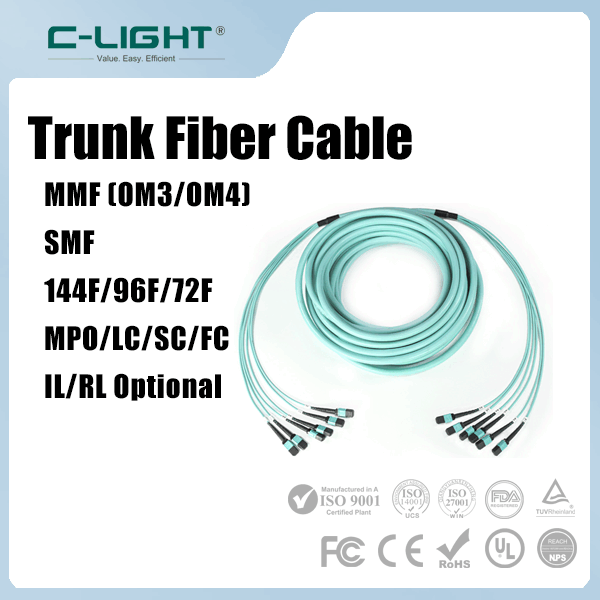
C-LIGHT offers a range of optical transceiver products for data center and telecom connectivity. Review the optical transceiver catalog and the relevant fiber cabling options when planning an optical link. Confirm the specific photonic platform and supported specifications with the product documentation.
12. Conclusion
Silicon photonics applications cover high-speed data center connectivity, AI networking, DCI, coherent optical transport, optical switching, near-package optical engines, and specialized sensing systems. Its ability to integrate optical functions on semiconductor-based circuits makes it an important technology for compact, scalable photonic systems.
The most suitable application depends on the required bandwidth, optical reach, wavelength plan, power budget, packaging approach, and environmental conditions. Evaluating the complete system—including the laser source, photonic circuit, electronic components, fiber interface, and host equipment—is essential for achieving reliable performance.
13. Frequently Asked Questions
What is the most common application of silicon photonics?
High-speed optical communication is a major application area, particularly optical transceivers and optical engines used in data centers and telecommunications. Silicon photonics is also used in selected sensing and measurement systems.
Can silicon photonics be used in 800G and 1.6T optical modules?
Yes. Silicon photonics can support optical engines for these aggregate data rates. The actual implementation depends on lane rate, modulation, optical reach, packaging, and product architecture.
Does silicon photonics eliminate the need for laser diodes?
No. Most conventional silicon photonics systems still require a light source. This may be an external laser or a source integrated through a hybrid or heterogeneous approach.
Is silicon photonics the same as co-packaged optics?
No. Silicon photonics is a photonic integration technology, whereas co-packaged optics is a packaging architecture that places optical engines close to the host ASIC. A CPO design may use silicon photonics, but the terms describe different aspects of the system.
Can silicon photonics support long-distance optical communication?
It can be used in suitable long-reach and coherent optical architectures. Actual reach depends on the complete transceiver, optical components, modulation, DSP, fiber route, and line-system characteristics.
Does silicon photonics always reduce optical transceiver power?
No. Integration can improve design efficiency, but total power depends on the laser, drivers, receiver electronics, DSP, and thermal requirements. Complete-module measurements are needed to establish the actual power consumption.
Planning high-speed optical connectivity for your network?
Share your target data rate, transmission distance, fiber type, host platform, and operating requirements to identify suitable optical products.
Contact C-LIGHT >

 >
 >
 >
 >
 >
 >
 >