TEL:+86 132 6656 7067


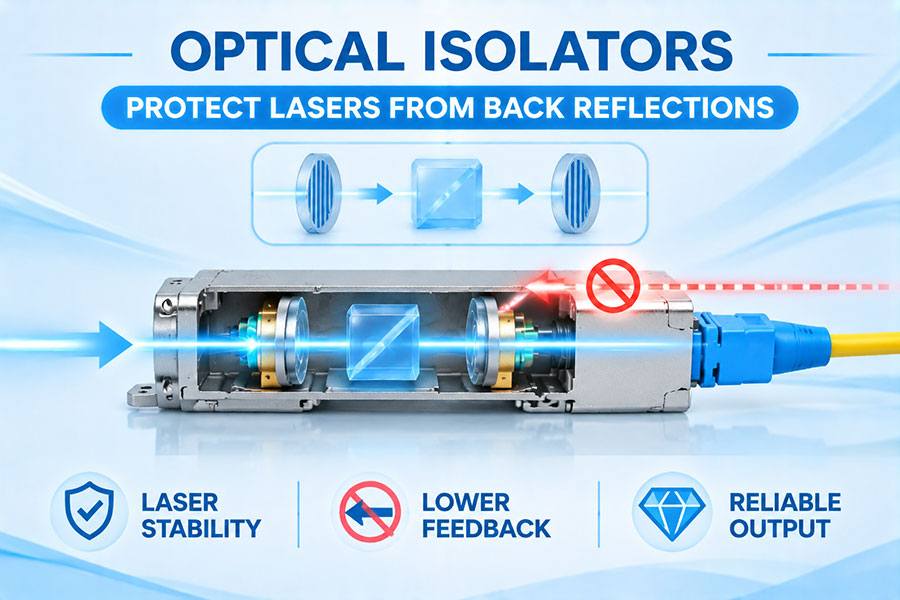
Optical isolators play an important role in laser modules by reducing unwanted optical feedback. In fiber-optic systems, reflections can originate from connectors, fiber interfaces, filters, splitters and other components along the transmission path. When this reflected light returns to a semiconductor laser, it can interfere with the laser's internal optical field and affect its operating stability.
An optical isolator provides directional protection: it allows the intended optical signal to travel toward the output while attenuating light traveling in the reverse direction. This helps maintain stable laser characteristics and reduces the influence of downstream reflections on the source.
Although optical isolators are particularly relevant to reflection-sensitive and narrow-linewidth lasers, they are not required in every optical transceiver. Their use depends on the laser architecture, optical feedback tolerance, packaging constraints and the performance requirements of the application.
1. Why Laser Modules Need Optical Isolation
A semiconductor laser generates light through stimulated emission within its active region and optical cavity. Its output is then coupled into an optical path, which may include lenses, isolators, fiber pigtails, connectors and other optical components.
Not all optical power travels forward. Small portions of the signal can be reflected or scattered by downstream interfaces and return toward the laser. Sources of unwanted feedback include:
Fiber connectors: Imperfect or contaminated interfaces can produce reflections.
Fiber ends: Unwanted reflections may occur at improperly matched or terminated fiber interfaces.
Optical filters: Wavelength-selective components can introduce residual reflections.
Splitters and couplers: Some optical power may return through paths connected to reflective components.
Internal optical interfaces: Lenses, windows and package interfaces can contribute unwanted reflections.
When this light re-enters the laser cavity, it acts as external optical feedback. The resulting effect depends on the feedback level, optical phase, laser design and operating conditions. Even relatively weak feedback can affect sensitive semiconductor lasers.
2. How an Optical Isolator Works
The most widely used optical isolator design is based on the Faraday effect, a magneto-optic phenomenon in which the polarization direction of light rotates as it passes through a material exposed to a magnetic field.
A typical polarization-dependent Faraday isolator contains three principal optical elements:
Input polarizer: Establishes the required polarization state of the forward optical signal.
Faraday rotator: Rotates the polarization direction by a specified angle, commonly 45 degrees in a conventional arrangement.
Output polarizer: Allows the correctly rotated forward signal to pass while rejecting light returning in the reverse direction.
Forward transmission
Light entering the isolator first passes through the input polarizer. The Faraday rotator then changes its polarization direction. The output polarizer is aligned to transmit this rotated state, allowing the intended signal to continue toward the optical output.
Reverse isolation
When reflected light returns through the output side, it passes through the Faraday rotator in the opposite propagation direction. Unlike ordinary reciprocal polarization rotation, Faraday rotation remains non-reciprocal: the rotation does not simply reverse when the propagation direction changes.
Consequently, the returning light experiences another rotation in the same sense relative to the magnetic-field reference. Its polarization no longer matches the input polarizer's transmission axis, so the reverse signal is strongly attenuated or redirected, depending on the isolator design.
3. How Back Reflections Affect Semiconductor Lasers
Semiconductor lasers can be sensitive to light that returns from the external optical path. The reflected field can interact with the field inside the laser cavity, changing the laser's amplitude, phase and frequency behavior.
The degree of disturbance depends on several factors, including feedback strength, the phase relationship between the returned and original fields, the laser's linewidth, cavity structure and operating conditions.
Frequency and linewidth instability
External optical feedback can change the effective laser frequency and spectral linewidth. For applications requiring stable optical frequency, these changes may affect signal quality and coherent receiver performance.
Mode hopping
Under certain feedback and operating conditions, the laser may transition between different optical modes. Such changes can produce sudden variations in output spectrum and operating characteristics.
Amplitude and intensity noise
Reflected light can introduce fluctuations in the output intensity. Depending on the feedback regime, this may increase relative intensity noise or create additional amplitude instability.
More severe feedback disturbances
Stronger or unfavorable feedback conditions can cause complex laser dynamics, including substantial linewidth broadening and coherence degradation. These effects can reduce the stability of the optical source and complicate system-level performance.
| Feedback-related effect | Possible laser behavior | Potential system impact |
|---|---|---|
| Frequency variation | Change in emission frequency or wavelength stability | Reduced frequency stability in sensitive optical systems |
| Linewidth broadening | Wider optical spectrum | Reduced performance margin in applications requiring narrow linewidth |
| Mode hopping | Transition between optical modes | Sudden changes in spectral characteristics |
| Intensity fluctuations | Increased amplitude or relative intensity noise | Degraded signal quality |
| Coherence degradation | Unstable laser dynamics under stronger feedback | Reduced suitability for coherence-sensitive applications |
4. The Position of an Optical Isolator in a Laser Module
An optical isolator is generally placed in the optical path between the laser source and the external components that may return reflected light. In a packaged laser module, it may be integrated inside the package rather than installed as a separate external component.
A simplified transmitter optical path can be represented as:
The exact arrangement depends on the module architecture. Some designs integrate the isolator close to the laser chip, while other systems use a separate optical isolator in the external source path.
Placement is important because an isolator can suppress feedback that reaches it from downstream optical components, but it cannot remove reflections generated between the laser and the isolator. Internal optical interfaces and package design therefore remain relevant.
5. Common Types of Optical Isolators
Optical isolators are available in different configurations depending on polarization behavior, packaging, optical power and application requirements.
Polarization-dependent optical isolators
These isolators are designed for light with a defined input polarization state. The forward transmission depends on the alignment between the input polarization and the internal polarizer. They are suitable for optical paths where the source polarization is known and controlled.
Because semiconductor laser outputs often have a preferred polarization state, polarization-dependent designs can be integrated into certain laser packages.
Polarization-independent optical isolators
Polarization-independent designs are intended to provide isolation without relying on one fixed input polarization orientation. They are useful in fiber-optic paths where polarization may vary.
These designs generally use more complex optical arrangements to manage different polarization components while maintaining directional isolation.
Single-stage and dual-stage isolators
Single-stage isolators use one principal isolation stage. Dual-stage configurations combine multiple isolation stages to achieve greater reverse attenuation where the application requires it.
Additional stages can also affect forward insertion loss, size and packaging complexity. The required isolation should therefore be selected according to the laser's feedback tolerance and the expected reflection conditions, rather than simply choosing the highest available value.
| Isolator type | Operating characteristic | Typical application consideration |
|---|---|---|
| Polarization-dependent | Requires a defined input polarization orientation | Laser packages with controlled polarization |
| Polarization-independent | Designed to handle varying input polarization states | Fiber paths with changing polarization |
| Single-stage | One isolation stage | Applications with suitable reverse-feedback requirements |
| Dual-stage | Multiple isolation stages | Applications requiring higher isolation performance |
6. Important Optical Isolator Parameters
Optical isolator selection involves balancing reverse isolation against forward transmission loss, wavelength coverage, polarization behavior and environmental requirements.
Isolation ratio
Isolation describes how strongly the device attenuates light traveling in the reverse direction. It is commonly expressed in decibels (dB). A higher isolation value indicates greater attenuation of reverse-propagating light under the specified test conditions.
The precise measurement convention should follow the manufacturer's specification. Isolation performance can depend on wavelength, temperature, polarization and optical alignment.
Insertion loss
Insertion loss describes the reduction in forward optical power caused by the isolator. It is important because the isolator is inserted directly into the intended signal path.
Lower insertion loss preserves more of the laser's available output power. In a compact optical module, even a small additional loss can influence the transmitter's optical power budget.
Polarization-dependent loss
Polarization-dependent loss (PDL) describes the variation in forward insertion loss with the input polarization state. It is especially relevant when polarization may vary or when the optical system requires consistent transmission across different polarization conditions.
Operating wavelength range
The isolator must support the laser's operating wavelength and the expected wavelength variation over its operating conditions. A device designed for one wavelength region should not be assumed to provide its specified isolation at another wavelength.
Optical power handling
The isolator must tolerate the expected optical power without unacceptable thermal or optical degradation. Power handling depends on the materials, optical design and package construction.
Temperature performance
Isolation and insertion loss can change with temperature. Qualification should therefore consider the specified operating range rather than relying only on room-temperature measurements.
| Parameter | What it measures | Why it matters |
|---|---|---|
| Isolation | Attenuation of reverse-propagating light | Determines suppression of optical feedback |
| Insertion loss | Forward optical power reduction | Influences available transmitter output power |
| PDL | Forward loss variation with polarization | Important for polarization-sensitive optical paths |
| Operating wavelength | Wavelength range for specified performance | Must match the laser source |
| Power handling | Maximum supported optical input or transmitted power | Helps avoid performance degradation |
| Temperature range | Conditions under which specifications apply | Supports stable performance in the target environment |
| Return loss | Reflection level at the device's optical interfaces | Helps characterize reflections generated by the component itself |
7. Isolation, Return Loss and Insertion Loss Are Not the Same
These three parameters are sometimes discussed together, but they describe different optical characteristics.
Isolation: Measures how effectively reverse-propagating light is attenuated by the isolator.
Return loss: Measures how much optical power is reflected back toward the source from a component or interface.
Insertion loss: Measures how much desired forward optical power is lost while passing through a component.
A component can have low insertion loss but still provide insufficient reverse isolation. Likewise, a module's high return-loss specification does not automatically establish the isolation performance of an internal optical isolator.
Keeping these parameters separate is important when evaluating laser protection and the overall optical link budget.
8. Optical Isolators in Telecom Laser Modules
In optical communication systems, the laser transmitter is exposed to reflections from the optical path beyond the module. The importance of isolation depends on the laser's sensitivity to feedback and the stability requirements of the application.
DFB laser modules
Distributed Feedback (DFB) lasers use an internal grating structure to support controlled wavelength operation. External optical feedback can still influence their frequency and intensity behavior. Depending on the specific DFB design and application requirements, an isolator may be included to reduce feedback sensitivity.
Tunable laser modules
Tunable lasers need controlled optical-frequency behavior across their supported tuning range. Reflections can interfere with frequency stability and may complicate operation in systems that rely on predictable spectral characteristics. Isolation can help reduce this external feedback.
Coherent optical transmitters
Coherent systems depend on controlled optical frequency and phase characteristics. Narrow-linewidth lasers are especially sensitive to external optical feedback because disturbances can affect linewidth and coherence. An optical isolator is therefore an important design consideration in many coherent laser source architectures.
Directly modulated and other laser architectures
The need for an isolator varies with the laser structure and module design. Some products use other reflection-reduction measures, such as angled optical interfaces or suitable anti-reflection coatings. These approaches can reduce feedback, but they are not automatically equivalent to the reverse isolation provided by a Faraday isolator.
9. Optical Isolators and Laser Module Reliability
By reducing external feedback, an isolator helps maintain the intended operating conditions of the laser. This can contribute to more stable transmitter characteristics and reduce the influence of downstream optical reflections.
Its reliability benefits are particularly relevant to:
Stable optical output: Reduces feedback-induced changes in laser amplitude and frequency.
Consistent spectral behavior: Helps limit feedback-related linewidth changes and mode instability.
Coherent signal quality: Supports laser stability in applications that depend on controlled phase and frequency characteristics.
Reduced sensitivity to downstream reflections: Limits the influence of connectors and other optical interfaces on the source.
More predictable operation: Helps the laser maintain its specified performance under the expected external optical conditions.
An isolator does not eliminate every possible cause of laser instability. Temperature variation, drive-current noise, mechanical stress, aging and electrical interference can still affect the laser. It should be viewed as one part of a broader source-stability and module-reliability strategy.
10. Optical Isolators Versus Other Reflection-Reduction Methods
Optical isolation is not the only way to reduce unwanted reflections. Other optical design techniques can complement an isolator or reduce the need for one in suitable applications.
| Method | Primary function | Limitation |
|---|---|---|
| Optical isolator | Attenuates reverse-propagating light through non-reciprocal transmission | Adds insertion loss, cost and packaging requirements |
| Angled fiber interface | Reduces direct coupling of reflected light back toward the source | Does not provide the same directional isolation as a Faraday device |
| Anti-reflection coating | Reduces reflections at selected optical surfaces | Performance depends on wavelength, coating design and surface condition |
| Angled laser output waveguide | Reduces optical feedback coupled into the laser cavity | Depends on laser and package design |
| Integrated feedback-tolerant laser design | Reduces sensitivity to external reflections through the laser architecture | Requires specialized device design and qualification |
These methods address different parts of the feedback problem. An angled interface or anti-reflection coating reduces the reflection generated at a particular surface, whereas an isolator suppresses reverse transmission through a defined optical path.
11. Integrated Isolator-Free Laser Designs
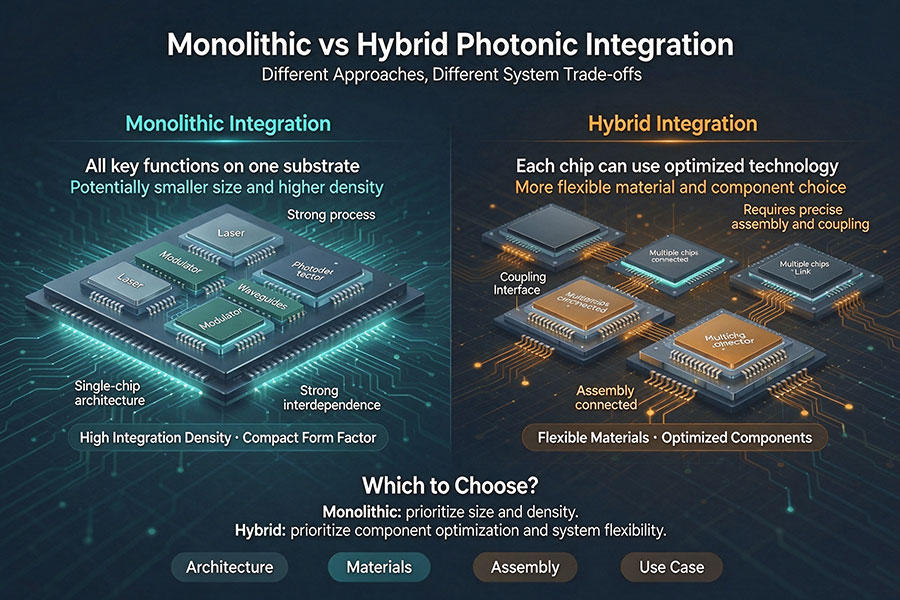
Some newer photonic integration approaches seek to reduce the need for conventional discrete Faraday isolators. This is relevant because conventional isolators can increase package size, optical insertion loss, assembly complexity and cost.
Research has explored feedback-tolerant laser architectures that use integrated optical resonators or other photonic structures to reduce the impact of downstream reflections. Certain approaches have demonstrated improved tolerance to external feedback under defined experimental conditions.
However, an isolator-free design should not automatically be considered equivalent to a conventional isolated laser. Its reflection tolerance depends on the specific architecture, wavelength, feedback conditions and system configuration. The relevant performance needs to be established through device and link-level validation.
12. When Does a Laser Module Need an Optical Isolator?
The decision to include an optical isolator depends on the balance between feedback sensitivity, stability requirements, package constraints and cost. It should be based on the laser and system specifications rather than a universal rule.
An isolator may be particularly valuable when:
The laser has a narrow linewidth or high sensitivity to external optical feedback.
The system includes downstream optical components that may introduce reflections.
Stable frequency, phase or spectral behavior is important to the application.
The transmitter must operate consistently across a range of external optical conditions.
Other reflection-reduction techniques alone do not provide sufficient feedback tolerance.
A separate isolator may be unnecessary in some designs where the laser has sufficient feedback tolerance or where the optical architecture already controls reflections to an acceptable level. The decision should be supported by the applicable product specification and system-level testing.
13. Qualification and Testing Considerations
When an isolator is included in a laser module, its performance should be evaluated as part of the complete optical transmitter. Testing only the isolated component does not establish the behavior of the assembled module.
Relevant qualification areas include:
Forward insertion loss: Verify that the desired optical path retains sufficient output power.
Reverse isolation: Confirm that reflected light is attenuated according to the required specification.
Wavelength dependence: Check performance across the laser's specified operating wavelength range.
Polarization behavior: Evaluate PDL or polarization-independent performance as appropriate.
Temperature dependence: Confirm that isolation and insertion loss remain within their specified limits.
Power handling: Verify performance under the intended optical power conditions.
Module-level stability: Evaluate laser output and spectral behavior in the presence of representative downstream reflections.
Long-term reliability: Assess whether the assembled optical path maintains its required characteristics over the qualification program.
Test conditions and acceptance limits should follow the isolator, laser-module and system specifications. Measurements should distinguish the isolator's own performance from the complete transmitter's behavior.
14. Conclusion
Optical isolators help protect laser modules from unwanted optical feedback by allowing forward transmission while attenuating reverse-propagating light. Through the non-reciprocal Faraday effect, they reduce the influence of downstream reflections on laser frequency, amplitude, linewidth and coherence characteristics.
In optical communication systems, this function can improve transmitter stability and reduce the risk of feedback-related performance problems. The appropriate isolator depends on the laser wavelength, polarization characteristics, required isolation, forward insertion loss, optical power and temperature conditions.
As photonic integration advances, some laser architectures are also exploring ways to improve feedback tolerance without conventional discrete isolators. Whether a design uses an integrated isolator, an external component or another feedback-control approach, the final requirement remains the same: the laser must maintain stable performance under the expected optical conditions of the complete system.
For optical connectivity requirements involving laser-based communication systems and transceiver applications, view the optical transceiver product range or Contact C-LIGHT.
 >

 >
 >
 >
 >
 >
 >
 >