TEL:+86 132 6656 7067


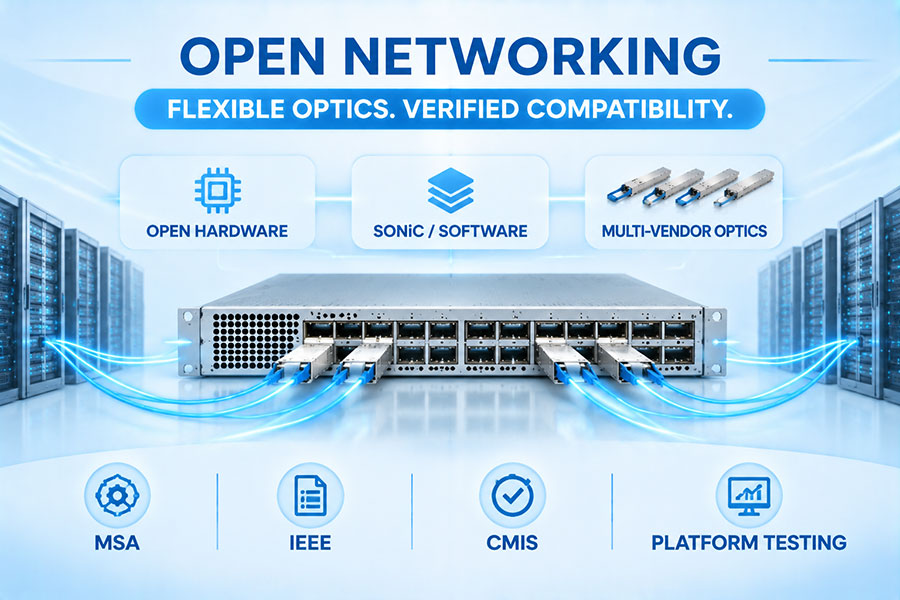
Open networking is changing how data center operators select, deploy and manage optical transceivers. By separating network software from switching hardware and encouraging standardized interfaces, open networking gives operators more flexibility to combine switches, network operating systems and optical modules from different suppliers. This reduces dependence on a single vertically integrated equipment ecosystem and creates more opportunities for multi-vendor sourcing.
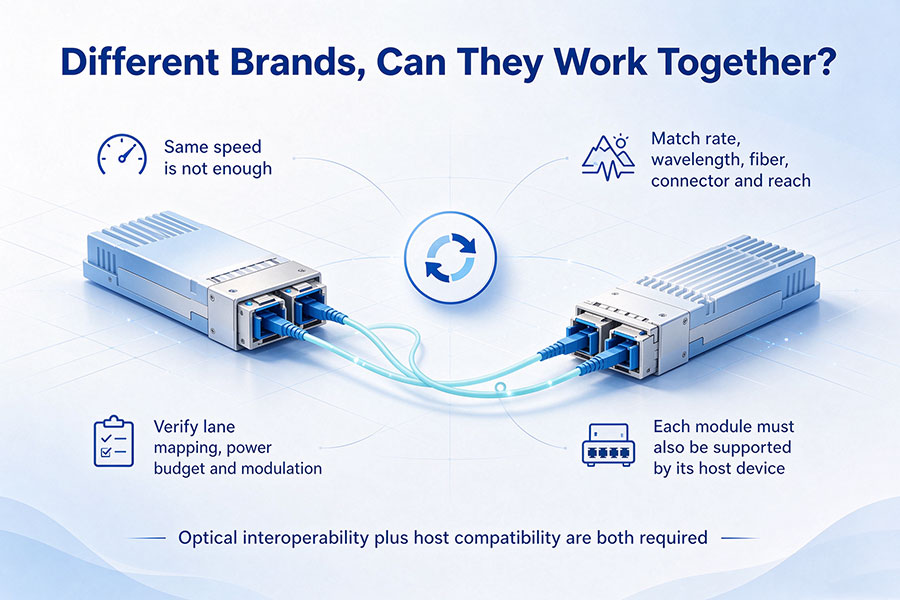
However, optical transceiver compatibility is not determined by whether a switch runs an open network operating system alone. The module must still satisfy mechanical, electrical, optical and management requirements, while the switch platform must provide the necessary drivers, firmware support and transceiver handling functions. Open networking changes the way these compatibility layers are implemented and validated; it does not eliminate them.
1. Why Open Networking Changes Optical Procurement
Traditional networking products are frequently delivered as integrated systems in which the switch hardware, network operating system, firmware and supported transceiver list are managed by one equipment vendor. This model can simplify accountability, but it may also limit the operator's choice of hardware and optical suppliers.
Open networking separates more of these components. A network operator may deploy a switch built by an original design manufacturer (ODM), use a network operating system developed independently of the hardware manufacturer, and purchase optical modules from qualified third-party suppliers.
This disaggregated approach changes optical procurement in several ways:
More sourcing options: Operators can evaluate optical modules from multiple manufacturers instead of relying exclusively on a single switch vendor's branded portfolio.
Greater hardware flexibility: Compatible switch platforms can be selected according to port density, ASIC capabilities, power consumption and deployment requirements.
More software-driven management: Module discovery, diagnostics and monitoring can be integrated into a common operating system and automation workflow.
Independent qualification: Operators can establish their own acceptance criteria for optical modules and validate suppliers against specific hardware configurations.
Reduced procurement dependency: Qualified alternatives can provide additional sourcing flexibility when availability, lead times or product lifecycles change.
2. Hardware and Software Disaggregation
Open networking is based on separating functions that were traditionally supplied as one integrated networking product. Instead of treating the switch as an indivisible system, operators can work with different hardware and software components through defined interfaces.
The Open Compute Project (OCP) Networking Project promotes disaggregated networking technologies, including open switch hardware, Linux-based network operating systems, APIs, automation and connectivity. Its objective is to provide alternatives to closed, proprietary switching systems.
For optical connectivity, this separation creates two important responsibilities:
Hardware responsibility: The switch platform must provide compatible cages, electrical interfaces, module power, cooling, low-level access and physical connectivity.
Software responsibility: The network operating system and platform software must identify the module, interpret its management data, configure supported functions and report status correctly.
These responsibilities may be distributed across the switch ODM, ASIC provider, operating-system project and module manufacturer. Therefore, compatibility testing becomes a coordinated activity rather than a simple check against a single vendor's product list.
3. SONiC and the Changing Role of Transceiver Management
Software for Open Networking in the Cloud (SONiC) is an example of a network operating system designed for disaggregated switching environments. It provides common software components for networking functions while relying on platform-specific implementations to interact with the underlying switch hardware.
Transceiver management is part of this platform interaction. The switch operating system needs to obtain module information, monitor insertion and removal events, access diagnostic data and expose relevant status to network management tools.
EEPROM access and module identification
Pluggable optical modules store identification and capability information in electrically accessible memory. Depending on the form factor and specification, this information can include manufacturer identity, part number, serial number, supported media characteristics and diagnostic information.
SONiC platform software provides mechanisms for accessing transceiver EEPROM information. Its transceiver-monitoring components can collect module identification and Digital Optical Monitoring (DOM) data and publish relevant information to the system's state database.
Transceiver event handling
Insertion, removal and error events must also be detected. A platform may need to report conditions such as an unreadable EEPROM, unsupported cable, high module temperature or an I²C communication problem.
These operations depend on the platform's hardware drivers and APIs. The SONiC software architecture offers common management logic, but individual hardware platforms still need suitable implementations for their transceiver interfaces and event reporting.
This is an important distinction: using the same network operating system does not guarantee that every switch platform exposes identical optical-module behavior. Platform integration remains part of the compatibility process.
4. Standardized Interfaces Create a Common Compatibility Foundation
Optical transceiver compatibility depends on several standards and industry agreements. Open networking benefits from these specifications because they define common expectations between hardware and module manufacturers.
| Specification area | What it defines | Compatibility role |
|---|---|---|
| Form-factor MSA | Module dimensions, cage interface, pin assignment and related mechanical or electrical requirements | Establishes physical and host-interface requirements for a module family |
| IEEE Ethernet standards | Ethernet lane rates, optical media specifications, transmission parameters and link requirements | Defines the optical or electrical link behavior for supported Ethernet interfaces |
| SFF specifications | Module identification, memory maps and diagnostic or management details for supported form factors | Provides common identification and monitoring conventions |
| CMIS | Common management interface, module states, controls and diagnostic information | Improves consistency in host-to-module management |
| Host platform APIs | Access to hardware resources, module events and platform functions | Connects operating-system software to the physical switch implementation |
These specifications address different layers. A form-factor MSA does not define every optical transmission parameter, and a management specification does not guarantee that the host electrical interface or optical link will operate correctly.
Compatibility therefore requires the relevant mechanical, electrical, optical and management specifications to align at both ends of the link.
5. CMIS and More Consistent Module Management
The Common Management Interface Specification (CMIS) is an important development in modern pluggable optics. It provides a standardized management framework that allows a host system to identify and control compatible optical modules through defined memory maps, state transitions, commands and diagnostic information.
As module architectures become more complex, basic identification and DOM access are no longer sufficient for every deployment. High-speed modules may include multiple optical lanes, digital signal processing, configurable operating modes and more detailed fault reporting. A common management interface helps the host interact with these functions in a consistent way.
Relevant management capabilities can include:
Module identification and capability reporting.
Module initialization and datapath state monitoring.
Transmit and receive lane control where supported.
Temperature, voltage, optical power and other diagnostics.
Alarm and warning reporting.
Control of supported module operating modes and functions.
Access to defined firmware-management features where implemented.
CMIS does not make every module implementation identical. The host and module must still support compatible revisions, required features and relevant form-factor extensions. Optional functions and implementation differences also need to be considered.
By May 2026, OIF had published CMIS Revision 5.4. In September 2026, OIF also approved a CMIS Out-of-Band Link Training agreement, extending standardized host-module coordination for high-speed electrical link training. These developments demonstrate that module management and host interoperability continue to evolve alongside higher lane rates.
6. Open Networking Does Not Remove Host Compatibility Restrictions
One of the most important misconceptions is that an open network operating system automatically accepts every standards-compliant third-party transceiver. In practice, the host platform may still apply module validation policies, product identification checks or software-specific restrictions.
Depending on the switch and its software implementation, the host may examine:
Module vendor name and identifier.
Product number and revision information.
Form factor and supported application codes.
Module power class and thermal characteristics.
Supported media type and lane configuration.
Management interface and diagnostic capabilities.
Platform-specific compatibility or qualification information.
Some platforms accept a broad range of compliant modules, while others may restrict operation to validated module identities or supported product profiles. Certain systems may display a warning, limit management functions or disable a port when a module is not recognized.
These behaviors are determined by the host's hardware, firmware and software policies. They are not removed simply because the operating system is open source.
7. Why MSA Compliance Is Not the Same as Full Compatibility
Multi-Source Agreements help manufacturers develop interoperable components by establishing common mechanical, electrical or management requirements. They are essential to an open optical ecosystem, but compliance with one MSA is not proof that a module will work in every switch.
Consider a module that fits a QSFP-DD cage and follows the relevant form-factor requirements. It may still fail to establish a link if the host does not support its electrical lane configuration, the selected Ethernet application or the required FEC behavior.
Similarly, a module may support the correct optical standard but encounter problems during initialization because the host software does not correctly manage its CMIS state transitions or diagnostic functions.
| Compatibility layer | Example requirement | Possible failure condition |
|---|---|---|
| Mechanical | Correct form factor and cage interface | Module cannot be installed correctly or exceeds mechanical limits |
| Electrical | Compatible host lane rate, signal integrity and lane mapping | Port fails link initialization or experiences signal errors |
| Optical | Matching wavelength, fiber, reach and link budget | Insufficient optical margin or incompatible media configuration |
| Protocol | Matching Ethernet application and FEC behavior | Link parameters do not align between endpoints |
| Management | Compatible EEPROM or CMIS implementation | Module is not correctly identified, initialized or monitored |
| Platform policy | Accepted module identity and supported software release | Host rejects or restricts an otherwise suitable module |
| Thermal and power | Power class and operating conditions within platform limits | Module is restricted, overheats or triggers platform alarms |
8. OCP and the Evolution of Optical Reliability
Open networking initiatives are increasingly addressing reliability and platform integration beyond basic hardware portability. The Open Compute Project's Optics Reliability workstream is developing an interoperable approach for transceivers and hosts to exchange physical-layer telemetry, calculate link-health information and support configurable responses to link-flap conditions.
This is important because optical link failures can be difficult to diagnose when switch, NIC and transceiver vendors use different telemetry formats or interpret link conditions differently.
A common approach could improve several operational areas:
Shared telemetry: Host and transceiver can exchange relevant physical-layer observations.
Consistent health assessment: A common link-health metric can make diagnostic information easier to interpret across platforms.
Faster fault localization: More consistent reporting can help distinguish module, host-interface and link-related problems.
Automated response: Configurable actions can help prevent, localize or remediate recurring link instability.
The workstream is an evolving interoperability initiative rather than a guarantee that all current switches and modules already implement a shared reliability framework. Operators should verify actual platform and module support before relying on these capabilities.
9. Open Switch Platform Architecture and the Remaining Integration Gap
Even when the network operating system and data-plane interfaces become more portable, switch platform management can remain highly dependent on the hardware manufacturer. Functions such as device discovery, thermal monitoring, firmware handling and low-level peripheral access may be implemented differently across switch models.
In October 2026, OCP announced the Open Switch Platform Architecture (OSPA) initiative. Its draft architecture aims to establish vendor-neutral guidelines for switch platform management and reduce duplicated platform-specific implementation work. The published draft was still under review at the time of the announcement.
OSPA is not an optical transceiver specification and does not replace CMIS or the relevant form-factor and optical standards. Its relevance is at the platform integration layer: more consistent hardware access and management can make it easier for software to support different switch platforms, including the functions used to manage pluggable interfaces.
This distinction is important. Standardizing the switch platform layer can reduce one source of integration variation, while optical module interoperability still depends on the module, host electrical interface and management implementation.
10. How Open Networking Changes Third-Party Transceiver Evaluation
In a disaggregated environment, operators may qualify optical modules independently of the switch manufacturer's branded transceiver portfolio. This creates flexibility, but it also shifts more responsibility toward the network operator, integrator and optical supplier.
A robust evaluation should examine the complete target configuration rather than relying only on a generic compatibility statement.
Identify the exact switch platform
Record the switch model, hardware revision, ASIC generation, port type and supported interface rates. Two switches running the same operating system may have different cages, electrical implementations, power limits and platform drivers.
Verify the network software environment
Record the network operating system, software release, platform package and relevant firmware versions. Module support may change when software updates introduce new transceiver drivers, CMIS revisions or validation rules.
Match the optical application
Check the Ethernet standard or MSA application, lane rate, modulation, wavelength, fiber type, connector, reach and link budget. The two transceivers at opposite ends of a link must support compatible optical specifications, even when their manufacturers are different.
Check management behavior
Confirm that the host can read module identification, access required management pages, retrieve DOM values and interpret alarms. Where applicable, verify initialization, lane configuration and supported CMIS functions.
Validate platform-specific acceptance
Check whether the switch has module allowlists, vendor-identification checks, unsupported-optic warnings or other restrictions. Confirm the applicable support policy before production deployment.
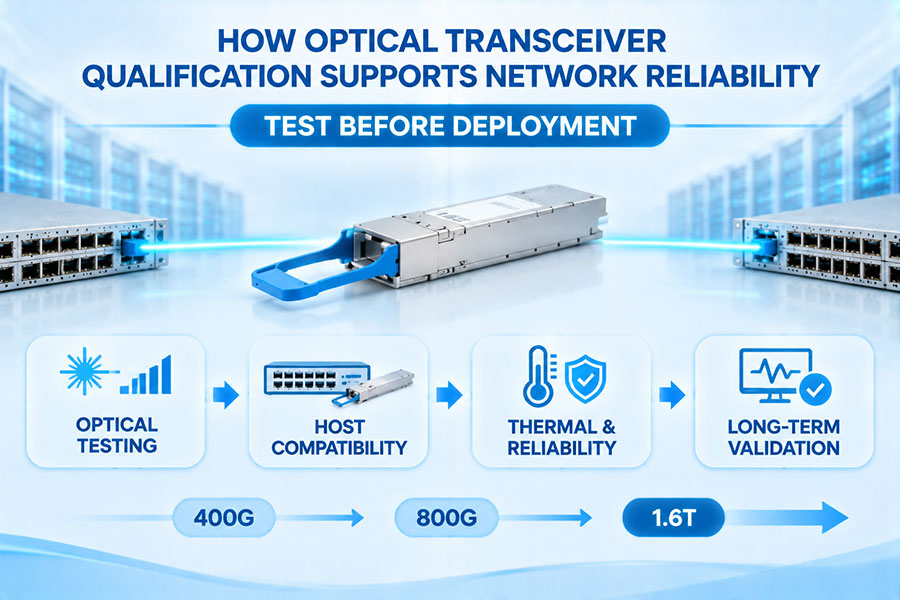
11. Compatibility Testing in an Open Network Environment
Testing should cover both initial link establishment and sustained operation. A module that is recognized and reaches link-up status may still have problems under extended traffic, temperature variation, firmware changes or diagnostic polling.
| Test category | Validation objective | Representative checks |
|---|---|---|
| Module recognition | Confirm correct host identification | Vendor ID, part number, serial number, module type and application codes |
| Link initialization | Verify successful host-module startup | Module state, lane configuration, reset behavior and link-up stability |
| Optical performance | Confirm the optical link meets its specification | Tx/Rx power, wavelength, receiver sensitivity and error performance |
| Electrical performance | Validate host-side signal operation | Lane mapping, signal quality, FEC status and link training where supported |
| Diagnostics | Verify management data is available and meaningful | Temperature, voltage, optical power, alarms and warning flags |
| Thermal behavior | Confirm operation within platform limits | Temperature under representative airflow and workload conditions |
| Software compatibility | Check behavior across approved software versions | Module detection, driver handling, firmware interactions and upgrade regression |
| Operational stability | Confirm sustained network operation | Link flaps, error counters, traffic tests and repeated initialization |
For multi-vendor links, test the complete pair of endpoints. A module may be accepted by one switch but rejected by the device at the other end. Successful recognition on both hosts is necessary, but optical and electrical interoperability must still be verified across the fiber connection.
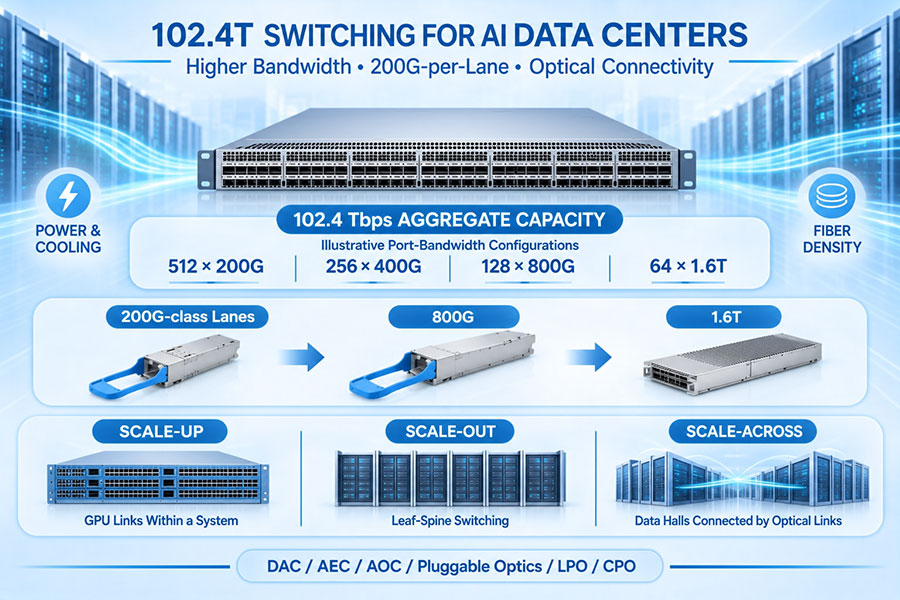
12. Open Networking and the Future of 400G, 800G and 1.6T Optics
As data center interfaces move toward higher lane rates and denser optical configurations, host-module coordination becomes more demanding. Higher-speed electrical lanes require careful signal-integrity design, while multi-lane modules need consistent management of lane state, diagnostics and configuration.
At 400G and 800G, operators must consider form-factor support, electrical lane rates, optical architecture, FEC and module management capabilities. For emerging 1.6T interfaces, host and module interoperability will become even more dependent on precise alignment of electrical and optical specifications.
Standardized management interfaces help create a reusable integration foundation, but the full physical link must still satisfy its electrical and optical requirements. For example, standardized module management cannot correct an unsupported host SerDes rate, insufficient signal margin or incompatible fiber configuration.
Open interoperability efforts are therefore increasingly focused on the relationship between the module and the host, not just the module's internal specification. The OIF CMIS-LT agreement approved in September 2026 is one example: it defines a standardized out-of-band method for exchanging per-lane and per-direction link-training information through the module-management interface.
13. Commercial and Operational Implications
More flexible transceiver sourcing can improve procurement options, but the purchase price is only one part of the total deployment cost. Qualification, inventory management, technical support and lifecycle control also affect the economics of an open network.
Operators should evaluate:
Supplier diversity: Whether multiple qualified suppliers can provide equivalent modules for the target platforms.
Inventory efficiency: Whether common optical specifications can reduce unnecessary spare-part variation.
Qualification effort: The engineering time required to test each module against specific hardware and software configurations.
Lifecycle management: Whether replacement modules remain compatible after switch software or firmware updates.
Support responsibilities: Which supplier handles module defects, interoperability issues and diagnostic investigations.
Change control: How module revisions, coding profiles and software releases are recorded and approved.
A qualified third-party module can provide greater sourcing flexibility, but an operator should maintain a clear compatibility matrix and a controlled approval process. A successful test on one switch model or software release should not automatically be treated as qualification for every platform.
14. Practical Checklist for Open Networking Optical Compatibility
The following checklist provides a structured approach to evaluating optical modules in disaggregated network environments.
Identify the exact switch model, hardware revision, port type and ASIC platform.
Confirm that the network operating system and platform software support the target switch.
Verify the module form factor, cage requirements and power class.
Match the host electrical interface, lane configuration and supported link rate.
Confirm the optical standard, wavelength, fiber type, connector and reach.
Check the applicable FEC and link-training requirements.
Verify EEPROM identification, management interface and required CMIS functions.
Confirm that the host platform accepts the module's identification and coding profile.
Test DOM readings, alarms, initialization and link stability.
Validate both ends of the optical link and record the tested software and firmware versions.
Retest after significant switch software, platform firmware or module revision changes.
15. Conclusion
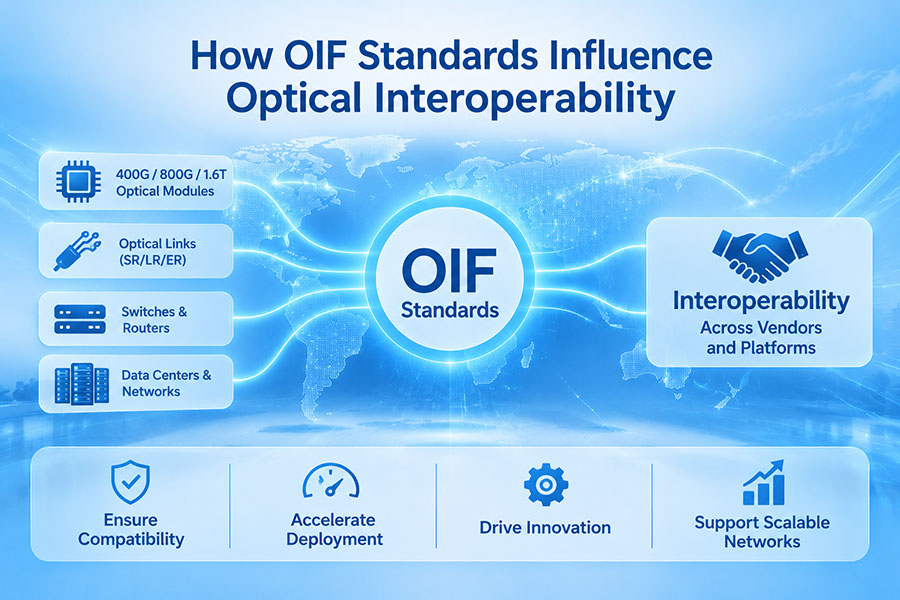
Open networking is expanding the optical transceiver ecosystem by separating switch hardware, network software and optical sourcing decisions. Standardized form factors, Ethernet interfaces, CMIS and common platform APIs help different manufacturers build components that can work together more consistently.
However, compatibility remains a multi-layer engineering requirement. Mechanical fit, electrical signal support, optical performance, module management, platform drivers, software policy and thermal behavior must all align. Open network operating systems can make module management more flexible, but they do not automatically remove hardware-specific integration or host acceptance restrictions.
As OCP and OIF continue advancing platform and module interoperability work, the industry is moving toward more reusable interfaces and more consistent diagnostics. For operators, the practical benefit comes from combining these standards with platform-specific qualification, controlled software updates and complete end-to-end optical testing.
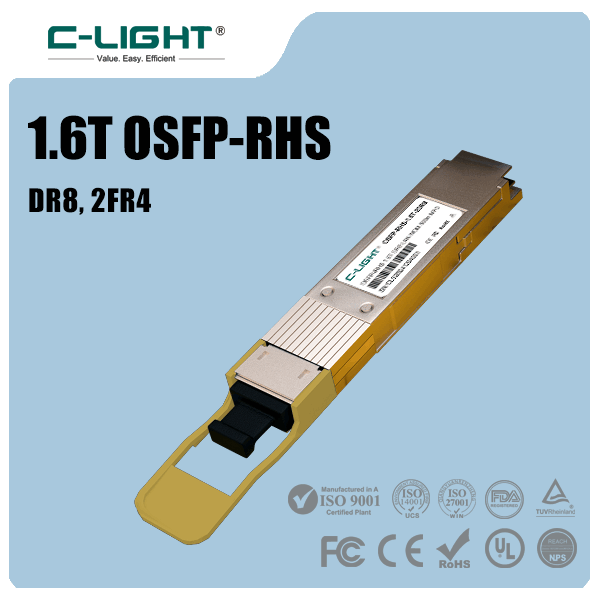
For optical connectivity requirements across different switch platforms and data center applications, view the optical transceiver product range or Contact C-LIGHT.
 >

 >
 >
 >
 >
 >
 >
 >