TEL:+86 132 6656 7067


Modern optical networks rely on equipment from multiple manufacturers. Data center operators, telecommunications providers, and enterprise network teams often combine switches, routers, optical transceivers, coherent transport systems, and fiber infrastructure from different vendors. Making these components work together reliably requires more than matching connector types and transmission speeds.
The Optical Internetworking Forum (OIF) plays an important role in addressing this challenge. Through its Implementation Agreements (IAs), OIF defines common electrical, optical, management, and protocol interfaces that help equipment manufacturers develop interoperable products. These agreements provide a shared technical foundation for high-speed networking, coherent optical transmission, and next-generation data center connectivity.
OIF standards are particularly relevant as networks move toward 400G, 800G, and 1.6T optical interfaces. Higher data rates introduce tighter signal-integrity requirements, more complex module management, and greater demands on multi-vendor compatibility. Common interface specifications help reduce implementation differences and make system integration more predictable.
1. What Is OIF?
The Optical Internetworking Forum is an industry organization that brings together network operators, equipment manufacturers, component suppliers, and technology developers to advance interoperable optical networking solutions.
OIF develops Implementation Agreements that define technical requirements for specific interfaces and functions. These agreements address areas such as electrical signaling, coherent optical transmission, module management, and energy-efficient optical interfaces.
1.1 The Purpose of OIF Implementation Agreements
An OIF Implementation Agreement establishes common technical requirements that participating manufacturers can use when designing compatible hardware and software. Depending on the application, an agreement may specify electrical characteristics, optical interface parameters, management registers, signaling behavior, or other implementation details.
These specifications help reduce the differences that can arise when manufacturers independently develop products for the same networking application.
For example, two vendors may develop coherent optical modules intended for the same 400ZR application. A shared implementation agreement provides a common reference for important interface characteristics, making multi-vendor interoperability more practical.
1.2 Why Multi-Vendor Interoperability Matters
Network operators generally want flexibility when selecting equipment. Depending on a single supplier for every switch, router, optical module, and transport component can limit purchasing options and complicate future network expansion.
Interoperable interfaces help operators combine equipment from different manufacturers, provided that the products support the same specifications and meet the relevant system requirements.
For optical transceiver suppliers, standardized interfaces also create a clearer technical framework for product development, validation, and compatibility testing.
2. How OIF Standards Influence Optical Interoperability
Optical interoperability involves several layers of compatibility. A transceiver must communicate correctly with its host device, generate and receive suitable optical signals, and operate through the intended fiber link. OIF addresses important parts of this process through different groups of specifications.
2.1 Common Electrical Interfaces
Before data reaches an optical transmitter, it usually travels through an electrical interface between the host ASIC, switch board, or processor and the optical module. At high data rates, this electrical channel must meet demanding requirements for signal quality and timing.
OIF's Common Electrical I/O (CEI) specifications define electrical interface characteristics and interoperability requirements for high-speed connections. They address different signaling rates and reach categories, helping equipment developers design compatible electrical interfaces.
2.2 Standardized Optical Interfaces
Optical interoperability requires agreement on parameters such as wavelength range, modulation format, symbol rate, optical power, receiver performance, and transmission behavior.
OIF coherent optical Implementation Agreements, including 400ZR and 800ZR, define specific coherent interfaces for high-capacity optical networking applications. By providing a common technical reference, these agreements help different manufacturers build equipment intended to operate across the same optical interface.
2.3 Common Module Management
Optical modules also need to communicate management and monitoring information to their host devices. This includes module identification, operating status, temperature, voltage, optical power, alarms, and other diagnostic information.
The Common Management Interface Specification (CMIS) provides a standardized management framework for pluggable modules. It helps hosts and modules exchange information through a common management model, reducing differences in how manufacturers implement module control and monitoring.
| OIF Technical Area | Primary Function | Interoperability Benefit |
|---|---|---|
| CEI | Defines high-speed electrical interface requirements | Improves compatibility between host electrical interfaces and connected devices |
| 400ZR / 800ZR | Defines coherent optical interface requirements | Supports multi-vendor coherent optical links |
| CMIS | Defines module management and monitoring behavior | Provides a common host-to-module management framework |
| Energy Efficient Interfaces | Addresses power-efficient electrical and optical integration | Supports consistent approaches to emerging high-speed interfaces |
| FlexE | Defines flexible Ethernet client and PHY mapping functions | Supports flexible bandwidth allocation and transport integration |
3. OIF CEI Standards and High-Speed Electrical Compatibility
Electrical signal integrity becomes increasingly important as optical module interfaces move from 100G-class lanes toward 200G-class lanes and beyond. The electrical connection between a host ASIC and an optical module must maintain reliable signal transmission within the supported channel reach.
3.1 What Is CEI?
Common Electrical I/O is an OIF specification family covering high-speed electrical interfaces. CEI agreements address electrical signaling characteristics and interoperability requirements across different data-rate generations and reach categories.
These specifications are relevant to switch ASICs, optical modules, retimers, electrical interface devices, and other components that exchange high-speed serial signals.
3.2 Why CEI Matters for 400G and 800G Modules
Modern 400G and 800G optical modules use multiple high-speed electrical lanes between the host and the module. The number of lanes and their signaling rates depend on the module architecture and the applicable interface specification.
As lane rates increase, electrical channels become more sensitive to insertion loss, return loss, crosstalk, jitter, and equalization requirements. A common electrical interface specification helps manufacturers design host and module interfaces around compatible signal characteristics.
3.3 CEI and 200G-per-Lane Technology
200G-per-lane signaling is an important development for next-generation 800G and 1.6T connectivity. Higher lane rates can increase bandwidth density, but they also make electrical channel design more demanding.
OIF's CEI work provides a framework for addressing these electrical interface challenges. Its specifications cover different reach categories and signaling approaches, allowing system designers to select appropriate implementations for their products.
4. OIF 400ZR and 800ZR Standards for Coherent Optics
Coherent optical technology is widely used in high-capacity data center interconnect and transport networks. OIF has developed coherent optical Implementation Agreements to establish common interface requirements for specific applications.
4.1 What Is 400ZR?
400ZR is an OIF coherent optical interface designed primarily for high-capacity data center interconnect applications. It supports a nominal 400G client data rate over a coherent optical line interface and is intended for amplified DWDM links within its defined application range.
The 400ZR Implementation Agreement specifies important optical and transmission characteristics, including modulation, line-interface behavior, and performance requirements. It helps manufacturers develop coherent modules that can interoperate across supported systems.
400ZR is particularly relevant to connections between data centers and high-capacity router or switch ports. Its standardized interface can simplify the deployment of coherent pluggable optics in compatible equipment.
4.2 What Is 800ZR?
800ZR extends coherent optical connectivity to an 800G line interface. The OIF 800ZR Implementation Agreement targets single-span amplified DWDM links in the approximately 80–120 km range for data center interconnect applications.
Compared with 400ZR, 800ZR increases the nominal interface capacity and introduces more demanding requirements for optical performance, signal processing, and system integration.
Standardized 800ZR interfaces help manufacturers develop compatible high-capacity coherent solutions for next-generation DCI networks.
4.3 400ZR vs. 800ZR
| Comparison | 400ZR | 800ZR |
|---|---|---|
| Nominal line capacity | 400G | 800G |
| Technology | Coherent optical transmission | Coherent optical transmission |
| Typical application | Data center interconnect | Higher-capacity data center interconnect |
| Transmission environment | Amplified DWDM links within the defined application range | Single-span amplified DWDM links, approximately 80–120 km |
| Key design considerations | Optical performance, power, host compatibility | Higher capacity, optical performance, power, thermal design |
The distance ranges shown are application targets rather than guaranteed reach on every fiber route. Actual performance depends on fiber characteristics, optical line design, amplifier configuration, and system conditions.
5. CMIS and Standardized Optical Module Management
Optical interoperability is not limited to the transmission of data. The host device must also recognize, configure, monitor, and manage the optical module correctly.
Without a common management approach, different modules may expose information or control functions in different ways, creating additional integration work for switch and router manufacturers.
5.1 What Is CMIS?
The Common Management Interface Specification defines a standardized framework for communication between a host system and a pluggable module. It describes management functions, memory maps, control mechanisms, and diagnostic information.
CMIS is designed to support a range of module technologies and form factors. It provides a common approach for reading module information, monitoring operating conditions, and controlling supported functions.
5.2 What Information Can CMIS Provide?
Depending on the module and supported CMIS revision, management information can include:
Module identification and vendor information.
Supported application and interface information.
Module temperature and supply voltage.
Transmit and receive optical power.
Laser and channel operating status.
Alarm and warning flags.
Module state and supported control functions.
This information helps network operators and host systems identify module conditions, monitor link health, and troubleshoot potential faults.
5.3 Coherent CMIS
Coherent optical modules have management requirements that extend beyond those of many conventional optical transceivers. They may expose additional parameters related to coherent signal processing, optical performance, and transmission configuration.
Coherent CMIS extends the common management approach to support digital coherent optics. It defines additional management information and functions needed for coherent module operation.
For multi-vendor coherent deployments, standardized management behavior can make module integration and operational monitoring more consistent.
6. OIF and Other Optical Networking Standards Organizations
OIF is one part of a broader standards ecosystem. Optical interoperability depends on specifications from multiple organizations, each addressing different aspects of networking and transmission.
| Organization | Main Technical Focus | Examples |
|---|---|---|
| OIF | Electrical, optical, management, and protocol implementation agreements | CEI, 400ZR, 800ZR, CMIS |
| IEEE | Ethernet and related networking standards | IEEE 802.3 Ethernet physical layers |
| ITU-T | Telecommunication networks and optical transport recommendations | OTN, wavelength grids, optical network architecture |
| MSA groups | Multi-vendor specifications for particular module form factors or applications | QSFP-DD MSA, OSFP MSA, OpenZR+ |
6.1 OIF vs. IEEE
IEEE develops widely used networking standards, including Ethernet specifications that define data rates, physical layers, and related requirements.
OIF focuses on implementation agreements for specific electrical, optical, and management interfaces. Its work can complement IEEE standards by addressing interface details and interoperability requirements that are important to equipment implementation.
6.2 OIF vs. ITU-T
ITU-T develops recommendations for telecommunications networks, including optical transport technologies, network architecture, and wavelength-related specifications.
OIF implementation agreements address specific interface requirements that help vendors build interoperable equipment. In practical optical networks, OIF and ITU-T specifications may both be relevant to the same transmission system.
6.3 OIF vs. MSA
Multi-Source Agreements (MSAs) are industry specifications developed by groups of companies to define common product form factors, mechanical dimensions, electrical interfaces, or application requirements.
OIF agreements and MSAs can complement one another. An MSA may define a module's physical form factor, while an OIF specification addresses a particular electrical, optical, or management interface. The exact division of responsibilities depends on the specification.
7. How OIF Standards Improve Multi-Vendor Optical Interoperability
Common specifications help reduce uncertainty during equipment integration. Their value becomes particularly clear when network operators deploy transceivers and transport equipment from different manufacturers.
7.1 Reducing Interface Differences
Without shared specifications, manufacturers may implement electrical signaling, optical parameters, or management functions differently. Even when products have the same nominal data rate, these differences can prevent reliable operation.
OIF agreements provide common technical references that help reduce unnecessary implementation variation.
7.2 Supporting Multi-Vendor Coherent Links
Coherent optical transmission involves multiple parameters, including modulation format, symbol rate, optical spectrum, transmitter performance, receiver requirements, and forward error correction.
OIF coherent agreements define a common interface for specific applications. This makes it easier for equipment developers to build products that are intended to operate together, subject to the requirements of the complete optical link.
7.3 Simplifying Module Monitoring
Standardized management interfaces help host systems retrieve module information through consistent mechanisms. This can reduce the engineering effort required to integrate and monitor products from different suppliers.
7.4 Encouraging Industry Validation
OIF also organizes multi-vendor interoperability demonstrations and related industry activities. These events allow participating companies to evaluate implementations together and identify potential issues before wider deployment.
Such demonstrations provide practical evidence of interoperability progress, complementing the technical requirements defined in Implementation Agreements.
8. Why OIF Compliance Does Not Guarantee Universal Compatibility
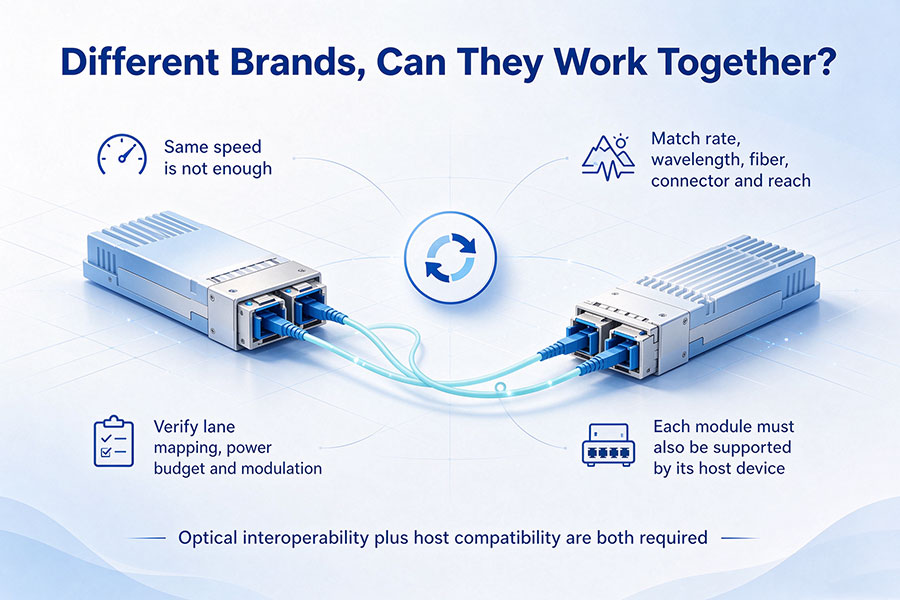
OIF standards provide a common technical foundation, but optical interoperability still depends on the complete system. A module that supports a particular OIF interface may not operate correctly in every switch, router, or transport platform.
8.1 Host Device Compatibility
The host must support the module's form factor, electrical interface, lane configuration, power requirements, and application. A module designed for a specific electrical interface cannot be assumed to work in a host that supports a different configuration.
8.2 Firmware and Software Support
Host firmware and network operating systems may affect module recognition, application selection, configuration, and diagnostic monitoring. Even when the physical interfaces are compatible, software support may differ between platforms.
8.3 Optical Link Budget
Optical interoperability also depends on the transmission path. Fiber attenuation, connector losses, dispersion, optical power, and OSNR can influence link performance.
Two modules that support the same optical interface may still require a properly engineered fiber route and suitable optical line equipment.
8.4 Module Implementation Differences
Manufacturers may implement optional features differently or support different revisions of an interface specification. These differences can affect module configuration, monitoring, and system behavior.
Compatibility testing should therefore verify the exact module model, hardware revision, firmware, host platform, and intended application.
9. How to Validate OIF-Based Optical Interoperability
OIF compliance should be treated as a starting point for interoperability testing rather than a replacement for system-level validation.
9.1 Verify the Applicable Specification
Identify the exact OIF Implementation Agreement and revision supported by the module and host equipment. Check whether the specification applies to the electrical interface, coherent optical interface, or management interface being tested.
9.2 Check Host and Module Compatibility
Confirm the host model, port type, supported data rate, form factor, lane configuration, power requirements, firmware version, and module application support.
9.3 Verify Module Recognition and Management
Check whether the host correctly identifies the module and reads its supported application information. Verify that temperature, voltage, optical power, alarms, and other supported diagnostics are reported correctly.
9.4 Test Optical Link Performance
For optical links, verify transmitter and receiver power, wavelength, fiber type, connector configuration, and link status. For coherent systems, additional checks may include OSNR, pre-FEC BER, post-FEC performance, and relevant transmission-quality indicators.
9.5 Run Sustained Traffic Tests
After the link is established, perform traffic testing under representative operating conditions. Monitor packet errors, link stability, module temperature, alarms, and performance over time.
These tests help identify issues that may not appear during initial module recognition or basic link-up testing.
10. The Future of OIF Standards in High-Speed Optical Networking
Optical networking is moving toward higher bandwidth, greater port density, and more tightly integrated electrical and photonic systems. OIF continues to address these developments through work on coherent optics, high-speed electrical interfaces, module management, and energy-efficient interfaces.
10.1 Higher-Speed Electrical Interfaces
As 200G-per-lane and higher-speed interfaces become more important, electrical signal integrity and link training require increasingly precise coordination between host and module implementations.
OIF's CEI work provides a common framework for addressing these requirements across different interface reach categories and implementation approaches.
10.2 Expansion of Coherent Pluggable Optics
400ZR and 800ZR demonstrate how standardized coherent interfaces can support higher-capacity DCI and optical transport applications. Continued development of coherent interface agreements will help address new network capacity and reach requirements.
10.3 Energy-Efficient Optical Integration
AI infrastructure is increasing demand for high-bandwidth, power-efficient connections. OIF's Energy Efficient Interfaces work addresses technologies such as retimed transmitter and linear receiver interfaces, external laser sources, and co-packaged optical modules.
These developments are relevant to future switch and accelerator architectures where power consumption, thermal management, and electrical channel limitations are major design considerations.
10.4 More Consistent Module Management
As optical modules become more sophisticated, standardized management remains essential. CMIS and coherent management specifications help provide a common operational framework across different module technologies and vendors.
11. Conclusion
OIF standards play an important role in improving optical interoperability by defining common electrical, optical, and management interfaces. CEI supports high-speed electrical connectivity, coherent agreements such as 400ZR and 800ZR provide common optical interface requirements, and CMIS helps standardize communication between host systems and optical modules.
These specifications reduce implementation differences and make multi-vendor equipment integration more practical. They are particularly valuable as optical networks move toward 400G, 800G, 1.6T, and more advanced photonic integration architectures.
However, standards compliance alone does not guarantee universal compatibility. Host support, firmware, optical link conditions, module implementation, and system configuration must all be validated. Combining standardized interfaces with structured interoperability testing provides a more reliable foundation for high-capacity optical networks.
 >

 >
 >
 >
 >
 >
 >
 >