TEL:+86 132 6656 7067


Artificial intelligence is changing the scale and architecture of modern data center networks. Large AI training and inference systems connect thousands of GPUs and other accelerators, requiring continuous data exchange between compute nodes, memory systems, storage platforms, and network switches. As these clusters grow, network bandwidth and interconnect efficiency become increasingly important to overall system performance.
Traditional data center connectivity was designed around a different balance of traffic volume, link distance, and power consumption. Modern AI workloads place greater demands on network bandwidth, port density, signal integrity, and latency. Copper connections remain useful for short-reach applications, but optical interconnects are becoming increasingly important for high-bandwidth connections across servers, racks, and data center facilities.
The transition involves more than moving from 400G to 800G or 1.6T transceivers. It includes changes in network architecture, electrical signaling, optical integration, fiber management, and thermal design. Technologies such as pluggable optics, active electrical cables, linear pluggable optics, near-packaged optics, and co-packaged optics address different parts of this evolving connectivity landscape.
1. Why AI GPU Clusters Need Higher-Performance Connectivity
AI training workloads distribute computation across multiple GPUs. Each accelerator processes part of a model or dataset and exchanges intermediate results with other accelerators. This communication can involve gradient synchronization, tensor transfers, parameter updates, and distributed memory operations.
As the number of GPUs increases, the network must carry more traffic between compute nodes while maintaining predictable performance. Insufficient bandwidth or network congestion can prevent accelerators from operating efficiently, reducing the effective utilization of expensive computing resources.
1.1 Increasing East-West Traffic
Traditional enterprise networks often prioritize traffic between users, applications, and external services. AI clusters generate substantial east-west traffic, meaning data moves between servers, GPUs, and switches inside the data center.
Distributed training requires frequent communication among accelerators. Inference systems also exchange data between compute nodes, memory resources, and storage services. These patterns increase demand for high-capacity connections throughout the internal network rather than only at the data center edge.
1.2 Higher Bandwidth per Accelerator
New GPU and accelerator platforms provide greater computing performance, but their networking interfaces must also keep pace. A cluster with powerful accelerators can become communication-limited if the network cannot transfer data quickly enough.
This creates demand for higher-speed network interfaces and optical transceivers. As 400G and 800G connections expand, 1.6T interfaces are becoming an important part of next-generation network planning.
1.3 Greater Port Density and Network Scale
Large GPU clusters require many high-speed links between servers and switches. Increasing the number of accelerators can rapidly increase the number of network connections, switch ports, cables, and optical modules required.
Higher-capacity optical links help increase bandwidth per port, while improved switching capacity allows network designers to connect more devices without relying entirely on additional physical interfaces.
2. Three Connectivity Layers in AI GPU Networks
AI infrastructure is not a single network. It consists of different connectivity layers, each with its own bandwidth, distance, latency, and scalability requirements. Three useful architectural concepts are scale-up, scale-out, and scale-across.
| Network Layer | Primary Connection | Main Requirement | Typical Connectivity |
|---|---|---|---|
| Scale-Up | Accelerator to accelerator within a tightly coupled compute domain | Very high bandwidth and low latency | High-speed copper, advanced electrical links, and emerging optical interconnects |
| Scale-Out | Server and rack connections across the AI cluster | High aggregate bandwidth and predictable network performance | 800G and 1.6T optical transceivers, DAC, AEC, and AOC |
| Scale-Across | Connections between buildings, campuses, or data center facilities | Longer reach and high-capacity optical transport | Coherent optics, DWDM, and data center interconnect systems |
2.1 Scale-Up: Connecting Accelerators More Closely
Scale-up networking connects GPUs or other accelerators within a closely coupled computing system. Its purpose is to make multiple processors cooperate with high communication bandwidth and low latency.
As accelerator bandwidth increases, the electrical connections between processors become more difficult to manage. High-speed signals are increasingly sensitive to channel loss, PCB routing, connector transitions, and signal integrity limitations.
Copper remains attractive for short connections because it can provide low latency and avoids optical-electrical conversion at the link endpoints. However, its practical reach becomes more constrained as signaling rates and bandwidth requirements rise.
Optical technologies are therefore being evaluated for connections closer to compute packages and across larger scale-up domains. Near-packaged optics, co-packaged optics, and optical I/O are among the approaches being developed to address these requirements.
2.2 Scale-Out: Connecting Servers and Racks
Scale-out networking connects separate GPU servers and racks through a switching fabric. It allows an AI cluster to expand beyond the capacity of a single server or tightly coupled system.
This layer is a major application area for high-speed pluggable optical transceivers. Links between top-of-rack switches, aggregation switches, and spine switches often require substantial bandwidth over distances that are not practical for conventional passive copper connections.
800G and 1.6T optical modules help increase bandwidth per connection and support larger network fabrics. Depending on the switch architecture and deployment distance, these links may use QSFP-DD or OSFP form factors and different optical interfaces.
2.3 Scale-Across: Connecting Distributed AI Infrastructure
As AI infrastructure expands across multiple data center buildings or geographically distributed facilities, connectivity must extend beyond the local cluster fabric.
These connections may involve campus fiber networks, data center interconnect (DCI), and high-capacity optical transport systems. Coherent optical technologies and DWDM can support higher-capacity transmission across longer distances, depending on the network design.
Scale-across connectivity is particularly relevant when organizations distribute compute, storage, and inference resources across multiple facilities. It introduces additional requirements for optical reach, transport capacity, latency, and network resilience.
3. The Migration from 400G to 800G and 1.6T Optical Connectivity
Increasing AI cluster bandwidth is accelerating the adoption of higher-speed optical interfaces. The transition from 400G to 800G and 1.6T is driven by the need to support greater traffic volumes without increasing port counts and cabling complexity at the same rate.
| Optical Generation | Representative Lane Architecture | Network Application |
|---|---|---|
| 400G | Commonly 4 × 100G-class or 8 × 50G-class lanes, depending on implementation | Data center switching and AI network connections |
| 800G | Commonly 8 × 100G-class lanes | High-density GPU cluster fabrics |
| 1.6T | Commonly 8 × 200G-class lanes | Next-generation high-bandwidth AI infrastructure |
| 3.2T | Future architectures based on higher per-lane signaling rates | Longer-term high-capacity network development |
These lane configurations are representative examples, not universal requirements for every module. Actual optical architectures depend on the interface standard, transceiver design, host electrical interface, and application.
3.1 400G Optical Connectivity
400G optical transceivers provide a foundation for high-speed data center networks. Common form factors include QSFP-DD and OSFP, with optical interfaces such as DR4, FR4, and other application-specific designs.
400G connections remain relevant in existing data center infrastructure, switch uplinks, and AI deployments where the network architecture and port capacity are designed around 400G interfaces.
For example, C-LIGHT offers 400G QSFP-DD optical modules and 400G OSFP optical modules for different high-speed network configurations.
3.2 800G Optical Connectivity
800G increases the capacity available from a single optical interface and supports higher-density network fabrics. It is particularly relevant to large AI clusters where many accelerator nodes exchange data through high-capacity Ethernet or InfiniBand networks.
Common 800G optical module families include QSFP-DD and OSFP. The appropriate form factor depends on the switch platform, port design, power envelope, cooling strategy, and supported optical interface.
C-LIGHT's 800G QSFP-DD and 800G OSFP product categories provide options for high-bandwidth data center connectivity.
3.3 1.6T Optical Connectivity
1.6T represents another increase in per-port bandwidth. A common architecture uses eight 200G-class electrical and optical lanes, although implementations can differ according to the module design and host interface.
Higher lane rates create new challenges for electrical signal integrity, optical engine design, power consumption, and thermal management. These factors influence module form factors, connector arrangements, and the integration of optical components into switching systems.
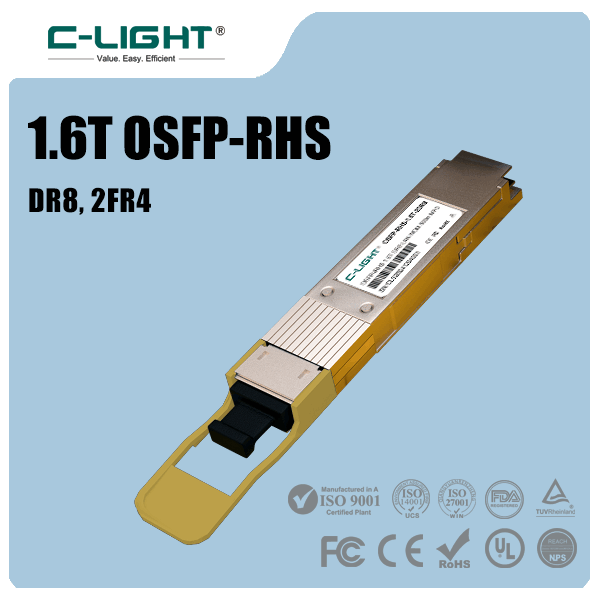
C-LIGHT's 1.6T OSFP-RHS optical module is relevant to this transition. Its documented application options include DR8 at 500 m and 2×FR4 at 2 km. These are specific product configurations rather than universal 1.6T reach specifications.
4. Why Optical Interconnects Are Expanding Beyond Traditional Copper
Copper and optical connections serve different roles in AI infrastructure. Copper is often suitable for short electrical connections within servers, racks, and tightly integrated systems. Optical links provide advantages when higher bandwidth must be carried over longer distances or through dense network fabrics.
4.1 Bandwidth and Transmission Distance
As data rates increase, electrical signal attenuation and channel loss become more difficult to manage. PCB traces, connectors, cables, and other electrical transitions can limit the distance over which high-speed signals maintain adequate signal integrity.
Optical transmission converts electrical data into light for transport over fiber. Fiber links can support high bandwidth over distances that would be difficult to achieve with comparable high-speed passive copper connections.
4.2 Signal Integrity at Higher Data Rates
High-speed electrical signaling is affected by insertion loss, return loss, crosstalk, reflections, and electromagnetic interference. These factors become increasingly important as per-lane data rates rise.
Optical fiber avoids many electrical transmission limitations over the fiber span. However, optical links still require careful management of transmitter performance, receiver sensitivity, dispersion, connector loss, and bit error rate.
4.3 Power Efficiency and Thermal Management
Power consumption is a major design consideration in high-density AI systems. Thousands of optical and electrical connections can contribute to the overall energy and cooling requirements of a data center.
Higher-speed optical modules must balance bandwidth, power consumption, and thermal performance. The power requirements of a transceiver depend on its architecture, DSP implementation, optical engine, laser technology, and operating conditions.
As bandwidth increases, reducing power per bit becomes an important design objective. This is one reason why the industry is evaluating LPO, NPO, CPO, and other optical integration approaches.
4.4 Rack Density and Cable Management
Large AI clusters require dense cabling between servers and switches. Copper cables can become difficult to route and manage when many high-speed connections are concentrated in a limited rack space.
Fiber cabling offers smaller cable diameters and electromagnetic immunity, which can help support dense network layouts. However, fiber infrastructure also requires appropriate connector management, bend-radius control, cleaning procedures, and polarity planning.
5. Optical Interconnect Technologies for Next-Generation AI Networks
AI networking is not moving toward a single universal optical architecture. Different technologies address different reach, power, latency, and maintenance requirements.
5.1 Pluggable Optical Transceivers
Pluggable optical modules remain an established solution for switch-to-switch and rack-to-rack connectivity. They can be inserted into compatible front-panel ports and replaced without redesigning the entire switching system.
Their modular design supports flexible network deployment, field replacement, and multi-vendor sourcing. Common high-speed form factors include QSFP-DD and OSFP.
Pluggable optics are particularly useful in scale-out networks, where links connect servers, top-of-rack switches, aggregation switches, and spine layers.
5.2 Active Electrical Cables and Active Optical Cables
Not every AI interconnect needs a pluggable optical transceiver. DAC, AEC, and AOC cables provide different approaches for short- and medium-reach connections.
| Technology | Transmission Medium | Typical Role |
|---|---|---|
| DAC | Passive copper | Short-distance connections with low power requirements |
| AEC | Active copper with signal conditioning or retiming | Extending practical copper reach in supported applications |
| AOC | Optical fiber with integrated electrical-optical conversion | High-speed connections over longer distances than typical passive DAC links |
DAC remains useful for short connections where the host interface and cable length are compatible. AEC adds active signal processing to help manage electrical channel limitations. AOC uses optical transmission within an integrated cable assembly.
For AI cluster deployments, the selection depends on port type, reach, power budget, cable routing, and network topology. C-LIGHT provides DAC, AEC, and AOC product categories for different interconnect requirements.
5.3 Linear Pluggable Optics
Linear Pluggable Optics (LPO) is an optical module architecture designed to reduce power consumption and latency by removing or simplifying the DSP function inside the module.
In a conventional DSP-based pluggable transceiver, digital signal processing helps compensate for channel impairments. LPO shifts more of the signal conditioning responsibility to the host electrical interface, requiring the host SerDes and system channel to meet stricter performance requirements.
LPO can reduce module power and simplify the signal path in suitable designs. However, it places greater emphasis on host-module interoperability, electrical channel quality, and system-level validation.
5.4 Near-Packaged Optics
Near-Packaged Optics (NPO) places optical engines closer to the switch ASIC or compute package than traditional front-panel pluggable modules.
Shorter electrical connections between the ASIC and optical engine can help reduce signal loss and improve the feasibility of high-bandwidth interfaces. NPO also introduces new packaging, serviceability, fiber routing, and thermal design considerations.
5.5 Co-Packaged Optics
Co-Packaged Optics (CPO) integrates optical engines close to or within the same package assembly as a switch ASIC or other high-performance processor.
Traditional pluggable optics require high-speed electrical signals to travel from the switch ASIC across the board to the front-panel transceiver. CPO reduces the length of these electrical paths by positioning optical conversion much closer to the computing or switching silicon.
This approach can help address power consumption and signal integrity challenges at very high bandwidth densities. However, it also changes system architecture, optical packaging, service procedures, and fault isolation.
6. How Optical Connectivity Supports AI Cluster Architecture
The value of optical connectivity becomes clearer when it is considered across the full AI infrastructure rather than as an isolated transceiver upgrade.
6.1 GPU-to-Switch Connectivity
GPU servers connect to network switches through high-speed network interfaces. Depending on the server architecture, these connections may use DAC, AEC, AOC, or optical transceivers.
Short electrical connections can remain appropriate inside a server or rack. Optical links become more important when connections extend across racks or require higher bandwidth over greater distances.
6.2 Switch-to-Switch Connectivity
Leaf-spine and other high-capacity network architectures use multiple switch layers to connect a large number of servers. The links between these switches carry substantial east-west traffic.
800G and 1.6T optical transceivers can increase link capacity and support higher-bandwidth switch fabrics. The specific module type depends on the port architecture, fiber infrastructure, reach, and optical budget.
6.3 Storage and Inference Connectivity
AI inference and training environments also depend on fast access to datasets, checkpoints, model parameters, and distributed storage resources.
Optical connections help link storage systems, inference servers, and network switches across data center infrastructure. Their role becomes more significant as storage traffic and distributed inference workloads grow alongside accelerator capacity.
7. Optical Connectivity Challenges in Large AI GPU Clusters
Higher bandwidth alone does not guarantee better AI cluster performance. Optical networks must also meet demanding requirements for reliability, latency, power, and operational consistency.
7.1 Link Reliability and Bit Error Rate
AI training jobs often involve many accelerators communicating over multiple network paths. Errors or unstable links can reduce effective throughput and interrupt distributed workloads.
Optical modules must maintain appropriate transmitter and receiver performance across operating temperatures and expected environmental conditions. Link validation should include optical power measurements, error monitoring, and traffic testing.
7.2 Latency and Network Congestion
Distributed AI workloads are sensitive to communication delays and congestion. Network performance depends not only on the speed of individual optical links but also on switching architecture, routing, congestion control, and traffic patterns.
Optical connectivity provides high-capacity physical links, but it does not independently eliminate network congestion or guarantee low end-to-end latency. System-level network design remains essential.
7.3 Thermal Constraints
High-density switches and optical modules operate within limited thermal envelopes. As transceiver speeds increase, power dissipation and cooling requirements become more important.
OSFP and QSFP-DD platforms may have different mechanical, thermal, and power characteristics. The supported module type must match the switch platform and its cooling design.
7.4 Fiber Management and Deployment Complexity
Large AI clusters can contain thousands of optical links. Managing fiber routing, connector polarity, labeling, cleaning, and replacement becomes a significant operational task.
Structured fiber management and accurate link documentation help reduce installation errors and simplify troubleshooting. MPO-based parallel optics and duplex LC links require different cabling arrangements and polarity checks.
8. What the Transition to Next-Generation Optical Connectivity Means for Data Centers
The growth of AI GPU clusters is changing how data center networks are designed. Rather than treating optical transceivers as simple replaceable components, operators increasingly need to consider optical connectivity as part of the overall compute and switching architecture.
Several trends are shaping this transition:
Higher per-port bandwidth: 800G and 1.6T interfaces increase the capacity available to large AI network fabrics.
Higher bandwidth density: More data can move through a given number of network ports, subject to switch and system capabilities.
Closer optical integration: LPO, NPO, CPO, and optical I/O are being developed to address electrical channel and power limitations.
More diverse interconnect options: DAC, AEC, AOC, and pluggable optical modules serve different distances and system requirements.
Greater emphasis on system validation: Host compatibility, signal integrity, optical performance, and thermal behavior must be evaluated together.
Expanded optical transport: DCI and high-capacity fiber systems support connections between larger AI facilities.
These developments do not mean that every data center will immediately adopt the same optical architecture. Deployment choices depend on accelerator design, switch capabilities, rack layout, network protocol, cost, and operational requirements.
9. Selecting Optical Connectivity for AI GPU Clusters
Choosing the right interconnect requires a system-level assessment of bandwidth, distance, power, and host compatibility.
| Selection Factor | Key Questions |
|---|---|
| Bandwidth | Does the interface support the required aggregate data rate and lane configuration? |
| Transmission distance | Is the connection within the supported reach of the selected cable or optical module? |
| Fiber infrastructure | Does the installation use multimode or single-mode fiber, and which connector type is required? |
| Host compatibility | Does the switch, NIC, or accelerator platform support the selected module or cable? |
| Power and thermal limits | Can the host platform support the module's power consumption and cooling requirements? |
| Network architecture | Is the connection part of a scale-up, scale-out, or scale-across network? |
| Reliability | Can the link maintain acceptable optical power, error performance, and operational stability? |
| Future expansion | Can the selected infrastructure support planned bandwidth upgrades and additional compute capacity? |
For short-reach connections, DAC, AEC, or AOC may be appropriate depending on the host interface and distance. For rack-to-rack and switch-fabric links, pluggable optical transceivers provide flexible options across different data rates and reaches. For larger facilities, coherent optics and optical transport systems may be required.
C-LIGHT offers connectivity products for different stages of AI network deployment, including 400G QSFP-DD, 800G QSFP-DD, 800G OSFP, 800G AOC, and 800G AEC solutions.
10. Conclusion
AI GPU clusters are driving a fundamental change in data center connectivity. Larger accelerator systems, distributed training, and high-throughput inference increase the amount of data exchanged across servers, racks, switches, and facilities.
Optical connectivity is becoming increasingly important because it supports high bandwidth over distances and network densities that are difficult to address with conventional electrical connections alone. The evolution from 400G to 800G and 1.6T transceivers is one part of this transition, while LPO, NPO, CPO, and optical I/O represent additional approaches to bringing optical technology closer to compute and switching silicon.
Different technologies will continue to serve different network layers. Copper remains useful for short-reach connections, pluggable optics provide flexible scale-out connectivity, and advanced optical integration is being developed for increasingly demanding scale-up applications. The next generation of AI networks will depend on selecting and validating the right combination of these technologies across the entire infrastructure.
 >

 >
 >
 >
 >
 >
 >
 >