TEL:+86 132 6656 7067


1. AI Computing Is Reshaping Data Center Network Infrastructure
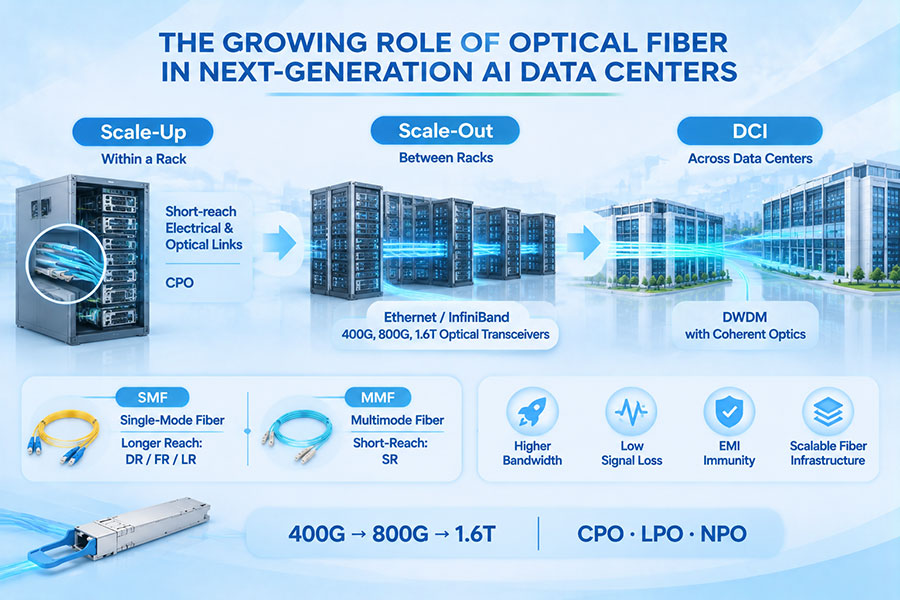
Artificial intelligence workloads are changing the way modern data centers are designed. Large language models, generative AI applications, and distributed GPU clusters require continuous communication between thousands of processors. As model sizes increase and training datasets become more complex, network traffic inside AI infrastructure is growing rapidly.
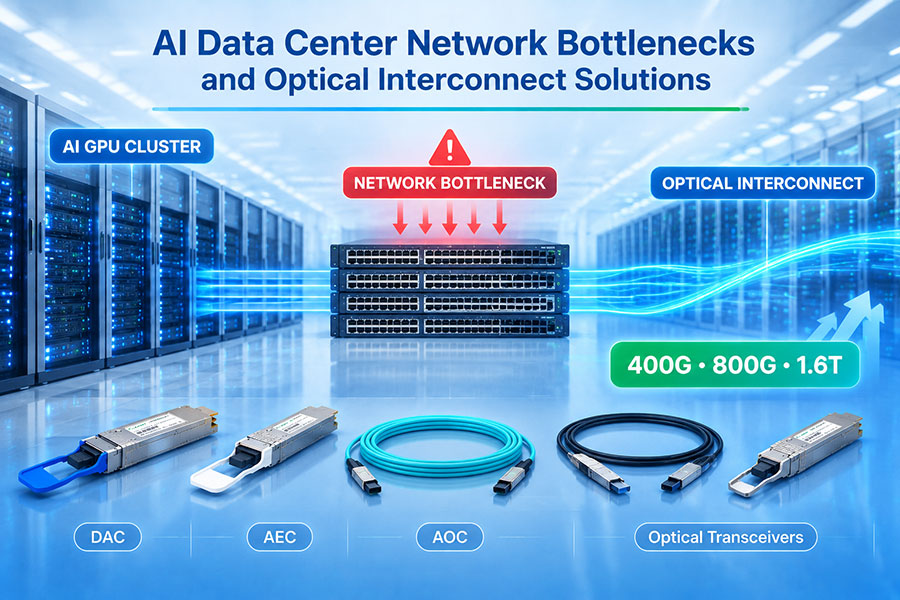
Traditional data center networks were primarily designed around general-purpose computing, storage access, and conventional server communication. AI infrastructure introduces a different traffic pattern, with intensive east-west communication between GPUs, switches, storage systems, and accelerator nodes. These connections must support high throughput, predictable latency, and efficient scaling.
Electrical interconnects remain important for short-distance communication, but their limitations become increasingly significant as transmission speeds and connection densities rise. Optical fiber provides a scalable transmission medium for connecting servers, racks, switches, and data center network layers.
2. Why Optical Fiber Is Becoming Essential for AI Data Centers
Optical fiber offers several advantages that directly address the connectivity requirements of AI computing environments. Its ability to transmit large volumes of data over different distances makes it suitable for both high-density rack connections and longer data center links.
Higher Bandwidth Capacity
AI clusters require extremely high aggregate bandwidth to transfer model parameters, training data, and intermediate computing results. As network interfaces move from 400G to 800G and 1.6T, optical transmission technologies provide the bandwidth capacity needed to support increasingly demanding connections.
Lower Signal Loss Over Distance
Copper interconnects are effective for relatively short connections, but signal attenuation and electrical limitations become more challenging as data rates increase. Optical fiber supports high-speed transmission over longer distances with lower signal loss, reducing the limitations associated with high-speed electrical links.
Electromagnetic Interference Immunity
Optical fiber transmits information through light rather than electrical signals. This makes it immune to electromagnetic interference and helps maintain reliable communication in dense equipment environments containing high-speed switches, power systems, and cooling infrastructure.
Flexible Network Expansion
Fiber infrastructure can support different transmission technologies and network architectures as AI computing requirements evolve. Data centers can deploy additional fiber connections, higher-speed optical transceivers, and denser optical distribution systems without fundamentally changing the transmission medium.
3. Optical Fiber in Scale-Up and Scale-Out AI Architectures
Modern AI infrastructure generally relies on two important communication dimensions: scale-up and scale-out. Both influence how optical connectivity is deployed, although their bandwidth, distance, and latency requirements differ.
Scale-up networking connects processors and accelerators within a tightly integrated computing system. High-bandwidth communication and extremely low latency are important, making electrical interconnects, short-reach optical connections, and emerging co-packaged optical technologies relevant depending on system architecture.
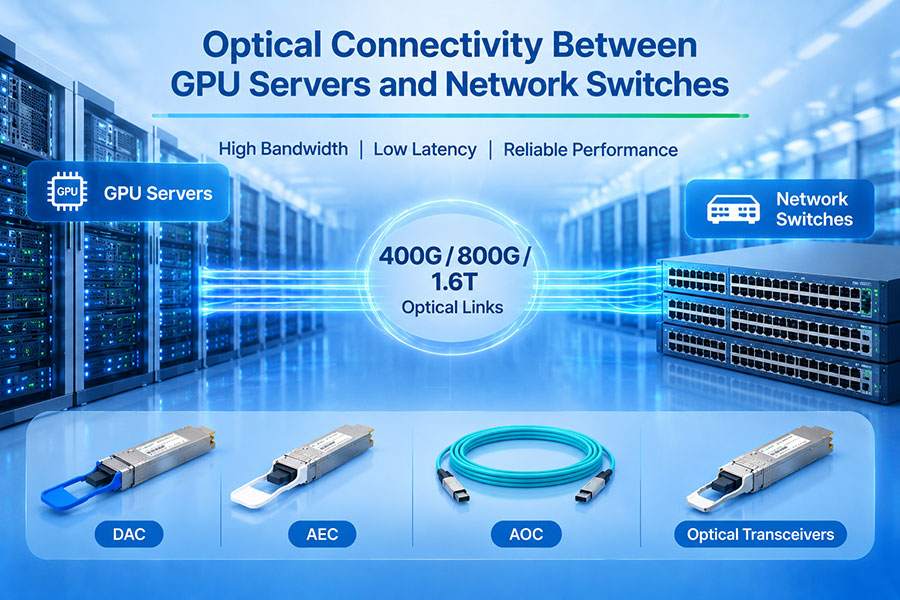
Scale-out networking connects multiple servers, racks, and GPU clusters across the data center. These connections require substantial aggregate bandwidth and often span greater physical distances. Optical transceivers and fiber cabling are therefore central components of high-speed Ethernet and InfiniBand networks.
| Network Dimension | Primary Function | Connectivity Requirements | Relevant Technologies |
|---|---|---|---|
| Scale-Up | Connect GPUs and accelerators within tightly integrated systems | High bandwidth, low latency, short reach | High-speed electrical links, optical interconnects, CPO |
| Scale-Out | Connect servers, racks, and GPU clusters | High aggregate bandwidth, scalable reach | Ethernet, InfiniBand, 400G/800G/1.6T optics |
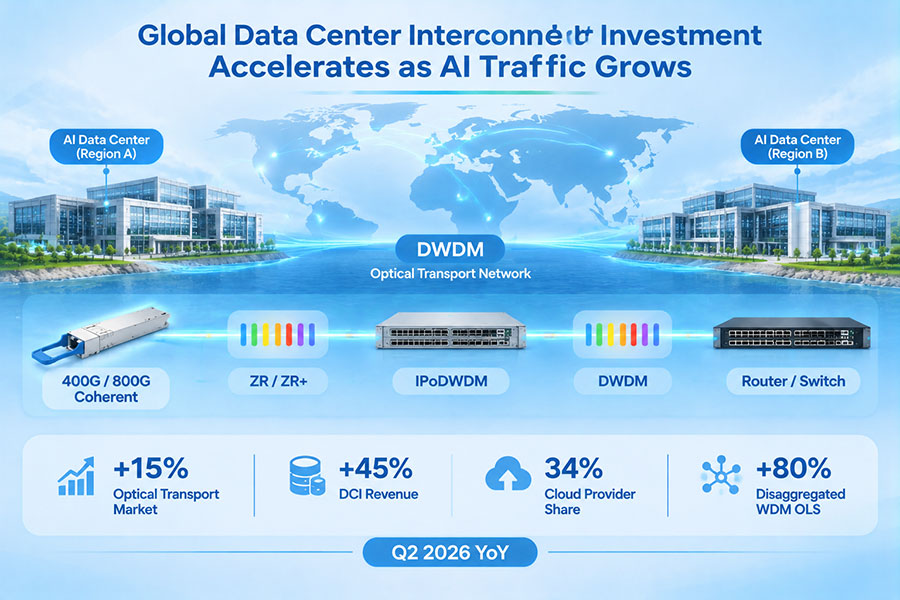
| Data Center Interconnect | Connect separate data center facilities | Longer reach, high capacity, optical performance | DWDM, coherent optics, DCO |
4. The Transition from 400G to 800G and 1.6T Optical Connectivity
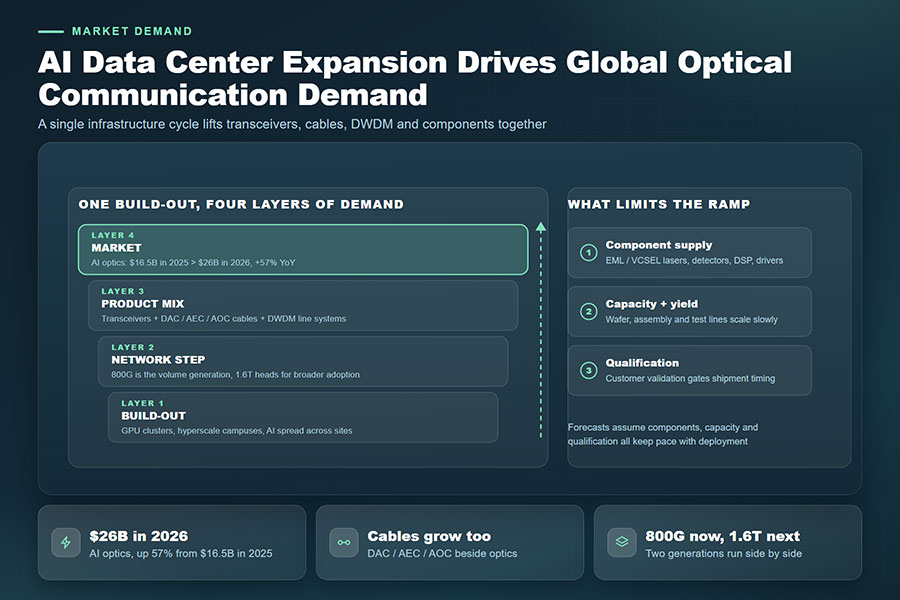
Increasing AI cluster sizes are accelerating the adoption of higher-speed optical interfaces. The transition from 400G to 800G and eventually 1.6T reflects the growing demand for bandwidth density, network scalability, and improved data transfer efficiency.
Different optical transceiver configurations address different link distances and network requirements.
| Optical Technology | Typical Application | Common Form Factors |
|---|---|---|
| 400G SR8 | Short-reach multimode fiber connections | QSFP-DD, OSFP |
| 400G DR4 | Up to 500 m over single-mode fiber | QSFP-DD, OSFP |
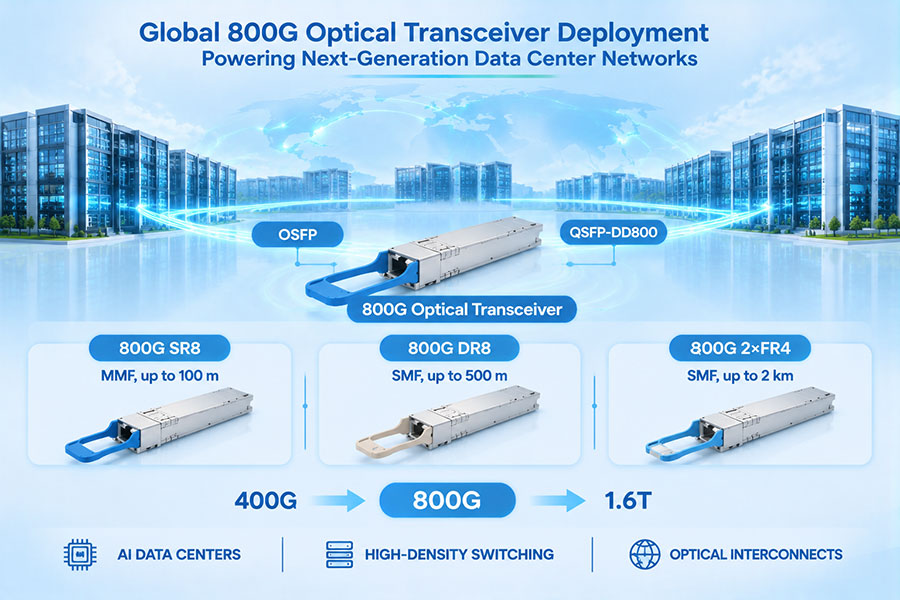
| 800G SR8 | Short-reach high-density optical links | OSFP, QSFP-DD |
| 800G DR8 | Parallel single-mode fiber connections | OSFP, QSFP-DD |
| 800G 2FR4 | Up to 2 km over single-mode fiber | OSFP, QSFP-DD |
| 1.6T DR8 | Next-generation high-bandwidth data center links | OSFP |
| 1.6T 2DR4 | High-speed single-mode fiber connectivity | OSFP |
These technologies allow network designers to select optical interfaces according to link distance, fiber infrastructure, switch port density, and system power requirements. The actual supported reach depends on the transceiver specification, fiber type, and link budget.
5. Single-Mode and Multimode Fiber in AI Data Center Deployment
Fiber selection is another important consideration when designing AI data center infrastructure. Single-mode fiber (SMF) and multimode fiber (MMF) serve different connectivity requirements.
Multimode fiber is commonly used for short-distance connections within equipment rooms and data center environments. It supports optical transmission using multiple propagation modes and is frequently paired with SR-series transceivers operating at 850 nm.
Single-mode fiber supports longer transmission distances and higher-capacity optical networking. It is widely used with DR, FR, LR, and other single-mode optical interfaces, making it particularly important for connections between racks, network switches, and separate data center areas.
| Characteristic | Multimode Fiber | Single-Mode Fiber |
|---|---|---|
| Fiber Core | Typically 50 μm | Typically 9 μm |
| Common Wavelength | 850 nm | 1310 nm, 1550 nm |
| Typical Applications | Short-reach connections | Short, medium, and long-reach connections |
| Common Transceiver Types | SR, SR4, SR8 | DR4, DR8, FR4, LR4, ZR |
For large AI deployments, single-mode fiber is increasingly important because it offers greater flexibility for network expansion and supports a broad range of high-speed transmission technologies.
6. Fiber Infrastructure and Optical Interconnect Density
As AI data centers increase the number of high-speed connections, fiber management becomes an important engineering challenge. Thousands of optical links may be deployed across racks, switches, and network distribution points. Efficient fiber routing is necessary to maintain accessibility, airflow, and long-term network reliability.
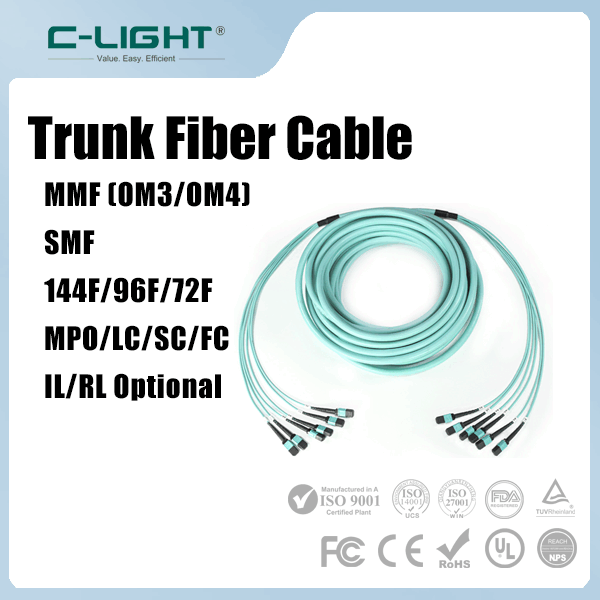
MPO and MTP connectivity solutions help simplify high-density optical cabling. Multi-fiber connectors can support parallel optical transmission architectures such as 400G SR8, 800G SR8, and DR8 configurations, depending on the interface and fiber arrangement.
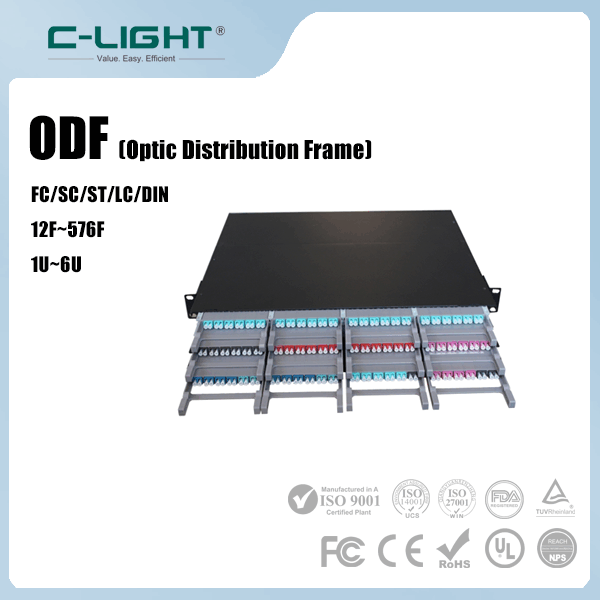
Pre-terminated MPO/MTP trunk cables, fiber patch cords, and high-density optical distribution systems can reduce installation complexity and improve deployment consistency. Proper polarity management, connector cleanliness, insertion loss control, and bend-radius compliance remain essential for reliable operation.
7. Emerging Optical Technologies for Next-Generation AI Networks
Beyond conventional pluggable transceivers, several optical technologies are attracting attention as AI infrastructure continues to scale.
Co-Packaged Optics (CPO)
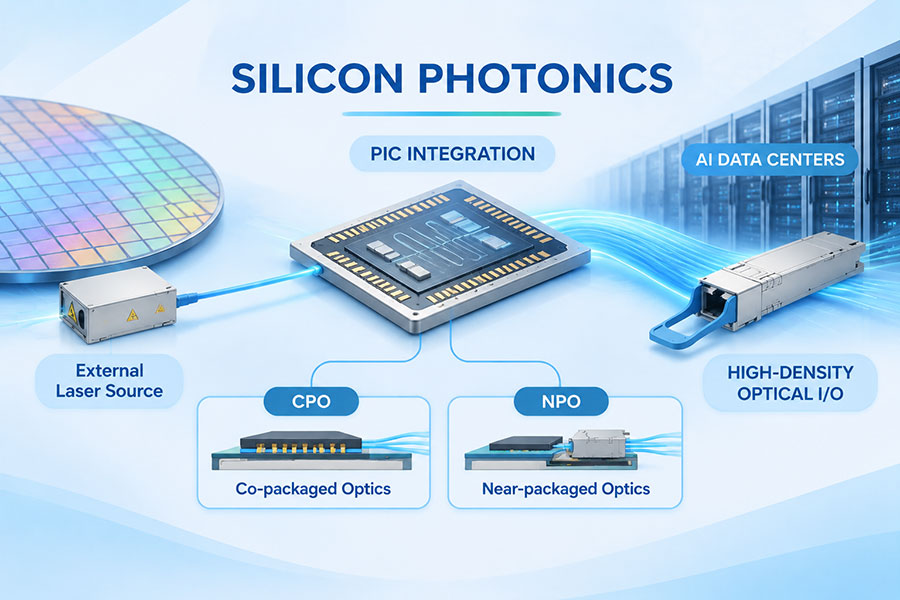
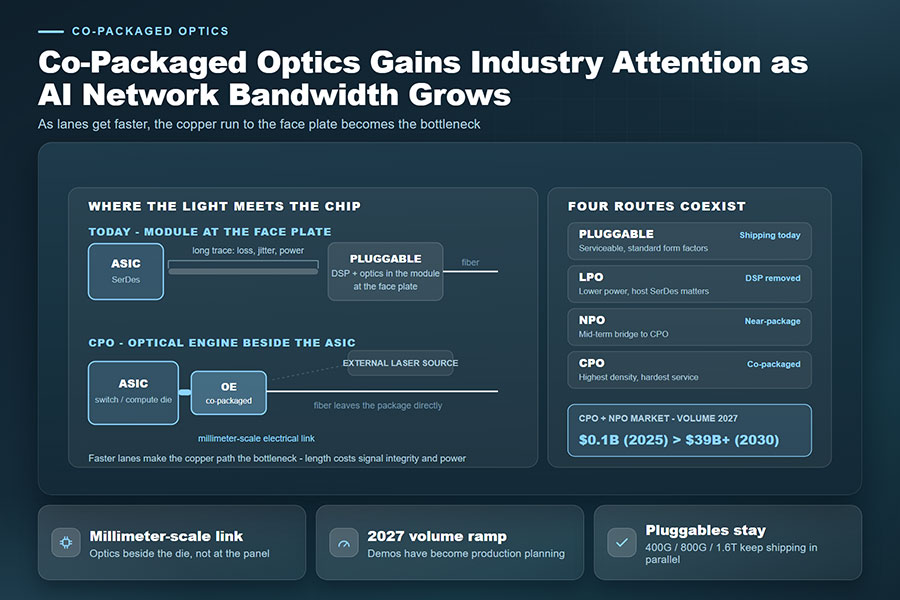
CPO integrates optical engines closer to switching or computing ASICs, reducing the length of high-speed electrical connections. This architecture aims to address electrical signal integrity challenges and improve bandwidth density and energy efficiency in future high-capacity systems.
Linear Pluggable Optics (LPO)
LPO uses a simplified optical module architecture that reduces or eliminates certain DSP functions within the transceiver. By reducing signal-processing complexity, LPO can potentially lower power consumption and latency, although system-level signal integrity and interoperability require careful engineering.
Near-Packaged Optics (NPO)
NPO places optical engines near the main processing or switching ASIC without integrating them directly into the same package. It represents another approach to shortening electrical signal paths while retaining a different degree of modularity and serviceability compared with CPO.
Coherent Optical Technology
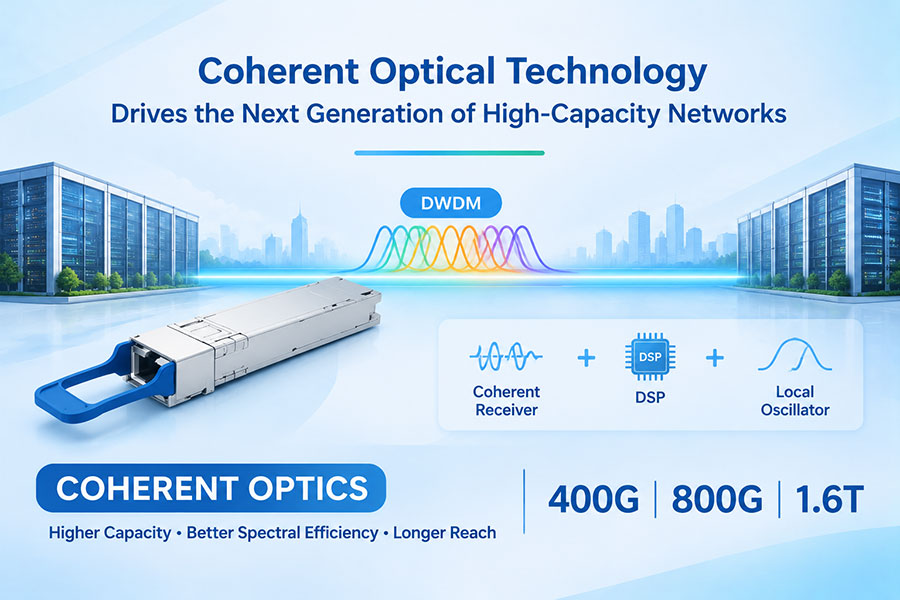
Coherent optics enable high-capacity transmission over longer distances and are particularly relevant to data center interconnect (DCI). Coherent pluggable modules, including 400G and 800G solutions, can support connections between geographically separated AI computing facilities.
8. Power Efficiency and Thermal Management in Optical Networks
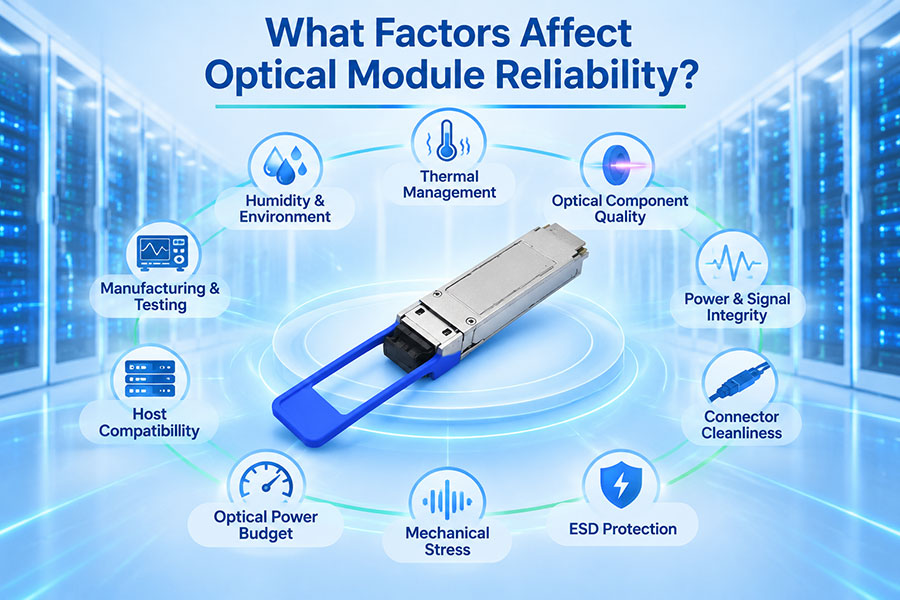
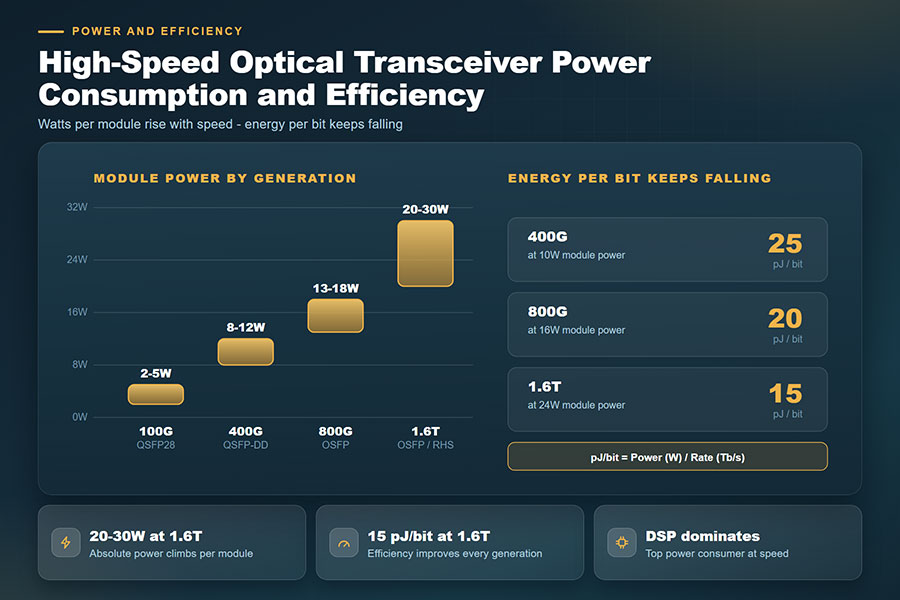
High-speed optical connectivity introduces additional power and thermal considerations. As transceiver speeds increase, module power consumption, switch thermal capacity, and cooling system performance become increasingly important to overall data center efficiency.
AI data centers already operate with high power densities because of GPU accelerators, high-performance switches, and supporting infrastructure. Optical transceivers must therefore be evaluated not only by bandwidth and reach but also by power consumption, thermal characteristics, and operational stability.
Several engineering approaches can help improve network efficiency:
Selecting optical modules with power consumption appropriate to the intended application.
Using suitable DAC and AEC solutions for compatible short-reach electrical connections.
Optimizing fiber routing and optical distribution to reduce unnecessary connection complexity.
Evaluating LPO, NPO, and CPO architectures for appropriate high-density applications.
Maintaining sufficient airflow and thermal headroom around optical modules and switching equipment.
9. C-LIGHT Optical Connectivity Solutions for AI Data Centers
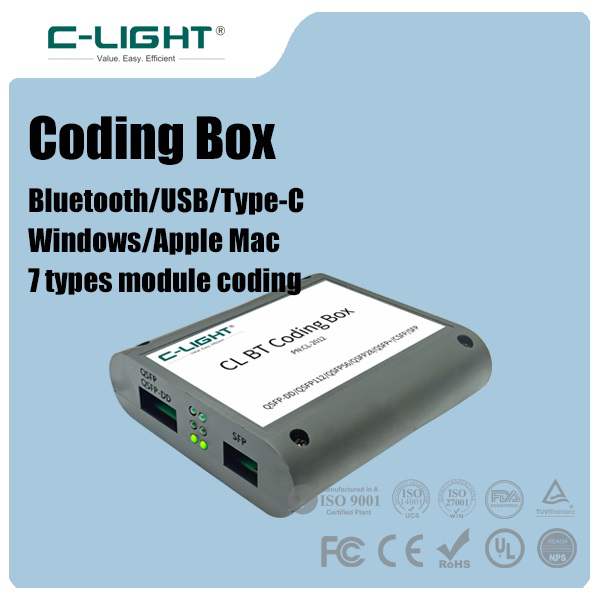
Building scalable AI network infrastructure requires optical connectivity products that support different transmission speeds, distances, and deployment environments. C-LIGHT provides a range of optical transceivers, direct attach cables, active optical cables, and fiber connectivity solutions for data center and high-performance networking applications.
Relevant product categories include:
800G Optical Transceivers: 800G SR8, 800G DR8, and 800G 2FR4 solutions for high-bandwidth data center connections.
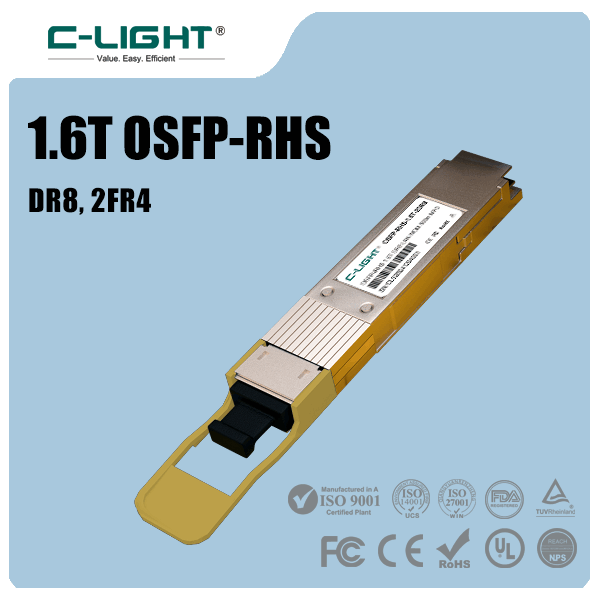
1.6T Optical Transceivers: 1.6T DR8 and 1.6T 2DR4 solutions for next-generation AI networking infrastructure.
400G Optical Transceivers: QSFP-DD and OSFP solutions for existing high-speed Ethernet and InfiniBand deployments.
DAC and AEC Cables: 400G, 800G, and 1.6T connectivity options for compatible short-reach applications.
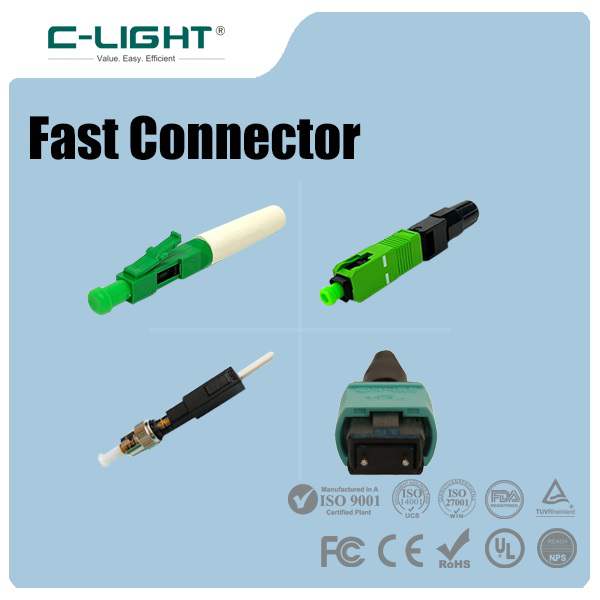
MPO/MTP Fiber Assemblies: High-density fiber connectivity for parallel optical transmission and structured cabling.
Choosing the right optical connectivity solution requires consideration of switch compatibility, transmission distance, fiber type, connector configuration, power consumption, and operating temperature. C-LIGHT supports customers in selecting suitable optical modules and cabling solutions for different network architectures.
For product specifications, compatibility requirements, or customized optical connectivity solutions, Contact C-LIGHT.
10. Conclusion
Optical fiber is becoming a foundational component of next-generation AI data center infrastructure. The growing scale of GPU clusters, increasing east-west traffic, and transition toward 800G and 1.6T networking are driving demand for higher-capacity and more flexible optical connectivity.
From single-mode and multimode fiber to high-density MPO/MTP assemblies, advanced optical transceivers, and emerging CPO and NPO architectures, optical technologies are evolving to address the changing requirements of AI computing. As data center networks continue to expand, efficient fiber infrastructure and reliable optical connectivity will play an increasingly important role in supporting large-scale AI workloads.
 >

 >
 >
 >
 >
 >
 >
 >