TEL:+86 132 6656 7067


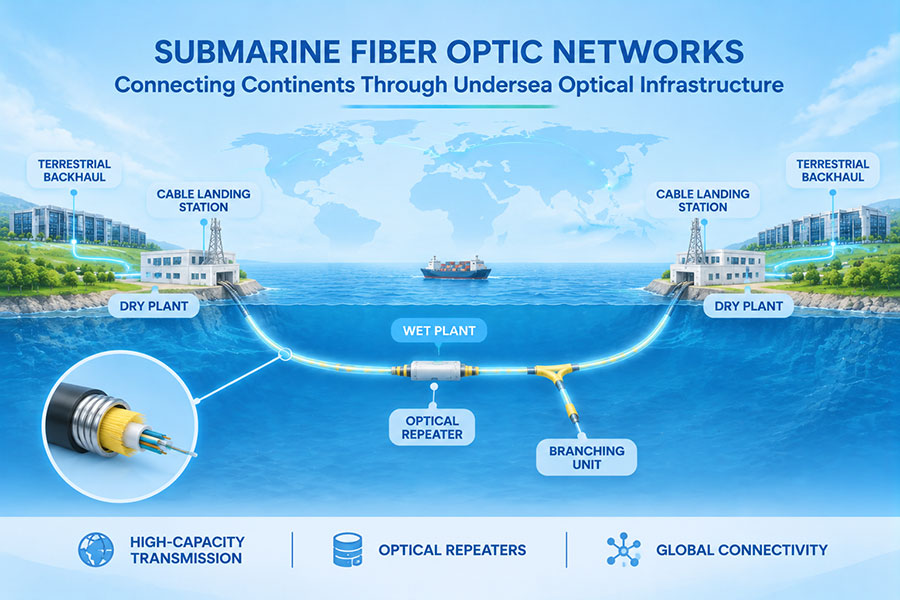
International communication depends on a vast optical infrastructure extending far beyond terrestrial fiber routes and data center networks. Beneath the world's oceans, submarine fiber optic cable systems connect continents, countries, and island regions, carrying the data that supports cloud computing, financial transactions, video streaming, enterprise services, and global internet access.
Although satellites provide important communication capabilities, submarine fiber optic cables remain the primary infrastructure for high-capacity intercontinental data transmission. Their ability to carry enormous volumes of traffic over long distances makes them essential to the global digital economy.
As cloud platforms, artificial intelligence, video services, and international data exchange continue to expand, submarine cable networks are undergoing another period of investment and technological development. Higher-capacity optical transmission, coherent technology, wavelength-division multiplexing, and improved network diversity are shaping the next generation of undersea connectivity.
1. Why Submarine Fiber Optic Networks Are Essential to Global Connectivity
Modern digital services frequently cross national borders. A user accessing a cloud application, joining an international video conference, or retrieving content from a data center in another region may rely on several interconnected terrestrial and submarine networks.
Submarine fiber optic cables provide the high-capacity connections that link these geographically separated networks. They carry the majority of international data traffic and form a fundamental part of the global internet backbone.
According to the ITU's Global Connectivity Report 2025, submarine cables carry more than 99% of international data flows. Their importance extends beyond internet browsing to critical services such as:
Cloud computing: Connecting geographically distributed cloud regions and data centers.
Financial services: Supporting international banking, payment processing, trading platforms, and financial data exchange.
Video and content delivery: Transporting streaming media, software updates, and digital content between continents.
Enterprise communication: Connecting multinational offices, corporate networks, and international service platforms.
Research and education: Supporting cross-border collaboration, scientific data exchange, and remote learning.
Government and public services: Providing international communication paths for essential digital services.
Without submarine cable infrastructure, the capacity and economics of global digital communication would be significantly different. Satellite systems complement these networks, particularly for remote coverage and specialized applications, but do not replace the capacity of submarine fiber systems for most intercontinental data traffic.
2. How a Submarine Fiber Optic Cable System Works
A submarine cable system is more than a long optical cable placed on the ocean floor. It is an integrated transmission infrastructure that includes undersea optical components, shore-based equipment, cable landing facilities, and connections to terrestrial networks.
The complete system can be divided into two main parts: the wet plant and the dry plant.
Wet plant refers to the undersea infrastructure, including submarine fiber cables, repeaters, branching units, and related components installed along the seabed.
Dry plant refers to the shore-based equipment and facilities used to power, monitor, and manage the submarine transmission system. It includes submarine line terminal equipment, power feeding equipment, and cable landing station infrastructure.
| System Component | Location | Primary Function |
|---|---|---|
| Submarine fiber cable | Seabed | Carries optical signals between landing locations |
| Optical repeater | Undersea route | Regenerates optical signal strength through optical amplification |
| Branching unit | Undersea route | Connects cable branches in multi-landing systems |
| Submarine line terminal equipment | Landing station | Generates, receives, and manages optical transmission signals |
| Power feeding equipment | Landing station | Supplies electrical power to undersea system components |
| Terrestrial optical transport | On land | Connects landing stations to regional and international networks |
The optical transmission path begins at a landing station, where terminal equipment converts electrical client signals into optical signals suitable for long-distance transmission. The signals travel through submarine fiber, with optical amplification along repeatered routes where required, before reaching the receiving terminal at another landing location.
At the destination, the terminal equipment receives and processes the optical signals before handing traffic to terrestrial optical transport networks and connected data centers or service providers.
3. Submarine Cable Landing Stations Connect Undersea and Terrestrial Networks
A submarine cable landing station is a critical interface between undersea cable infrastructure and terrestrial communication networks. It houses the equipment required to terminate submarine cable systems, manage optical transmission, supply power to the wet plant, and connect international traffic to domestic backbone networks.
Landing stations are strategically located along coastlines and are connected to inland fiber routes, data centers, carrier facilities, and internet exchange infrastructure.
The main functions of a cable landing station include:
Terminating submarine cable systems and connecting them to terrestrial networks.
Housing submarine line terminal equipment and associated monitoring systems.
Providing electrical power to undersea repeaters and other powered components.
Supporting optical channel configuration and transmission management.
Connecting international cable capacity to domestic backbone infrastructure.
Supporting maintenance coordination and system fault localization.
The terrestrial connections extending from landing stations are especially important. A high-capacity submarine cable cannot deliver its full value if the landing facility has insufficient inland fiber capacity or limited access to regional data centers and network exchange points.
For this reason, submarine cable development increasingly involves coordinated investment in undersea routes, landing facilities, terrestrial backhaul, and data center connectivity.
4. The Main Technologies Behind Submarine Fiber Optic Transmission
Submarine optical transmission systems must deliver high capacity over distances that can span thousands of kilometers. Achieving this requires carefully engineered fiber characteristics, optical amplification, wavelength management, modulation formats, and transmission monitoring.
Several technologies are particularly important.
Dense Wavelength Division Multiplexing (DWDM) allows multiple optical channels at different wavelengths to travel through the same fiber pair. Each wavelength carries an independent data stream, increasing the total capacity available from the optical infrastructure.
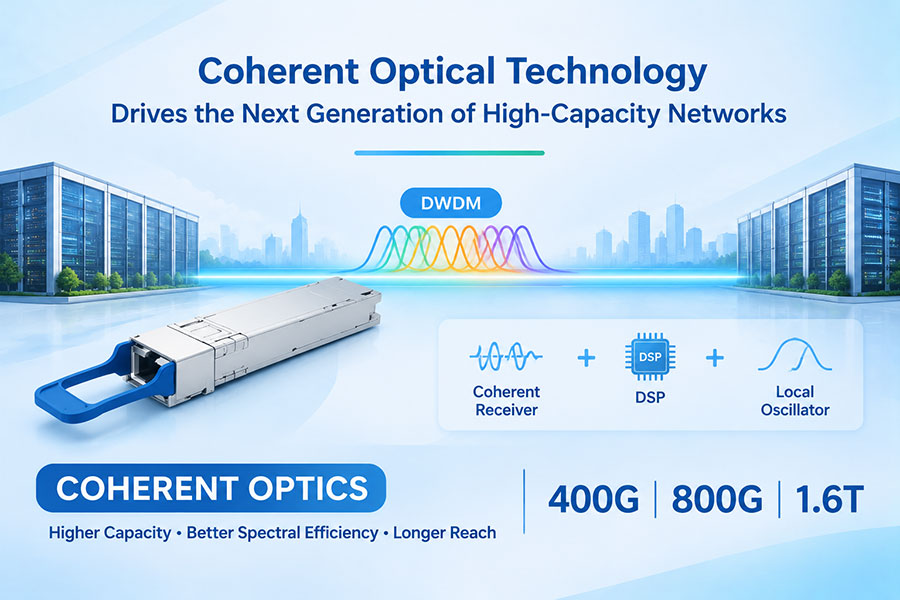
Coherent optical communication uses advanced modulation and digital signal processing to recover information from the amplitude, phase, and polarization properties of optical signals. It enables higher spectral efficiency and supports high-capacity transmission across long-distance fiber routes.
Optical amplification compensates for signal attenuation along long fiber spans. Erbium-Doped Fiber Amplifiers (EDFAs) are widely used in optical transmission systems, including repeatered submarine cable designs.
Forward Error Correction (FEC) improves transmission reliability by allowing receivers to detect and correct certain data errors. Modern coherent systems use advanced FEC techniques to support high-capacity optical transmission under demanding signal-to-noise conditions.
Space Division Multiplexing (SDM) increases the number of spatial transmission paths within a cable system. Depending on the design, this can involve additional fiber pairs or specialized multi-core fiber structures.
5. DWDM Increases Submarine Cable Capacity
DWDM is a fundamental technology for maximizing the capacity of submarine fiber infrastructure. Instead of transmitting all information through one optical wavelength, DWDM systems combine multiple wavelength channels into a single fiber using optical multiplexing equipment.
Each wavelength can carry a high-speed data channel. At the receiving end, demultiplexing equipment separates the channels so that they can be processed independently.
DWDM provides several advantages for submarine cable systems:
Higher fiber utilization: Multiple optical channels share the same fiber infrastructure.
Scalable capacity: Additional wavelengths can be activated when the system design and available optical resources permit.
Flexible transmission rates: Different generations of optical transmission technology can support different channel capacities.
Efficient long-distance transport: Wavelength multiplexing supports high-capacity international routes.
Capacity upgrades: Existing cable systems may gain additional usable capacity through terminal equipment upgrades, subject to the limitations of the wet plant.
DWDM capacity is influenced by the number of supported channels, channel spacing, modulation format, optical signal-to-noise ratio, fiber characteristics, and system engineering. A larger number of wavelengths does not automatically guarantee a proportional increase in usable transmission capacity.
6. Coherent Optics Transform Long-Distance Submarine Transmission
Coherent optical technology has become central to high-capacity long-distance transmission. Traditional direct-detection systems primarily recover information from optical intensity, while coherent receivers use local oscillators and digital signal processing to extract more information from the received optical field.
This enables advanced modulation formats and more efficient use of available optical spectrum.
Important characteristics of coherent transmission include:
Advanced modulation: Formats such as QPSK and higher-order QAM can increase the number of bits transmitted per symbol.
Digital signal processing: DSP compensates for important transmission impairments and supports signal recovery.
Polarization multiplexing: Two polarization states can carry independent information channels.
Flexible line rates: Modern systems can support different data rates and transmission configurations.
Improved spectral efficiency: More capacity can be carried within a given optical bandwidth when link conditions permit.
However, higher-order modulation formats generally require better signal quality and may reduce achievable reach under the same transmission conditions. Submarine system design therefore balances capacity, optical reach, spectral efficiency, and available signal margin.
Coherent technology also supports upgrades at submarine cable landing stations. Depending on the original system design and wet-plant limits, new terminal equipment may increase the capacity of an existing route without replacing the undersea cable itself.
7. Space Division Multiplexing and the Next Generation of Submarine Cables
As international bandwidth demand increases, improving the capacity of each individual optical channel is only part of the solution. Submarine cable designers are also looking for ways to increase the number of independent transmission paths within a cable system.
Space Division Multiplexing is one approach to this challenge. In many modern submarine system designs, SDM increases the number of fiber pairs within a cable and optimizes the relationship between fiber-pair count, repeater power, and total system capacity.
SDM can provide several benefits:
More independent spatial transmission paths.
Greater aggregate cable capacity.
Improved flexibility in allocating capacity across routes and customers.
New opportunities to optimize system design around power and fiber-pair resources.
Support for future capacity expansion as terminal technology advances.
SDM does not necessarily mean that every system uses multi-core fiber. Many commercial SDM submarine systems use multiple conventional single-mode fiber pairs. Multi-core fiber is a separate technology option with its own manufacturing, amplification, splicing, and deployment considerations.
8. What Is Driving Global Investment in Submarine Cable Infrastructure?
The growth of cloud computing, hyperscale data centers, international content delivery, and AI-related infrastructure is increasing demand for high-capacity intercontinental connectivity.
Large cloud and content providers increasingly require direct connections between data center regions. Their networks support distributed computing, data replication, content delivery, and large-scale application platforms.
Several factors are driving new submarine cable investment:
Cloud expansion: Cloud providers are connecting more regional data center facilities.
AI infrastructure: Distributed AI services and global data platforms increase the need for high-capacity backbone connectivity.
Video and content traffic: International streaming and content delivery generate sustained demand for network capacity.
International business: Multinational companies depend on reliable communication between offices, cloud regions, and service providers.
Regional connectivity: Emerging digital markets require additional international routes and landing locations.
Network resilience: Operators invest in alternative routes to reduce dependence on a limited number of cable systems.
The OECD Digital Economy and Society Outlook 2026 highlights the increasing role of cloud and content providers in submarine cable investment. It also reports that announced cable projects scheduled to enter service during 2025–2027 represent more than USD 13 billion in estimated construction costs.
This investment reflects a broader change in the global connectivity market. Traditional telecommunications operators remain important, while hyperscale technology companies and content providers are becoming increasingly influential in financing and developing international cable infrastructure.
9. Submarine Cable Networks Support Global Data Center Interconnection
Data center interconnection is one of the most important drivers of modern submarine cable demand. Cloud platforms and large digital service providers operate geographically distributed facilities that need to exchange data across regional and continental boundaries.
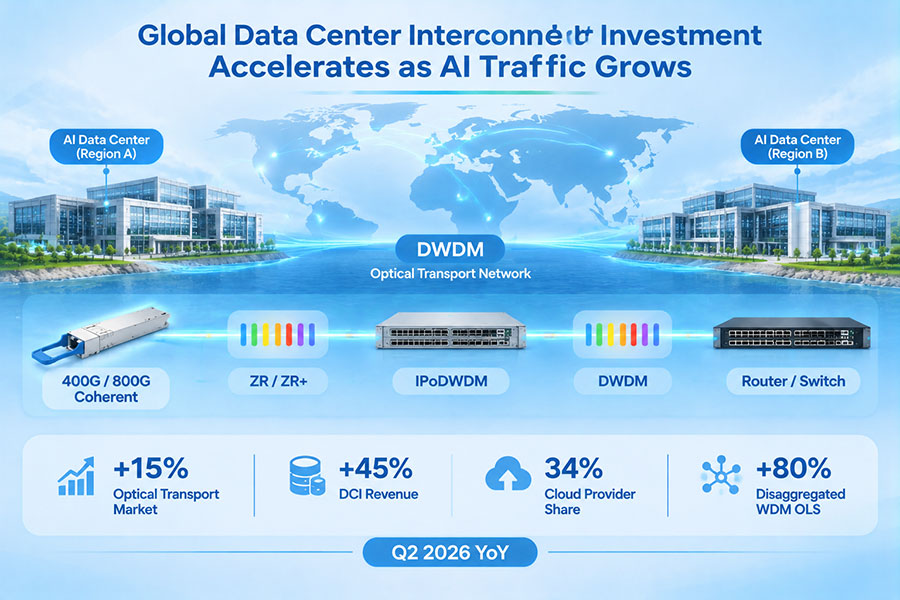
Submarine cables provide the international transport layer connecting these facilities. At each end of a submarine route, terrestrial fiber networks and optical transport equipment connect cable landing stations to data center campuses, carrier hotels, and internet exchange locations.
High-capacity submarine connectivity supports several DCI applications:
Cloud region interconnection: Connecting separate cloud regions for service delivery and data exchange.
Data replication: Transferring information between geographically distributed facilities.
Content distribution: Supporting international delivery of video, software, and digital services.
Disaster recovery: Providing connectivity between geographically separated backup and recovery facilities.
AI and high-performance computing: Connecting distributed data infrastructure and cloud platforms.
As data center traffic grows, submarine cable capacity must be coordinated with terrestrial backbone capacity. The performance of an international connection depends on the complete end-to-end route, not only the nominal capacity of the undersea cable.
10. Submarine Cable Routes and Global Network Diversity
Submarine cable networks connect continents through major oceanic routes, including transatlantic, transpacific, and intra-Asian corridors. Regional systems also connect islands, coastal communities, and neighboring countries.
Route diversity is essential because international connectivity can become concentrated around a limited number of landing stations, geographic corridors, or cable systems.
A resilient network design considers:
Geographic route diversity: Alternative cable paths should avoid unnecessary dependence on the same geographic corridor.
Landing station diversity: Multiple landing locations can reduce the impact of a localized incident.
Terrestrial backhaul diversity: Separate inland routes help prevent a single terrestrial failure from affecting multiple submarine systems.
Carrier diversity: Multiple network providers can offer alternative international connectivity paths.
Capacity planning: Backup routes need sufficient available capacity to carry rerouted traffic.
Operational coordination: Cable owners, landing station operators, and network providers need clear procedures for fault response.
Having multiple submarine cables does not automatically guarantee resilience. If several systems share the same landing station, terrestrial backhaul, or vulnerable geographic corridor, a single incident may still affect multiple routes.
11. Submarine Cable Faults and Network Resilience
Submarine fiber optic cables are engineered for long operating lifetimes, but they remain exposed to physical and environmental risks. Faults can occur along the seabed, near coastlines, or at cable landing facilities.
Common causes include:
Accidental damage from fishing activities and ship anchors.
Seabed movement, underwater landslides, and other geological events.
Earthquakes and extreme environmental conditions.
Equipment failures in undersea or shore-based components.
Damage associated with cable installation, maintenance, or external activities.
The OECD's 2026 report notes that submarine cable faults have remained broadly around 150–200 incidents per year despite the expansion of the global cable network. Accidental human activities, particularly fishing and anchoring, are among the most common causes.
When a cable fault occurs, the effect on users depends on the location of the damage, the available alternative routes, network capacity, and traffic engineering arrangements.
Network operators can improve resilience through:
Alternative submarine and terrestrial routes.
Automatic or controlled traffic rerouting.
Continuous optical performance monitoring.
Redundant landing facilities and network equipment.
Coordinated maintenance and repair procedures.
Regular testing of network recovery arrangements.
Submarine cable repair also requires specialized vessels, equipment, and operational coordination. Repair times depend on water depth, weather, the location of the fault, vessel availability, and the complexity of the cable system.
12. Submarine Cable Security and Infrastructure Protection
Submarine cables are critical infrastructure because international communication, financial systems, cloud services, and government networks depend on them. Protecting these systems requires cooperation among cable owners, network operators, governments, landing station operators, and maritime stakeholders.
Security considerations extend beyond the physical cable itself. Landing stations, terrestrial backhaul networks, power systems, management platforms, and operational technology can also affect overall service availability.
Important resilience measures include:
Improved mapping and monitoring of cable routes and landing facilities.
Physical protection and controlled access at critical sites.
Geographic diversity in cable routes and terrestrial connections.
Coordinated fault reporting and repair arrangements.
Secure management access to optical transport equipment.
Business continuity planning for international connectivity services.
Cooperation between public authorities and private infrastructure operators.
Because submarine cable networks cross international waters and connect multiple jurisdictions, effective protection requires cross-border coordination. No single operator can manage every risk affecting the global cable infrastructure.
13. Optical Transport Equipment at Submarine Cable Landing Stations
Submarine cable landing stations rely on specialized optical transmission systems to terminate and manage high-capacity undersea links. Submarine line terminal equipment is designed for the particular optical characteristics and engineering requirements of the cable system.
Alongside these specialized systems, terrestrial optical transport networks connect landing stations to data centers, carrier networks, and regional backbones. These networks may use DWDM equipment, coherent optical interfaces, optical amplifiers, and high-speed pluggable transceivers.
The main equipment categories include:
Submarine line terminal equipment: Terminates and manages the submarine cable transmission system.
Coherent optical transceivers: Provide high-capacity optical interfaces for compatible terrestrial transport and DCI equipment.
DWDM multiplexers and demultiplexers: Combine or separate wavelength channels.
Optical amplifiers: Compensate for signal loss in compatible terrestrial optical spans.
OTN equipment: Supports transport-layer functions, service mapping, and performance monitoring.
Terrestrial fiber infrastructure: Connects landing stations with domestic and regional network facilities.
It is important to distinguish pluggable coherent transceivers used in terrestrial optical networks from the specialized wet-plant components and submarine line terminal systems. A standard coherent module is not automatically a submarine terminal interface. Compatibility depends on the host equipment, line system, optical power requirements, modulation configuration, and system engineering.
14. C-LIGHT Coherent and DWDM Optical Connectivity Products
As submarine cable systems expand, the terrestrial networks connected to their landing stations also require higher-capacity optical transport. Coherent transceivers and DWDM optical modules can support these terrestrial backbone connections, regional transport networks, and data center interconnection links.
C-LIGHT provides coherent and wavelength-division optical transceiver products for compatible optical transport applications. These products are relevant to the terrestrial infrastructure surrounding submarine cable landing stations rather than the specialized undersea cable itself.
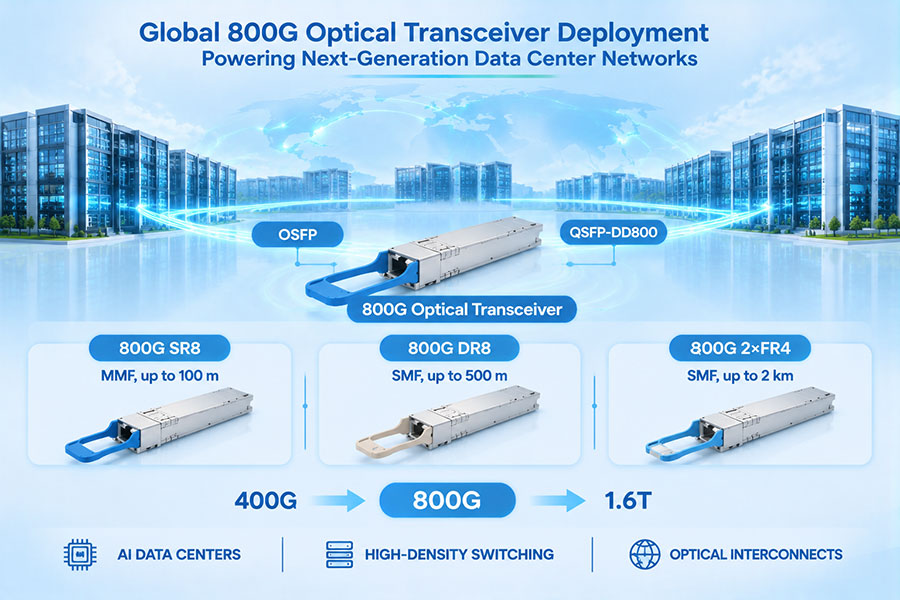
C-LIGHT's DWDM DCO portfolio covers 100G, 200G, 400G, and 800G coherent optical transceivers. Available form factors include QSFP28, CFP2, QSFP-DD, and OSFP, depending on the model.
The product family integrates coherent DSP technology, tunable C-band DWDM lasers, and optical components for high-capacity transport applications. Listed configurations include support for coherent standards and technologies such as 400ZR, OpenZR+, and 800ZR, with model-specific transmission distances ranging from 120km to 2,400km.
These products can be considered for compatible terrestrial backbone links, metro networks, regional optical transport, and data center interconnection associated with submarine cable landing facilities. The stated reach is configuration-dependent and should not be interpreted as a guaranteed distance on every fiber route.
Product details: C-LIGHT DWDM DCO 800G/400G/200G/100G Coherent Transceivers
C-LIGHT's DWDM optical transceiver family includes 100G, 40G, and 25G options for wavelength-division networks. Selected configurations support C-band tunable DWDM wavelengths with 50GHz or 100GHz channel spacing and model-specific transmission distances.
These modules can be used in compatible metropolitan networks, regional transport links, backbone connections, and other terrestrial optical infrastructure requiring multiple wavelength channels over fiber.
Product details: C-LIGHT DWDM 100G/40G/25G Optical Transceivers
C-LIGHT also provides CWDM optical transceiver options for network applications requiring wavelength-based fiber utilization. The product family covers 25G, 40G, and 100G configurations, with wavelength and reach options depending on the selected model.
CWDM technology can support suitable terrestrial access, metro, and enterprise transport links. Its channel spacing and wavelength plan differ from DWDM, so the two technologies should be selected according to the optical system design.
Product details: C-LIGHT CWDM 100G/40G/25G Optical Transceivers
When selecting optical modules for terrestrial networks connected to submarine landing stations, network operators should verify the host platform, optical interface, line rate, modulation format, channel plan, transmission distance, optical budget, and interoperability requirements.
15. The Future of Submarine Fiber Optic Networks
The next generation of submarine cable infrastructure will be shaped by the combined development of optical transmission technology, global data center investment, and network resilience requirements.
Several trends are expected to influence future deployments:
Higher-capacity coherent transmission: Advances in DSP, modulation, and optical components will continue to improve the capacity of submarine and terrestrial optical systems.
Greater use of SDM: More fiber pairs and optimized system designs will support higher aggregate cable capacity.
Cloud-provider investment: Hyperscale companies will continue to influence the development of international routes and data center connectivity.
AI-driven bandwidth demand: Distributed AI services and data center infrastructure will add pressure to global backbone networks.
Improved route diversity: Operators will place greater emphasis on alternative routes and landing locations.
Stronger infrastructure protection: Monitoring, maintenance coordination, and cross-border resilience planning will become increasingly important.
Terrestrial network upgrades: Landing stations will require scalable optical transport connections to keep pace with undersea capacity growth.
Future improvements will not depend on one technology alone. The overall performance of global connectivity will continue to rely on the coordination of submarine cables, terrestrial fiber routes, coherent optical transport, data center infrastructure, and network management systems.
16. Conclusion
Submarine fiber optic networks are a fundamental part of the global communication infrastructure. They connect continents, support international data exchange, and provide the high-capacity transport required by cloud computing, financial services, content delivery, and modern enterprise networks.
Technologies such as DWDM, coherent optical transmission, advanced FEC, and Space Division Multiplexing are helping increase the capacity of submarine cable systems. At the same time, route diversity, landing station infrastructure, and coordinated maintenance are essential to maintaining reliable international connectivity.
As submarine cable investment continues, the terrestrial networks connected to these systems will also need to evolve. High-speed coherent transceivers, DWDM optical modules, and scalable optical transport equipment will remain important components of the broader infrastructure connecting cable landing stations with data centers and regional backbones.
C-LIGHT provides DWDM DCO coherent transceivers, DWDM optical modules, and CWDM solutions for compatible terrestrial backbone networks, metro transport, and data center interconnection. Contact our team for product specifications, platform compatibility verification, and optical connectivity support.
 >

 >
 >
 >
 >
 >
 >
 >