TEL:+86 132 6656 7067


The rapid expansion of artificial intelligence infrastructure is changing the performance requirements of modern data center networks. GPU clusters now process massive datasets through distributed computing architectures, requiring continuous communication between accelerators, servers, network adapters, and switching systems.
While GPU processing capabilities continue to advance, network infrastructure must deliver sufficient bandwidth and predictable communication performance to keep these computing resources fully utilized. Network congestion, insufficient uplink capacity, signal integrity limitations, optical power consumption, and cable density can all restrict the efficiency of large-scale AI deployments.
High-speed optical interconnect technologies, including 400G, 800G, and 1.6T transceivers, together with DAC, AEC, and AOC solutions, provide different approaches to addressing these infrastructure challenges.
1. Why Network Bottlenecks Are Becoming More Significant in AI Data Centers
Traditional enterprise data center networks primarily handle application traffic, storage access, and communication between conventional servers. AI training clusters introduce a different traffic pattern. Thousands of GPUs may exchange large volumes of intermediate data during distributed training, requiring sustained bandwidth across multiple network layers.
The communication workload can become especially demanding during All-Reduce, All-Gather, and All-to-All operations. These collective communication patterns require data to move between multiple computing nodes, sometimes simultaneously across an entire GPU cluster.
When the network cannot provide sufficient throughput or balanced traffic distribution, GPUs may spend additional time waiting for data instead of performing computation.
2. Major Network Bottlenecks in AI Infrastructure
Insufficient Network Bandwidth
A GPU cluster may contain hundreds or thousands of accelerators, each capable of generating substantial communication traffic. If the aggregate capacity of the network links is insufficient, data transfer becomes a limiting factor during distributed workloads.
Bandwidth limitations can occur at several levels, including server NICs, leaf switches, spine switches, inter-switch uplinks, and external network connections. Upgrading individual ports without evaluating the complete network architecture may simply move the bottleneck to another layer.
Network Congestion and Traffic Imbalance
Network congestion occurs when incoming traffic exceeds the available forwarding capacity of a link or switching path. In AI clusters, synchronized communication patterns can generate short periods of concentrated traffic.
Even when the total network capacity appears sufficient, uneven traffic distribution can overload certain links while other paths remain underutilized. This can increase queueing delays and reduce effective application throughput.
Latency and Communication Overhead
Distributed AI workloads depend on communication between GPUs across multiple servers. Additional switching hops, queueing delays, retransmissions, and inefficient routing can increase communication time.
The cumulative impact becomes important when workloads repeatedly synchronize across many nodes. Improving physical link quality is valuable, but low end-to-end latency also depends on network topology, congestion control, switching behavior, and software configuration.
Electrical Signal Integrity and Reach Limitations
High-speed electrical signals become more difficult to transmit as data rates and cable lengths increase. Insertion loss, crosstalk, reflections, and other signal-integrity effects place constraints on copper interconnects.
As a result, passive copper cables are most suitable for supported short-reach applications. Active electrical cables and optical interconnects provide additional options when link distance, signal conditioning, or bandwidth requirements exceed the practical limits of a passive electrical connection.
Power Consumption and Thermal Density
High-speed network interfaces and optical modules contribute to the overall power consumption of AI infrastructure. Increasing port density also concentrates thermal loads around switches and GPU servers.
Thermal conditions can affect component operating margins, reliability, and system design. Optical module selection should therefore consider power consumption, cooling capability, airflow, heatsink design, and the thermal specifications of the host equipment.
3. Where Network Bottlenecks Occur in AI Data Center Architecture
AI infrastructure typically contains several communication layers. Each layer serves a different purpose and has its own bandwidth, reach, and topology requirements.
The scale-up network handles communication between accelerators within a tightly integrated computing system. The scale-out network connects independent GPU servers and racks through switching fabrics. Scale-across connectivity extends communication between geographically separated data center facilities.
Optical interconnects are particularly important in scale-out and scale-across networks, while optical I/O and co-packaged optics are also being developed to address future scale-up bandwidth and reach requirements.
4. Optical Interconnect Solutions for Different Bottlenecks
Optical connectivity provides high-bandwidth data transmission through fiber, reducing the distance-related electrical signal limitations associated with copper links. Different interconnect solutions are suitable for different physical connection scenarios.
400G Optical Transceivers
400G optical transceivers provide high-speed connections between compatible network switches and other data center equipment. SR8, DR4, FR4, LR4, and other optical configurations support different fiber types and transmission distances.
For existing 400G AI infrastructure, QSFP-DD and OSFP modules provide flexible options for switch-to-switch and other high-speed network connections.
The C-LIGHT 400G QSFP-DD Optical Transceiver Series supports multiple configurations, including SR8, DR4, FR4, LR4, ER4, and coherent variants for different applications.
800G Optical Transceivers
As AI clusters expand, 800G optical interfaces provide higher bandwidth per physical port. They help increase switching capacity and support high-density network architectures.
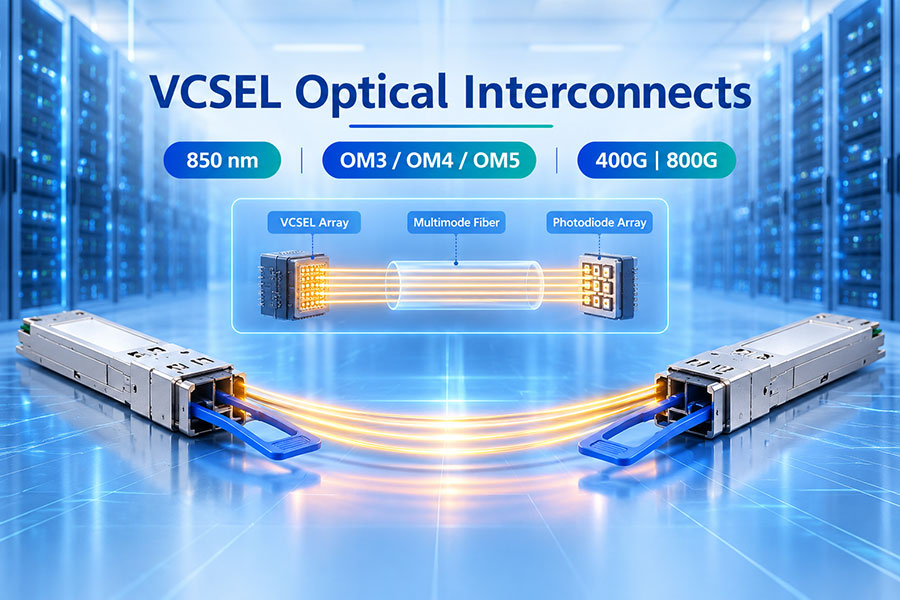
Common implementations include SR8 for short-reach multimode connections, DR8 for single-mode links, and 2xFR4 for compatible 2km applications.
The C-LIGHT 800G OSFP Optical Transceiver Series supports Ethernet and InfiniBand NDR-related applications, with configurations covering different transmission distances.
1.6T Optical Interconnects
The move toward 1.6T interfaces reflects the increasing bandwidth density required by next-generation AI switches and computing systems. Higher-speed optical modules can support greater aggregate throughput while reducing the number of physical ports required for a given bandwidth target.
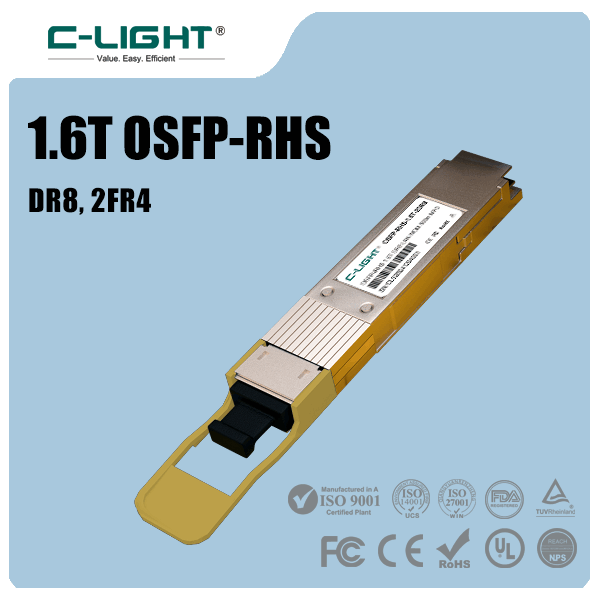
The C-LIGHT 1.6T OSFP-RHS Optical Transceiver is designed for high-density AI data center applications. Its reduced-height heatsink structure supports thermal integration with compatible cooling architectures.
DAC, AEC and AOC Interconnects
Not every network connection requires a separate optical transceiver and fiber patch cable. DAC, AEC, and AOC solutions provide integrated connectivity for different short-reach applications.
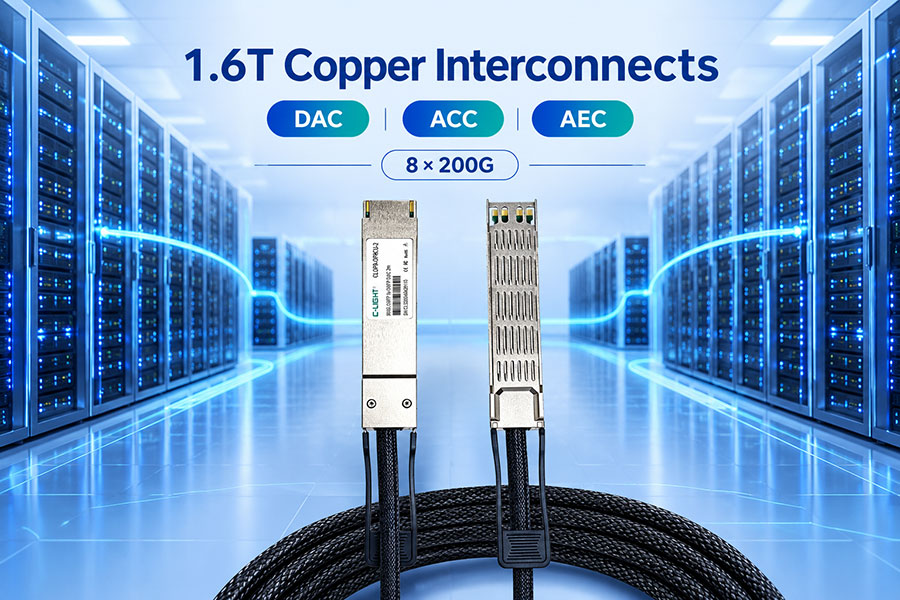
DAC: Passive copper connectivity for compatible short-distance server and switch connections.
AEC: Active electrical cables using signal-conditioning or retiming technology, depending on the design.
AOC: Integrated optical cable assemblies for flexible short-to-medium reach connections.
The C-LIGHT 800G DAC Cable supports short-distance data center cabling applications, while the 800G OSFP optical portfolio provides optical alternatives for compatible network links.
5. Matching Interconnect Technology to Network Requirements
The best interconnect solution depends on physical distance, port speed, switch architecture, host interface, and thermal conditions. Choosing a product based only on its advertised bandwidth can result in compatibility or deployment problems.
| Interconnect | Transmission Medium | Typical Deployment | Key Consideration |
|---|---|---|---|
| Passive DAC | Copper | Short in-rack connections | Electrical reach and cable loss |
| AEC | Active copper | Supported short-to-medium reach connections | Retimer design and power consumption |
| AOC | Integrated optical fiber | Flexible rack and nearby equipment connections | Fixed cable assembly and optical compatibility |
| SR Optical Module | Multimode fiber | Short-reach optical connections | Fiber grade and reach |
| DR / FR Optical Module | Single-mode fiber | Rack-to-rack and longer data center links | Optical budget and transmission distance |
| LR Optical Module | Single-mode fiber | Extended data center connections | Link budget and system compatibility |
6. Ethernet, RoCEv2 and InfiniBand Network Optimization
Optical transmission alone does not eliminate network congestion. The network protocol, switching architecture, routing strategy, and traffic management mechanisms are equally important in large-scale AI infrastructure.
Ethernet with RoCEv2
RoCEv2 enables Remote Direct Memory Access over Ethernet and is used in distributed AI and high-performance computing networks.
Its performance depends on more than link speed. Network engineers must consider congestion management, queue configuration, ECN marking, traffic prioritization, and suitable loss-handling mechanisms.
InfiniBand
InfiniBand is designed for high-performance computing and provides a dedicated fabric for low-latency communication between computing nodes.
Compatible high-speed optical modules and cable assemblies are used to connect InfiniBand adapters and switches. Product selection must match the relevant InfiniBand generation, signaling rate, form factor, and supported optical interface.
| Network Technology | Primary Characteristics | Optical Connectivity Requirements |
|---|---|---|
| Ethernet | Flexible network architecture and broad ecosystem | Ethernet-compatible transceivers and cables |
| RoCEv2 | RDMA over Ethernet with congestion-management requirements | Compatible Ethernet physical interfaces |
| InfiniBand | High-performance computing fabric | Generation-specific InfiniBand-compatible modules and cables |
7. The Role of CPO and Next-Generation Optical Architectures
Traditional pluggable optical transceivers provide flexibility and field replaceability. However, as switch capacity and port density increase, the electrical connections between switching ASICs and optical modules become more challenging in terms of signal integrity, power consumption, and thermal management.
Co-Packaged Optics (CPO) integrates optical engines closer to switching ASICs, reducing the length of high-speed electrical connections inside the system.
This architecture is being developed to address the increasing bandwidth density of next-generation AI switches. It may improve system-level power efficiency and signal-integrity margins, although manufacturing complexity, optical coupling, serviceability, and thermal design remain important engineering considerations.
CPO does not immediately replace all pluggable optical modules. Pluggable 400G and 800G transceivers remain important for current network deployments, while CPO and other optical I/O approaches represent additional architectural options for future infrastructure.
8. C-LIGHT Optical Connectivity Products for AI Data Centers
C-LIGHT provides high-speed optical transceivers and direct-attach connectivity products for data centers, AI computing clusters, Ethernet networks, and high-performance computing environments.
400G Optical Connectivity
400G QSFP-DD Optical Transceiver
Multiple SR8, DR4, FR4, LR4 and extended-reach configurations for compatible high-speed network links.
400G QSFP-DD ER4
40km single-mode optical connectivity for compatible extended-reach 400G applications.
800G Optical Connectivity
800G OSFP SR8
850nm multimode optical connectivity with a 100m reach for compatible short-reach network applications.
800G OSFP 2xFR4
Single-mode optical connectivity supporting 2km transmission for compatible 800G applications.
1.6T Optical Connectivity
1.6T OSFP-RHS 2DR4
Reduced-height heatsink design with 2x800G LAN-WDM connectivity and a 500m reach.
1.6T OSFP-RHS 2FR4
2x800G single-mode optical connectivity with a 2km reach for compatible high-bandwidth network deployments.
High-Speed Copper Connectivity
800G OSFP / QSFP-DD DAC
Short-distance copper connections for compatible GPU servers and network switches, with available cable configurations depending on the product model.
The product pages provide available specifications and model-specific datasheet download options. Actual compatibility should be verified against the target switch, server NIC or HCA, network protocol, port configuration, and operating environment.
9. Practical Considerations for Reducing AI Network Bottlenecks
Improving network performance requires coordinated planning across the entire infrastructure rather than upgrading individual optical modules in isolation.
Evaluate aggregate bandwidth: Calculate server-facing and switch-uplink capacity based on the number of GPU nodes and expected traffic patterns.
Optimize network topology: Review leaf-spine architecture, oversubscription ratios, routing paths, and the number of switching hops.
Balance traffic distribution: Use appropriate multipath routing and congestion-management mechanisms to avoid overloading individual links.
Select suitable interconnects: Match DAC, AEC, AOC, and optical transceivers to actual cable distances and host interfaces.
Monitor optical performance: Use DOM/DDM diagnostics where supported to monitor transmit power, receive power, module temperature, and voltage.
Plan thermal capacity: Consider switch airflow, module power consumption, cooling design, and high-density cable arrangements.
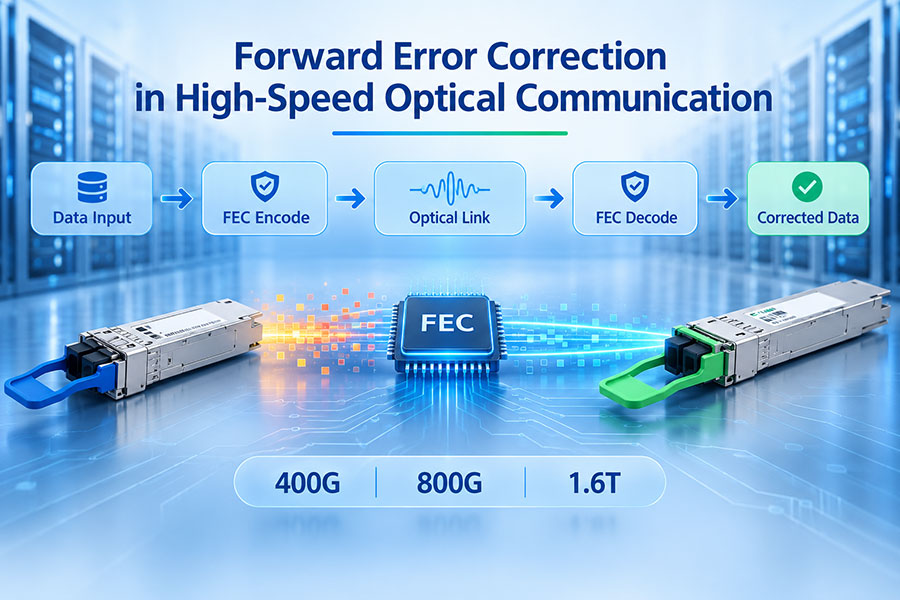
Verify interoperability: Test module recognition, FEC settings, firmware compatibility, link stability, and actual traffic performance.
10. Conclusion
AI data center network bottlenecks are increasingly associated with the growing communication demands of distributed GPU computing. Insufficient bandwidth, traffic congestion, latency, electrical signal limitations, and thermal constraints can all affect the efficiency of large-scale AI infrastructure.
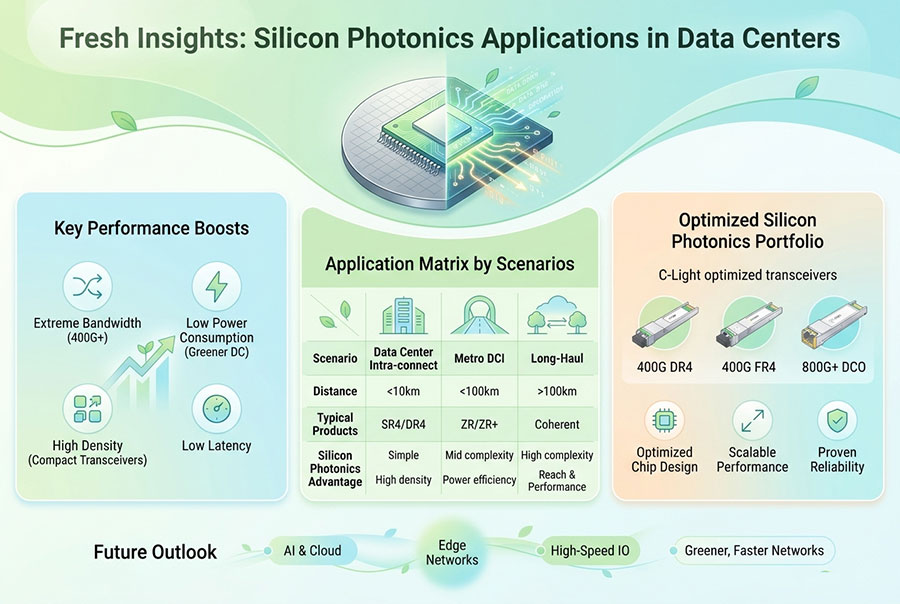
Optical interconnect technologies provide a scalable approach to increasing network bandwidth and extending transmission distances. DAC and AEC solutions remain useful for compatible short-reach electrical connections, while AOC and pluggable optical transceivers support flexible optical deployment. The evolution of 400G, 800G, 1.6T, silicon photonics, and CPO will continue to influence future AI network architectures.
For network designers and data center operators, the key is to match interconnect technology with the actual workload, network topology, transmission distance, and system requirements. A balanced optical and electrical architecture is essential for building reliable, scalable, and high-performance AI data center networks.
Explore C-LIGHT high-speed optical transceivers, DAC, AOC, and AEC connectivity solutions for 400G, 800G, and 1.6T networking.
Contact C-LIGHT >

 >
 >
 >
 >
 >
 >
 >