TEL:+86 132 6656 7067


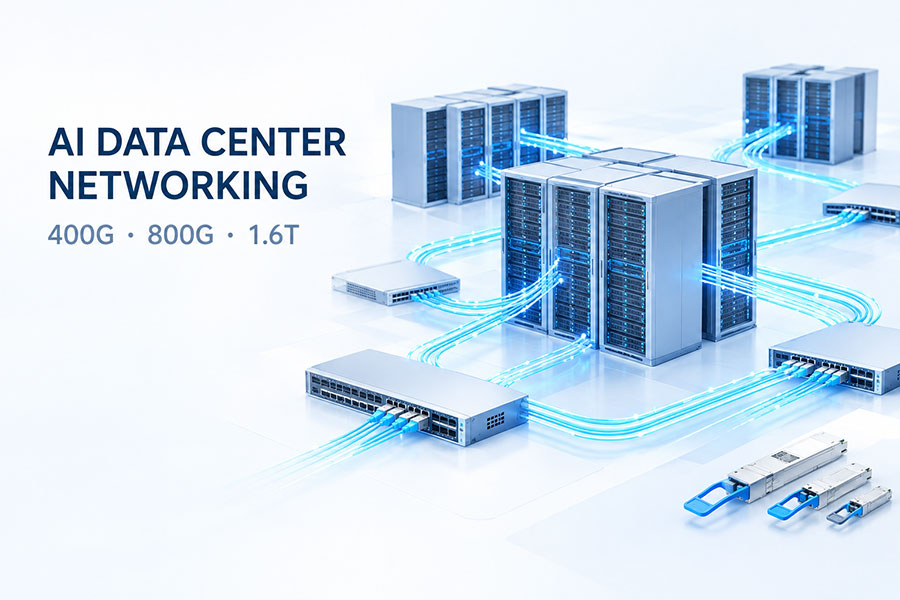
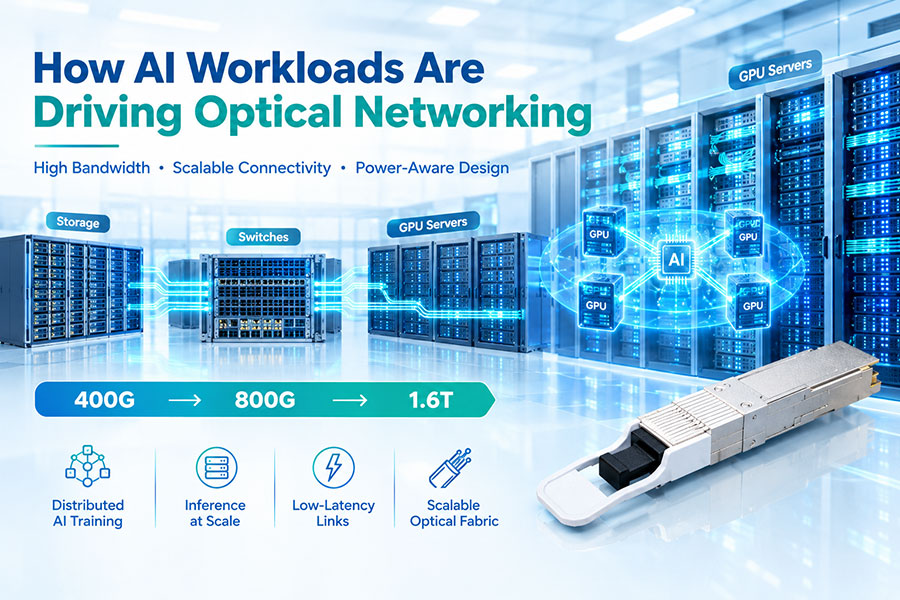
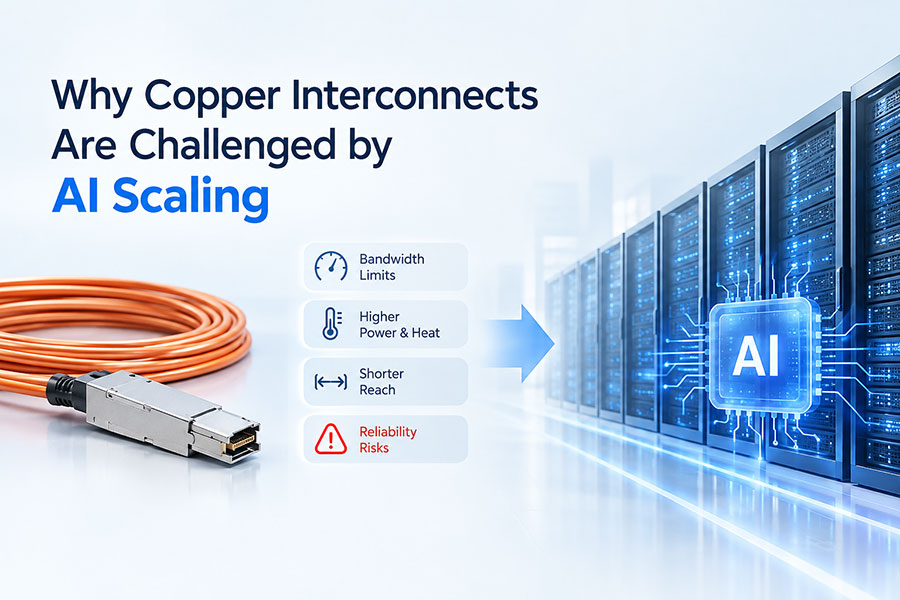
Artificial intelligence (AI) is transforming data center networking. Large GPU clusters, distributed training, and increasingly demanding inference workloads require enormous amounts of data to move between processors, servers, and network switches. As aggregate bandwidth rises from 400G and 800G toward 1.6T and beyond, traditional electrical interconnects face increasing challenges involving signal integrity, power consumption, and bandwidth density.
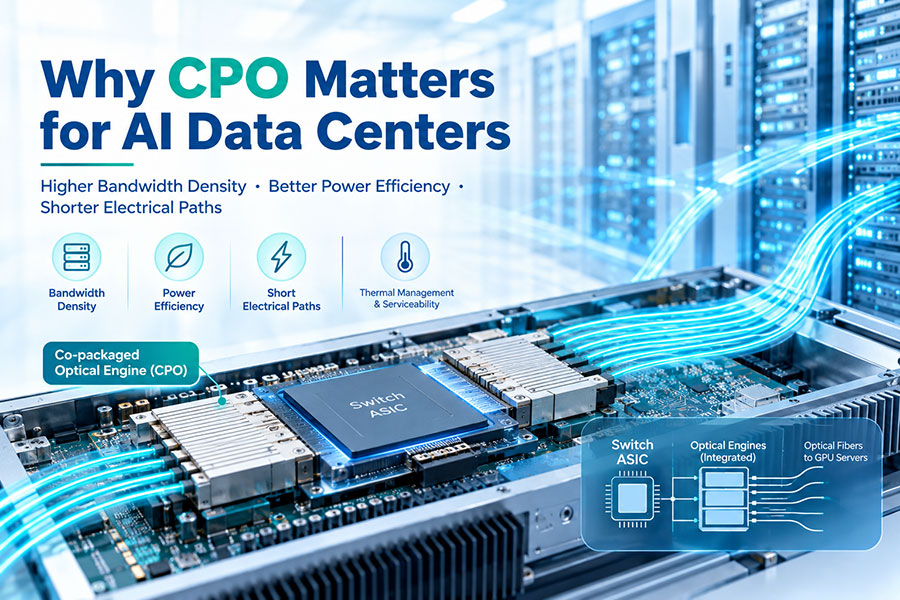
Co-Packaged Optics (CPO) is an optical integration architecture designed to address these challenges. Instead of placing all optical functionality in a conventional pluggable transceiver at the front panel, CPO integrates optical engines close to a switch or computing ASIC within a shared package or tightly integrated assembly. This shortens the high-speed electrical path between the ASIC and the optical interface.
For AI data centers, CPO offers the potential to improve interconnect power efficiency, increase bandwidth density, and support the scaling of high-capacity network fabrics. However, it also introduces challenges involving thermal management, packaging, fiber attachment, manufacturing, and serviceability. Understanding these trade-offs is essential when evaluating CPO for next-generation AI infrastructure.
1. Why AI Data Centers Need CPO
AI workloads require high-bandwidth communication between GPUs, servers, and network switches. During distributed training, GPUs exchange model parameters, gradients, and intermediate results. Large inference systems may also distribute requests and computation across multiple servers, generating substantial traffic within the data center.
As more computing nodes are added, networking capacity must increase without creating disproportionate power and cooling demands. Conventional pluggable optical modules remain effective for many applications, but the electrical connections between a switch ASIC and its front-panel optical modules become more challenging as signaling rates increase.
CPO addresses this issue by placing optical engines much closer to the ASIC. Shorter electrical connections can reduce channel losses and the signal-conditioning effort needed to compensate for those losses, helping improve system-level energy efficiency as bandwidth density increases.
The main motivations for evaluating CPO include:
Increasing aggregate bandwidth per switch and network interface.
Reducing power associated with high-speed electrical interconnects.
Improving bandwidth density around high-capacity ASICs.
Supporting larger AI network fabrics with demanding interconnect requirements.
Creating new options for optical connectivity as electrical signaling continues to scale.
2. What Is Co-Packaged Optics?
Co-Packaged Optics is an architecture in which optical engines are integrated closely with a host ASIC, such as a high-bandwidth Ethernet switch chip. The optical engines contain the components needed to convert electrical signals into optical signals and received optical signals back into electrical signals.
In a conventional pluggable architecture, high-speed electrical signals travel from the switch ASIC through the package, circuit board, and electrical interface to a front-panel optical transceiver. In CPO, optical engines are positioned much closer to the ASIC, reducing the length of the electrical channel before optical conversion.
The optical engines connect to fiber through a suitable fiber-attachment and routing system. Depending on the implementation, the laser source may be integrated into the optical engine or supplied externally. External continuous-wave laser sources are one approach to managing heat and maintaining serviceability.
CPO is an integration architecture rather than a single optical standard. Its implementation depends on the host ASIC, photonic technology, packaging method, optical engine design, fiber interface, and system-level requirements.
3. How CPO Works in an AI Data Center
A CPO-enabled switch combines conventional electronic switching functions with optical engines positioned alongside the switch ASIC. Incoming electrical data is processed by the ASIC, passed through short high-speed electrical connections, and converted into optical signals by the optical engines.
The optical signals travel through fiber to another network device or optical endpoint. At the receiving side, a compatible optical engine converts the incoming light into electrical signals for processing by the destination system.
A simplified CPO link consists of:
A switch ASIC that processes and forwards network traffic.
Short electrical connections between the ASIC and optical engines.
Optical engines that perform electrical-to-optical and optical-to-electrical conversion.
Laser sources and associated photonic components, integrated or externally connected according to the design.
Fiber attachment, connectors, and optical cabling connecting the switch to the network.
This architecture reduces the distance that high-speed electrical signals must travel before optical conversion. It does not eliminate electrical connections inside the system, nor does it remove the need for fiber management, optical testing, and compatible network endpoints.
4. CPO vs Conventional Pluggable Optical Transceivers
The fundamental difference between CPO and conventional pluggable optics is the location of the optical conversion interface. Pluggable modules are installed in replaceable ports near the device front panel, while CPO positions optical engines close to the host ASIC.
Pluggable optics offer modularity and convenient field replacement. CPO seeks to improve electrical path efficiency and bandwidth density by integrating optics more closely with the switching silicon.
| Characteristic | Pluggable Optical Transceivers | Co-Packaged Optics |
|---|---|---|
| Optical Engine Location | Inside a replaceable module at the host port | Close to the host ASIC in a shared package or tightly integrated assembly |
| Electrical Path | Extends from the ASIC toward the front-panel module | Shortened between the ASIC and optical engine |
| Power Considerations | Includes module electronics and electrical-channel compensation where required | Can reduce electrical interconnect power, depending on implementation |
| Bandwidth Density | Limited by port layout, module dimensions, and host design | Can support denser optical integration around the ASIC |
| Serviceability | Individual modules can generally be replaced at the port | Optical-engine service and replacement can be more complex |
| System Integration | Relatively modular | Requires closer coordination among ASIC, optics, package, fiber, and thermal design |
CPO is not automatically the best option for every switch. Pluggable optics remain useful when flexible deployment, field replacement, platform variety, and established operational procedures are priorities. CPO becomes particularly attractive when electrical I/O power and bandwidth density become major constraints.
5. How CPO Reduces Electrical Interconnect Power
Electrical signals traveling between a high-speed switch ASIC and a conventional optical module must pass through package connections, circuit-board traces, connectors, and other parts of the electrical channel. As signaling rates increase, these channels can introduce greater attenuation, reflections, and other forms of signal degradation.
To maintain signal integrity, conventional systems may use digital signal processing (DSP), equalization, and other signal-conditioning techniques. These functions can consume significant power, depending on the module design and data rate.
CPO places optical engines closer to the ASIC, shortening the electrical path and potentially reducing the compensation required for channel losses. The potential benefits include:
Lower electrical interconnect power in suitable architectures.
Reduced electrical channel loss between the ASIC and optical engine.
Higher bandwidth density around the host package.
Opportunities to improve system-level energy efficiency as data rates increase.
The actual savings depend on the ASIC, SerDes architecture, optical engine, laser source, cooling system, and link implementation. CPO still consumes power for electronic processing, optical conversion, and laser operation, so performance should be evaluated at the complete system level rather than from the optical engine alone.
6. CPO and Bandwidth Density for AI Switches
Bandwidth density describes the amount of network capacity that can be supported within a given physical area or package. As AI switch capacity increases, the number of high-speed electrical and optical interfaces required around the ASIC also grows.
Traditional pluggable designs must accommodate the electrical path to the front panel, module cages, connectors, and the space needed for airflow. At very high aggregate bandwidths, these requirements become more difficult to accommodate within a fixed chassis footprint.
CPO places optical engines closer to the switching silicon and can reduce dependence on long electrical connections to front-panel modules. This can make it easier to scale the optical interface capacity around high-radix, high-bandwidth switch ASICs.
Higher bandwidth density is especially relevant to AI clusters that use large numbers of switch ports to connect computing nodes. However, system density must also account for fiber routing, laser distribution, heat removal, manufacturing tolerances, and repair access.
7. Why CPO Matters for 800G and 1.6T Networking
As optical networking advances from 400G to 800G and 1.6T, higher aggregate data rates place increasing pressure on the electrical interfaces connecting switch silicon with optical modules.
Achieving greater capacity can involve increasing lane rates, adding parallel lanes, or combining both approaches. Higher lane rates make electrical signal integrity more demanding, while adding more lanes increases the number of connections and the physical space required to accommodate them.
CPO offers a way to address these challenges by moving the optical conversion point close to the host ASIC. This approach can reduce electrical channel losses and create opportunities for greater optical I/O density.
| Network Generation | Aggregate Data Rate | CPO-Relevant Design Challenge |
|---|---|---|
| 400G | 400Gbps | Balancing electrical reach, module power, and port density |
| 800G | 800Gbps | Managing higher lane rates and increasing I/O density |
| 1.6T | 1.6Tbps | Controlling electrical channel losses, power, and package integration |
These figures represent aggregate interface rates, not guaranteed application throughput. CPO does not automatically increase the nominal rate of an ASIC; instead, it changes how the ASIC connects to optical channels. The resulting capacity depends on the complete system and its supported architecture.
8. CPO in AI Scale-Out Networks
Scale-out networking connects multiple GPU servers through high-performance Ethernet or InfiniBand fabrics. These networks allow distributed training and inference workloads to communicate across servers and racks.
In a scale-out design, switches connect many computing nodes through high-speed ports. As the number of ports and aggregate bandwidth increase, electrical I/O power and front-panel density become important factors in switch design.
CPO-enabled switches can integrate optical engines close to the switching ASIC and connect them to fiber-based links across the fabric. This architecture is particularly relevant when electrical channels to conventional pluggable optics become a significant system-level constraint.
The optical architecture remains only one component of the network. Switch capacity, routing, congestion control, oversubscription, and protocol configuration still determine how effectively the fabric supports the workload.
9. CPO and AI Scale-Up Connectivity
Scale-up networks connect GPUs and accelerators within a tightly integrated computing domain. These connections often require high bandwidth and low communication overhead because processors exchange data frequently during distributed computation.
Many scale-up systems use dedicated high-speed interconnects. As physical reach and bandwidth density become more challenging, optical compute interconnects are being explored as another way to connect processing devices or network components.
CPO is relevant to this development because it can place optical engines close to host electronics, reducing the need to carry very high-speed signals over longer electrical paths. Depending on the architecture, optical engines may support chip-to-chip or system-level optical communication.
However, conventional switch CPO and direct GPU-to-GPU optical interconnects are not identical applications. Each requires its own optical architecture, protocols, packaging, and system integration. CPO should therefore be evaluated according to the particular scale-up or scale-out design rather than assumed to be a universal replacement for existing GPU interconnects.
10. CPO vs LPO: Different Approaches to Optical Integration
Linear Pluggable Optics (LPO) and CPO both target power and signal-integrity challenges in high-speed interconnects, but they use different integration approaches.
LPO retains a pluggable module form factor while simplifying the signal-processing path in supported designs, often by removing the conventional DSP from the optical module. This can reduce module power, but it places greater demands on the host electrical interface and coordination between the host and module.
CPO integrates optical engines close to the ASIC, shortening the electrical channel between the two. Unlike LPO, CPO changes the physical integration architecture rather than simply modifying the electronics inside a pluggable module.
| Characteristic | LPO | CPO |
|---|---|---|
| Physical Format | Pluggable optical module | Optical engines integrated close to the host ASIC |
| DSP Architecture | Typically removes the module DSP in supported implementations | Reduces the need for long electrical channels to the optical engine; the exact signal-processing architecture varies |
| Electrical Path | Retains an electrical path to the pluggable module | Shortens the electrical path between ASIC and optical engine |
| Serviceability | Retains the ability to replace compatible pluggable modules | Can require more complex system-level repair or replacement |
| Integration Complexity | Requires careful host-module signal coordination | Requires advanced packaging, fiber attachment, and thermal integration |
LPO can be attractive when a deployment requires a pluggable architecture with lower module power. CPO is intended for designs where integrating optics closer to the ASIC offers system-level advantages that justify the additional packaging and maintenance complexity.
11. CPO vs NPO: Optical Engine Placement
Near-Packaged Optics (NPO) positions optical engines close to the host ASIC but does not necessarily integrate them into the same package. CPO takes integration further by incorporating optical engines into a common package or closely integrated assembly with the ASIC.
The boundary between NPO and CPO can vary according to vendor terminology and physical packaging design. Both approaches seek to shorten high-speed electrical paths, but their implementations can differ in packaging, fiber attachment, thermal management, and serviceability.
| Characteristic | NPO | CPO |
|---|---|---|
| Optical Engine Location | Near the host ASIC | Co-packaged or tightly integrated with the host ASIC |
| Electrical Path | Shorter than conventional front-panel connections in suitable designs | Designed to minimize the electrical connection between ASIC and optics |
| Packaging | Near-package integration | Higher degree of package-level integration |
| Maintenance | Depends on assembly design and accessibility | May require more complex optical-engine or package-level servicing |
| Main Consideration | Balancing integration and modularity | Maximizing integration while managing thermal and reliability constraints |
Neither technology is universally preferable. NPO may provide an intermediate integration approach, while CPO targets systems where closer optical integration can provide sufficient benefits to justify its engineering and operational requirements.
12. The Role of Silicon Photonics in CPO
Silicon photonics integrates optical functions onto photonic integrated circuits using silicon-based manufacturing platforms and compatible materials. These circuits can support functions such as optical modulation, light routing, multiplexing, and photodetection.
Silicon photonics is an important technology for many CPO implementations because it can support compact optical engines designed for high-bandwidth integration around switch ASICs.
However, silicon photonics and CPO are not the same thing. Silicon photonics describes a photonic integration technology, while CPO describes the physical integration of optical engines close to the host ASIC. CPO implementations can use different optical components and materials according to system requirements.
Laser sources, electrical drivers, receivers, packaging, fiber attachment, and thermal design all contribute to the performance of the completed CPO system. The overall power and reliability benefits therefore depend on the complete implementation rather than the photonic chip alone.
13. External Laser Sources and CPO Design
Light generation is an important part of CPO system design. Depending on the architecture, the laser may be integrated into the optical engine or supplied by an external laser source that delivers continuous-wave light to the photonic engine.
External laser sources can help separate the light-generation component from the area close to a high-power ASIC. This can create additional options for laser thermal management, redundancy, replacement, and maintenance.
In an externally illuminated CPO architecture, the optical path includes the laser source, delivery fibers, optical engine, and the fiber connection to the remote endpoint. The design must account for coupling efficiency, optical power, connector losses, source reliability, and the number of channels supported.
Integrated laser approaches and external laser architectures each have advantages and constraints. The appropriate solution depends on package design, power budget, thermal conditions, optical loss, required redundancy, and maintenance strategy.
14. Thermal Management Is a Major CPO Challenge
CPO places optical engines close to high-performance ASICs that may generate substantial heat. The optical components must operate within their specified temperature range while the system removes heat from densely integrated electronic and photonic components.
Thermal design is complicated by the different operating requirements of the ASIC, optical engines, laser sources, and package materials. A cooling solution that works for the electronic chip may not provide the ideal operating conditions for every optical component.
Important thermal design considerations include:
Heat generated by the switch ASIC and nearby electronic components.
Temperature sensitivity of optical devices and photonic components.
Airflow or liquid-cooling requirements of the completed assembly.
Thermal effects on optical alignment, reliability, and operating stability.
Service access to components that may require inspection or replacement.
External laser sources can reduce the need to place every light-generation component in the hottest region of the package. However, they introduce additional optical connections and source-distribution requirements.
Effective thermal management must therefore be designed at the system level rather than handled as an isolated component issue.
15. CPO Reliability, Manufacturing, and Serviceability
CPO integrates multiple technologies into a more tightly coupled assembly, including electronic ASICs, optical engines, photonic circuits, fiber connections, and advanced packaging. This makes manufacturing yield, alignment precision, testing, and long-term reliability especially important.
Conventional pluggable transceivers offer a clear operational advantage: a technician can usually replace a compatible module without replacing the entire switch. In CPO systems, access to an optical engine or fiber connection may depend on the specific package and chassis architecture.
Reliability planning should consider:
Manufacturing yield and optical coupling quality.
Long-term stability of electrical, photonic, and fiber interfaces.
Thermal cycling and environmental operating conditions.
Module or engine replacement procedures.
Field diagnostics and system-level failure isolation.
Availability of qualified components and repair processes.
CPO can simplify some aspects of the network interface, but tighter integration also means that the package, optical connection, and service model must be engineered as a coherent system.
16. Fiber Attachment and Optical Connectivity in CPO
CPO moves optical connectivity closer to the ASIC, but the system still requires a reliable optical path between the integrated engines and the external fiber network.
Fiber attachment may use dedicated optical connectors, fiber arrays, or other precision coupling arrangements according to the design. These interfaces must maintain optical alignment while accommodating installation, environmental changes, vibration, and maintenance requirements.
Dense optical connections create additional routing and management considerations. Engineers must account for bend radius, connector cleanliness, mechanical strain relief, fiber access, and the optical loss budget of the complete path.
The external fiber system must also match the optical engine's channel configuration, wavelength, and supported link architecture. Optical integration does not remove the need for conventional fiber-engineering practices or interoperability testing.
17. CPO and Network Reliability for AI Clusters
AI clusters depend on large numbers of high-speed network links. A link failure or unstable connection can reduce available network capacity or interrupt communication between computing nodes.
CPO can reduce certain failure points associated with conventional electrical and optical interfaces, depending on the design. Shorter electrical paths and more integrated assemblies may also support improved link performance under appropriate operating conditions.
However, tighter integration does not guarantee higher reliability in every scenario. System reliability depends on component quality, packaging, laser-source architecture, thermal management, fiber attachment, manufacturing yield, and failure-recovery procedures.
For large AI networks, reliability engineering should include component qualification, system-level testing, diagnostic coverage, redundancy, and practical maintenance procedures. These factors are particularly important when the optical engines are not field-replaceable in the same way as conventional pluggable modules.
18. CPO Adoption and the Transition from Pluggable Optics
CPO is moving from research and development into early commercial deployment for selected high-capacity networking systems. Its adoption is driven by the power, density, and electrical reach challenges associated with very high-bandwidth switch architectures.
However, the transition will not happen uniformly across every data center or optical application. Pluggable transceivers offer flexibility and a mature service model, while CPO requires system-level integration, advanced packaging, qualified optical engines, and updated maintenance practices.
Adoption depends on several factors:
Availability of qualified CPO switch platforms.
Manufacturing yield and the capacity of advanced packaging facilities.
Optical-engine performance and long-term reliability.
System power and thermal requirements.
Interoperability, component supply, and operational support.
Economic benefits compared with available pluggable alternatives.
The transition is therefore expected to follow application requirements and platform readiness. CPO is particularly relevant where the benefits of closer optical integration outweigh the loss of some conventional module-level service flexibility.
19. How to Evaluate CPO for an AI Data Center
CPO should be evaluated against the requirements of the target network rather than treated as a universal replacement for pluggable optics. The decision depends on switching capacity, electrical I/O constraints, optical reach, power budget, system cooling, serviceability, and deployment scale.
| Evaluation Factor | What to Confirm |
|---|---|
| Network Architecture | Scale-out switching, scale-up connectivity, and intended topology |
| Bandwidth Requirements | Aggregate switch capacity, optical channel count, and target lane rates |
| Electrical I/O | Electrical path losses and power requirements of the current architecture |
| Optical Architecture | Integrated or external laser sources, optical engine design, and fiber routing |
| Power and Cooling | ASIC, optical engine, laser source, and chassis thermal requirements |
| Reliability | Component qualification, link stability, testing, and failure isolation |
| Serviceability | Replacement procedures, accessibility, redundancy, and repair strategy |
| Manufacturing and Supply | Packaging capacity, optical-engine availability, and production maturity |
| Total Cost | Complete system cost, power, cooling, maintenance, and operating requirements |
A useful evaluation compares a complete CPO-based switch or system with a comparable pluggable-optics design. Power consumption, bandwidth density, cooling, serviceability, and operating cost should be assessed under equivalent network requirements.
20. The Future of CPO in AI Data Centers
As AI infrastructure expands, network designers must move increasing amounts of data while managing the power, thermal, and physical constraints of high-capacity systems. CPO offers one approach to these challenges by integrating optical engines close to switching or computing silicon.
Its potential advantages include shorter electrical paths, improved bandwidth density, and lower electrical interconnect power in suitable designs. These characteristics make CPO particularly relevant to high-capacity AI switch systems and emerging optical compute interconnects.
Nevertheless, the future of CPO depends on progress in advanced packaging, fiber attachment, optical-engine reliability, thermal design, manufacturing scale, and maintenance practices. Pluggable optics, LPO, and NPO will continue to serve applications where their particular balance of integration, flexibility, and serviceability is appropriate.
The longer-term direction is likely to include multiple optical architectures selected according to the requirements of each platform. For AI data centers, the most suitable design will be the one that achieves the required bandwidth and efficiency while maintaining reliable operation, manageable maintenance, and acceptable total system cost.
21.Conclusion
CPO matters for AI data centers because it addresses growing challenges in electrical I/O power, bandwidth density, and high-speed signal transmission. By integrating optical engines close to a switch or computing ASIC, CPO reduces the length of the electrical path before optical conversion and creates opportunities for more efficient high-capacity networks.
The technology is particularly relevant as AI networking advances toward 800G, 1.6T, and higher-bandwidth system architectures. However, CPO also requires careful attention to thermal management, packaging, fiber attachment, reliability, production yield, and serviceability.
CPO will not make conventional pluggable optics unnecessary in every application. Instead, it offers another integration option for systems where the benefits of placing optics closer to the ASIC justify the additional complexity. A successful deployment depends on evaluating the complete network and system architecture rather than focusing on optical integration alone.
 >
>

 >
>
 >
>
 >
>
 >
>
 >
>
 >
>
 >
>