TEL:+86 132 6656 7067


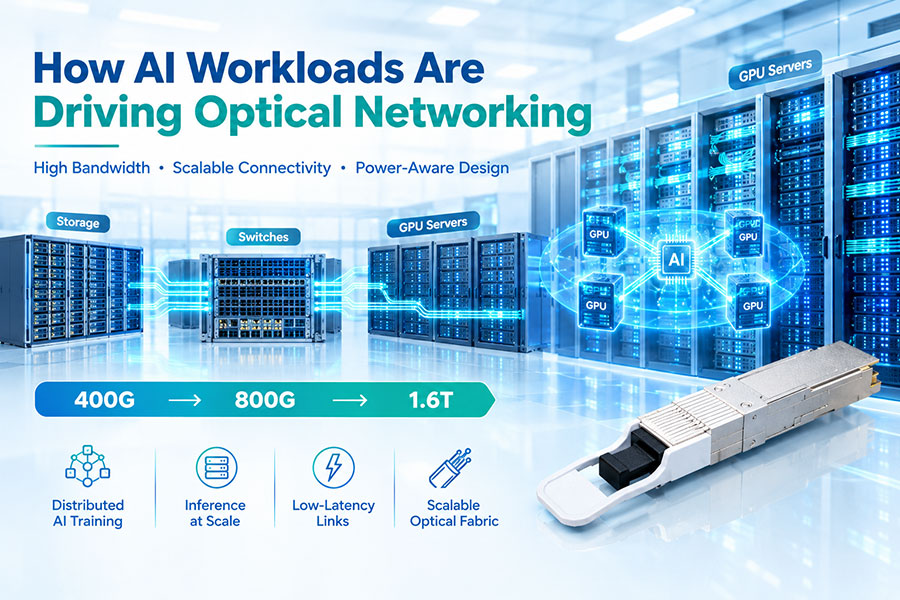
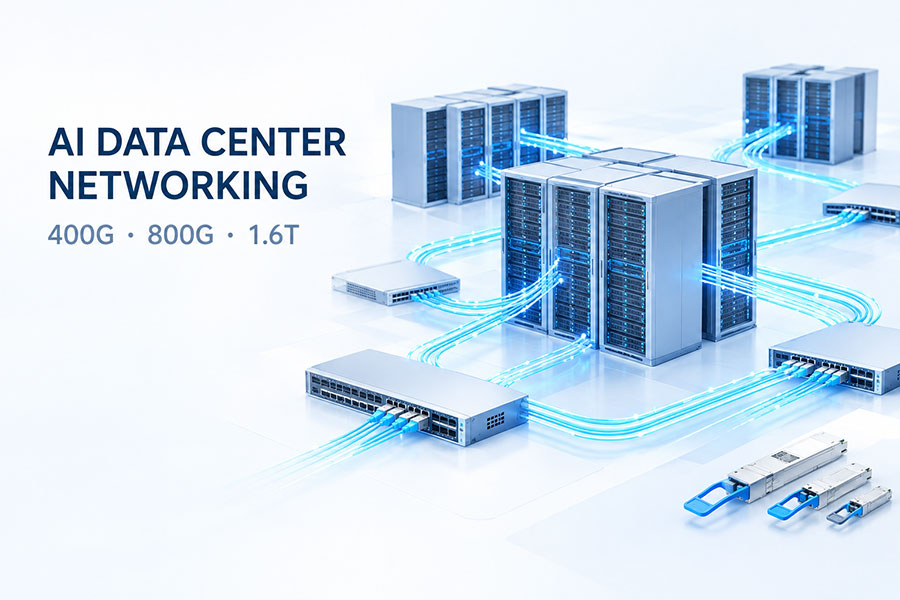
The rapid development of artificial intelligence is transforming data center network architecture. Large language models, generative AI, distributed training, and inference services require massive computing resources and continuous data exchange between GPUs, servers, storage systems, and network switches. As AI infrastructure expands, networking has become a critical factor in determining how efficiently computing resources operate.
Traditional electrical interconnects remain important for short-distance communication, but increasing bandwidth requirements, signal integrity constraints, and power consumption are creating opportunities for optical networking. Optical transceivers, fiber optic cabling, silicon photonics, and emerging integrated optical architectures are helping data centers build higher-capacity and more scalable networks.
The transition from 400G to 800G and emerging 1.6T optical connectivity reflects a broader change in AI infrastructure. Optical networking is no longer simply a method of connecting distant devices; it is becoming a fundamental part of the architecture used to connect large computing clusters efficiently.
1. Why AI Workloads Are Changing Data Center Networking
AI workloads place different demands on data center networks compared with many traditional applications. Distributed model training requires frequent communication between GPUs, while large-scale inference services may need to distribute requests, access model data, and coordinate computing resources across multiple servers.
These workloads generate substantial east-west traffic, which refers to communication between servers and systems within a data center. As more GPUs participate in a workload, the network must support increasing numbers of connections without creating excessive congestion or communication delays.
AI infrastructure therefore places greater emphasis on:
High bandwidth between GPU servers and network switches
Low and predictable communication latency
Scalable connectivity across racks and data center areas
Power-efficient interconnects and manageable thermal requirements
Reliable operation under sustained, high-volume network traffic
Optical networking addresses important physical connectivity requirements in this environment. However, overall AI performance also depends on network topology, switch capacity, congestion management, software configuration, and the communication patterns of the workload.
2. How Distributed AI Training Increases Network Traffic
Distributed AI training divides computational tasks among multiple GPUs or groups of GPUs. Each accelerator processes part of the workload, and the results must be exchanged to maintain coordination throughout the training process.
Collective communication operations such as All-Reduce can generate significant traffic between GPUs located on different servers. Other communication patterns, including All-Gather and Reduce-Scatter, also require data to move efficiently throughout the cluster.
When network bandwidth becomes insufficient, GPUs may wait for data from other computing nodes. This reduces effective utilization and can increase the time required to complete a training job.
High-bandwidth optical links help provide the physical capacity required for distributed communication. The network must still be engineered to avoid congestion, balance traffic, and provide sufficient bandwidth across every relevant stage of the fabric.
3. AI Inference Is Increasing Demand for Network Connectivity
AI inference introduces additional networking requirements as models serve users, applications, and automated workloads. Large inference systems may distribute requests across multiple servers, access remote storage, and coordinate computation between different model components.
Some architectures, particularly those involving Mixture-of-Experts (MoE) models, can generate substantial inter-server traffic when tokens or intermediate data must be routed to different expert networks. The resulting traffic depends on the model architecture, parallelization strategy, batching, and inference workload.
Inference clusters also need to accommodate changing traffic levels. During periods of high demand, communication capacity and congestion control influence response times and the efficiency of resource utilization.
Optical networking provides high-speed connectivity for these systems, particularly when inference infrastructure spans multiple racks or requires large numbers of server-to-switch links.
4. Scale-Up and Scale-Out Networks Have Different Optical Requirements
AI data center networking is often divided into scale-up and scale-out architectures. They address different connectivity requirements and may use different interconnect technologies.
Scale-up networking connects GPUs and accelerators within a tightly integrated computing domain. Technologies such as NVLink and other dedicated accelerator interconnects support high-bandwidth communication within supported systems. Some scale-up architectures can also incorporate optical technologies as integration requirements evolve.
Scale-out networking connects multiple servers through Ethernet or InfiniBand fabrics. Optical transceivers are widely used for switch-to-switch and other links across racks, allowing large numbers of computing nodes to participate in distributed workloads.
| Characteristic | Scale-Up Networking | Scale-Out Networking |
|---|---|---|
| Primary Purpose | Connect GPUs and accelerators within a computing domain | Connect servers and racks across the cluster |
| Common Technologies | Dedicated accelerator interconnects and platform-specific links | InfiniBand and high-performance Ethernet |
| Typical Priorities | High bandwidth and tightly coupled communication | Bandwidth, scalability, congestion management, and reach |
| Role of Optical Networking | Depends on system architecture and integration requirements | Pluggable optics and fiber links are widely deployed |
| Deployment Scope | Within a system or tightly integrated computing platform | Across servers, racks, and data center network layers |
Understanding this distinction helps prevent the assumption that every GPU connection requires a conventional optical transceiver. The appropriate technology depends on where the link operates within the overall AI system.
5. Why Optical Transceivers Are Essential for AI Data Centers
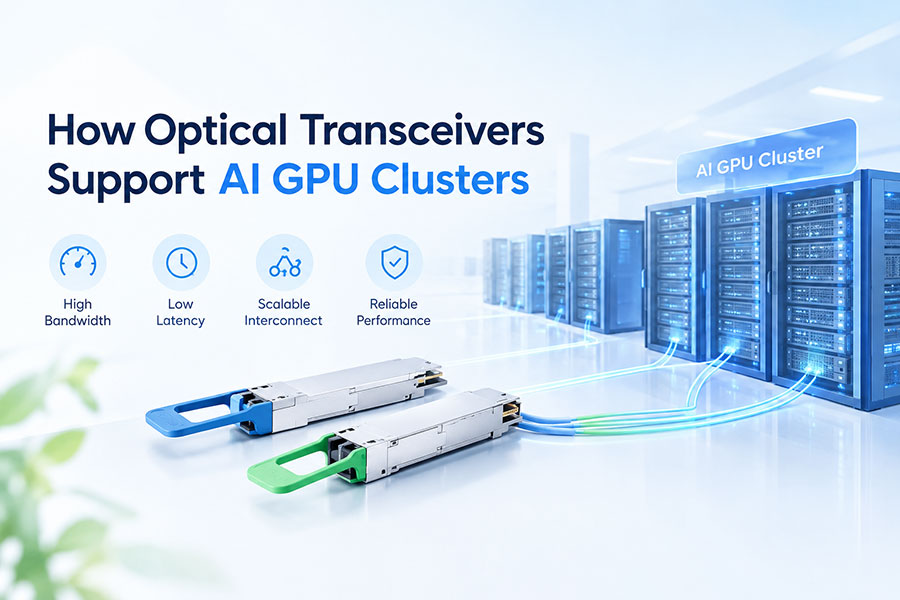
An optical transceiver converts electrical signals into optical signals for transmission through fiber and converts received optical signals back into electrical signals. These modules provide the physical interface between networking equipment and optical cabling.
In AI data centers, transceivers are commonly installed in compatible network switches, routers, and network interface devices. They connect equipment through fiber links that can extend across racks or data center areas.
Optical transceivers support AI networking by providing:
High-speed connectivity between network devices
Flexible transmission distances based on module specifications
Fiber-based cabling for dense network deployments
Multiple optical lane configurations for different data rates
Compatibility with different network architectures and fiber infrastructures when properly specified
The module alone does not guarantee end-to-end network performance. Its optical and electrical specifications must match the host device, remote endpoint, fiber infrastructure, and network protocol.
6. The Transition from 400G to 800G and 1.6T
As AI clusters expand, the demand for aggregate network capacity is increasing. Higher-speed optical interfaces allow network equipment to carry more data per port, potentially reducing the number of physical connections required for a given bandwidth target.
400G and 800G optical transceivers are important options for high-speed data center networks. 1.6T optical connectivity is advancing for next-generation platforms that require still greater capacity.
| Optical Generation | Aggregate Data Rate | Typical Networking Role |
|---|---|---|
| 400G | 400Gbps | High-speed Ethernet and InfiniBand connections on supported platforms |
| 800G | 800Gbps | Higher-bandwidth AI fabrics and hyperscale data center networks |
| 1.6T | 1.6Tbps | Emerging high-bandwidth interconnects for next-generation systems |
These figures describe nominal aggregate interface rates rather than application throughput. Actual throughput depends on protocol overhead, link utilization, network congestion, and the capabilities of the attached equipment.
Higher aggregate bandwidth does not automatically make every network operation faster. The switch architecture, topology, lane configuration, and end-to-end communication path must support the intended workload.
7. PAM4 and Higher Optical Lane Rates
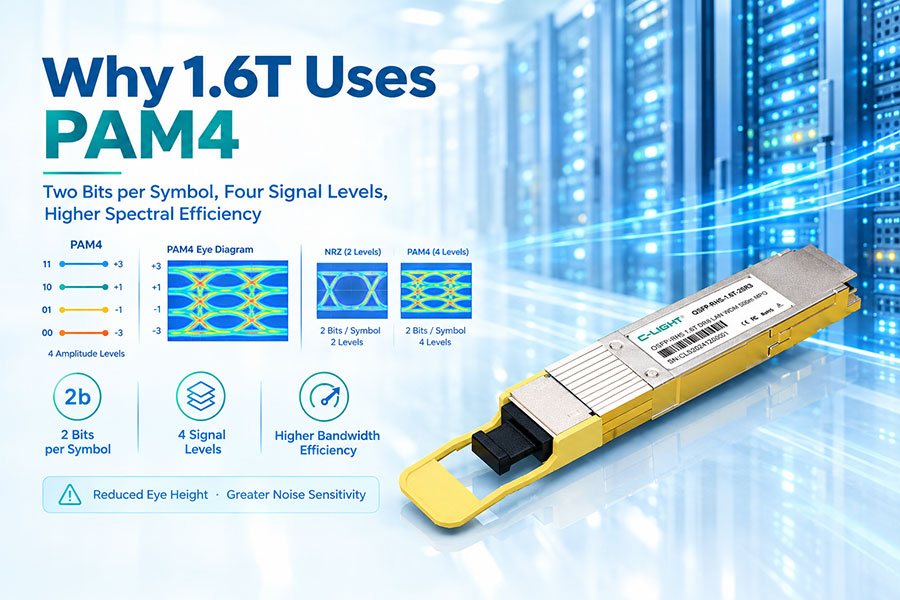
High-speed optical transceivers commonly use PAM4 modulation, which encodes two bits per symbol through four signal levels. This allows more bits to be transmitted per symbol than traditional NRZ signaling, which uses two levels and one bit per symbol.
PAM4 helps increase data rate without requiring the symbol rate to rise proportionally with the bit rate. However, its smaller amplitude margin between adjacent levels places greater demands on signal quality, transmitter linearity, receiver performance, and error correction.
Modern optical modules may combine multiple high-speed lanes to achieve aggregate rates such as 400G and 800G. The number of lanes, modulation format, symbol rate, and electrical interface depend on the specific implementation.
As per-lane data rates increase, optical component performance and electrical interface design become increasingly important. Module selection should therefore consider the complete lane architecture rather than relying only on the aggregate bandwidth label.
8. Single-Mode and Multimode Fiber in AI Networking
AI data centers use both single-mode and multimode fiber, depending on link distance, transceiver architecture, and deployment requirements.
Multimode fiber is widely associated with short-reach data center links using 850nm VCSEL-based transceivers. It can provide cost-effective connectivity where the required distance remains within the supported reach of the chosen module and fiber grade.
Single-mode fiber supports a broad range of optical link distances and is commonly used with 1310nm-class optics and other single-mode architectures. It is often selected for connections across racks, network tiers, or more extended routes.
| Characteristic | Multimode Fiber | Single-Mode Fiber |
|---|---|---|
| Common Wavelength | 850nm for many short-reach links | 1310nm and other wavelengths depending on design |
| Common Laser Technology | VCSEL | DFB, EML, and silicon photonics-based implementations |
| Typical Use | Short-reach data center connectivity | Short-, medium-, and longer-reach connectivity |
| Key Selection Factor | Supported reach and multimode fiber grade | Optical budget, fiber route, and transceiver specifications |
The best choice depends on the complete link. Wavelength, fiber type, connector arrangement, optical budget, and required distance must be checked together.
9. The Role of Optical Transceiver Technologies
Several laser and optical integration technologies support the development of AI networking. Their suitability depends on data rate, reach, power budget, module architecture, and system requirements.
VCSEL technology is widely used in short-reach multimode transceivers. DFB lasers are common in single-mode optical sources, while EML combines a laser with an electro-absorption modulator to support demanding transmission requirements. Silicon photonics integrates optical functions into photonic circuits and can support high-density optical architectures.
These technologies are not directly interchangeable. A suitable implementation must meet the intended optical standard, link distance, signal quality, and host interface requirements.
As AI data rates rise, optical designs increasingly focus on improving bandwidth density, integration, and power efficiency while maintaining reliability and manufacturability.
10. InfiniBand and Ethernet Are Both Important to AI Networking
InfiniBand and Ethernet are both used to connect servers in high-performance computing and AI data centers. The appropriate network depends on the system architecture, hardware ecosystem, software requirements, operational model, and performance objectives.
InfiniBand is widely used in high-performance computing environments and AI clusters designed around compatible InfiniBand fabrics. Ethernet-based AI networks may use RoCEv2, which supports remote direct memory access over Ethernet when configured with suitable network adapters and infrastructure.
Optical transceivers provide physical optical connectivity in both environments when the selected module supports the relevant protocol and host platform.
| Characteristic | InfiniBand | Ethernet with RoCEv2 |
|---|---|---|
| Network Architecture | High-performance networking fabric | Ethernet fabric with RDMA support |
| Typical Applications | AI training and HPC clusters | AI clusters, cloud networks, and enterprise infrastructure |
| Optical Connectivity | Compatible optical transceivers and cables | Compatible Ethernet optical transceivers and cables |
| Design Priorities | Bandwidth, latency, and fabric performance | Bandwidth, congestion management, interoperability, and operations |
Matching only the data rate is not sufficient to guarantee compatibility. The module, host interface, remote endpoint, and supported protocol must all be verified before deployment.
11. Power Efficiency Is Becoming a Key Networking Priority
AI data centers consume substantial power, and networking contributes to the total energy required to operate a computing cluster. Large deployments may contain thousands of optical interfaces, making the power consumption of each connection relevant at the system level.
Higher-speed optical modules may require more advanced signal processing and thermal management. The actual power depends on the module's reach, optical architecture, components, and operating conditions.
Optical networking can support system-level efficiency by enabling high bandwidth over fiber and reducing certain constraints associated with long electrical channels. However, optical conversion requires power, so fiber transmission should not be assumed to be more energy-efficient in every individual short-link configuration.
Power evaluation should consider the entire link, including transceivers, active cable electronics, host interfaces, switches, and cooling requirements. The most efficient architecture depends on the actual deployment scenario.
12. Copper Limitations Are Encouraging Optical Adoption
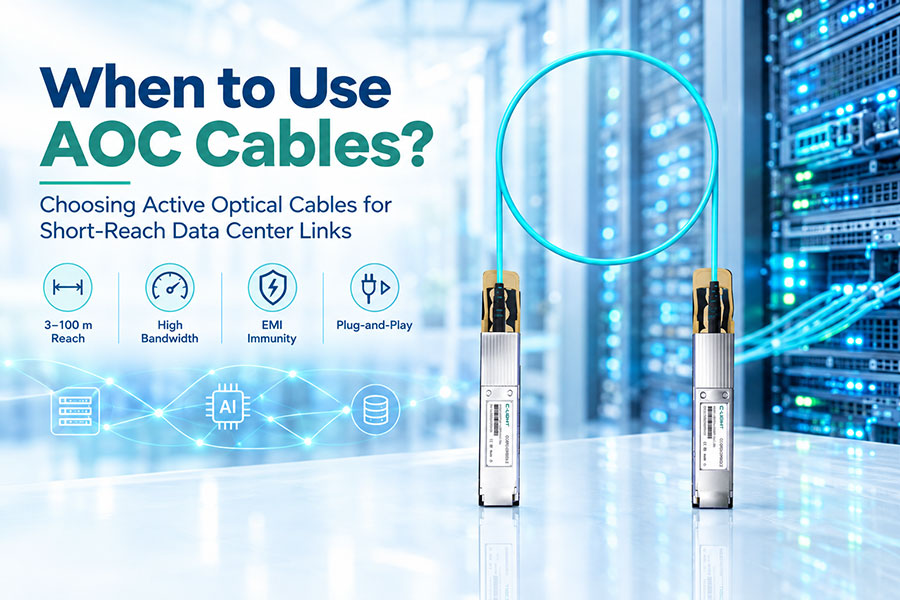
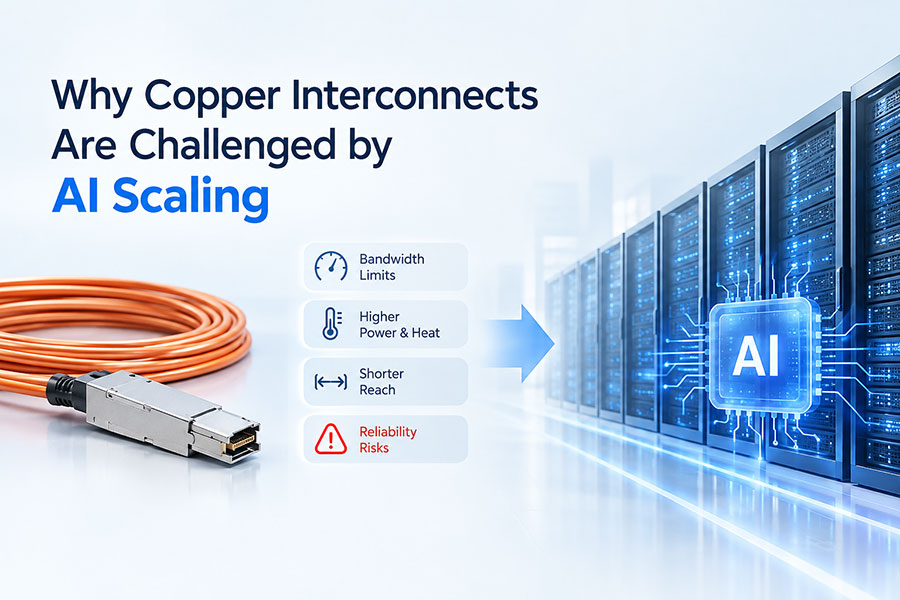
Copper interconnects remain valuable for suitable short connections because passive DAC cables can provide low-cost, low-power connectivity. However, higher electrical lane rates increase the demands on signal integrity, cable construction, equalization, and channel length.
Active copper solutions, including ACC and AEC, can extend certain electrical links, but they introduce additional design and power considerations. Their supported reach depends on the particular implementation.
Optical links provide another option for connections that require longer reach, different cable-management characteristics, or high bandwidth across a data center fabric.
The industry is therefore moving toward a combination of copper and optical technologies rather than eliminating one medium entirely. Copper continues to serve suitable short-reach applications, while optical networking becomes more attractive as bandwidth, reach, and density requirements increase.
13. AI Data Center Topology Affects Optical Demand
Network topology determines how servers, switches, and other equipment are connected. Leaf-spine architectures are widely used in scalable data center networks, while other high-performance systems may use alternative topologies suited to their communication patterns.
In a leaf-spine design, leaf switches connect to servers and communicate through spine switches. The required optical connections depend on the number of ports, inter-switch capacity, physical distances, and planned oversubscription ratio.
As AI clusters expand, networks may require more high-speed connections between racks and switching layers. Optical transceivers and fiber cabling help provide the reach and capacity required by these interconnects.
More optical bandwidth does not automatically eliminate congestion. Engineers must ensure that switch capacity, routing, topology, and traffic management are aligned with the expected AI workloads.
14. Optical Circuit Switching and Flexible AI Networks
Optical Circuit Switching (OCS) offers another approach to AI network design. Instead of forwarding every packet electronically, an optical circuit switch can establish optical paths between selected endpoints, depending on the system architecture.
OCS can be useful where workloads have traffic patterns that benefit from reconfigurable high-capacity optical connections. Some AI infrastructure designs explore OCS to connect groups of computing devices dynamically or to provide alternative network paths.
OCS is not a replacement for every conventional packet switch. Its usefulness depends on workload characteristics, connection setup requirements, network control, and the role of packet-based switching elsewhere in the architecture.
When appropriately deployed, optical circuit switching can complement optical transceivers and conventional switches in large AI networks. These technologies serve different functions: transceivers provide optical interfaces, while OCS changes the optical paths between connected ports.
15. Silicon Photonics Is Advancing Optical Integration
Silicon photonics integrates optical functions into photonic integrated circuits fabricated using silicon-based platforms and related semiconductor processes. This technology can combine functions such as modulation, light routing, multiplexing, and photodetection within a compact optical architecture.
For AI networking, silicon photonics offers opportunities to support higher bandwidth density and more integrated optical engines. It can be used in certain pluggable optical modules and is also an important technology for more highly integrated architectures.
However, silicon photonics is not a single transceiver standard or a guarantee of lower power in every application. System performance depends on the complete implementation, including laser sources, modulators, drivers, receivers, packaging, and thermal design.
As optical interfaces scale, silicon photonics provides an important platform for developing high-capacity interconnects while maintaining strict requirements for reliability, manufacturing yield, and system compatibility.
16. LPO, NPO, and CPO Are Evolving Optical Architectures
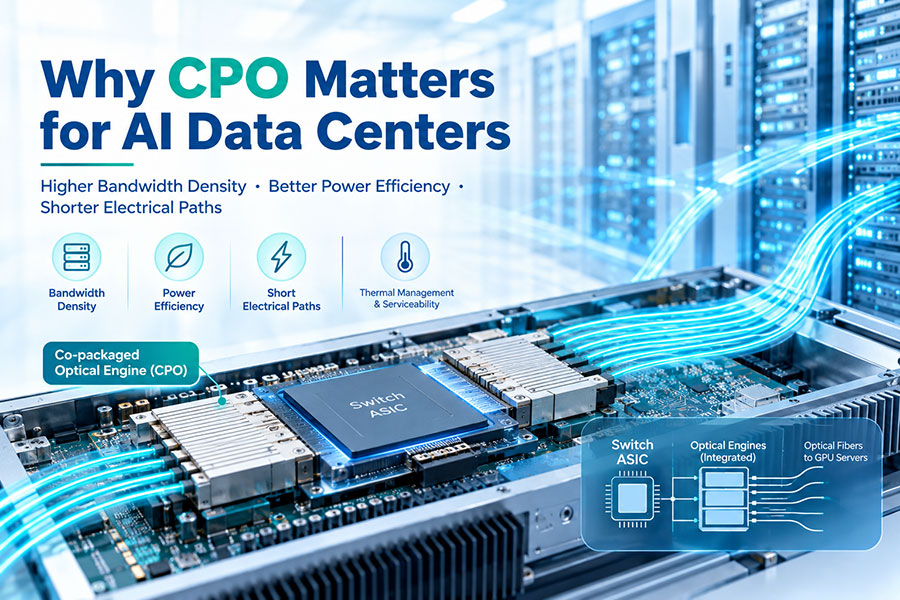
As AI networking moves toward higher bandwidth density, the industry is exploring different approaches to optical integration. Linear Pluggable Optics (LPO), Near-Packaged Optics (NPO), and Co-Packaged Optics (CPO) represent distinct approaches to reducing electrical link constraints or placing optical functions closer to processing and switching devices.
LPO uses a pluggable form factor but reduces or changes the role of conventional module DSP functions in supported designs. This can reduce power and signal-processing complexity, but it requires careful coordination between the host and optical module.
NPO positions optical engines near the host ASIC or other major electronic components. CPO integrates optical engines more closely with the host package, reducing the length of certain high-speed electrical connections.
| Technology | Integration Approach | Primary Design Consideration |
|---|---|---|
| Pluggable Optics | Replaceable optical module installed in a host port | Modularity, serviceability, power, and compatibility |
| LPO | Pluggable optics with a simplified signal-processing path | Host-module coordination and signal integrity |
| NPO | Optical engine placed near the host electronics | Integration, thermal design, and maintenance |
| CPO | Optical engines integrated closely with the host package | Power efficiency, packaging, reliability, and serviceability |
These architectures are at different stages of adoption and suit different platforms. Pluggable optics remain important for flexible deployment and field replacement, while NPO and CPO target specific system-level bandwidth and integration challenges.
17. Optical Networking Supports Expansion Beyond a Single Data Center
Large AI deployments may distribute computing resources across different data halls, facilities, or geographic locations. Connecting these environments requires optical infrastructure that supports the necessary bandwidth, distance, reliability, and network architecture.
Data Center Interconnect (DCI) connects separate data centers or major computing facilities. Depending on distance and bandwidth requirements, DCI may use direct-detect optical technologies, coherent optics, wavelength-division multiplexing, optical amplification, and other transport technologies.
Coherent optical systems are especially relevant to many higher-capacity single-mode transport links because they can support high spectral efficiency and longer reach. They differ from short-reach data center transceivers in both architecture and application.
When AI resources are distributed across facilities, network planning must consider fiber availability, route diversity, latency, capacity, optical power budget, and the transport equipment required at each endpoint.
18. Reliability and Monitoring Are Critical in AI Optical Networks
AI clusters depend on communication across many physical links. An individual optical fault may affect a server connection, while multiple failures or poorly managed congestion can reduce the effective capacity of a larger fabric.
Reliable optical networking depends on compatible transceivers, suitable fiber infrastructure, correct connector installation, adequate optical power, thermal stability, and effective monitoring.
Digital Optical Monitoring (DOM) or Digital Diagnostics Monitoring (DDM), where supported, can provide information about module temperature, supply voltage, transmit optical power, receive optical power, and laser bias current.
Engineers should combine module diagnostics with switch telemetry, error counters, link-state monitoring, and structured maintenance practices. These measures help identify abnormal conditions and make troubleshooting more efficient.
19. How to Select Optical Connectivity for AI Workloads
Optical networking requirements vary according to AI workload, server configuration, network topology, and physical deployment. A suitable transceiver must match the host device, remote endpoint, optical path, and required network protocol.
| Selection Factor | What to Verify |
|---|---|
| AI Workload | Training, inference, or mixed workload requirements |
| Network Architecture | Scale-up, scale-out, topology, and traffic patterns |
| Network Protocol | InfiniBand or Ethernet and its required configuration |
| Data Rate | 400G, 800G, 1.6T, or another supported interface |
| Transmission Distance | Physical route and complete optical link length |
| Fiber and Connector | Single-mode or multimode, connector family, fiber count, and polarity |
| Optical Architecture | SR, DR, FR, LR, or a transport solution suited to the required reach |
| Power and Cooling | Module power, host port limits, thermal conditions, and airflow |
| Compatibility | Host platform, remote transceiver, firmware, and breakout support |
| Validation | Optical budget, module diagnostics, interoperability, and link testing |
For AI data center projects, providing the host equipment model, port rate, optical reach, fiber type, connector, and intended protocol helps narrow the available solutions. The final module specification should be validated against the intended platform before deployment.
20. The Future of Optical Networking for AI
AI workloads are driving optical networking toward greater bandwidth, higher integration, better power efficiency, and more flexible network architectures. The growth of distributed training, large inference clusters, and high-density computing systems is increasing the importance of the physical network connecting accelerators.
400G and 800G optical transceivers support current high-speed data center architectures, while 1.6T connectivity and integrated optical technologies are advancing next-generation designs. Silicon photonics, LPO, NPO, CPO, and OCS each address different aspects of bandwidth, electrical reach, optical integration, or network reconfiguration.
These technologies will not necessarily replace one another. Their roles depend on the workload, topology, distance, power budget, deployment model, and system requirements.
The long-term direction is toward more closely coordinated compute, networking, and optical infrastructure. By selecting the appropriate interconnect at each level, data center operators can build networks that support larger AI workloads while balancing capacity, reliability, power, and operational complexity.
21.Conclusion
AI workloads are driving optical networking because distributed training and inference require high-capacity communication between GPUs, servers, and network switches. As data center clusters expand, optical transceivers and fiber infrastructure provide the bandwidth and reach needed to connect computing resources across racks and facilities.
The transition from 400G to 800G and emerging 1.6T connectivity reflects increasing demands for bandwidth density and system efficiency. At the same time, silicon photonics, LPO, NPO, CPO, and OCS are creating additional options for integrating optics and organizing large-scale AI networks.
Optical connectivity alone does not guarantee efficient AI performance. Network topology, congestion control, switching capacity, protocol configuration, and workload communication patterns remain equally important. A well-designed AI network combines the appropriate optical technologies with a balanced architecture to support scalable and reliable computing infrastructure.
 >
>

 >
>
 >
>
 >
>
 >
>
 >
>
 >
>
 >
>