TEL:+86 132 6656 7067


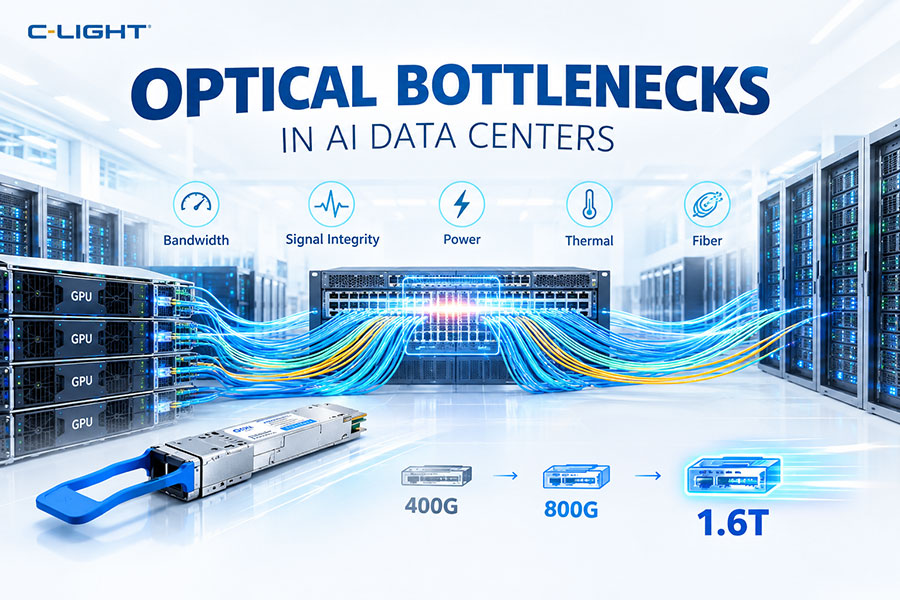
AI data centers are moving into a new phase of network scaling. As GPU and accelerator clusters become larger and switch bandwidth continues to increase, 800G optical connectivity is being followed by the development and deployment of 1.6T optical transceivers.
The emergence of 1.6T is not simply a matter of doubling the data rate of an 800G module. It reflects a broader change in AI networking, where bandwidth density, power per bit, lane rate, thermal management, optical integration, and physical port density are becoming equally important.
Higher-speed 1.6T modules can provide more bandwidth per front-panel port while supporting the continued evolution of high-radix AI switches, accelerator fabrics, and large-scale Ethernet and InfiniBand networks.
1. Why AI Data Centers Need More Optical Bandwidth
AI training workloads require large amounts of communication between GPUs, accelerators, NICs, switches, and storage systems. Distributed training can involve many devices exchanging information at nearly the same time.
As the number of GPUs increases, aggregate network traffic grows rapidly. A network link that is sufficient for a smaller cluster may become a bottleneck when thousands of accelerators participate in the same workload.
This creates a continuing need for higher network bandwidth without increasing the physical footprint of the infrastructure at the same rate.
2. From 400G to 800G and 1.6T
The transition to 1.6T follows the same broader bandwidth scaling path that has already moved data center optics from 400G to 800G.
| Generation | Representative Aggregate Rate | Typical Role |
|---|---|---|
| 400G | 400Gb/s | Established high-speed data center and AI connectivity |
| 800G | 800Gb/s | High-density AI scale-out and switching |
| 1.6T | 1.6Tb/s | Next-generation AI and high-bandwidth data center networks |
| 3.2T | 3.2Tb/s | Future high-density optical connectivity |
Each generation attempts to increase the amount of traffic that can be carried by a single network interface while controlling power, thermal load, and physical complexity.
3. Why 800G Alone Is Not Enough
800G has become an important interface generation for modern AI fabrics, but switch and accelerator bandwidth continues to increase.
When the network capacity of a switch increases, using the same 800G interface rate can require more ports to deliver equivalent aggregate switching capacity. More ports mean more optical modules, more fiber connections, more power consumption, and greater front-panel density.
Moving to 1.6T allows a single optical interface to carry twice the aggregate bandwidth of an 800G interface.
The practical objective is therefore not simply higher throughput per module. It is to increase bandwidth density at the system level.
4. What 1.6T Means for AI Switch Port Density
Port density is an important factor in AI networking because modern switches can contain very large numbers of high-speed interfaces.
Consider a simplified example. A switch architecture requiring 16 × 800G interfaces for a given connectivity requirement could potentially use 8 × 1.6T interfaces to carry the same aggregate bandwidth, assuming the system architecture supports that configuration.
This can reduce the number of physical interfaces required for a given amount of bandwidth and create additional room for future scaling.
| Interface Rate | Interfaces for 12.8T Aggregate Bandwidth |
|---|---|
| 400G | 32 |
| 800G | 16 |
| 1.6T | 8 |
This is a simplified bandwidth calculation rather than a recommendation for a specific switch architecture, but it illustrates why higher-rate optics can improve system-level bandwidth density.
5. 200G per Lane Was a Key Step Toward 1.6T
The first major transition toward 1.6T involved increasing the optical lane rate from 100G-class to 200G-class signaling.
A simplified architecture can use eight 200G-class lanes:
8 × 200G = 1.6T
This approach builds on the PAM4 optical ecosystem already developed for 800G and other high-speed interfaces.
However, eight optical lanes require a large number of optical channels, drivers, receivers, coupling structures, and fiber paths. The next challenge is therefore to increase the bandwidth per lane.
6. 400G per Lane Makes 1.6T More Efficient
400G-per-lane optical technology changes the architecture significantly.
Four 400G-class optical lanes can provide:
4 × 400G = 1.6T
Compared with an eight-lane 200G-class design, the number of line-side optical lanes is reduced by half.
| Architecture | Optical Lane Count | Aggregate Rate |
|---|---|---|
| 8 × 200G-class | 8 | 1.6T |
| 4 × 400G-class | 4 | 1.6T |
Fewer lanes can simplify the optical path count and increase bandwidth density, although 400G-per-lane operation places substantially higher requirements on electrical signal integrity, DSPs, optical components, and thermal design.
7. PAM4 Is Central to 1.6T Optical Scaling
PAM4 is an important signaling technology for high-speed optical modules.
NRZ uses two signal levels and carries one bit per symbol, while PAM4 uses four signal levels and carries two bits per symbol.
This allows higher data rates without requiring the symbol rate to increase in direct proportion to the aggregate bit rate.
The tradeoff is that the four-level signal has smaller vertical eye openings and is more sensitive to noise, distortion, crosstalk, insertion loss, and other impairments. As lane rates increase toward 400G-class operation, signal processing becomes increasingly important.
8. The Role of Optical DSP in 1.6T Modules
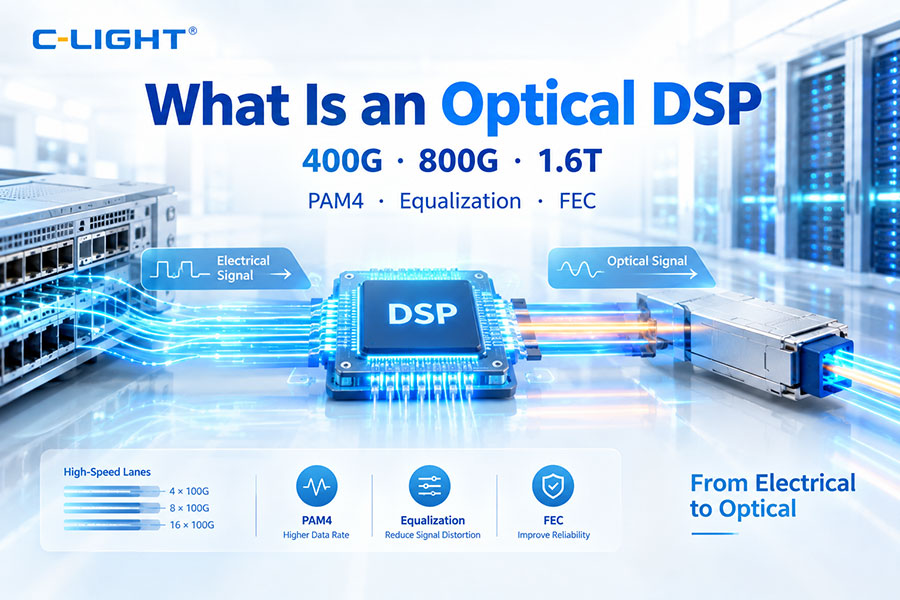
Advanced DSP technology is a major enabling component for practical 1.6T optical modules.
Depending on the architecture, the DSP can perform electrical equalization, signal recovery, FEC processing, lane conversion, diagnostics, and other signal-conditioning functions.
At 400G-per-lane speeds, the electrical and optical channels become significantly more demanding. DSP process technology therefore has a direct relationship with module power consumption, performance, and thermal requirements.
In March 2026, Broadcom announced a 3nm 400G/lane PAM4 optical DSP specifically optimized for 1.6T transceiver solutions and described it as a path toward future 3.2T modules.
9. 1.6T Optical Transceivers and AI Scale-Out Networks
Scale-out networking connects large numbers of AI servers and accelerator nodes through high-speed switches.
In such environments, each node may require multiple high-bandwidth connections. Increasing the speed of individual optical interfaces allows more aggregate bandwidth to be carried through the same physical switching infrastructure.
1.6T modules are therefore closely connected with the evolution of high-radix AI switches and large-scale East-West traffic fabrics.
The goal is to provide sufficient interconnect bandwidth so that communication does not become a limiting factor as accelerator counts increase.
10. 1.6T for AI East-West Traffic
AI workloads generate substantial East-West traffic because accelerators communicate with other accelerators rather than only communicating with external servers or users.
During distributed training, collective communication operations can create synchronized bursts across large portions of the cluster.
Higher-speed optical interfaces help increase the capacity of these internal network paths. This is particularly important in Clos, rail-optimized, dual-plane, and multi-plane AI fabrics where a large number of optical links operate simultaneously.
11. Why OSFP Is Important for 1.6T
High-speed optical modules require a form factor capable of accommodating increasingly demanding power and thermal requirements.
OSFP is an important form factor for high-bandwidth data center optics because its mechanical and thermal design provides a platform for high-speed optical components, DSPs, and associated electrical interfaces.
Current 1.6T development includes multiple OSFP-based implementations. Coherent's 2026 optical roadmap, for example, identifies a full suite of 1.6T transceivers in the OSFP form factor and describes 1.6T as an accelerating part of its pluggable roadmap.
12. 1.6T DR4 and FR4 Architectures
Short- and medium-reach 1.6T optical modules can use different optical architectures depending on the required distance and wavelength configuration.
| Architecture | General Concept | Typical Design Focus |
|---|---|---|
| 1.6T DR4 | Four parallel single-mode optical lanes | Short-reach high-bandwidth connectivity |
| 1.6T FR4 | Four high-speed optical channels using multiple wavelengths | Longer reach than short parallel single-mode architectures |
The exact reach and optical implementation depend on the applicable standard, module design, fiber infrastructure, optical budget, and host platform.
13. Power per Bit Is Becoming More Important
AI data centers are highly sensitive to power consumption because networking equipment operates alongside large numbers of accelerators and high-performance switching systems.
For optical modules, the relevant metric is not only total module power but also power consumed per transmitted bit.
A higher-bandwidth module can potentially deliver more traffic without proportionally increasing the number of modules and electrical interfaces required by the system.
However, moving from 200G-class lanes to 400G-class lanes introduces more demanding DSP and optical components. Improvements in semiconductor processes, optical efficiency, integration, and thermal design are therefore necessary to realize meaningful power-per-bit improvements.
14. 1.6T Creates New Thermal Challenges
More bandwidth in the same physical space generally means greater thermal density.
1.6T modules combine high-speed DSPs, optical drivers, lasers, modulators, photodiodes, control electronics, and mechanical components in a compact package.
Thermal performance becomes particularly important when a switch contains many high-speed modules operating simultaneously.
| Thermal Factor | Why It Matters |
|---|---|
| DSP Power | Higher-speed signal processing increases heat generation |
| Optical Device Efficiency | Laser and modulator efficiency affects total module power |
| Module Density | More high-speed modules increase aggregate thermal load |
| Cooling | Airflow and liquid-cooling strategies influence operating margins |
| Temperature Stability | Optical performance can vary with temperature |
This is why optical module development is increasingly linked to the thermal architecture of the switch and data center.
15. Silicon Photonics Supports 1.6T Integration
Silicon photonics is another important technology in the evolution of high-speed optical connectivity.
By integrating waveguides, modulators, photodetectors, and related photonic functions onto silicon-based photonic integrated circuits, silicon photonics can support highly integrated optical engines.
At 1.6T and beyond, higher levels of integration can help address optical density, packaging complexity, and the physical constraints of high-speed transceiver designs.
Silicon photonics can also support optical architectures beyond conventional pluggable modules, including NPO and CPO.
16. 1.6T and the Evolution Toward NPO and CPO
As switch bandwidth increases, the electrical connection between the switch ASIC and front-panel optical modules becomes increasingly challenging.
The electrical channel becomes shorter and more demanding at higher signaling rates, increasing the value of placing optical conversion closer to the switching silicon.
| Architecture | Optical Position | Main Design Objective |
|---|---|---|
| Pluggable Optics | Front panel | Modularity and serviceability |
| NPO | Near the switch ASIC | Short electrical paths and high-density integration |
| CPO | Integrated with the switch package | Maximum electrical and optical integration |
1.6T does not necessarily require NPO or CPO. Pluggable 1.6T modules remain an important architecture, while higher-speed interfaces are also encouraging development of more integrated optical solutions.
17. 1.6T Is a Building Block for 3.2T
One reason the industry is developing 1.6T now is that higher-speed optical lanes can provide a scalable path toward future module generations.
A simplified relationship is:
4 × 400G = 1.6T
8 × 400G = 3.2T
Once 400G-per-lane technology becomes practical, the same fundamental lane technology can be used to build higher aggregate bandwidth through additional lanes or more advanced optical packaging.
Coherent demonstrated 400G/lane PAM4 links at OFC 2026 for next-generation 3.2T architectures, while its September 2026 ECOC demonstrations showed a 3.2T 2×DR4 concept using eight 425G PAM4 optical lanes.
18. 1.6T Optical Transceiver Development Is Becoming Multi-Technology
There is no single optical technology that defines every 1.6T module.
Current development spans different combinations of DSPs, EMLs, silicon photonics, photodiodes, wavelengths, optical engines, and packaging approaches.
This allows manufacturers to optimize different products for cost, reach, power, integration, and deployment environment.
Coherent's 2026 demonstrations, for example, cover multiple 1.6T electrical interfaces and DSP platforms while also developing 400G-per-lane optical technologies using Differential EML and silicon photonics.
19. What 1.6T Means for AI Data Center Interconnects
Although much of the focus on 1.6T is on AI scale-out networks, the technology can affect several layers of data center connectivity.
| Application | Role of 1.6T Optics |
|---|---|
| AI Scale-Out | High-bandwidth GPU-to-switch and switch-to-switch connectivity |
| AI Scale-Up | Potential use in tightly coupled high-bandwidth optical architectures |
| Data Center Switching | Higher bandwidth per front-panel interface |
| Inter-Data Hall Connectivity | High-capacity optical links where supported by the specific architecture |
| Future AI Fabrics | Foundation for higher-rate 3.2T and beyond |
The appropriate module still depends on the actual link distance, topology, host interface, optical budget, and network protocol.
20. Why 1.6T Optical Transceivers Are Emerging Now
The emergence of 1.6T is the result of several technologies reaching the required level of maturity at the same time.
AI workloads are increasing aggregate network demand. Switch ASICs are moving toward higher bandwidth and port density. 200G-per-lane PAM4 has enabled the previous generation of high-speed optical connectivity, while 400G-per-lane technology is now being developed to reduce optical lane count for 1.6T.
At the same time, advanced DSPs, higher-speed EMLs, silicon photonics, improved packaging, and more capable thermal architectures are enabling higher-density optical modules.
The transition can therefore be summarized as:
AI workload growth → higher switch bandwidth → higher network port density → 800G scaling → 400G-per-lane development → 1.6T optical transceivers → future 3.2T and higher-speed optical architectures.
For AI data centers, the value of 1.6T is ultimately the ability to move more data through a constrained physical, electrical, optical, and thermal infrastructure while maintaining a scalable path for future network generations.
 >
>

 >
>
 >
>
 >
>
 >
>
 >
>
 >
>
 >
>