TEL:+86 132 6656 7067


AI workloads place unusually high demands on data center networks because large numbers of GPUs and accelerators must exchange model parameters, gradients, activations, and other data at very high rates. Unlike traditional enterprise traffic, AI cluster traffic is dominated by high-bandwidth east-west communication between compute nodes and switching infrastructure, making the interconnect a critical part of overall system performance. Optical technology provides a practical path for moving this traffic across racks and between network layers because fiber supports high bandwidth over longer distances with low electromagnetic interference and better cabling scalability than copper at extended reach. As AI infrastructure advances from 400G to 800G and 1.6T-class interfaces, optical transceivers, AOCs, optical engines, and related technologies are becoming increasingly important to the design of GPU and hyperscale data center networks.
1. What Is AI Data Center Optical Interconnect?
AI data center optical interconnect refers to the optical communication infrastructure used to connect GPUs, accelerator systems, NICs, switches, storage systems, and other network equipment within an AI data center.
It includes optical transceivers, active optical cables, optical engines, fiber links, connectors, and related switching interfaces that transport high-speed data between different parts of the AI cluster.
2. Why Does AI Networking Need Optical Interconnect?
AI clusters generate very large amounts of east-west traffic. GPUs participating in distributed training or inference frequently exchange data with other GPUs through high-speed network fabrics.
As the number of GPUs grows, the aggregate traffic between compute nodes can quickly exceed the practical bandwidth of lower-speed network interfaces. Optical interconnect provides a scalable way to increase port bandwidth while maintaining manageable cable reach and system density.
3. What Is East-West Traffic in an AI Data Center?
East-west traffic refers to data exchanged between servers, GPUs, switches, storage systems, and other resources inside the data center rather than traffic between the data center and external networks.
AI workloads generate substantial east-west traffic because distributed computing requires frequent synchronization and communication among many compute nodes.
4. AI Optical Interconnect vs Traditional Data Center Interconnect
Traditional enterprise data center networks often have a mixture of north-south and east-west traffic with relatively moderate bandwidth per endpoint. AI clusters place much greater emphasis on synchronized, high-bandwidth east-west communication.
This changes the requirements for network port speed, optical reach, latency, switch bandwidth, cable density, power consumption, and system-level signal integrity.
5. What Are the Main Components of AI Optical Interconnect?
A typical AI optical interconnect environment can include switch ASICs, GPUs, NICs, optical transceivers, AOCs, DACs, AECs, fiber patching, optical distribution components, and high-speed electrical interfaces.
The actual combination depends on topology, distance, switch generation, GPU architecture, network protocol, and required bandwidth.
6. What Is the Role of the GPU in Optical Interconnect?
The GPU is the primary compute resource in many AI clusters. During distributed training and other parallel workloads, GPUs exchange data through the network interface and switching fabric.
The network connection therefore needs to provide sufficient bandwidth and predictable latency so that communication does not become a major bottleneck for the compute system.
7. What Is the Role of the NIC?
The Network Interface Card or network adapter provides the interface between the compute system and the data center network. In AI systems, the NIC must handle very high data rates and efficient packet or transport processing.
The NIC connects to the switching infrastructure through high-speed electrical or optical interfaces, depending on the architecture.
8. What Is the Role of the Switch ASIC?
The switch ASIC provides packet switching and network fabric functions between many connected endpoints. As AI cluster size increases, switch bandwidth and optical port density become increasingly important.
Modern switch ASICs can provide very high aggregate bandwidth, which in turn drives the demand for higher-speed optical interfaces such as 800G and future 1.6T connectivity.
9. What Is the Optical Transceiver in an AI Network?
An optical transceiver converts electrical data from the host system into optical signals for transmission over fiber and converts received optical signals back into electrical data.
In an AI data center, optical transceivers can be deployed between GPUs or servers and switches, between switches, and in other high-bandwidth network connections.
10. How Does an AI Optical Interconnect Work?
The host ASIC or NIC generates a high-speed electrical signal that enters the optical transceiver. The transmitter converts the electrical data into an optical signal, which travels through the fiber to the receiving module.
The receiving module detects the incoming optical signal and converts it back into an electrical waveform for the remote switch ASIC, NIC, or other host device.
A simplified path is:
GPU / CPU → NIC → Switch ASIC → Optical Transceiver → Fiber → Optical Transceiver → Switch ASIC / NIC → GPU / CPU
11. Why Is Fiber Used for AI Interconnect?
Fiber provides high bandwidth with relatively low attenuation and is largely immune to electromagnetic interference. It also allows longer physical reach without the electrical losses associated with high-speed copper interconnects.
These properties become increasingly important as AI systems expand across more racks and higher-speed switch tiers.
12. What Optical Technologies Are Used in AI Data Centers?
AI data centers can use several optical and electrical interconnect technologies, including pluggable optical transceivers, AOCs, optical engines, DACs, AECs, LPO modules, and co-packaged optical architectures.
Each technology targets different combinations of bandwidth, distance, latency, power, thermal load, cost, and system complexity.
13. 400G Optical Interconnect for AI
400G optical connectivity has become an important bandwidth level for modern AI and high-performance data center networks. A 400G link can be implemented using multiple optical or electrical lanes and different optical architectures depending on reach and application.
400G remains relevant for server-to-switch and switch-to-switch connections where 400G provides an appropriate balance of bandwidth and deployment cost.
14. 800G Optical Interconnect for AI
800G provides twice the aggregate bandwidth of a 400G interface and is increasingly important for high-capacity AI fabrics.
Modern 800G optical modules commonly use PAM4-based multi-lane architectures and are available in form factors such as OSFP and QSFP-DD. Different optical configurations support short, medium, and longer reaches.
15. 1.6T Optical Interconnect for AI
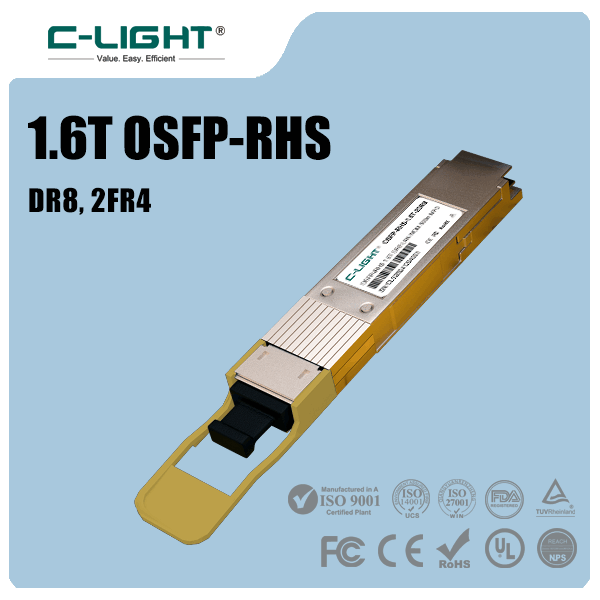
1.6T optical connectivity is the next major step in port bandwidth for AI networking. A common conceptual architecture uses eight 200G-per-lane channels to achieve an aggregate 1.6T interface.
The move toward 1.6T increases the importance of optical engine efficiency, electrical signal integrity, thermal management, packaging, transmitter quality, and receiver performance.
16. Why Is PAM4 Important for AI Optical Interconnect?
PAM4 uses four signal levels and carries two bits per symbol. This improves signaling efficiency and allows higher bit rates without requiring the same proportional increase in baud rate as binary NRZ signaling.
PAM4 is widely used in modern 400G, 800G, and higher-speed interfaces, but its smaller adjacent-level spacing also makes the link more sensitive to noise, jitter, crosstalk, distortion, and other impairments.
17. AI Optical Interconnect and Lane Architecture
High-speed optical interfaces are normally built from multiple lanes. For example, an 800G architecture can use eight approximately 100G-class lanes, while a 1.6T architecture can use eight 200G-class lanes.
The lane architecture affects optical components, connector design, electrical routing, power consumption, and overall module complexity.
18. Parallel Optics in AI Networks
Parallel optics uses separate optical lanes and fibers for different channels. It is conceptually straightforward and can be effective for short and medium-reach data center links.
Parallel optics may require more fibers than WDM-based architectures, so fiber count and cabling density become important considerations at large cluster scale.
19. WDM Optical Interconnect for AI
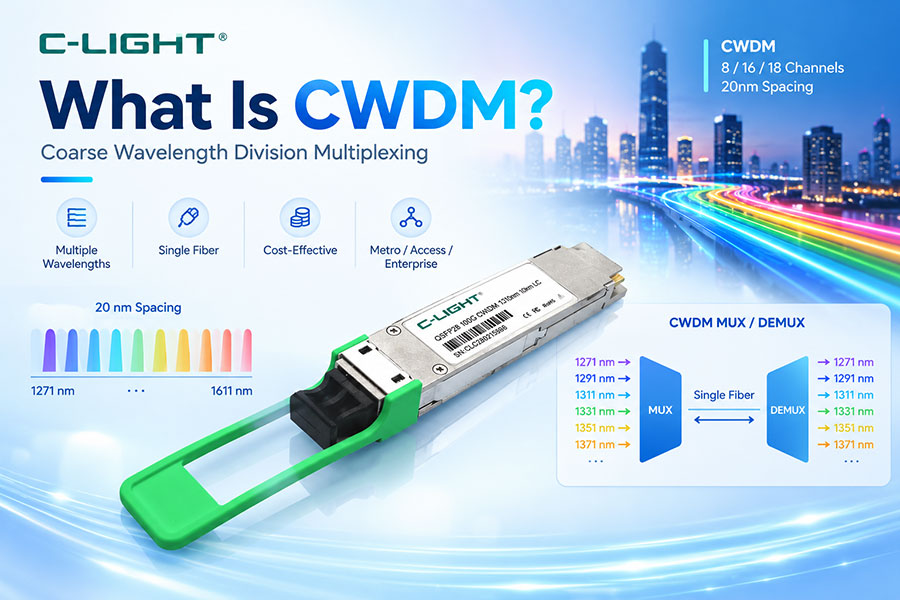
Wavelength-division multiplexing combines multiple optical channels with different wavelengths onto fewer fiber paths. This improves fiber utilization and can reduce the number of fibers required for certain reach classes.
CWDM, LAN-WDM, and DWDM architectures can be used in different applications, depending on required channel spacing, reach, capacity, and system complexity.
20. 800G SR8 in AI Data Centers
800G SR8 is a short-reach optical architecture generally designed for multimode fiber. It commonly uses eight parallel optical channels around the 850 nm region and is intended for short data center links.
It is suitable for environments where GPUs, servers, and switches are physically close and the deployment can take advantage of multimode fiber.
21. 800G DR8 in AI Data Centers
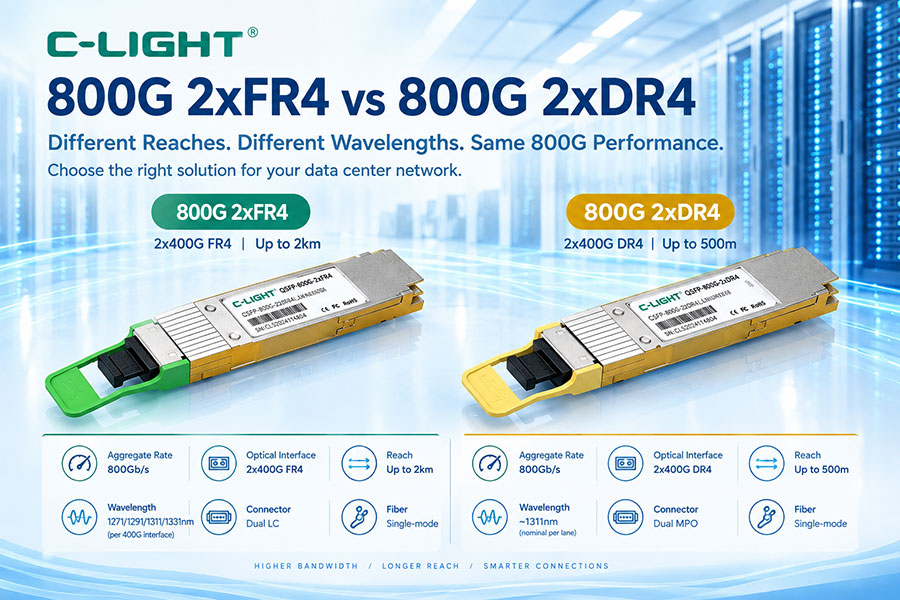
800G DR8 uses single-mode fiber and parallel optical channels to provide greater reach than short-reach multimode architectures. It is commonly associated with links of up to approximately 500 m in suitable implementations.
DR8 is useful when the physical topology extends beyond the practical range of short multimode connections.
22. 800G 2xFR4 in AI Networks
800G 2xFR4 combines two 400G FR4 sections and uses multiple wavelengths to transport high bandwidth over single-mode fiber. A typical implementation can support reach of approximately 2 km.
This architecture can reduce the number of fibers required compared with fully parallel optics and is useful for longer data center and campus-scale connections.
23. Optical Interconnect Between GPU Servers and ToR Switches
Top-of-rack switches aggregate traffic from many servers or GPU systems within a rack. The physical distance is relatively short, but the aggregate traffic can be extremely high.
Depending on the rack architecture, DAC, AEC, AOC, and optical transceivers can all be used for GPU-to-ToR connectivity.
24. Optical Interconnect Between ToR and Spine Switches
Spine-leaf or similar architectures use higher-level switching layers to connect multiple racks. The distance between ToR and spine switches is generally greater than the distance between a server and its local switch.
Fiber-based optical transceivers are therefore commonly used at these layers because they provide longer reach and lower cable bulk compared with high-speed copper.
25. AI Spine and Fabric Interconnect
In a large AI fabric, spine and leaf switches create a high-capacity network that allows compute nodes to communicate across different racks. Because many paths can be active simultaneously, the optical fabric must provide consistent bandwidth and low error performance.
Higher-speed ports such as 800G can reduce the number of interfaces required to achieve a given aggregate switching capacity.
26. AI Optical Interconnect and Network Topology
Optical requirements depend strongly on topology. A single-rack network has different distance and cable-management requirements from a multi-rack leaf-spine fabric or a multi-room data center.
Topology determines the required optical reach, number of fibers, module count, switch port density, cabling complexity, and power budget.
27. Optical Interconnect and Bandwidth Density
Bandwidth density refers to the amount of network bandwidth provided within a given amount of rack space, port count, or physical infrastructure.
800G and 1.6T interfaces increase bandwidth per port, helping network operators build higher-capacity fabrics without increasing port count at the same rate.
28. Optical Interconnect and Latency
Optical links themselves can provide fast physical transmission, but total network latency includes serialization, switching, buffering, signal processing, FEC, and other system delays.
In AI clusters, low and predictable latency is important because communication overhead can affect the synchronization efficiency of distributed workloads.
29. Optical Interconnect and Power Consumption
Power consumption becomes a major concern when thousands of high-speed optical ports are deployed. The power consumed by each module can add significantly to the total network power budget.
This is one reason why technologies such as LPO, improved optical engines, and more efficient transmitter and receiver architectures are receiving attention for AI networks.
30. Optical Interconnect and Thermal Management
High-speed optical modules generate heat through lasers, drivers, receivers, DSPs, and other active components. As switch port counts and per-port speeds increase, thermal density also increases.
Module heat sinks, airflow, switch chassis design, thermal interfaces, and system power management must therefore be considered together.
31. AI Optical Interconnect and DSP
DSPs can perform equalization, signal recovery, FEC-related processing, and other functions that help compensate for electrical and optical impairments.
DSP-based optical modules can provide strong signal-conditioning capability, but the additional processing also increases power consumption and can add latency.
32. AI Optical Interconnect and LPO
LPO, or Linear Pluggable Optics, reduces or eliminates conventional DSP processing inside the optical module and relies more heavily on host-side SerDes and system electronics.
This can reduce module power and latency, which is attractive for high-density AI switches, but LPO requires better electrical channel quality and tighter system-level interoperability.
33. AI Optical Interconnect and AOC
Active Optical Cable integrates optical transceivers and fiber into a factory-terminated cable assembly. It can simplify installation compared with separate transceivers and fiber patching.
AOC is particularly useful where the required connection is longer than practical copper cable but does not require the flexibility of separate optical modules and patch cords.
34. AI Optical Interconnect and DAC
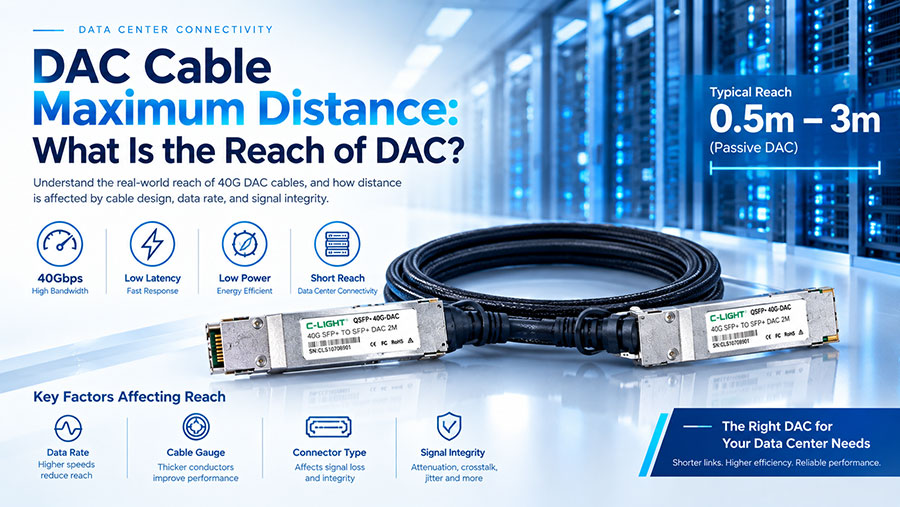
Direct Attach Copper provides a direct electrical connection through copper conductors. Passive DAC is particularly attractive for very short links because it offers low power, low latency, and relatively low cost.
However, electrical loss increases with cable length and data rate, limiting the practical reach of DAC in high-speed AI environments.
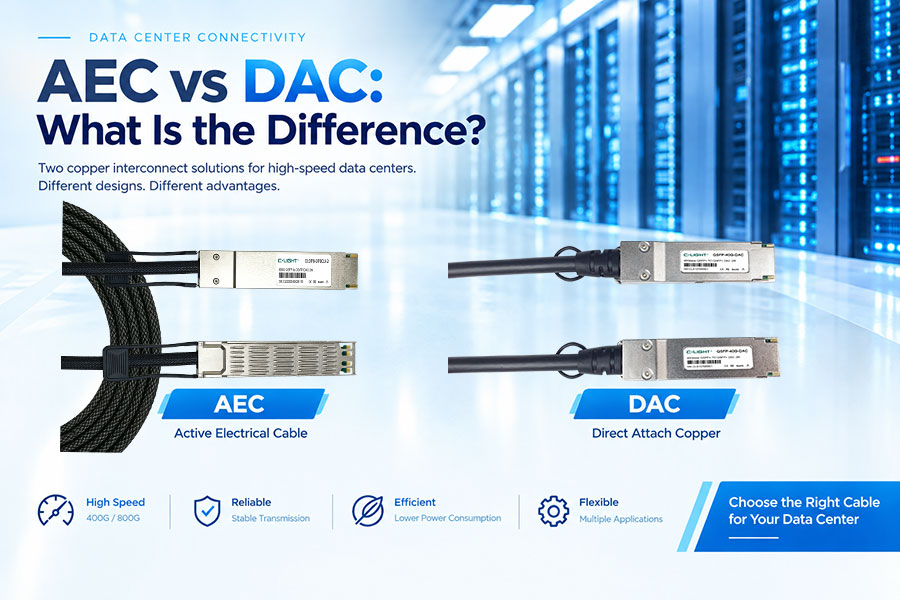
35. AI Optical Interconnect and AEC
Active Electrical Cable uses copper conductors together with active electronics that condition the signal. It can extend the practical reach of electrical interconnect compared with passive DAC.
AEC can therefore occupy an important middle ground between passive copper connectivity and fiber-based optical solutions.
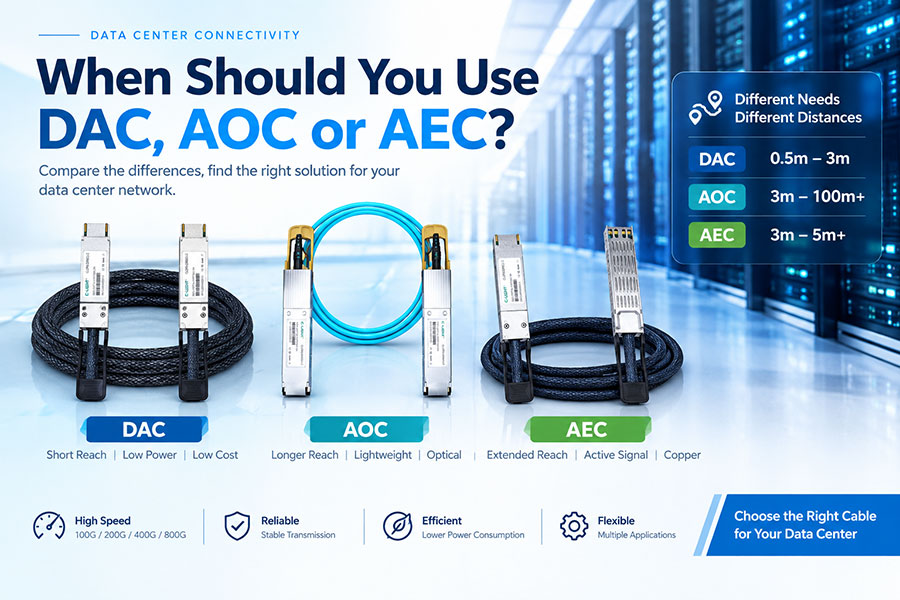
36. DAC vs AEC vs AOC vs Optical Transceiver
| Technology | Medium | Active Electronics | Typical Reach | Main Advantage |
|---|---|---|---|---|
| DAC | Copper | None or minimal | Very short | Low cost and low power |
| AEC | Copper | Yes | Short | Extended electrical reach |
| AOC | Optical fiber | Yes | Short to medium | Integrated fiber assembly |
| Optical Transceiver | Optical fiber | Yes | Short to long | Flexible reach and deployment |
37. AI Optical Interconnect and Single-Mode Fiber
Single-mode fiber is widely used for longer-reach AI network connections. Its small core supports a single primary propagation mode and avoids the modal dispersion associated with multimode fiber.
SMF is particularly important for DR, FR, LR, DWDM, and other optical architectures requiring greater reach or higher fiber utilization.
38. AI Optical Interconnect and Multimode Fiber
Multimode fiber supports multiple propagation modes and is typically used for shorter optical links. VCSEL-based 850 nm architectures are common in short-reach data center applications.
MMF can be attractive when the physical distance is short and the infrastructure is already designed for multimode connectivity.
39. AI Optical Interconnect and Optical Link Budget
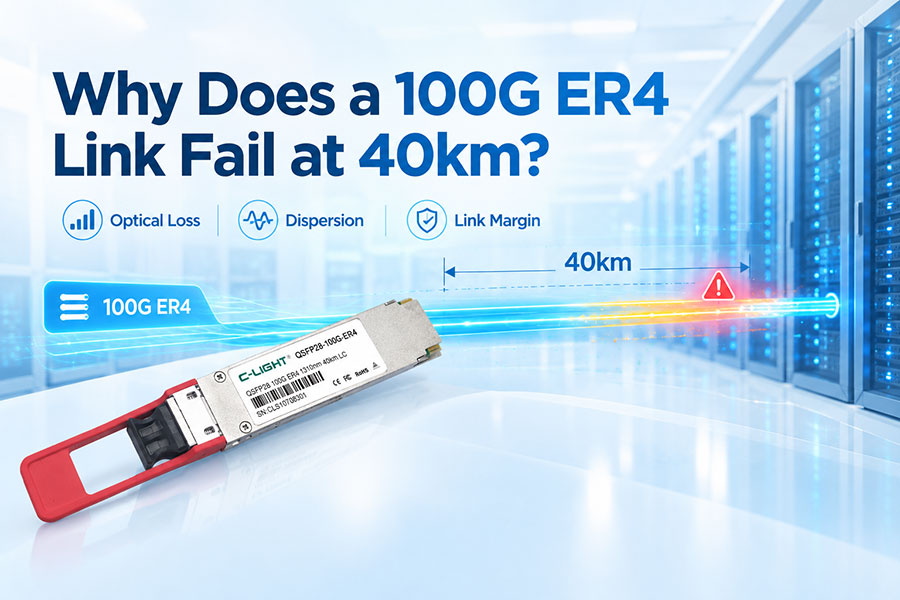
Optical link budget determines whether enough optical power remains at the receiver after accounting for fiber attenuation, connector loss, splice loss, MUX/DEMUX loss, and other passive components.
A simplified relationship is:
Link Margin = Transmitter Launch Power − Total Optical Loss − Receiver Sensitivity Requirement
For AI networks, the link budget must be evaluated against the actual reach and optical architecture rather than relying only on the nominal module distance.
40. AI Optical Interconnect and BER
BER measures the ratio of incorrectly received bits to the total number of tested bits. It is a key indicator of digital transmission reliability.
High BER can result from insufficient optical power, dispersion, noise, jitter, crosstalk, electrical loss, poor transmitter quality, receiver degradation, or interoperability issues.
41. AI Optical Interconnect and FEC
Forward Error Correction adds redundancy to the transmitted data so that the receiver can correct a defined amount of transmission errors.
FEC is particularly important in high-speed AI networking because it allows the physical layer to maintain reliable communication despite a controlled level of raw transmission errors.
42. AI Optical Interconnect and OMA
Optical Modulation Amplitude describes the optical power separation between signal levels. For PAM4 systems, OMA and OMAouter are important transmitter parameters.
OMA should be considered together with eye quality, TDECQ, average optical power, receiver sensitivity, and BER rather than as an isolated measure of optical performance.
43. AI Optical Interconnect and TDECQ
TDECQ is a PAM4 transmitter-quality metric that evaluates effective eye closure caused by noise, distortion, inter-symbol interference, and other impairments.
As AI networks adopt higher lane rates, TDECQ becomes an important parameter for validating transmitter performance at the optical interface.
44. AI Optical Interconnect and Electrical Signal Integrity
The electrical channel between the switch ASIC, PCB, connector, cage, and optical module is a major part of a high-speed link.
Insertion loss, return loss, crosstalk, reflections, impedance discontinuity, and jitter can all reduce available margin, particularly for 100G-per-lane and 200G-per-lane PAM4 interfaces.
45. Why Is 200G per Lane Important?
Moving from 100G-per-lane to 200G-per-lane signaling increases the bandwidth available from each physical lane and provides a path toward 1.6T-class optical interfaces.
At the same time, the higher symbol rate creates tighter requirements for electrical channel loss, transmitter bandwidth, receiver performance, packaging, and thermal management.
46. AI Optical Interconnect and Optical Engines
An optical engine integrates multiple optical transmit and receive functions into a compact assembly. Compared with conventional discrete optical components, a highly integrated optical engine can reduce interconnect length and support higher port density.
Optical engines are important in the development of higher-speed pluggable modules, co-packaged optics, and other next-generation architectures.
47. AI Optical Interconnect and Co-Packaged Optics
Co-packaged optics places optical engines much closer to the switch ASIC than a conventional front-panel pluggable module. The objective is to reduce the electrical distance between the ASIC and optical interface.
This can help address electrical loss and power challenges as SerDes speeds increase, although CPO introduces different packaging, serviceability, thermal, and operational considerations.
48. LPO vs CPO for AI Networks
| Parameter | LPO | CPO |
|---|---|---|
| Optical Position | Pluggable | Close to or integrated with ASIC package |
| In-Module DSP | Reduced or eliminated | Architecture dependent |
| Electrical Path | Shorter than heavily processed pluggable paths | Very short |
| Serviceability | High | More complex |
| Power Potential | Lower module power | High system efficiency potential |
| Deployment Model | Pluggable optics | Integrated optical architecture |
49. AI Optical Interconnect and Fiber Count
Fiber count is a major consideration when building large AI clusters. A fully parallel optical architecture can require multiple fibers per connection, and the total fiber count grows rapidly with cluster size.
WDM architectures can reduce fiber requirements by carrying multiple wavelengths over the same fiber pair, which can simplify cabling in selected applications.
50. AI Optical Interconnect and Rack Density
AI racks can contain a high concentration of compute, networking, power, and cooling infrastructure. Optical connectivity must therefore fit within strict space and thermal constraints.
Higher bandwidth per port can increase network capacity without requiring a proportional increase in physical port count, but the associated module and cabling density must still be managed carefully.
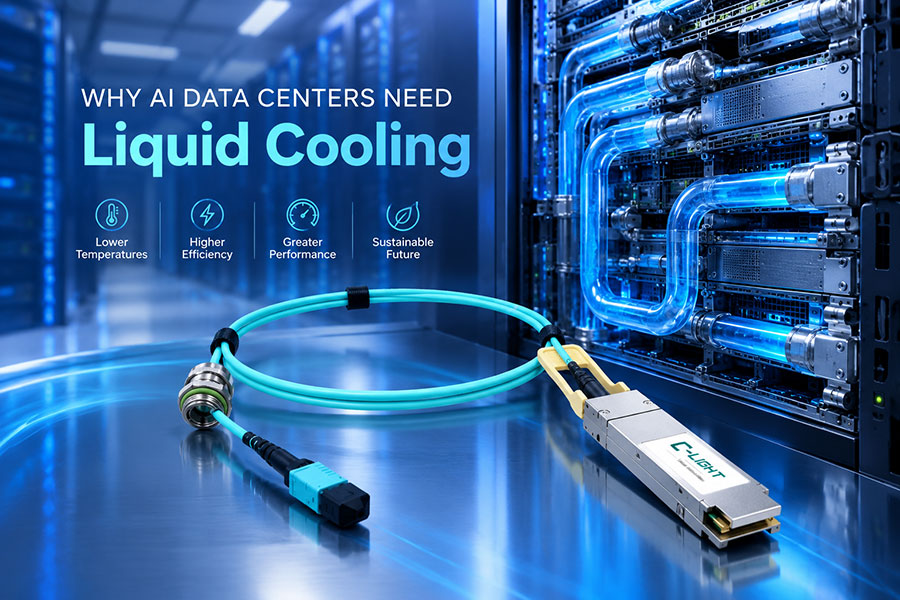
51. AI Optical Interconnect and Liquid Cooling
AI servers and accelerators can generate substantial heat, increasing the importance of advanced cooling systems. Optical module power also contributes to the total switch thermal load, especially in high-density front-panel deployments.
Reducing module power through more efficient optical architectures can therefore support the broader thermal-efficiency goals of AI data centers.
52. AI Optical Interconnect and Network Efficiency
Network efficiency is influenced by bandwidth, latency, packet processing, topology, congestion, link utilization, and optical reliability. A high-speed optical link is useful only when the surrounding network can effectively use its capacity.
Optical interface design should therefore be considered together with switch architecture, NIC performance, traffic patterns, and workload communication requirements.
53. How to Choose an AI Optical Interconnect?
The first step is to determine the physical distance and host interface. Short in-rack connections may favor DAC, while longer rack-to-rack connections may require AEC, AOC, or optical transceivers.
For optical links, the next factors are 800G or 1.6T bandwidth, OSFP or QSFP-DD form factor, MMF or SMF, parallel or WDM architecture, connector type, optical budget, power consumption, thermal environment, and host compatibility.
For large AI deployments, interoperability and fleet-level reliability are also important because a small per-port issue can become significant when multiplied across a large number of network links.
54. AI Optical Interconnect Testing
Validation can include optical output power, receiver sensitivity, wavelength, OMA, TDECQ, BER, eye diagrams, jitter, FEC performance, temperature testing, electrical compliance, and interoperability.
For AI networks, testing should also evaluate the actual switch ASIC, NIC, GPU platform, fiber infrastructure, and optical modules together because system-level behavior can differ from standalone module measurements.
55. Common Challenges in AI Optical Interconnect
Major challenges include increasing lane rates, limited electrical channel margin, optical module power, thermal density, fiber count, connector density, interoperability, manufacturing consistency, and long-term reliability.
As the industry moves toward 1.6T and higher speeds, these challenges increasingly require joint optimization of optical, electrical, mechanical, thermal, and networking technologies.
56. What Is the Future of AI Data Center Optical Interconnect?
The long-term direction is toward higher bandwidth per port, lower power per transmitted bit, shorter electrical paths, greater optical integration, and more efficient use of fiber infrastructure.
Technologies such as 800G, 1.6T, 200G-per-lane PAM4, LPO, optical engines, WDM, and co-packaged optics will likely continue to coexist, with the appropriate architecture depending on reach, topology, power, serviceability, and system requirements.
57. AI Data Center Optical Interconnect FAQ
Q1. What is AI data center optical interconnect?
Q2. Why is optical interconnect important for AI?
Q3. What speeds are used for AI optical interconnect?
Q4. What optical modules are used in AI data centers?
Q5. Why is PAM4 used in AI optical interconnect?
Q6. What is the difference between LPO and DSP optical modules?
Q7. Is DAC suitable for AI data centers?
Q8. Why is single-mode fiber important for AI networks?
58. Summary
AI data center optical interconnect is a critical part of modern GPU and accelerator networking because AI workloads depend on high-bandwidth communication between large numbers of compute nodes. Optical transceivers, AOCs, DACs, AECs, LPO, WDM, and emerging optical-engine technologies provide different approaches for balancing bandwidth, reach, latency, power, thermal performance, fiber count, and system complexity. 400G and 800G are important bandwidth levels for current AI networks, while 1.6T and 200G-per-lane technologies are shaping the next generation. As AI clusters continue to scale, optical interconnect design will increasingly require coordinated optimization across the optical module, electrical channel, switch ASIC, fiber infrastructure, thermal system, and overall network topology.
 >
>

 >
>
 >
>
 >
>
 >
>
 >
>
 >
>
 >
>