TEL:+86 132 6656 7067


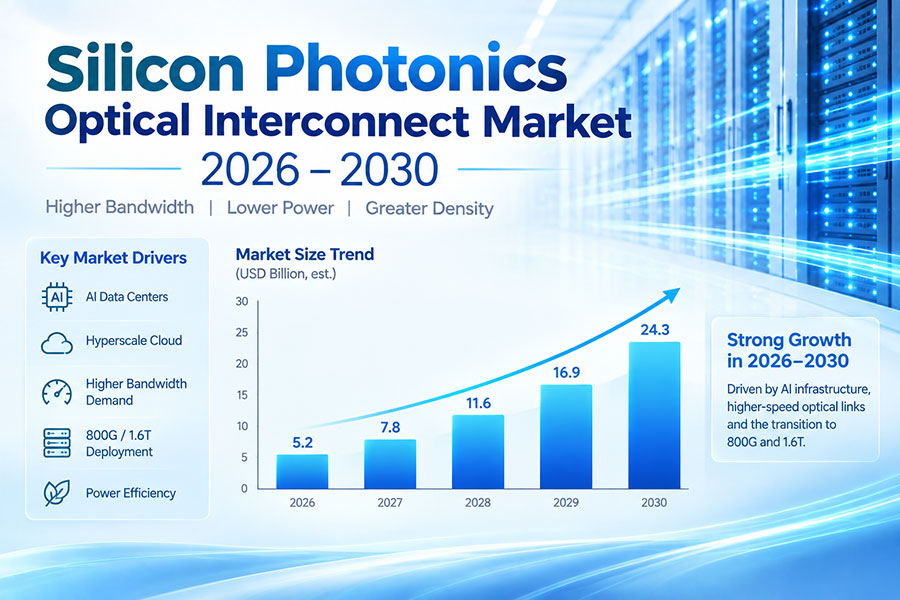
The silicon photonics optical interconnect market is expanding as AI data centers require higher bandwidth, lower power consumption, and greater interconnect density. The technology is increasingly used in 800G and 1.6T optical systems, LPO, CPO, and next-generation data center architectures.
1. What Is the Silicon Photonics Optical Interconnect Market?
The silicon photonics optical interconnect market covers technologies and components that use silicon photonics to transmit high-speed data between servers, switches, accelerators, racks, and other computing systems.
2. Why Is Silicon Photonics Important?
Electrical interconnects face increasing limitations in bandwidth, distance, power consumption, and signal integrity. Silicon photonics enables optical transmission with high bandwidth density and supports continued scaling of data center networks.
3. Silicon Photonics and AI Data Centers
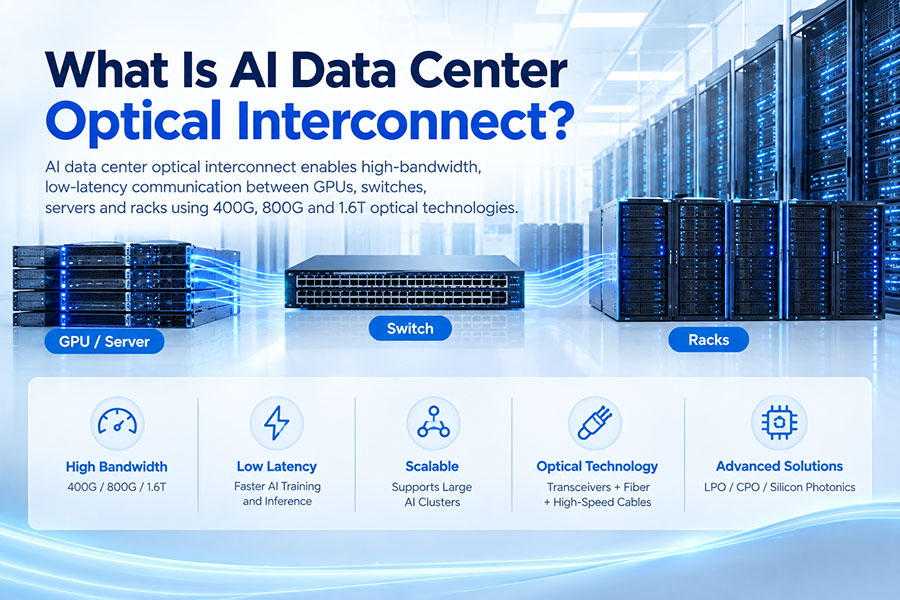
Large AI clusters generate massive communication traffic between GPUs, switches, memory systems, and racks. Higher-speed optical interconnects are becoming increasingly important as 800G and 1.6T platforms expand.
4. Market Growth Drivers
Key growth drivers include AI computing, hyperscale data centers, increasing network bandwidth, higher GPU density, power constraints, and the transition toward 800G and 1.6T connectivity.
5. 800G Optical Interconnect Demand
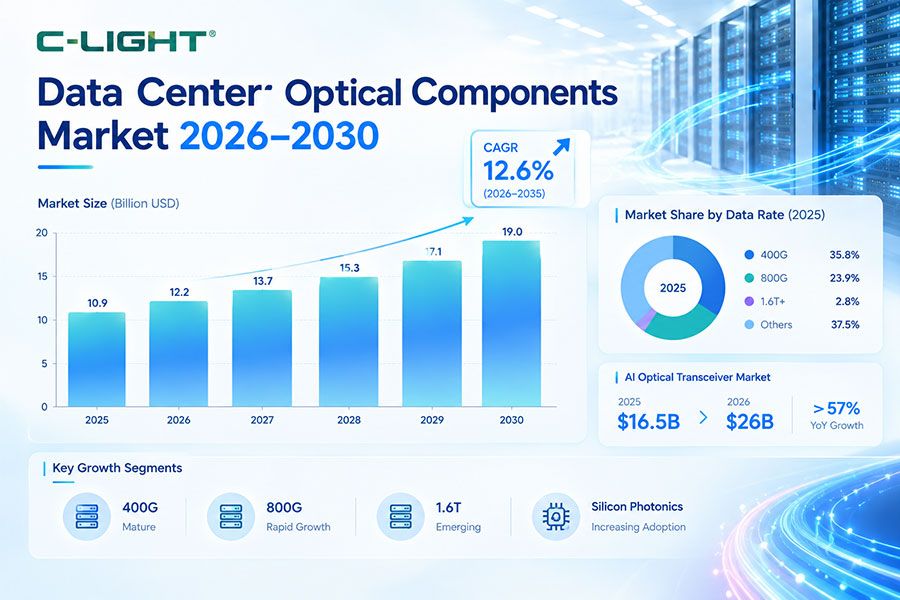
800G optical modules are becoming a major building block for AI networking. Industry forecasts indicate that 800G and above transceiver shipments are rapidly increasing as next-generation AI clusters scale.
6. 1.6T Optical Interconnects
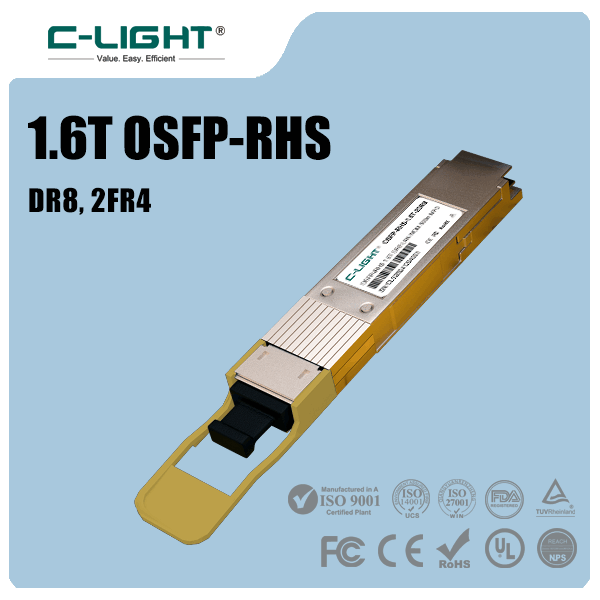
1.6T represents the next major bandwidth step after 800G. Silicon photonics can support the optical integration and packaging requirements associated with higher-speed interfaces.
7. Silicon Photonics Architecture
A silicon photonics system typically integrates optical waveguides, modulators, photodetectors, couplers, and related optical functions on a silicon photonic platform. Laser sources may be integrated or supplied separately depending on the architecture.
8. Silicon Photonics Optical Engine
Optical engines combine optical and electrical functions into compact assemblies. They can improve integration density and provide a scalable approach for high-bandwidth optical interconnects.
9. Silicon Photonics Transceivers
Silicon photonics can be used in pluggable optical transceivers for high-speed Ethernet and data center applications. It is particularly relevant to 400G, 800G, and emerging 1.6T platforms.
10. Silicon Photonics vs Traditional Optical Technology
| Technology | Main Advantage | Typical Application |
|---|---|---|
| Silicon Photonics | High integration and scalability | High-speed data centers |
| Traditional Pluggable Optics | Mature ecosystem | Data center and telecom |
| LPO | Lower power and reduced DSP dependence | Short-reach AI networks |
| CPO | High density and short electrical paths | High-performance switches |
11. Silicon Photonics and LPO
Silicon photonics can be combined with linear-drive architectures such as LPO. By reducing or eliminating conventional DSP functions in suitable designs, LPO can reduce power consumption and latency.
12. Silicon Photonics and CPO
Co-packaged optics integrates optical engines closer to switch ASICs, reducing the electrical distance between the switch and optical interfaces. Silicon photonics is an important platform for implementing these highly integrated optical systems.
13. NPO and Silicon Photonics
Near-packaged optics provides an intermediate architecture between conventional pluggable optics and fully co-packaged designs. Silicon photonics can support compact optical engines positioned close to high-speed switch devices.
14. PAM4 and Silicon Photonics
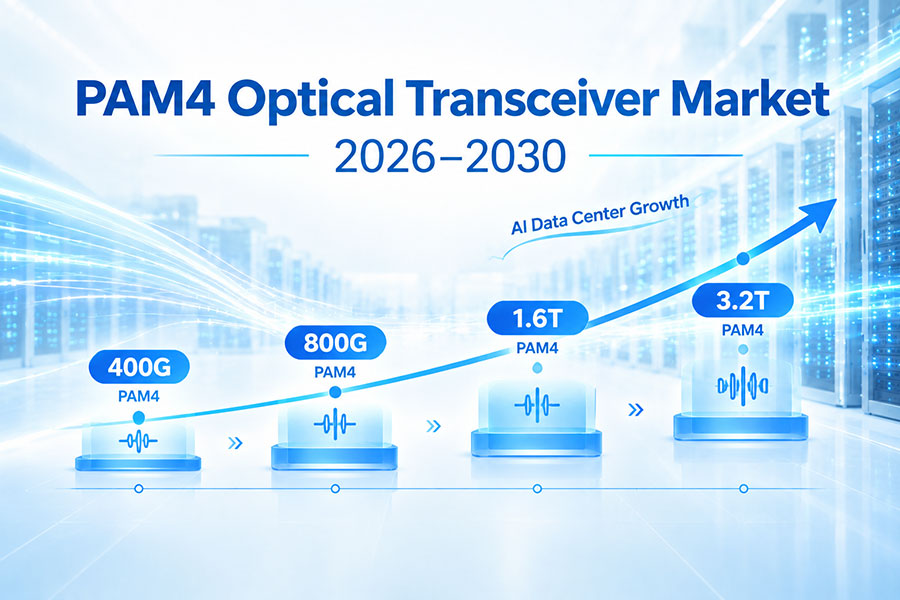
PAM4 signaling is widely used in modern high-speed optical interconnects. 400G commonly uses 8 × 50G PAM4 electrical lanes, 800G uses 8 × 100G PAM4, while 1.6T moves toward 8 × 200G PAM4 architectures.
15. Silicon Photonics and Optical Modulators
Optical modulators convert electrical signals into controlled optical signals. Silicon photonics supports compact modulator structures that can be integrated with other photonic components on the same platform.
16. Silicon Photonics and Lasers
Silicon itself is not an efficient light source for conventional telecommunications wavelengths, so many silicon photonics platforms use external or hybrid laser solutions. Laser availability and capacity are therefore important factors in the optical interconnect supply chain.
17. Silicon Photonics and Photodetectors
Photodetectors convert received optical signals back into electrical signals. Silicon photonics platforms can integrate photodetection functions to reduce component count and improve optical integration.
18. Key Applications
| Application | Role of Silicon Photonics |
|---|---|
| AI Data Centers | High-bandwidth accelerator and switch interconnects |
| Hyperscale Networks | Scalable high-speed optical connectivity |
| Data Center Interconnect | High-capacity rack and site connectivity |
| HPC | Low-latency and high-bandwidth computing networks |
| Optical Switching | High-speed optical network fabrics |
19. Power Efficiency as a Market Driver
As AI systems increase rack power density, the energy consumed by data movement becomes increasingly important. Silicon photonics, LPO, CPO, and related optical architectures are being developed to improve bandwidth per watt.
20. Data Center Bandwidth Evolution
The optical interconnect industry is moving from 400G toward 800G and 1.6T, while future architectures are expected to continue increasing bandwidth density. Silicon photonics provides a scalable platform for these generations.
21. Silicon Photonics Supply Chain
The ecosystem includes silicon photonics foundries, laser suppliers, optical component manufacturers, packaging companies, DSP and driver suppliers, module manufacturers, and testing providers.
22. Manufacturing and Packaging Challenges
Advanced optical packaging is critical because photonic alignment, thermal management, laser coupling, electrical connectivity, and high-volume manufacturing must all be controlled simultaneously.
23. Thermal Management
Higher-speed optical systems generate greater thermal challenges. Efficient optical and electrical integration can help reduce interconnect power, but thermal design remains a major consideration for 800G, 1.6T, and future optical platforms.
24. Silicon Photonics Market Outlook for 2026–2030
| Period | Market Trend |
|---|---|
| 2026 | Rapid adoption of 800G and early expansion of 1.6T |
| 2027 | Greater silicon photonics integration in AI networking |
| 2028 | Growth of optical engines, LPO, and CPO architectures |
| 2029 | Higher optical bandwidth and increasing integration density |
| 2030 | Broader deployment of advanced optical interconnect architectures |
25. Market Competition
Competition is developing across silicon photonics platforms, optical engines, lasers, packaging technologies, pluggable modules, LPO, and CPO. Cost, power efficiency, manufacturing scale, reliability, and ecosystem compatibility are important competitive factors.
26. Silicon Photonics vs Copper Interconnects
Copper remains highly competitive for very short connections because of its simplicity and low cost. Optical interconnects become increasingly attractive as bandwidth, reach, density, and power requirements increase.
27. Silicon Photonics for 800G and 1.6T
800G and 1.6T systems require higher-speed electrical and optical components, improved signal integrity, and tighter thermal budgets. Silicon photonics provides an integration path for these increasingly demanding optical interfaces.
28. Future Development Trends
Major trends include higher-speed silicon photonics platforms, optical engines, LPO, CPO, NPO, advanced packaging, co-designed lasers, and tighter integration between switches and optical interfaces.
29. Key Factors for Market Development
The growth of the silicon photonics optical interconnect market will depend on AI data center investment, optical module demand, component supply, manufacturing yield, packaging capacity, power efficiency, and the commercial adoption of new optical architectures.
30. Conclusion
The silicon photonics optical interconnect market is becoming an important part of the next generation of data center infrastructure. The transition to 800G and 1.6T, together with the development of LPO, CPO, and optical engines, is increasing demand for higher-density and more power-efficient optical connectivity.
 >
>

 >
>
 >
>
 >
>
 >
>
 >
>
 >
>
 >
>