TEL:+86 132 6656 7067


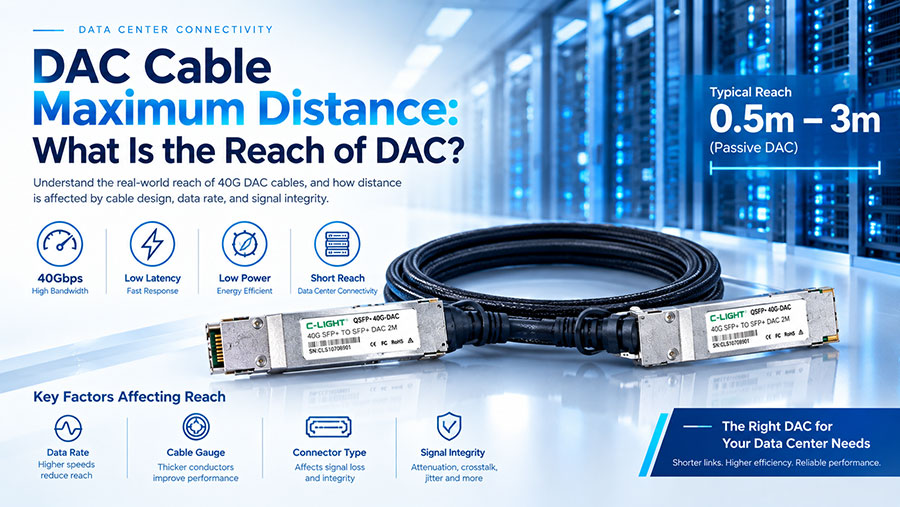
DAC cable maximum distance is mainly determined by cable construction, data rate, electrical signaling, cable gauge, and whether the cable is passive or active. Most DAC cables are designed for short-reach data center connections, typically from around 0.5m to several meters. Understanding the practical reach of DAC is important when selecting 100G, 200G, 400G, or 800G connectivity for servers, switches, GPUs, and AI data center networks.
1. What Is the Maximum Distance of a DAC Cable?
There is no single maximum distance that applies to every DAC cable. The achievable reach depends on the specific DAC design and transmission speed.
In general, passive DAC cables are commonly used for connections of a few meters or less. Active electrical cables can extend the practical reach beyond passive DAC, while optical solutions such as AOC and optical transceivers are normally selected when substantially longer distances are required.
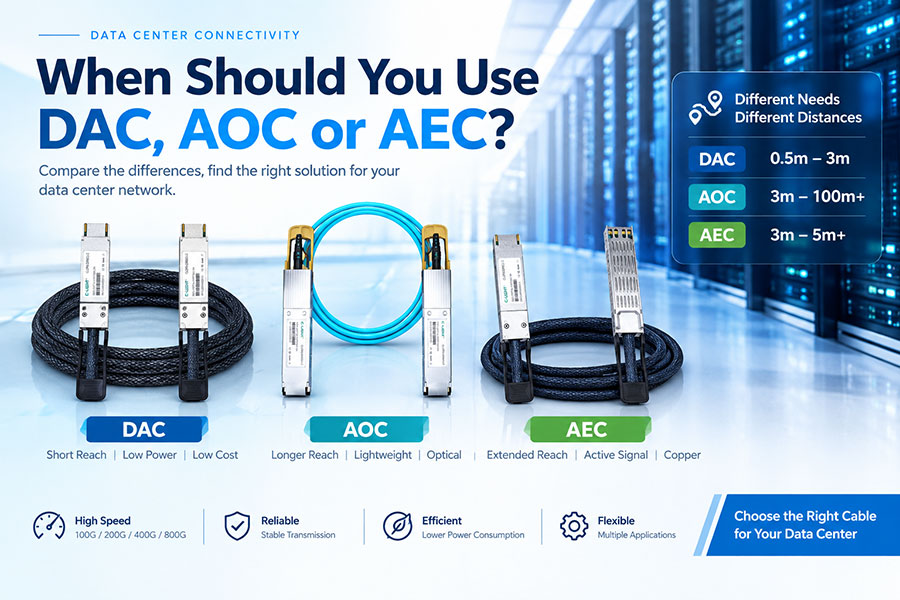
For many data center applications, a practical DAC range is approximately 0.5m to 3m, although specific products can support longer distances depending on the design.
2. How Far Can Passive DAC Reach?
Passive DAC does not contain signal amplification or retiming electronics in the cable assembly. The electrical signal travels directly through the copper conductors between the two connectors.
Because there is no active signal conditioning, passive DAC is primarily intended for short-reach applications. Typical configurations are around 0.5m, 1m, 1.5m, 2m, and 3m, depending on the data rate and cable design.
As the cable becomes longer, attenuation and signal integrity limitations become increasingly important, particularly at higher data rates.
3. How Far Can Active Copper Cable Reach?
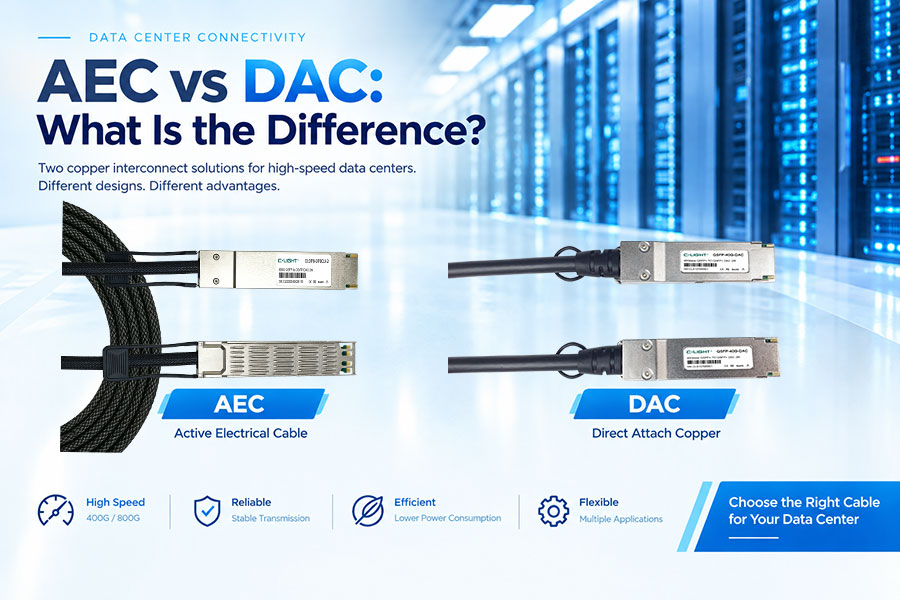
Active copper cables use electronic components to improve signal transmission over longer distances than passive DAC.
For high-speed data center applications, active copper solutions can commonly extend the reach to approximately 3m to 5m, with some specialized designs supporting longer distances.
Active copper can therefore fill the gap between short passive DAC connections and optical connectivity.
4. DAC Cable Distance by Data Rate
| Data Rate | Typical DAC Reach | Common Applications |
|---|---|---|
| 100G | Short-reach, typically a few meters | Server-to-switch, ToR connections |
| 200G | Short-reach, typically a few meters | GPU clusters, HPC, switch connections |
| 400G | Typically 0.5m–3m for DAC | AI data centers, GPU-to-switch, server-to-switch |
| 800G | Typically 0.5m–3m for DAC | AI clusters, HPC, high-speed switch connections |
These ranges are general deployment guidelines rather than universal limits. The actual maximum distance should always be checked against the specific manufacturer's electrical performance specifications.
5. Why Does DAC Have a Short Transmission Distance?
The main limitation is electrical signal attenuation and signal integrity.
As an electrical signal travels through copper, the signal gradually loses energy. At higher frequencies, skin effect, dielectric loss, connector loss, crosstalk, and other high-frequency effects become increasingly significant.
Higher-speed interfaces therefore require carefully controlled cable impedance, connector design, conductor size, shielding, and equalization.
6. Does Higher Data Rate Reduce DAC Distance?
Generally, yes.
As data rates increase, the electrical channel becomes more sensitive to insertion loss, return loss, crosstalk, jitter, and other signal integrity factors. This makes long copper connections increasingly difficult to maintain at very high speeds.
This is one reason why 400G and 800G DAC cables are generally optimized for very short connections rather than long-distance transmission.
7. 400G DAC Maximum Distance
400G DAC is designed primarily for short-reach high-bandwidth connectivity. Common cable lengths include 0.5m to 3m, with shorter configurations frequently used in high-density racks.
400G DAC can connect servers, GPUs, switches, and other network devices without requiring optical conversion.
For connections that exceed the practical copper reach, 400G AOC or 400G optical transceiver solutions are normally more appropriate.
8. 800G DAC Maximum Distance
800G DAC is designed for even higher bandwidth and is mainly used for short-distance connections in AI and HPC data centers.
Typical 800G DAC configurations are around 0.5m to 3m. The exact maximum length depends on the connector architecture, cable construction, electrical interface, and host equipment.
For example, C-LIGHT 800G DAC solutions include short-reach configurations designed for high-density server-to-switch, switch-to-switch, and GPU networking applications.
9. Does Cable Gauge Affect DAC Distance?
Yes. Cable gauge is an important factor in DAC electrical performance.
Lower AWG numbers generally indicate thicker conductors, which can provide lower electrical resistance and help reduce signal loss. However, thicker cables are also heavier and less flexible, which can create cable-management challenges in high-density racks.
High-speed DAC designs therefore balance conductor size, attenuation, flexibility, thermal characteristics, and mechanical requirements.
10. Does Connector Type Affect DAC Reach?
Yes. High-speed DAC performance depends not only on the copper cable but also on the connectors and electrical interfaces at both ends.
400G and 800G DAC products can use different form factors, including QSFP-DD, QSFP112, OSFP, and related high-speed interfaces.
Connector insertion loss, return loss, crosstalk, contact quality, and mechanical design all contribute to the overall electrical channel performance.
11. DAC Distance and PAM4 Signaling
Many modern 200G, 400G, and 800G interfaces use PAM4 signaling to increase data transmission per electrical lane.
PAM4 carries more information per symbol than traditional NRZ signaling, allowing higher aggregate bandwidth without proportionally increasing the number of physical lanes. However, PAM4 also introduces tighter signal integrity requirements.
For DAC applications, this means cable loss, crosstalk, jitter, connector performance, and equalization become especially important at higher speeds.
12. DAC vs AOC Distance
| Feature | DAC | AOC |
|---|---|---|
| Transmission medium | Copper | Optical fiber |
| Typical reach | Short | Longer than DAC |
| Power consumption | Very low for passive DAC | Higher |
| Cable weight | Higher | Lower |
| Signal transmission | Electrical | Optical |
| Typical use | Intra-rack and short links | Longer data center connections |
AOC is generally preferred when the required distance exceeds the practical range of copper or when lower cable weight and easier routing are important.
13. DAC vs Optical Modules Distance
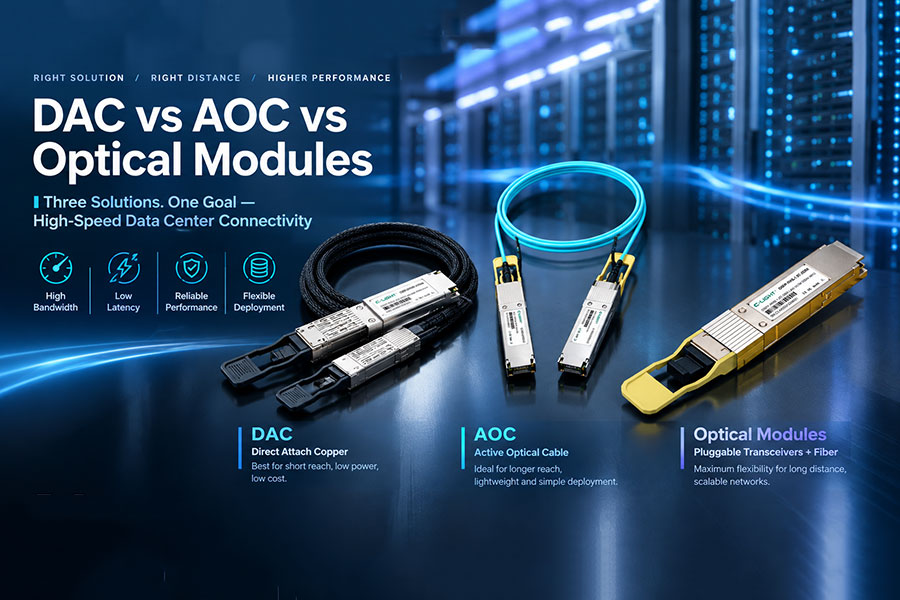
Optical modules provide substantially greater reach flexibility than DAC.
A DAC cable has fixed connectors and a fixed cable length. An optical module system uses separate transceivers and fiber cables, allowing the network designer to select different optical technologies and fiber types according to the required distance.
This makes optical modules more suitable for leaf-spine networks, longer data center links, data center interconnects, and telecommunications applications.
14. Can DAC Be Used for 10m?
DAC is generally not the first choice for a 10m high-speed connection, particularly at 400G or 800G.
At this distance, copper cable loss, cable thickness, routing difficulty, and signal integrity can become significant concerns. An AOC or optical module with fiber is normally a more practical solution.
Specific active copper products may support longer distances, but the manufacturer's specified channel performance should be checked before deployment.
15. Can DAC Be Used Between Two Racks?
It depends on the physical distance between the racks.
If two racks are located very close together and the required link remains within the specified DAC reach, DAC can be used. However, when rack-to-rack distances become several meters or more, AOC or optical modules are usually easier to manage.
Fiber also provides advantages in dense environments because it is lighter and generally easier to route over longer distances.
16. DAC Cable for AI Data Centers
AI data centers use large numbers of high-speed connections between GPUs, servers, switches, and network fabrics. Short physical distances make DAC an attractive solution for specific portions of the network.
400G and 800G DAC can be used for short GPU-to-switch, server-to-switch, and intra-rack connections where low power, low latency, and simple deployment are important.
For longer links between racks or network zones, optical technologies become increasingly practical.
17. DAC Distance for GPU-to-Switch Connections
GPU-to-switch connections are often located within the same rack or within a short physical distance. This makes DAC particularly suitable for selected GPU cluster architectures.
When the physical layout requires longer cable runs, designers need to consider whether extending copper cables is worthwhile compared with switching to AOC or optical modules.
The decision should consider not only maximum reach but also cable density, airflow, weight, power consumption, and maintenance.
18. How to Choose the Right DAC Cable Length?
The best DAC length is usually the shortest cable that can comfortably complete the required connection without creating excessive routing tension or congestion.
For example:
0.5m–1m: Suitable for very short device-to-device connections.
1m–2m: Common for server-to-switch and short rack connections.
2m–3m: Useful for longer intra-rack connections.
3m–5m: More commonly associated with active copper solutions or specific designs.
Beyond several meters: Consider AOC or optical modules.
19. What Happens If a DAC Cable Is Too Long?
Using a cable beyond its specified reach can reduce signal quality and potentially cause link instability.
Possible issues include increased insertion loss, degraded eye opening, higher jitter, increased bit error rate, and failure to establish the expected link speed.
For high-speed PAM4 systems, these problems can become particularly important because the signal has tighter electrical margins.
20. How Is DAC Maximum Distance Tested?
DAC performance should be evaluated as part of the complete electrical channel rather than by cable length alone.
Typical validation can include:
Insertion loss testing
Return loss testing
Near-end and far-end crosstalk testing
Eye diagram analysis
Jitter testing
BER testing
PAM4 signal integrity testing
Host compatibility testing
For high-speed 400G and 800G DAC, these measurements help verify that the cable can maintain reliable transmission at its specified length.
21. C-LIGHT DAC Cable Distance Options
C-LIGHT provides high-speed DAC solutions for short-reach data center connectivity, including 400G and 800G DAC configurations.
C-LIGHT 400G DAC products include multiple connector combinations and cable lengths, with configurations commonly covering 0.5m to 3m. They are designed for applications such as AI data centers, GPU-to-switch connections, server-to-switch links, HPC, and short-distance data center switching.
C-LIGHT 800G DAC products are also designed for short-reach high-bandwidth connectivity. Typical configurations cover approximately 0.5m to 2m for several product types, while specific configurations and active copper solutions can support different distances.
The appropriate cable length should be selected according to the exact product specification, host interface, and required transmission environment.
22. DAC Cable Maximum Distance: Key Takeaways
DAC is fundamentally a short-reach connectivity technology. Its maximum distance is not determined by bandwidth alone, but by the complete electrical channel, including the cable, connectors, host interfaces, and signal-conditioning technology.
For most passive DAC applications, 0.5m to 3m is a practical range. Active copper can extend the reach further, while AOC and optical modules are better suited to longer connections.
For 400G and 800G AI data center networks, DAC is particularly valuable for short GPU-to-switch, server-to-switch, and intra-rack connections where low power, low latency, and cost efficiency are priorities.
 >
>

 >
>
 >
>
 >
>
 >
>
 >
>
 >
>
 >
>