TEL:+86 132 6656 7067


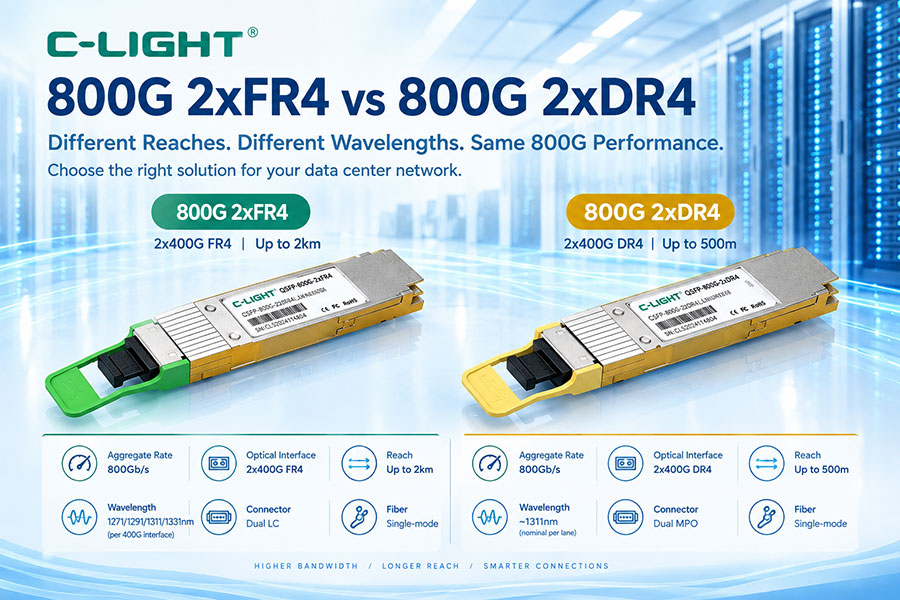
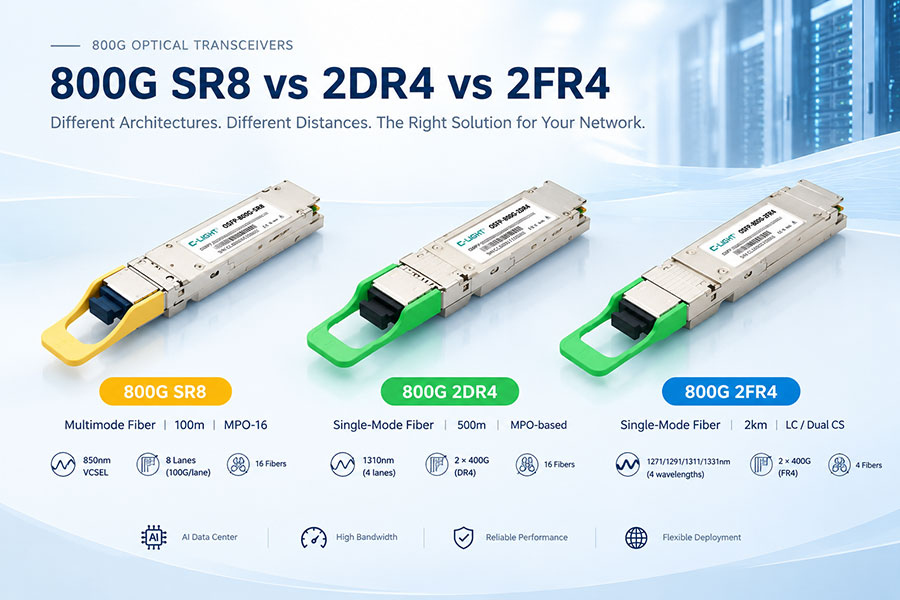
800G 2xFR4 and 800G 2xDR4 are high-speed optical transceivers designed for 800Gbps data center connectivity. Both provide two 400G optical interfaces, but they differ significantly in transmission distance, optical architecture, wavelength configuration, connectors, and application scenarios.
1. What Is 800G 2xFR4?
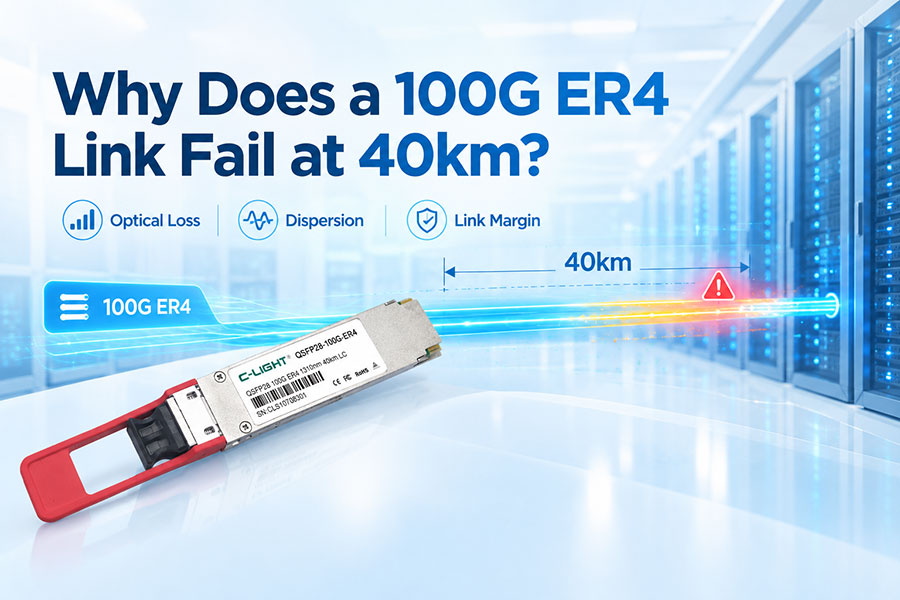
800G 2xFR4 is an 800Gbps optical transceiver based on two 400GBASE-FR4 optical interfaces. It supports a maximum transmission distance of 2km over single-mode fiber and uses four LAN-WDM wavelengths for each 400G interface.
2. What Is 800G 2xDR4?
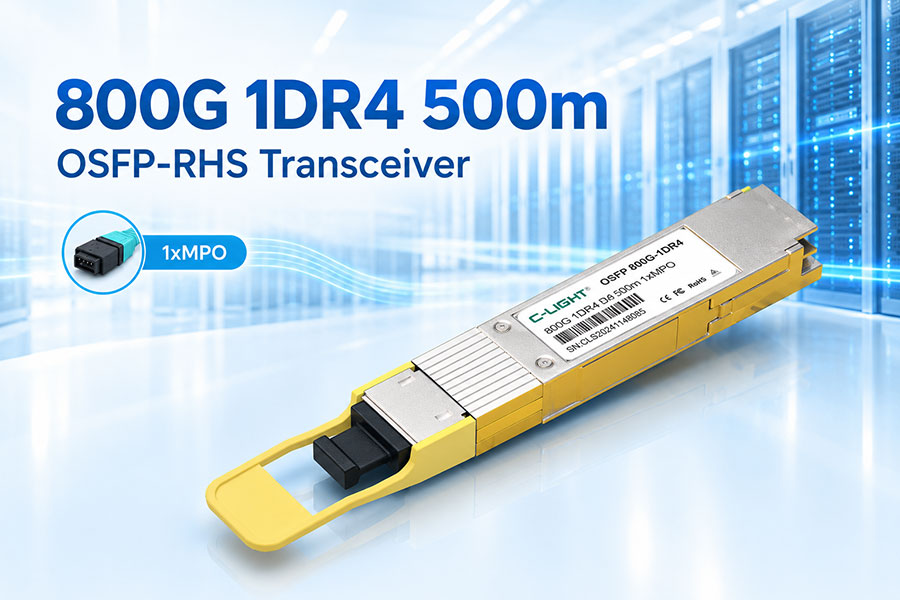
800G 2xDR4 is an 800Gbps optical transceiver based on two 400GBASE-DR4 optical interfaces. It supports up to 500m over single-mode fiber and uses parallel single-lane 100G DR optical channels.
3. 800G 2xFR4 vs 2xDR4: Basic Comparison
| Specification | 800G 2xFR4 | 800G 2xDR4 |
|---|---|---|
| Aggregate Data Rate | 850Gb/s | 850Gb/s |
| Optical Interface | 2x400GBASE-FR4 | 8x100GBASE-DR |
| Reach | Up to 2km | Up to 500m |
| Fiber | Single-mode fiber | Single-mode fiber |
| Wavelength | 1271/1291/1311/1331nm per 400G interface | 1311nm nominal per lane |
| Connector | Dual LC | Dual MPO |
| Electrical Interface | 2x400GAUI-4 C2M | 8x100GAUI-1 C2M |
| Optical Technology | LAN-WDM FR4 | DR4 parallel optics |
| Typical Use | Longer data center links | Shorter high-density links |
4. Transmission Distance
The most obvious difference is transmission distance. The 800G 2xFR4 model supports up to 2km, while the 800G 2xDR4 model supports up to 500m.
This makes 2xFR4 more suitable when the optical link must cover longer distances between racks, rows, or data center areas. The 2xDR4 architecture is better suited to shorter connections where 500m is sufficient.
5. Wavelength Configuration
800G 2xFR4 uses four LAN-WDM wavelength channels for each 400G optical interface, centered around 1271nm, 1291nm, 1311nm, and 1331nm.
800G 2xDR4 uses parallel DR optical channels with a nominal wavelength around 1311nm. Each 100G lane operates as an independent optical channel.
6. Optical Architecture
2xFR4 combines four wavelengths into each 400G optical interface. The complete module therefore provides two 400G FR4 optical interfaces.
2xDR4 uses eight 100GBASE-DR optical channels to form the complete 800G link. Two groups of four 100G channels provide the equivalent of two 400G DR interfaces.
7. Connector Difference
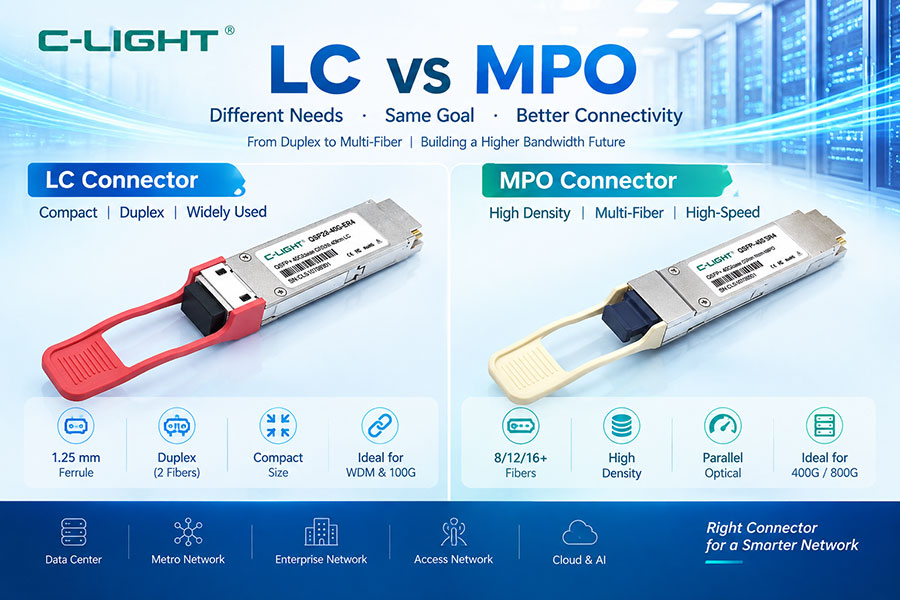
800G 2xFR4 uses dual LC connectors. This makes it compatible with conventional duplex single-mode fiber cabling and can simplify connections where LC infrastructure is already available.
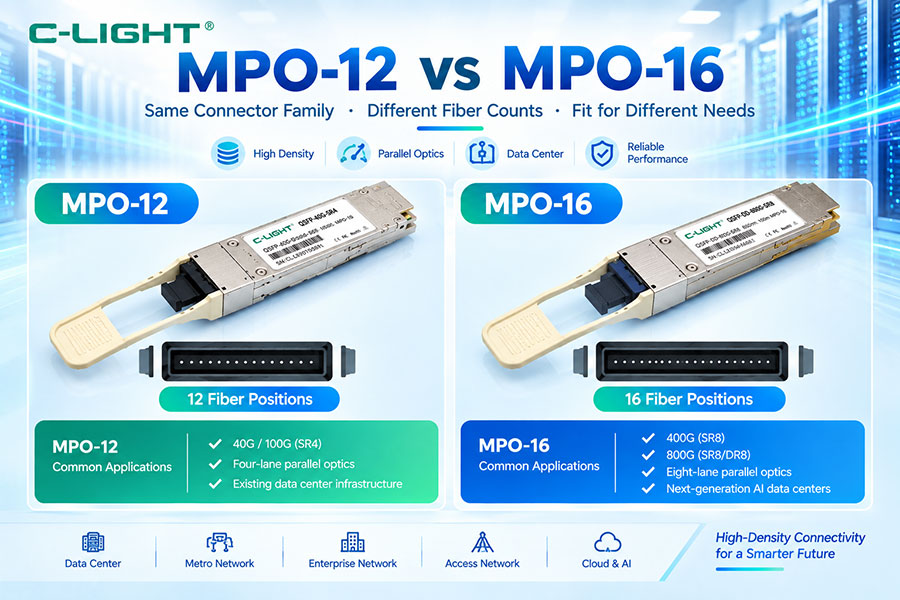
800G 2xDR4 uses dual MPO connectivity, providing higher optical channel density for parallel-fiber connections.
8. Electrical Interface Difference
The 800G 2xFR4 transceiver uses two 400GAUI-4 C2M electrical interfaces, while the 800G 2xDR4 transceiver uses eight 100GAUI-1 C2M electrical interfaces.
Both architectures deliver approximately 800Gbps aggregate bandwidth, but they divide the electrical and optical channels differently.
9. 800G 2xFR4 Optical Specifications
The 800G 2xFR4 module uses EML transmitters and single-mode fiber. Each optical channel is based on a LAN-WDM wavelength, with typical center wavelengths of 1271nm, 1291nm, 1311nm, and 1331nm.
The datasheet specifies an average launch power of -3.2 to 4.4dBm per lane and a maximum TDECQ of 3.4dB.
10. 800G 2xDR4 Optical Specifications
The 800G 2xDR4 module also uses EML transmitters and single-mode fiber. Its optical channels operate around a nominal 1311nm wavelength range of 1304.5 to 1317.5nm.
The specified average launch power is -2.9 to 4.0dBm per lane, with a maximum TDECQ of 3.4dB.
11. Fiber Type
Both 800G 2xFR4 and 800G 2xDR4 are designed for single-mode fiber. The main difference is therefore not the fiber type, but the optical architecture and supported reach.
12. Why Does 2xFR4 Reach 2km?
2xFR4 uses four-wavelength LAN-WDM transmission and is designed for longer-reach single-mode fiber links. Its optical architecture supports links up to 2km while maintaining 800Gbps aggregate bandwidth.
13. Why Is 2xDR4 Limited to 500m?
2xDR4 is optimized for shorter-reach parallel optical connectivity. Its 100G DR channels are designed around a 500m transmission target, making it suitable for high-density connections within a data center.
14. Power and Operating Temperature
Both modules support a case operating temperature of 0°C to 70°C and include digital diagnostic monitoring through a two-wire serial interface.
15. Standards and Compliance
800G 2xFR4 is designed around 2x400GBASE-FR4 optical interfaces and 2x400GAUI-4 electrical interfaces.
800G 2xDR4 is designed around 8x100GBASE-DR optical interfaces and 8x100GAUI-1 electrical interfaces. Both designs are based on 800G optical networking standards and OSFP form-factor requirements.
16. 800G 2xFR4 for Longer Data Center Links
2xFR4 is a strong choice for connections where 500m is not enough. Its 2km reach provides more flexibility for rack-to-rack, row-to-row, and larger data center interconnections.
17. 800G 2xDR4 for High-Density Connections
2xDR4 is suitable for shorter high-bandwidth connections where parallel optical transmission and MPO connectivity are preferred. It can be used in AI clusters, GPU networks, HPC systems, and high-density switch interconnects.
18. 2xFR4 vs 2xDR4 for AI Data Centers
AI data centers require high-bandwidth interconnects between switches, GPU systems, servers, and racks. Both 2xFR4 and 2xDR4 can provide 800Gbps connectivity, but the appropriate choice depends on link distance and cabling architecture.
For links extending beyond 500m, 2xFR4 provides a significant reach advantage. For shorter links within the same data center area, 2xDR4 can provide a practical high-density solution.
19. 2xFR4 vs 2xDR4: LC or MPO?
Choose 2xFR4 when duplex LC connectivity is preferred. Choose 2xDR4 when MPO-based parallel-fiber infrastructure is already deployed or when high-density optical connectivity is required.
20. 2xFR4 vs 2xDR4: 2km or 500m?
The choice can often be made directly from the required link distance. 2xDR4 supports up to 500m, while 2xFR4 extends the maximum specified reach to 2km.
21. 2xFR4 vs 2xDR4: Which Is More Suitable?
Neither architecture is universally better. 2xFR4 is more suitable for longer single-mode fiber links and LC-based deployment. 2xDR4 is more suitable for shorter links, parallel-fiber connectivity, and MPO-based high-density environments.
22. How to Choose Between 800G 2xFR4 and 2xDR4
Consider four factors: transmission distance, connector type, existing fiber infrastructure, and switch or system interface requirements.
For links up to 500m with MPO infrastructure, 2xDR4 is a practical option. For links requiring up to 2km and LC connectivity, 2xFR4 is generally the better fit.
23. 800G 2xFR4 and 2xDR4 in Switch-to-Switch Networks
Both transceivers can be used for 800G switch-to-switch connections. The final selection depends on the distance between switches and the optical cabling already deployed.
24. 800G 2xFR4 and 2xDR4 in GPU Clusters
AI and HPC clusters increasingly use 800G connectivity to support high-bandwidth traffic between switches and accelerator systems. 2xDR4 is suitable for shorter high-density links, while 2xFR4 offers additional reach for larger physical layouts.
25. 800G 2xFR4 vs 2xDR4 Summary
800G 2xFR4 and 800G 2xDR4 both provide 800Gbps-class optical connectivity, but their architectures are optimized for different deployment conditions.
2xFR4 provides up to 2km transmission using four LAN-WDM wavelengths per 400G interface and dual LC connectors. 2xDR4 provides up to 500m using eight 100GBASE-DR optical channels and dual MPO connectivity.
 >
>

 >
>
 >
>
 >
>
 >
>
 >
>
 >
>
 >
>