TEL:+86 132 6656 7067


1. AI Infrastructure Is Reaching a New Scaling Limit
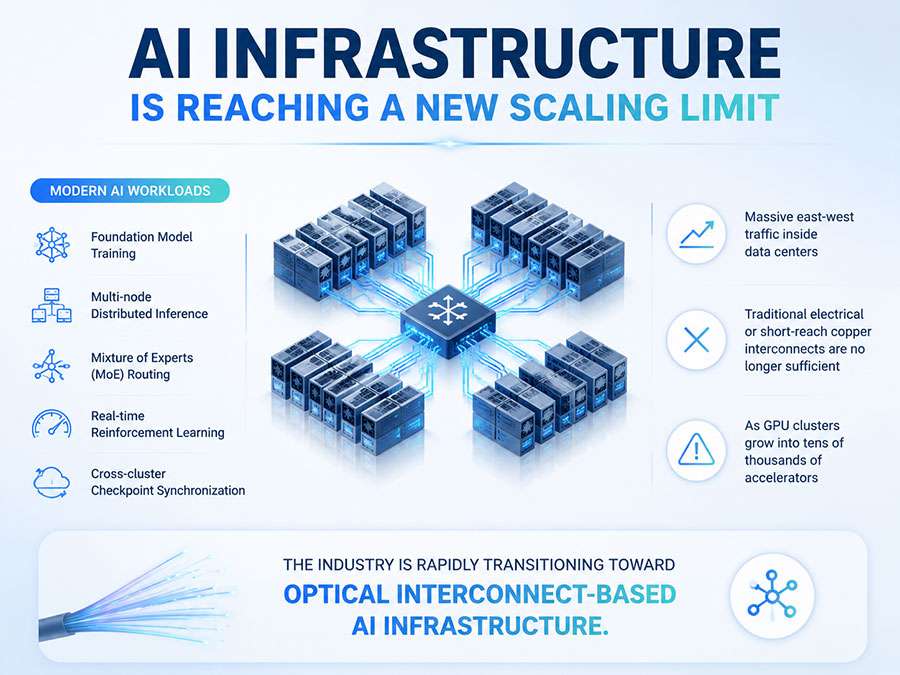
Artificial Intelligence has entered an era of unprecedented computational scale. Modern AI systems are no longer limited by compute alone—they are fundamentally constrained by data movement and network efficiency.
Large-scale AI workloads such as:
Foundation model training
Multi-node distributed inference
Mixture of Experts (MoE) routing
Real-time reinforcement learning
Cross-cluster checkpoint synchronization
generate massive east-west traffic inside data centers.
As GPU clusters grow into tens of thousands of accelerators, traditional electrical or short-reach copper interconnects are no longer sufficient.
The industry is rapidly transitioning toward optical interconnect-based AI infrastructure.
2. Why Optical Interconnects Are Becoming Essential
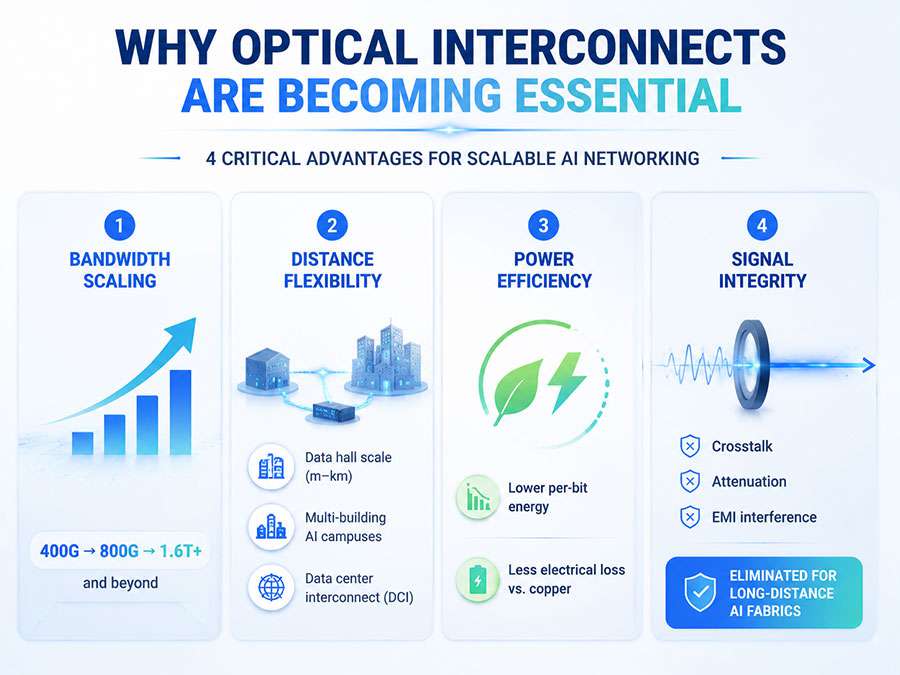 Optical interconnects provide the foundation for scalable AI networking because they solve four critical challenges:
Bandwidth Scaling
Optical systems naturally support the evolution from:
400G → 800G → 1.6T and beyond
Distance Flexibility
Unlike DAC copper solutions, optical links support:
Data hall scale (meters to kilometers)
Multi-building AI campuses
Data center interconnect (DCI)
Power Efficiency
As AI racks exceed 40kW–100kW power density:
Reducing per-bit energy consumption becomes critical
Optical links reduce electrical loss compared to copper-based signaling
Signal Integrity
High-speed SerDes systems suffer from:
Crosstalk
Attenuation
EMI interference
Optical transmission eliminates these constraints for long-distance AI fabrics.
3. AI Network Evolution: From Copper to Full Optical Fabric
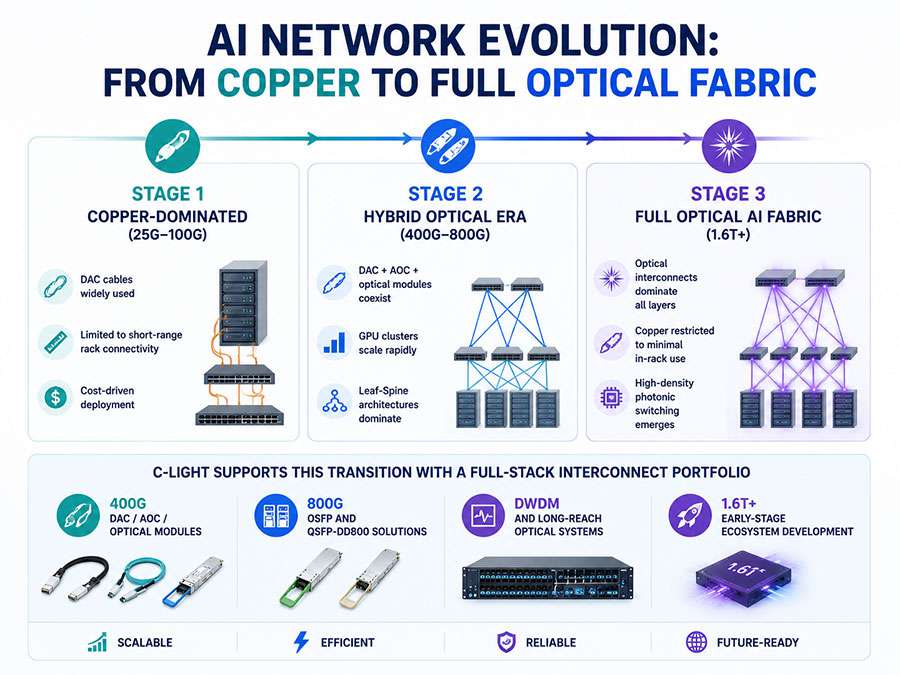
AI data center networks are evolving in three stages:
Stage 1: Copper-Dominated (25G–100G)
DAC cables widely used
Limited to short-range rack connectivity
Cost-driven deployment
Stage 2: Hybrid Optical Era (400G–800G)
DAC + AOC + optical modules coexist
GPU clusters scale rapidly
Leaf-Spine architectures dominate
Stage 3: Full Optical AI Fabric (1.6T+)
Optical interconnects dominate all layers
Copper restricted to minimal in-rack use
High-density photonic switching emerges
C-LIGHT supports this transition with a full-stack interconnect portfolio:
400G DAC / AOC / optical modules
800G OSFP and QSFP-DD800 solutions
DWDM and long-reach optical systems
Early-stage 1.6T ecosystem development
4. Where Optical Interconnects Are Used in AI Data Centers
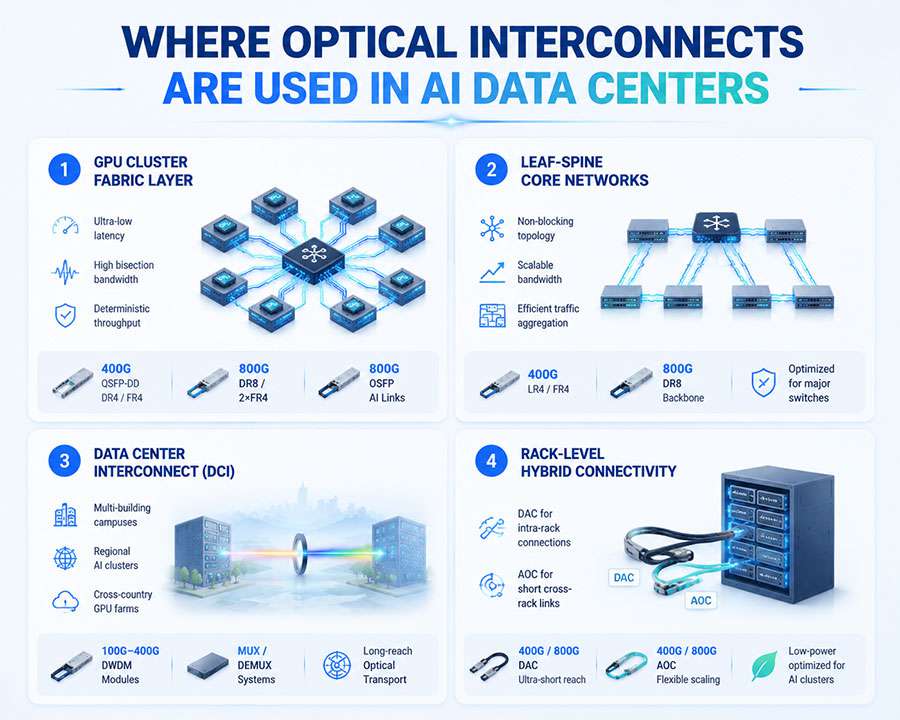
4.1 GPU Cluster Fabric Layer
In modern AI clusters, GPU-to-GPU communication is the most bandwidth-intensive workload.
Typical requirements include:
Ultra-low latency synchronization
High bisection bandwidth
Deterministic throughput under load
C-LIGHT solutions include:
400G QSFP-DD DR4 / FR4 optical modules
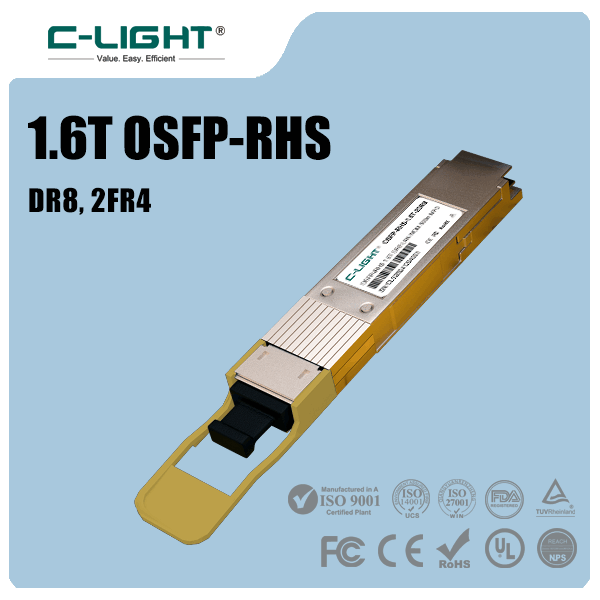
800G DR8 / 2×FR4 interconnects
800G OSFP high-density AI links
These products ensure stable performance in NVIDIA-based AI training clusters.
4.2 Leaf-Spine Core Networks
The leaf-spine architecture remains the backbone of scalable AI infrastructure.
Optical interconnects enable:
Non-blocking topology design
Scalable bandwidth expansion
Efficient traffic aggregation
C-LIGHT provides:
400G LR4 / FR4 optical transceivers
800G DR8 backbone interconnects
Compatibility-optimized solutions for major switch platforms
4.3 Data Center Interconnect (DCI)
AI is no longer confined to a single data hall.
Modern deployments span:
Multi-building campuses
Regional AI clusters
Cross-country GPU farms
Optical interconnects using DWDM systems are essential for:
High-capacity long-distance transmission
Fiber resource optimization
Scalable AI cloud expansion
C-LIGHT DWDM portfolio includes:
100G–400G DWDM optical modules
MUX/DEMUX systems
Long-reach optical transport solutions
4.4 Rack-Level Hybrid Connectivity
Even in optical-centric architectures, copper still plays a role:
DAC for intra-rack GPU connections
AOC for short cross-rack deployments
C-LIGHT provides:
400G/800G DAC for ultra-short reach
400G/800G AOC for flexible rack scaling
Low-power interconnect optimization for AI clusters
5. Why 400G and 800G Are the Foundation of Optical Evolution
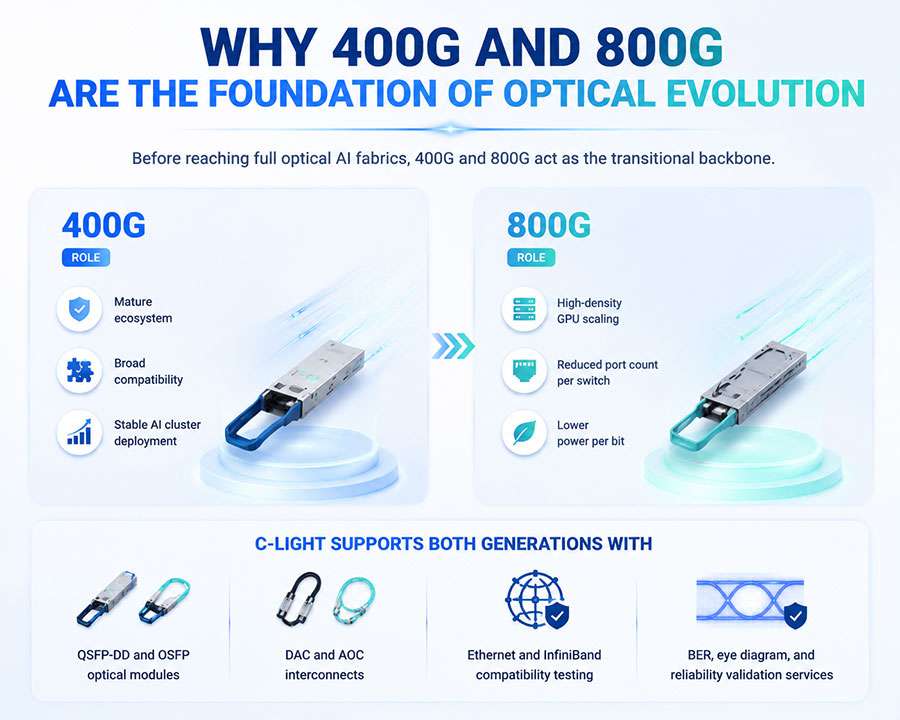
Before reaching full optical AI fabrics, 400G and 800G act as the transitional backbone.
400G Role:
Mature ecosystem
Broad compatibility
Stable AI cluster deployment
800G Role:
High-density GPU scaling
Reduced port count per switch
Lower power per bit
C-LIGHT supports both generations with:
QSFP-DD and OSFP optical modules
DAC and AOC interconnects
Ethernet and InfiniBand compatibility testing
BER, eye diagram, and reliability validation services
6. The Road Toward 1.6T Optical AI Networks
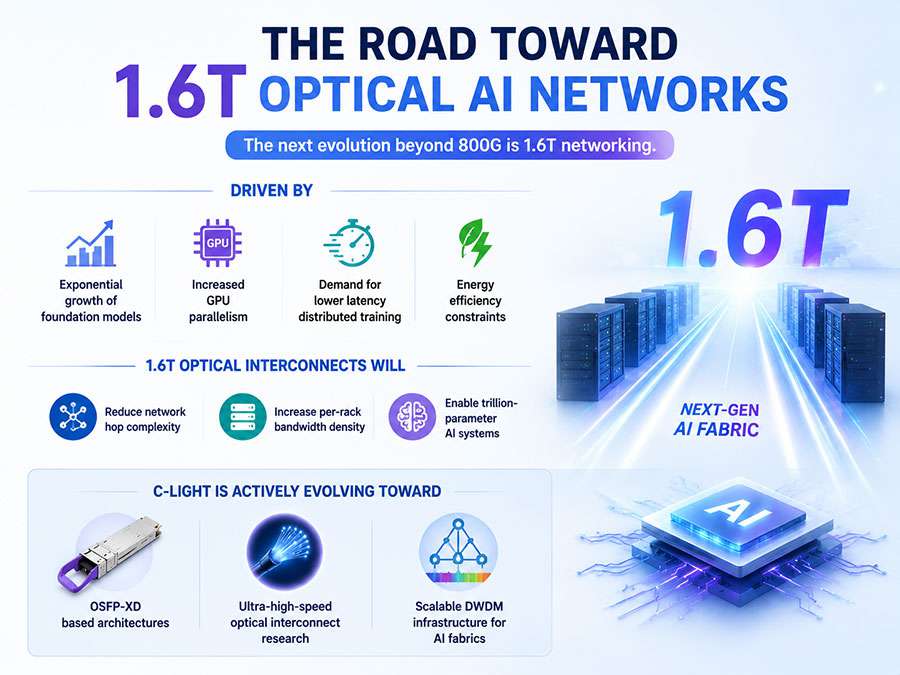
The next evolution beyond 800G is 1.6T networking.
This transition is driven by:
Exponential growth of foundation models
Increased GPU parallelism
Demand for lower latency distributed training
Energy efficiency constraints
1.6T optical interconnects will:
Reduce network hop complexity
Increase per-rack bandwidth density
Enable trillion-parameter AI systems
C-LIGHT is actively evolving toward:
OSFP-XD based architectures
Ultra-high-speed optical interconnect research
Scalable DWDM infrastructure for AI fabrics
7. Why the Future of AI Depends on Optical Interconnects
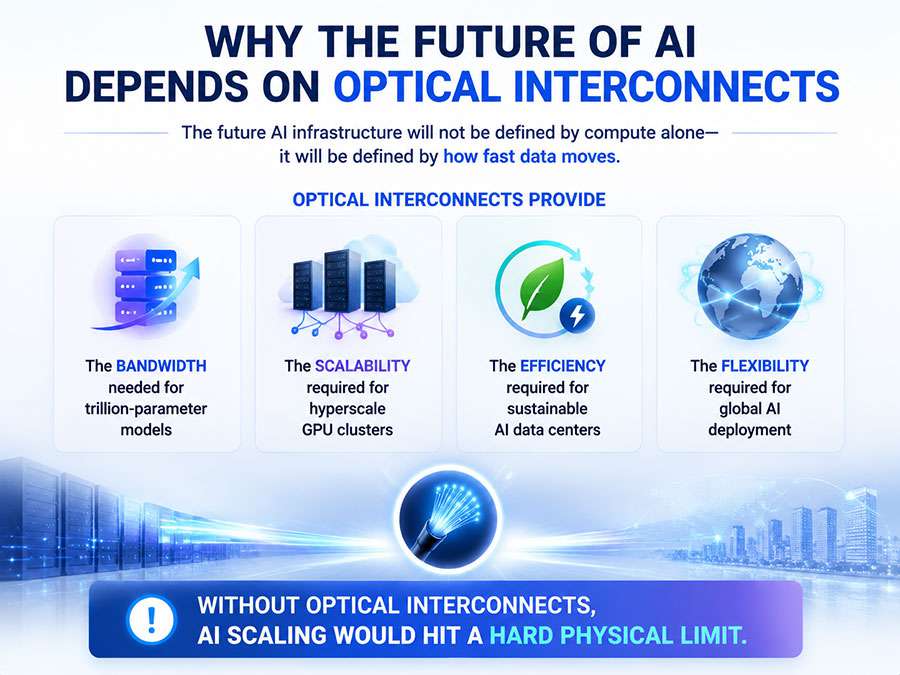 The future AI infrastructure will not be defined by compute alone—it will be defined by how fast data moves.
Optical interconnects provide:
The bandwidth needed for trillion-parameter models
The scalability required for hyperscale GPU clusters
The efficiency required for sustainable AI data centers
The flexibility required for global AI deployment
Without optical interconnects, AI scaling would hit a hard physical limit.
8. Conclusion
The evolution of AI infrastructure is fundamentally an evolution of networking.
Copper (DAC) enables short-range efficiency
AOC bridges flexible medium-distance connectivity
Optical transceivers unlock scalable AI fabrics
Together, they form a complete interconnect ecosystem—but the long-term foundation of AI scalability is clearly optical.
C-LIGHT delivers a full portfolio spanning:
400G AI interconnect solutions
800G high-density optical modules
DAC and AOC for rack-level optimization
DWDM systems for global AI connectivity
Next-generation 1.6T readiness roadmap
As AI continues to scale toward trillion-parameter systems, optical interconnects will define the future of AI infrastructure.
 >
>

 >
>
 >
>
 >
>
 >
>
 >
>
 >
>
 >
>