TEL:+86 132 6656 7067


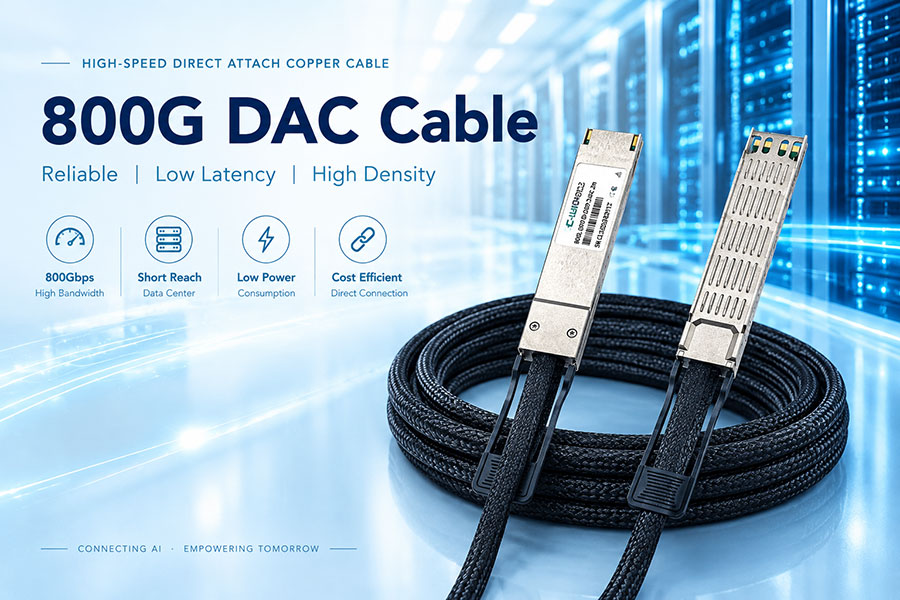
As AI data centers move toward higher-bandwidth networking, 800G connectivity is becoming increasingly important for GPU clusters, high-performance computing, and large-scale Ethernet fabrics. While optical transceivers are widely used for longer links, 800G DAC cables provide a practical solution for short-distance connections where low latency, lower power consumption, high port density, and cost efficiency are critical.
This article explains the main applications of 800G DAC cables in AI data centers and how they fit into server, GPU, switch, rack, and high-density network architectures. Current industry discussions and testing also show continued development of 800G copper interconnects for short-reach data center applications.
1. What Is an 800G DAC Cable?
800G DAC QSFP-DD/OSFP112 Cable丨C-LIGHT
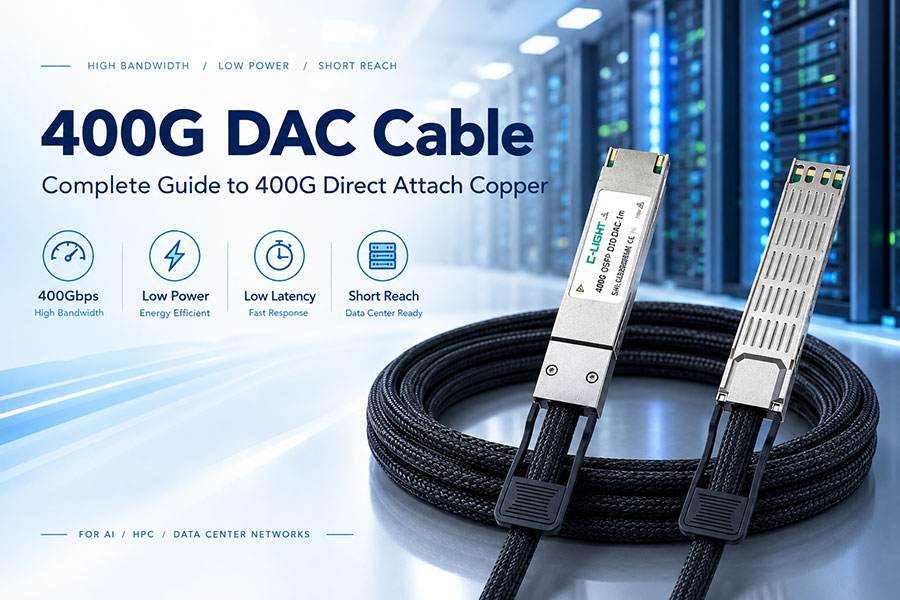
An 800G DAC (Direct Attach Copper) cable is a high-speed copper cable assembly with transceiver-style connectors integrated at both ends. Unlike an optical transceiver connected to a separate fiber patch cable, a DAC provides a direct copper connection between two compatible high-speed ports.
800G DAC solutions are primarily designed for short-reach applications. Their simple passive structure can provide low latency, low power consumption, and a cost-effective physical interconnect for high-density data center systems.
2. Why 800G DAC Cables Are Important for AI Data Centers
AI training and inference systems generate substantial east-west traffic between GPUs, servers, switches, and storage resources. Large GPU clusters require high-throughput communication links to exchange data efficiently, making the physical interconnect layer an important part of overall system performance.
For short connections, copper remains attractive because it can avoid the optical components required by fiber-based links. This can help reduce power consumption, simplify installation, and lower the cost of individual connections.
3. 800G DAC for GPU-to-Switch Connectivity
One of the most important applications for 800G DAC cables is connectivity between GPU servers and high-speed network switches.
In AI clusters, GPU servers communicate continuously with the network fabric. Where the physical distance is short enough, an 800G DAC can provide a direct high-bandwidth connection between the server-side network interface and the switch port.
This deployment is particularly suitable for tightly packed AI racks where networking equipment and compute servers are positioned within a short physical distance.
4. 800G DAC in Top-of-Rack Architecture
Top-of-rack (ToR) switching is a common architecture for data center networks. Servers located within the same rack can connect directly to a ToR switch using short high-speed cable assemblies.
800G DAC cables can be used in this environment to connect compatible 800G server or accelerator interfaces with high-capacity ToR switches. The short cable distance allows the copper link to remain practical while minimizing cabling complexity.
5. 800G DAC for Rack-to-Rack Connections
Although DAC is primarily a short-reach technology, it can also be considered for selected connections between adjacent racks when the required cable length and electrical channel budget remain within the supported limits.
For these applications, network designers need to evaluate cable length, gauge, connector performance, host SerDes capability, insertion loss, crosstalk, and overall channel margin.
At 800G, each electrical lane operates at a significantly higher signaling rate than previous generations, making signal integrity increasingly important. Recent 800G testing has specifically evaluated BER, packet loss, latency, lane-level performance, and equalizer behavior across different cable lengths and gauges.
6. 800G DAC for AI GPU Clusters
AI GPU clusters depend on high-speed fabric connections for collective communication, parameter synchronization, distributed training, and data exchange. The interconnect must deliver sufficient bandwidth while minimizing unnecessary latency and power consumption.
800G DAC cables are well suited to short physical links inside dense GPU environments. They can complement optical transceivers and AOC cables by handling the shortest connections while optical solutions are deployed where greater reach is required.
7. 800G DAC for InfiniBand and Ethernet AI Networks
High-performance AI infrastructure can use different networking technologies, including Ethernet-based AI fabrics and InfiniBand environments. The choice of cable depends on the platform, interface, protocol support, signaling architecture, and vendor interoperability.
800G cable solutions are increasingly discussed for both high-performance Ethernet and AI/HPC networking environments. Industry sources also identify DAC as one of the key short-reach interconnect options alongside AEC, ACC, AOC, and optical transceivers.
8. 800G DAC for Switch-to-Switch Connectivity
800G DAC cables can also be deployed between high-speed switches when the physical distance is sufficiently short.
For example, two switches installed within the same rack or in closely positioned network cabinets may use direct copper connectivity to reduce the need for additional optical components. This can be attractive for short-distance fabric connections where both endpoints already support compatible 800G interfaces.
9. 800G DAC for High-Density Data Center Cabling
Cable density becomes increasingly important as switch port speeds rise from 400G to 800G and beyond. AI data centers can contain large numbers of high-speed connections concentrated within a relatively small physical space.
DAC cables provide a straightforward point-to-point connection method and eliminate separate fiber patch cords and optical transceiver components. However, cable thickness, bend radius, weight, airflow, and connector density must still be considered when designing high-density racks.
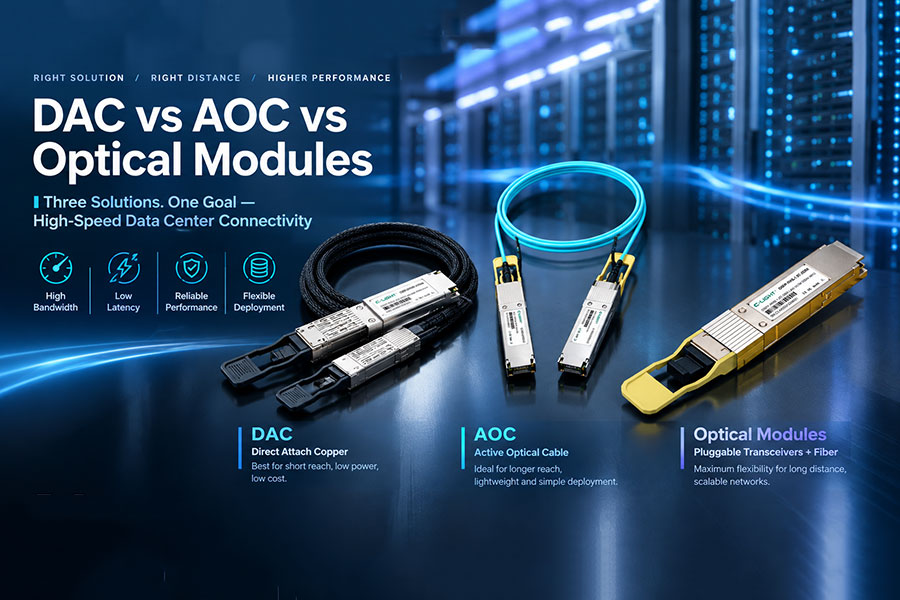
10. 800G DAC vs. 800G AOC
| Feature | 800G DAC | 800G AOC |
|---|---|---|
| Transmission Medium | Copper | Optical fiber |
| Typical Use | Very short-reach links | Short-to-medium reach links |
| Power Consumption | Very low for passive DAC | Higher than passive DAC |
| Latency | Very low | Low |
| Optical Components | No | Integrated optics |
| Cost | Generally lower for short links | Generally higher |
| Cabling Distance | Limited by copper channel performance | Longer than passive copper |
The selection between DAC and AOC should be based primarily on link distance, electrical channel performance, cable management, power budget, and system requirements. In recent 800G application discussions, DAC is positioned as a short-reach solution while AOC provides greater reach through optical transmission.
11. 800G DAC vs. 800G AEC
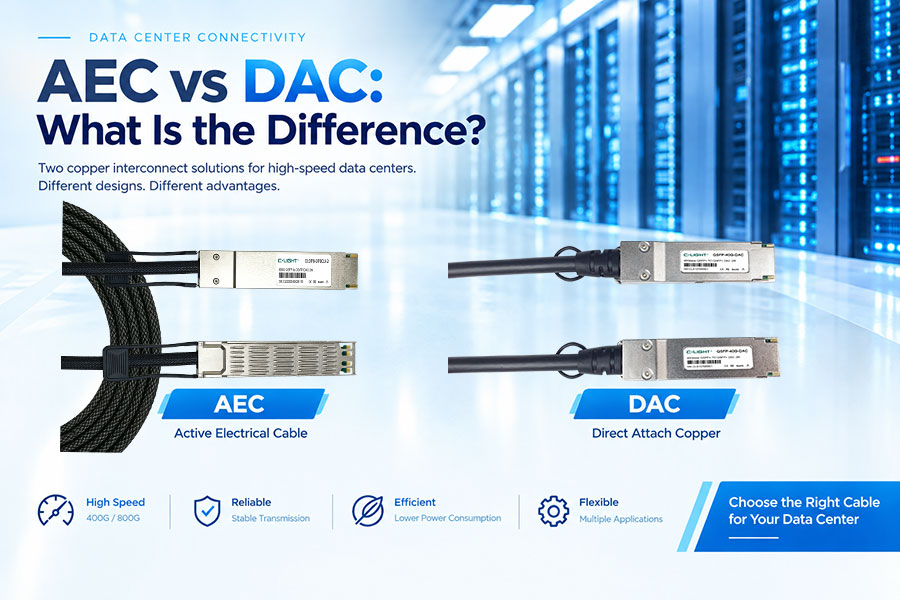
DAC, ACC, and AEC are all copper-based interconnect approaches, but they use different levels of signal conditioning.
A passive DAC relies primarily on the host electrical interfaces and the passive cable channel. AEC introduces active electrical components to compensate for signal degradation and improve reach or signal integrity. This makes AEC attractive when a passive DAC cannot provide sufficient electrical margin at the required distance. :contentReference[oaicite:5]{index=5}
As signaling speeds increase, the boundary between passive copper and active copper becomes increasingly important for system designers.
12. Signal Integrity Challenges at 800G
800G electrical links place demanding requirements on copper channels. High-speed PAM4 signaling is sensitive to insertion loss, return loss, crosstalk, skew, connector characteristics, and other channel impairments.
As a result, the cable itself cannot be evaluated independently from the host system. Switch SerDes behavior, equalization settings, cable gauge, connector design, PCB characteristics, and thermal conditions can all affect real-world link performance.
Recent system-level 800G evaluations have therefore measured parameters such as pre-FEC BER, packet loss, latency, lane-to-lane variation, and transmitter equalizer tuning instead of relying only on traditional frequency-domain measurements.
13. Cable Length and Gauge Selection
Choosing the correct 800G DAC cable length is critical. Longer copper channels generally introduce greater insertion loss and reduce available signal margin. Cable gauge also influences electrical performance, flexibility, weight, and thermal characteristics.
For AI data center deployment, the shortest practical cable should normally be considered first. This helps simplify cable routing and can improve signal margin while reducing unnecessary cable bulk.
| Selection Factor | Why It Matters |
|---|---|
| Cable Length | Directly affects channel loss and signal margin |
| AWG | Influences loss, flexibility, and cable size |
| Connector | Affects insertion loss and mechanical compatibility |
| Host SerDes | Determines electrical link capability |
| Thermal Environment | Important in high-density AI racks |
| Compatibility | Required for stable operation with switches and NICs |
14. 800G DAC Applications in AI Data Center Networks
Typical applications include high-speed connections between GPUs, NICs, switches, servers, and other nearby network devices.
GPU server to ToR switch
Server-to-switch connectivity
Switch-to-switch connections
Intra-rack AI fabric connections
Adjacent-rack short-reach links
HPC cluster interconnects
High-density Ethernet data centers
Short-reach AI networking deployments
15. When Should You Choose an 800G DAC Cable?
An 800G DAC cable is generally most attractive when the connection is short, both endpoints support compatible 800G electrical interfaces, low latency is important, and minimizing power and cost is a priority.
For longer links, especially where the copper channel cannot provide sufficient signal margin, AEC, AOC, or pluggable optical transceivers may be more appropriate.
The practical decision should therefore consider distance first, followed by signal integrity, system compatibility, thermal conditions, cable management, and total cost.
16. 800G DAC in the Evolution Toward 1.6T
The transition toward 1.6T networking is increasing the pressure on both optical and electrical interconnect technologies. As SerDes speeds continue to rise, copper channels will face greater challenges in loss, equalization, thermal behavior, and reach.
This does not eliminate DAC from future AI data centers. Instead, it is likely to make application boundaries more important, with passive DAC concentrated on the shortest links while active copper and optical technologies address progressively longer or more demanding connections.
17. C-LIGHT 800G DAC Solutions
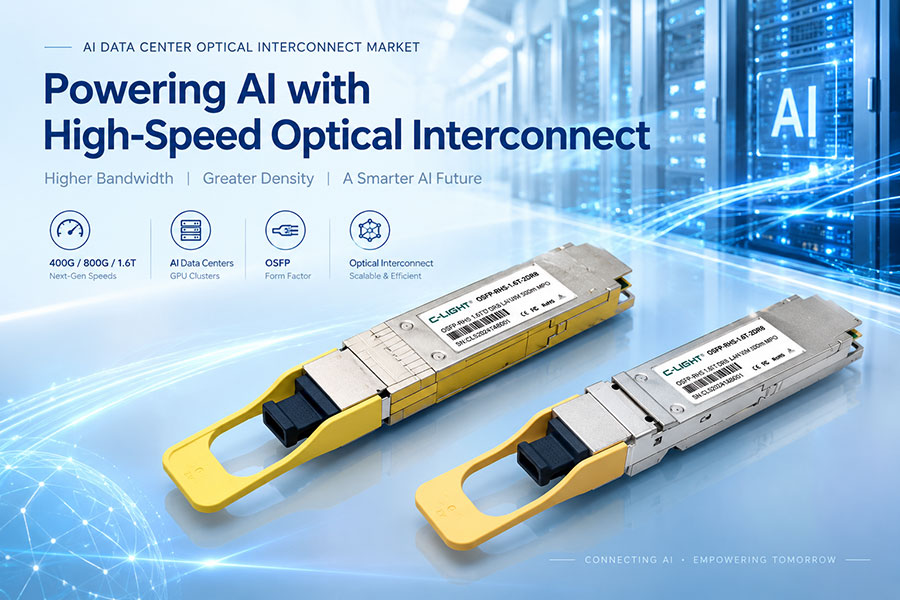
C-LIGHT provides high-speed data center interconnect solutions covering DAC, AOC, AEC, and optical transceiver technologies. The 800G DAC product family can be positioned for short-reach AI data center, HPC, and high-density networking applications where direct copper connectivity is preferred.
For a complete network design, 800G DAC can be combined with C-LIGHT 800G optical transceivers, AOC cables, and AEC solutions to create different connectivity zones according to distance and system requirements.
18. Conclusion
800G DAC cables play an important role in short-reach AI data center connectivity. Their combination of low latency, low power consumption, straightforward deployment, and cost efficiency makes them attractive for high-density connections between GPUs, servers, NICs, and switches.
As 800G networks become more common and 1.6T architectures begin to emerge, the key challenge is not choosing one interconnect technology for every link. Instead, AI data center designers need to match DAC, AEC, AOC, and optical transceivers to the physical distance, electrical channel requirements, bandwidth, power budget, and system architecture of each connection.
 >
>

 >
>
 >
>
 >
>
 >
>
 >
>
 >
>
 >
>