TEL:+86 132 6656 7067


The expansion of large-scale AI training clusters is creating new demands on data center network architecture. Thousands of GPUs and accelerators must exchange massive volumes of distributed training data through high-bandwidth, low-latency interconnects. As electrical switching fabrics become increasingly constrained by power consumption, port density and network scalability, Optical Circuit Switching (OCS) is gaining attention as an alternative approach to building flexible AI network fabrics.
OCS establishes optical connections between network endpoints by dynamically configuring physical light paths. Instead of processing every packet through conventional electronic switching hardware, an optical circuit switch establishes a dedicated optical path that carries traffic between selected ports. This approach can reduce the need for repeated optical-electrical-optical conversions within the switched path and provide high-capacity connectivity for traffic patterns that benefit from circuit-based communication.
In AI data centers, OCS is particularly relevant to distributed GPU training, collective communication, scale-out networking and dynamically reconfigurable network topologies. Combined with high-speed optical transceivers, fiber infrastructure and software-defined network control, it provides another architectural option for next-generation AI computing environments.
1. Optical Circuit Switching Architecture in AI Data Centers
Optical Circuit Switching is a network technology that establishes direct optical connections between selected input and output ports. The switching fabric changes the physical optical connectivity according to a predefined or dynamically calculated connection plan.
An OCS system generally includes an optical switching fabric, optical interfaces, control electronics, management software and network orchestration functions. The switching fabric redirects incoming optical signals toward designated output ports without requiring the payload to be converted into electronic packets inside the optical switching element.
A typical OCS-based data center architecture contains the following components:
Optical Circuit Switch: Establishes and removes optical connections between selected ports.
Optical Transceivers: Convert electrical signals into optical signals and recover received optical signals at network endpoints.
Optical Fiber Links: Provide the physical transmission paths between servers, switches and OCS equipment.
Network Controller: Determines connection assignments according to traffic requirements and network topology.
Telemetry System: Collects link status, utilization, optical power and network performance information.
Orchestration Software: Coordinates optical circuit allocation with AI workload scheduling and conventional packet networking.
Unlike conventional packet switches, which make forwarding decisions for individual packets, an OCS fabric establishes optical connectivity for a circuit or connection interval. Once the optical path is configured, data can travel through that path without packet-by-packet forwarding decisions inside the OCS fabric.
2. How Optical Circuit Switching Works
An OCS network operates by configuring optical paths between designated input and output ports. The control system determines which endpoints should be connected, calculates the required optical paths and instructs the switching fabric to establish the connections.
Optical Signal Input
Optical transceivers convert electrical data from servers, switches or other network equipment into optical signals. These signals travel through fiber connections toward the optical switching fabric.
Optical Path Configuration
The OCS controller determines the required connection mapping. Depending on the switching technology, the optical fabric uses movable mirrors, optical beam steering, wavelength-selective components or other photonic mechanisms to redirect signals between ports.
Optical Circuit Establishment
After the switching fabric completes the requested configuration, an optical path is established between the selected endpoints. The connection remains available until the controller changes or releases the circuit.
Traffic Transmission
Data flows through the established optical connection. The optical switching fabric does not need to decode the Ethernet or InfiniBand packet payload to forward traffic along the configured path.
Connection Reconfiguration
When workload requirements change, the controller can release existing connections and establish new optical paths. The timing and coordination of these operations depend on the switching hardware, network control plane and traffic scheduling mechanism.
The complete process can be represented as:
3. OCS vs. Traditional Electrical Packet Switching
Electrical packet switches and optical circuit switches perform different network functions. Electrical switches inspect packet headers, apply forwarding rules and transmit packets through selected output ports. OCS equipment configures optical paths at the physical layer, allowing traffic to travel through an established optical connection.
| Parameter | Electrical Packet Switching | Optical Circuit Switching |
|---|---|---|
| Switching Method | Packet-based forwarding | Optical path configuration |
| Forwarding Decision | Per-packet or flow-based | Connection or circuit-based |
| Payload Processing | Electronic packet processing | Optical signal passes through the configured path |
| Buffering | Uses electronic packet buffers | Does not provide conventional packet buffering within the optical fabric |
| Reconfiguration | Forwarding tables and network policies | Physical optical path reconfiguration |
| Protocol Awareness | Can process Ethernet, IP and other packet protocols | Generally transparent to packet payload protocols |
| Traffic Flexibility | Flexible packet-level traffic handling | Requires circuit allocation and scheduling |
| Latency Characteristics | Includes electronic switching and queueing effects | Can avoid intermediate packet processing within the optical path |
| Typical Applications | General-purpose data center networking | High-volume interconnects and reconfigurable optical fabrics |
OCS can provide advantages when large traffic flows require sustained high-capacity connectivity. However, it is not a universal replacement for electrical switching. Packet networks remain important for bursty traffic, fine-grained forwarding, congestion management and connections that do not justify dedicated optical circuits.
4. Why AI Training Networks Need Optical Circuit Switching
Distributed AI training relies on frequent communication between GPUs and accelerator nodes. Operations such as All-Reduce, All-to-All, All-Gather and Reduce-Scatter generate substantial east-west traffic across the network.
As cluster sizes increase, communication patterns become more complex. Network congestion, oversubscription, link utilization and switching power can affect overall training efficiency. OCS introduces the ability to modify physical connectivity according to the communication requirements of different workloads.
GPU-to-GPU Communication
Large training jobs distribute model parameters, gradients and intermediate data across multiple accelerators. These operations generate synchronized traffic between different GPU groups.
When a workload produces predictable, high-volume communication between selected nodes, OCS can establish direct optical connections that provide dedicated paths for the corresponding traffic.
All-to-All Communication
Mixture-of-Experts (MoE) models frequently generate All-to-All traffic during token dispatch and expert aggregation. Traffic distribution can change according to expert placement, model configuration and training phase.
A reconfigurable optical fabric can adjust inter-group connectivity to better match the communication requirements of selected workloads. The effectiveness depends on circuit scheduling, traffic concentration and the time required to reconfigure the network.
Large-Scale Collective Operations
Collective communication requires coordinated data exchange among multiple accelerator nodes. OCS can provide additional optical paths between selected groups, supporting network designs that allocate connectivity according to collective communication patterns.
Dynamic GPU Cluster Topologies
Different AI jobs may require different communication structures. A fixed electrical network topology can provide predictable connectivity, but it may not always match the traffic distribution of every workload.
OCS allows the physical network topology to be adjusted over time, enabling network resources to be allocated according to job placement, cluster utilization and communication demand.
5. OCS in Scale-Up, Scale-Out and Scale-Across Architectures
Modern AI infrastructure is commonly organized around three connectivity domains: scale-up, scale-out and scale-across. Each domain has different requirements for bandwidth, latency, distance and network topology.
Scale-Up Connectivity
Scale-up networks connect processors and accelerators within a tightly integrated computing system. They require high bandwidth and low-latency communication, often using specialized electrical or optical interconnect technologies.
OCS may support selected optical scale-up architectures as photonic switching technology advances. However, conventional OCS is more commonly discussed in relation to cluster-level or inter-group connectivity rather than replacing tightly coupled chip-to-chip links.
Scale-Out Connectivity
Scale-out networks connect multiple GPU servers, accelerator nodes and network switches across racks. This domain is a major application area for OCS because large-scale distributed training produces significant inter-rack traffic.
An OCS fabric can establish optical paths between selected network groups, allowing the topology to adapt to traffic patterns and training requirements.
Scale-Across Connectivity
Scale-across architectures extend AI computing resources across multiple data center facilities or geographically distributed computing locations. Optical transport systems and DWDM technologies provide the transmission infrastructure for these longer-distance connections.
OCS can be used within appropriate optical network domains to provide configurable circuit connectivity, while coherent optical transceivers and optical line systems support high-capacity transmission over longer distances.
| Architecture | Connectivity Domain | Typical Network Technology | OCS Relevance |
|---|---|---|---|
| Scale-Up | Accelerators within a tightly coupled system | NVLink-class fabrics, specialized electrical and optical interconnects | Emerging photonic switching applications |
| Scale-Out | GPU servers and racks | Ethernet, InfiniBand, optical switching | Dynamic optical topology and inter-group connectivity |
| Scale-Across | Distributed data centers | DWDM, coherent optics, DCI and optical transport | Optical circuit provisioning within suitable network domains |
6. OCS Network Topologies: Spine-Leaf, Dragonfly and Optical Fabrics
The performance of an OCS-based network depends not only on switching hardware but also on the topology used to connect compute nodes and network groups. Different architectures provide different levels of connectivity, path diversity and reconfiguration flexibility.
Hybrid Spine-Leaf Architecture
A hybrid spine-leaf architecture combines conventional electrical packet switches with optical circuit switches. Electrical leaf switches connect servers and accelerator nodes, while OCS equipment provides configurable optical connectivity between selected spine or network groups.
This arrangement allows the electrical fabric to handle general packet forwarding while the optical layer provides additional high-capacity connections for suitable traffic patterns.
Dragonfly Topology
Dragonfly networks organize compute and switching resources into groups, reducing the number of network hops required for communication across large systems. Optical switching can provide configurable inter-group connections, making the topology adaptable to different AI traffic distributions.
The effectiveness of this architecture depends on routing algorithms, optical port availability, wavelength assignment where applicable and circuit scheduling.
Reconfigurable Optical Fabric
A reconfigurable optical fabric uses OCS equipment to establish different connection patterns between network endpoints. Instead of maintaining one fixed physical topology, the network can be adjusted according to workload demand.
This approach is particularly relevant to large GPU clusters where traffic matrices may vary between training phases and applications.
7. Optical Switching Technologies Used in OCS Systems
OCS hardware can use different photonic switching technologies. The implementation determines port scalability, insertion loss, optical bandwidth, switching speed, reliability and mechanical complexity.
MEMS Optical Switching
Micro-Electro-Mechanical Systems (MEMS) technology uses miniature movable mirrors to redirect optical beams between input and output fibers.
MEMS-based OCS designs can support large port counts and wavelength-transparent optical connections. They are relevant to applications requiring flexible optical circuit configuration without conventional packet-level processing.
Liquid Crystal Optical Switching
Liquid crystal switching technologies use electrically controlled changes in optical properties to control the direction or transmission of light. Their switching characteristics and implementation depend on the optical design and device architecture.
Beam-Steering Optical Switching
Beam-steering systems redirect optical signals through controlled changes in optical paths. Depending on the implementation, they can provide configurable connections between multiple fiber ports.
Silicon Photonics and Integrated Optical Switching
Silicon photonics integrates optical waveguides and switching elements onto semiconductor platforms. Integrated optical switching can reduce component size and enable closer integration with optical communication systems.
Scaling such systems requires careful management of optical loss, crosstalk, thermal sensitivity, fabrication tolerances and port connectivity.
| Switching Technology | Operating Principle | Engineering Considerations |
|---|---|---|
| MEMS | Movable mirrors redirect optical beams | Port scalability, mechanical reliability and optical alignment |
| Liquid Crystal | Electrically controlled optical properties | Switching characteristics and optical insertion loss |
| Beam Steering | Controlled optical beam redirection | Optical path stability and switching architecture |
| Silicon Photonics | Integrated waveguide and photonic switching elements | Integration density, crosstalk and thermal control |
8. OCS and 800G / 1.6T Optical Interconnect Technologies
The expansion of OCS-based AI networks is closely connected to the development of higher-speed optical transceivers. As the bandwidth of each network endpoint increases, the optical interfaces connecting servers, switches and OCS fabrics must support higher data rates and suitable transmission distances.
800G and 1.6T optical modules provide the bandwidth needed for next-generation AI network infrastructure. Depending on the OCS architecture, optical transceivers may be deployed at the endpoints of an optical circuit, with the OCS fabric providing the intermediate optical path.
800G Optical Interfaces
800G optical transceivers support high-bandwidth connectivity between AI servers, accelerator systems and network switches. OSFP and QSFP-DD are important form factors for high-density data center deployments.
Different optical interfaces support different transmission architectures, including SR8, DR8 and FR4-related configurations. The selected interface must match the endpoint equipment and the optical link design.
The C-LIGHT 800G OSFP portfolio covers multiple optical configurations, including VR8, SR8, DR8 and 2×FR4 applications. It supports high-speed data center networking, cloud computing, HPC and InfiniBand NDR environments.
Aggregate Data Rate: Up to 800Gbps
Form Factor: OSFP
Optical Applications: Short-reach and single-mode transmission
Network Environments: AI clusters and high-performance computing
800G QSFP-DD Optical Interfaces
QSFP-DD provides another high-density optical interface for next-generation Ethernet and AI network infrastructure. Different reach options allow the platform to support connections within racks, between racks and across data center network domains.
C-LIGHT 800G QSFP-DD transceivers support data center and AI network applications, with product configurations covering 100m, 500m and 2km transmission distances.
View C-LIGHT 800G QSFP-DD Products →1.6T Optical Interconnects
The move toward 1.6T optical connectivity increases the bandwidth available at each network port. An 8×200G PAM4 architecture can provide an aggregate 1.6Tbps interface, supporting high-density connections in advanced AI data centers.
In an OCS-based network, 1.6T endpoint interfaces can provide high-capacity optical links across selected circuit paths. However, the transceiver and OCS must be compatible in terms of wavelength transparency, optical power, insertion loss and supported fiber interfaces.
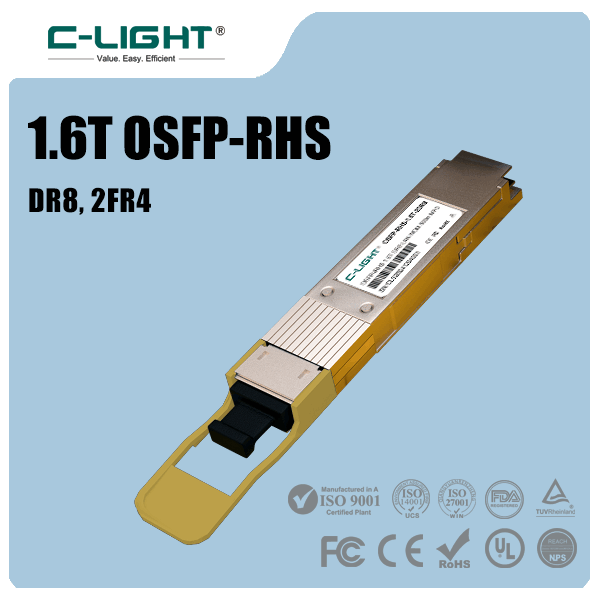
C-LIGHT 1.6T OSFP-RHS optical modules are designed for next-generation AI data centers and high-performance computing environments. The product family uses 8×200G PAM4 signaling with integrated DSP and FEC.
Available configurations include 1.6T 2×DR4 for up to 500m over single-mode fiber and 1.6T 2×FR4 for up to 2km, depending on the selected model.
View C-LIGHT 1.6T OSFP-RHS Products →9. OCS, DWDM and Optical Transport Network Integration
OCS and DWDM address different aspects of optical network architecture. OCS establishes configurable optical paths between ports, while DWDM enables multiple optical wavelengths to share the transmission capacity of a fiber.
Combining optical switching and wavelength multiplexing can provide flexible connectivity across network domains, depending on the OCS hardware and optical transport design.
Wavelength-Division Multiplexing
DWDM combines multiple optical wavelengths onto a single fiber, increasing aggregate transmission capacity without requiring a separate fiber for every wavelength channel.
In appropriate architectures, OCS can establish or modify optical connections between network endpoints while DWDM systems provide wavelength-based transmission capacity across the optical infrastructure.
Coherent Optical Transmission
Coherent optical transceivers use advanced modulation and digital signal processing to support high-capacity transmission over longer distances. They are important for data center interconnect and optical transport applications.
C-LIGHT DWDM DCO products cover 100G, 200G, 400G and 800G transmission rates. The portfolio includes QSFP28, CFP2, QSFP-DD and OSFP form factors, with tunable C-band DWDM technology and different transmission-distance options.
These products are relevant to high-capacity optical transport, AI data center interconnect and distributed computing infrastructure.
View C-LIGHT DWDM DCO Products →OCS and OTN Coordination
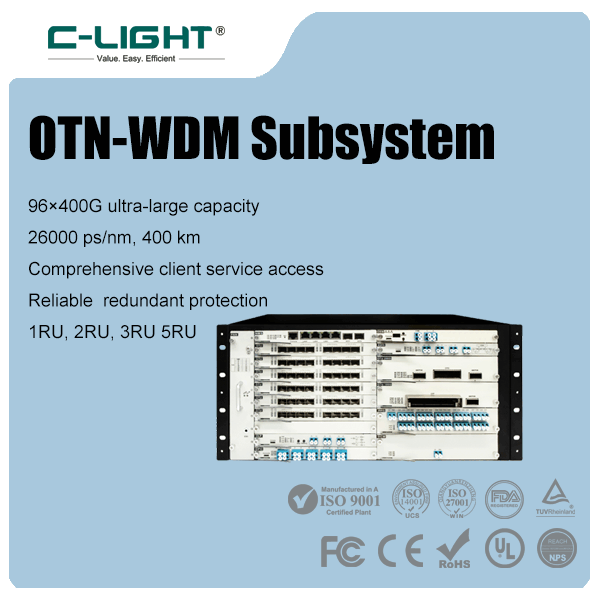
Optical Transport Network (OTN) technology provides transport-layer functions such as signal adaptation, multiplexing, monitoring and protection. OCS can complement OTN-based infrastructures by providing configurable optical connectivity at suitable network layers.
The relationship between OCS, DWDM and OTN depends on the deployment architecture. They should not be treated as interchangeable technologies because they perform different functions within the optical network.
10. Network Control, SDN and Dynamic Circuit Scheduling
The value of OCS in AI data centers depends heavily on the control system responsible for configuring optical paths. Optical switching hardware provides physical connectivity, while software determines when and where circuits should be established.
Software-Defined Networking (SDN) provides a framework for coordinating network resources through programmable control interfaces.
Traffic Monitoring
Network telemetry collects information about traffic volume, port utilization, congestion and link status. These measurements help identify which network groups require additional optical connectivity.
Traffic Matrix Analysis
A traffic matrix describes the communication demand between network endpoints or groups. AI workload scheduling systems can provide information about GPU placement and communication patterns, allowing the OCS controller to calculate suitable circuit assignments.
Circuit Scheduling
The controller determines which optical paths should be active and how network resources should be allocated over time. Scheduling must consider port availability, connection conflicts, reconfiguration time and application communication phases.
Topology Reconfiguration
Once the new circuit plan is calculated, the controller sends configuration instructions to the OCS hardware. The network can then establish the required optical connections and update the logical forwarding configuration.
Coordination between circuit scheduling and packet forwarding is essential. Traffic must be directed through available paths, and reconfiguration procedures must prevent active communication from being interrupted unexpectedly.
11. OCS Performance Considerations and Engineering Challenges
Although OCS provides significant architectural flexibility, its deployment introduces specific engineering challenges. Optical path quality, switching behavior, network scheduling and fault recovery must be considered together.
Optical Insertion Loss
Every optical switching element contributes insertion loss to the complete link. Fiber connectors, adapters, patch panels and intermediate optical components also consume optical power budget.
The total path loss must remain within the transmitter output power and receiver sensitivity limits of the connected optical interfaces.
Reconfiguration Time
OCS reconfiguration is not equivalent to packet forwarding at line rate. Depending on the switching technology, physical path changes may require a measurable settling interval.
This makes scheduling important. The network must determine whether the expected traffic benefit of a new circuit justifies the time and operational cost of changing the optical topology.
Port Scalability and Blocking
The number of available input and output ports determines how many connections can be established simultaneously. Some OCS architectures support flexible port-to-port connections, while others have wavelength, direction or topology-related constraints.
Port utilization, connection conflicts and circuit blocking must be considered when designing large optical fabrics.
Failure Detection and Recovery
Optical links and switching components can experience fiber faults, power degradation or equipment failures. Network controllers require monitoring and recovery mechanisms to maintain connectivity when a circuit becomes unavailable.
Redundant optical paths, alternative routing and coordinated packet-network protection can improve system resilience.
Optical Signal Compatibility
The OCS fabric must support the optical characteristics of connected transceivers. Relevant parameters include wavelength range, optical power, insertion loss, polarization behavior and supported fiber interfaces.
| Engineering Parameter | Potential Impact | Design Requirement |
|---|---|---|
| Insertion Loss | Reduced receiver optical power | Maintain end-to-end optical power margin |
| Reconfiguration Time | Communication disruption or scheduling overhead | Coordinate circuit changes with workload phases |
| Port Count | Limits simultaneous circuit connections | Match OCS scale to network topology |
| Wavelength Compatibility | Optical connection mismatch | Verify wavelength transparency and filtering requirements |
| Telemetry | Limited network visibility | Monitor optical power and circuit status |
| Fault Recovery | Loss of connectivity | Implement alternative paths and recovery policies |
12. OCS and the Evolution Toward CPO and NPO
The development of OCS is part of a broader transition toward more integrated optical networking architectures. Co-Packaged Optics (CPO) and Near-Packaged Optics (NPO) address the increasing electrical bandwidth and power challenges associated with high-speed switch ASICs.
OCS, CPO and NPO operate at different architectural levels, but they share the objective of improving optical connectivity and reducing limitations associated with conventional electrical interconnects.
Co-Packaged Optics
CPO places optical engines close to the switch ASIC within a shared package or tightly integrated assembly. This reduces the length of high-speed electrical connections between the switching silicon and optical conversion components.
Near-Packaged Optics
NPO positions optical engines close to the main switching ASIC without necessarily integrating them into the same package. This approach provides an intermediate integration model between conventional pluggable optics and CPO.
OCS in the Optical Network Fabric
OCS operates at the optical circuit layer, dynamically establishing connections between network ports. It can coexist with pluggable transceivers, CPO-based switches and NPO architectures when the optical interfaces and network design support the required connectivity.
| Technology | Main Function | Architectural Position |
|---|---|---|
| OCS | Dynamic optical circuit configuration | Network switching fabric |
| CPO | Optical-electrical integration near the switch ASIC | Switch package and optical interface |
| NPO | Optical integration close to the switch ASIC | Near-package optical interface |
| Pluggable Optics | Electrical-to-optical signal conversion | Front-panel or equipment optical ports |
13. Optical Circuit Switching and the Future of AI Network Architecture
As AI computing clusters continue to scale, network architecture will increasingly need to adapt to workload-specific communication requirements. Fixed electrical topologies provide predictable packet connectivity, but large-scale AI applications can produce highly variable traffic patterns across different training stages.
OCS offers a way to make the physical optical topology more programmable. By combining workload-aware circuit scheduling, high-capacity optical links and hybrid packet-circuit networking, future AI data centers can allocate network connectivity according to actual communication demand.
Several development directions are particularly important:
Higher-port-count OCS fabrics: Increasing the number of endpoints that can be interconnected through configurable optical paths.
Faster optical reconfiguration: Reducing the overhead associated with changing network topologies.
AI-aware network scheduling: Coordinating optical circuit allocation with distributed training and GPU placement.
Open control interfaces: Improving interoperability between OCS hardware, SDN controllers and network management platforms.
Advanced optical integration: Combining optical switching with high-density transceivers and integrated photonic technologies.
Hybrid network architectures: Coordinating electrical packet switching and optical circuit switching within one network fabric.
The development of open OCS interfaces and control frameworks is also important for multi-vendor interoperability. Standardized hardware interfaces, telemetry models and software integration can simplify deployment in large data center environments.
14. C-LIGHT Optical Connectivity Solutions for AI Data Centers
OCS-based networks depend on high-performance optical connectivity at their endpoints and across the surrounding optical infrastructure. Transceiver bandwidth, optical reach, fiber interfaces and transmission characteristics must be matched to the selected switching architecture.
C-LIGHT provides optical transceiver solutions for AI data centers, high-performance computing, hyperscale cloud infrastructure and high-speed optical networking. Its product portfolio covers 400G, 800G and 1.6T optical connectivity, as well as DWDM coherent transmission solutions.
Designed for next-generation AI data centers and GPU clusters, the 1.6T OSFP-RHS portfolio supports 8×200G PAM4 signaling and high-density optical connectivity. Available configurations include 500m 2×DR4 and 2km 2×FR4 applications.
Explore C-LIGHT 1.6T OSFP-RHS →C-LIGHT 800G OSFP optical modules support high-speed AI networking and InfiniBand NDR applications. The product family covers multiple optical configurations for short-reach and single-mode data center connectivity.
Explore C-LIGHT 800G OSFP →The 800G QSFP-DD product family provides high-bandwidth optical connectivity for next-generation Ethernet, cloud computing, HPC and AI infrastructure.
Explore C-LIGHT 800G QSFP-DD →C-LIGHT DWDM DCO products cover 100G, 200G, 400G and 800G coherent optical transmission. They support high-capacity optical transport and data center interconnect applications using tunable C-band DWDM technology.
Explore C-LIGHT DWDM DCO →For AI data center optical connectivity projects, C-LIGHT can support product selection based on data rate, optical reach, fiber type, connector configuration and equipment compatibility. Visit the C-LIGHT Optical Transceiver Portfolio for additional product information.
For technical specifications, customized optical interconnection requirements or product inquiries, visit Contact C-LIGHT.
15. Frequently Asked Questions About Optical Circuit Switching
Optical Circuit Switching is a networking technology that establishes direct optical connections between selected input and output ports. It enables data to travel through configured optical paths without conventional packet-by-packet processing inside the optical switching fabric.
Large AI clusters generate substantial inter-node communication traffic. OCS can provide configurable optical connectivity, allowing network topology and available bandwidth to be adjusted according to distributed training workloads and communication patterns.
No. OCS generally complements electrical packet switching. Ethernet switches continue to handle packet forwarding, while OCS provides configurable optical circuit connections for selected high-volume traffic flows.
OCS establishes optical connections that remain active for a defined circuit interval. Optical packet switching would make switching decisions at packet granularity. OCS does not normally inspect individual packet headers or forward every packet independently.
OCS can reduce intermediate electronic packet-processing and queueing overhead along an optical path. However, total latency still includes fiber propagation, endpoint processing, network control and any required circuit reconfiguration.
Common technologies include MEMS mirrors, liquid crystal switching, optical beam steering and integrated photonic switching. Each approach has different characteristics in terms of port scalability, insertion loss, reconfiguration and integration.
OCS configures optical paths between network ports, while DWDM multiplexes multiple wavelengths onto a fiber. They can complement each other in suitable optical network architectures.
Yes, provided the optical switching fabric supports the required optical bandwidth, wavelength range, power levels and signal characteristics. The transceiver interfaces and end-to-end optical budget must also be compatible.
SDN provides programmable network control. It can coordinate traffic monitoring, circuit scheduling, optical path configuration and topology updates according to workload requirements.
Key challenges include optical insertion loss, reconfiguration time, port scalability, circuit scheduling, connection blocking, optical compatibility and fault recovery. These factors must be considered when integrating OCS into large AI data center networks.
16. Conclusion
Optical Circuit Switching is becoming an important architectural option for large-scale AI data center networks. By establishing configurable optical paths between selected network endpoints, OCS can provide additional bandwidth flexibility and reduce dependence on intermediate electronic packet switching for suitable high-volume traffic patterns.
Its value is particularly relevant to distributed GPU training, collective communication, reconfigurable scale-out fabrics and large AI computing clusters. MEMS, beam-steering and integrated photonic technologies provide different approaches to building scalable optical switching systems, while SDN and workload-aware scheduling coordinate circuit allocation with application requirements.
The evolution of OCS will also depend on advances in 800G and 1.6T optical transceivers, DWDM transmission, integrated photonics and hybrid packet-circuit networking. Together, these technologies provide a foundation for more programmable, bandwidth-efficient and scalable AI data center infrastructure.
 >

 >
 >
 >
 >
 >
 >
 >