TEL:+86 132 6656 7067


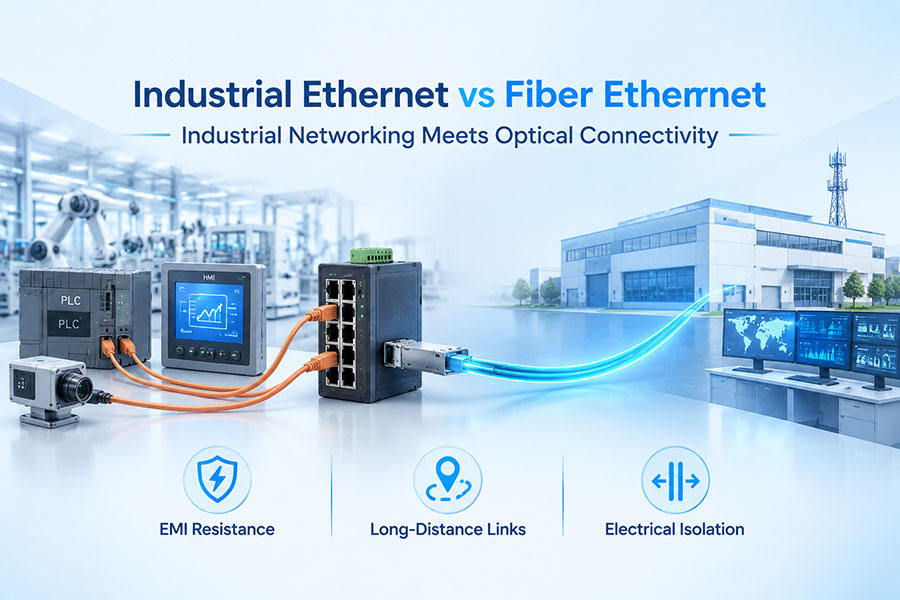
Industrial Ethernet and fiber Ethernet are not two competing communication protocols. Industrial Ethernet describes the use of Ethernet-based networking in industrial environments, while fiber Ethernet identifies Ethernet transmission over optical fiber. An industrial network can therefore use copper Ethernet, fiber Ethernet, or a combination of both.
The practical choice depends on transmission distance, electromagnetic interference, network topology, installation conditions, bandwidth requirements, and the interfaces available on industrial switches and field devices.
1. Industrial Ethernet and Fiber Ethernet: Different Technical Dimensions
Industrial Ethernet extends Ethernet connectivity into manufacturing facilities, power systems, transportation infrastructure, process automation, and other operational technology environments. It supports communication between programmable logic controllers (PLCs), industrial PCs, remote I/O modules, human-machine interfaces (HMIs), sensors, drives, and supervisory systems.
Fiber Ethernet refers to Ethernet links that use optical fiber as the physical transmission medium. Depending on the Ethernet standard and optical transceiver, these links can operate over multimode or single-mode fiber and support different data rates and distances.
For example, a PROFINET or EtherNet/IP network can use copper Ethernet connections within a machine and fiber Ethernet for communication between production areas. The application protocol and the physical transmission medium serve different functions.
2. Copper Ethernet vs Fiber Ethernet in Industrial Networks
Industrial Ethernet deployments frequently use twisted-pair copper cabling for connections between nearby devices. Fiber links become more attractive when the network spans large facilities, crosses electrically noisy areas, or connects buildings and remote equipment rooms.
| Technical Factor | Copper Ethernet | Fiber Ethernet |
|---|---|---|
| Transmission medium | Electrical signals over twisted-pair copper cable | Optical signals over multimode or single-mode fiber |
| Common interface | RJ45 | SC, LC, SFP or other optical interfaces, depending on equipment |
| Typical link distance | Up to 100 m for a standard balanced twisted-pair Ethernet channel | Depends on Ethernet standard, fiber type, wavelength and optical transceiver |
| Electromagnetic interference | Requires appropriate cable shielding, grounding and installation practices | Optical transmission is immune to electromagnetic interference along the fiber |
| Electrical isolation | Electrical connection remains between connected copper interfaces | Provides galvanic isolation between the optical endpoints |
| Installation | Convenient for short connections and devices with native RJ45 ports | Requires optical interfaces, fiber termination and appropriate transceivers or converters |
| Common applications | PLC connections, machine networks, local control cabinets and field devices | Plant backbones, inter-building links, remote monitoring and electrically noisy locations |
The 100 m copper channel limit is a common Ethernet structured-cabling reference, not a universal limit for every industrial cable or proprietary implementation. Fiber reach also varies significantly: a short multimode link and a long-distance single-mode link require different optical specifications.
3. Why Fiber Ethernet Is Valuable in Industrial Environments
Electromagnetic Interference Resistance
Industrial facilities can contain variable-frequency drives, electric motors, welding equipment, high-current power cables, and switching systems. These sources can create electromagnetic noise that complicates copper communication links when cable routing, shielding, bonding, or grounding is inadequate.
Optical fiber carries data as light rather than electrical signals. The fiber itself is therefore not affected by electromagnetic interference in the same way as copper conductors. This makes fiber particularly useful for links running between electrical rooms, production lines, substations, and remote control cabinets.
Longer Transmission Distances
Fiber Ethernet supports network connections beyond the reach of a conventional 100 m twisted-pair channel. Gigabit Ethernet optical links can support hundreds of meters over suitable multimode fiber or several kilometers and beyond over single-mode fiber, depending on the selected interface.
Longer optical links can reduce the number of intermediate network devices required between distant industrial locations. This is useful for connecting separate factory buildings, warehouses, outdoor monitoring stations, and remote infrastructure.
Electrical Isolation Between Network Segments
Fiber provides an electrically nonconductive transmission path between optical endpoints. This helps isolate network segments that may have different grounding conditions or electrical environments. It can also avoid creating a conductive communication path between separated buildings.
Bandwidth Expansion
Fiber infrastructure can accommodate different Ethernet generations through compatible optical transceivers and network equipment. Existing fiber routes may support upgrades from Fast Ethernet or Gigabit Ethernet to 10GbE and higher rates when the fiber type, connectors, optical budget, and installed equipment are suitable.
4. Industrial Ethernet Protocols and Optical Transmission Standards
Industrial communication protocols and Ethernet optical standards operate at different layers of the network. Industrial protocols define how devices exchange control, status, and process data. Ethernet physical-layer standards define electrical or optical signaling, data rates, and transmission characteristics.
| Technology | Primary Function | Typical Network Role |
|---|---|---|
| PROFINET | Industrial communication based on Ethernet | Factory automation, PLC and field-device communication |
| EtherNet/IP | Industrial protocol using standard Ethernet and IP technologies | Control systems, I/O devices and industrial automation |
| Modbus TCP | Client-server industrial communication over TCP/IP | PLC, instrumentation and supervisory systems |
| EtherCAT | Real-time industrial Ethernet technology | Motion control and distributed automation |
| 100BASE-FX | 100 Mbps Ethernet over optical fiber | Legacy and Fast Ethernet fiber connections |
| 1000BASE-X | Gigabit Ethernet optical physical-layer family | Gigabit fiber uplinks and network backbones |
| 10GBASE-R | 10 Gigabit Ethernet physical-layer family | High-capacity industrial aggregation and backbone links |
These technologies are not direct alternatives. For example, PROFINET traffic can travel through a network containing copper Ethernet switches, optical fiber uplinks, and fiber media converters, provided that the network equipment preserves the required Ethernet behavior and application performance.
5. Industrial Fiber Media Converters and SFP Transceivers
Industrial devices do not always provide native optical Ethernet ports. A fiber media converter can bridge a copper RJ45 Ethernet interface and an optical fiber interface, while an industrial switch with an SFP slot can accept a compatible optical transceiver directly.
The appropriate configuration depends on the number of ports, data rate, fiber type, optical reach, power arrangement, mounting method, and environmental specifications.
Industrial Fiber Media Converter
C-LIGHT's Industrial Fiber Media Converter series provides copper-to-fiber Ethernet conversion for industrial network extension. The product family includes different RJ45 and optical interface combinations for Fast Ethernet, Gigabit Ethernet, and selected 10G applications.
RJ45 interfaces combined with SC, SFP or SFP+ optical interfaces, depending on model.
100Base-X, 1000Base-X and selected 10G optical connectivity options.
12–48 VDC power input on listed models.
Redundant power input available on selected models.
Aluminum enclosure and fanless cooling on listed configurations.
Operating temperature of -40°C to 75°C for the listed CLIMC1200 series configurations.
This product family is suitable for industrial network extension, remote equipment connectivity, and fiber uplink deployment. Interface and environmental specifications should be confirmed against the selected model.
When to Use an Industrial Fiber Media Converter
A media converter is appropriate when an existing industrial device has an RJ45 Ethernet port but needs to connect to a fiber network. It can also be useful when adding an optical segment to an established copper network without replacing every connected device.
When to Use an SFP-Based Industrial Switch
An industrial Ethernet switch with SFP slots provides a more integrated solution when multiple devices need to be aggregated. The switch can connect local copper devices through RJ45 ports while using optical transceivers for uplinks to other switches or control centers.
C-LIGHT supplies optical transceivers across multiple Ethernet data rates and interface categories. Its optical transceiver portfolio includes 100M, 1.25G, 2.5G, 10G and 25G product categories, among others. These options can be evaluated for compatible industrial switch platforms according to the required speed, fiber type, wavelength, distance, and operating-temperature rating.
6. Typical Industrial Fiber Ethernet Network Architectures
Factory Floor Network
Within a production line, PLCs, HMIs, drives, and remote I/O devices may connect to industrial switches through copper Ethernet. Fiber uplinks can then connect individual production cells to a central aggregation switch or control room.
This architecture keeps short device connections simple while using fiber for longer backbone connections and areas with significant electromagnetic interference.
Inter-Building Industrial Network
Separate factory buildings or warehouses can be connected through single-mode fiber. Each building can use an industrial switch or media converter to connect local copper devices to the optical backbone. Fiber also provides electrical isolation between the network segments.
Remote Monitoring and SCADA
Remote pumping stations, substations, traffic monitoring equipment, and other distributed assets may require communication with a centralized supervisory system. Fiber Ethernet can provide a long-distance physical connection, while industrial switches and routers handle the required network traffic.
Mixed Copper and Fiber Topology
Many industrial networks use a hybrid architecture rather than selecting only one transmission medium.
Typical connection structure:
PLC / HMI / Industrial Devices → Copper Ethernet → Industrial Switch → SFP Optical Uplink → Fiber Backbone → Remote Industrial Switch → Control Center or SCADA System
Where legacy equipment only supports RJ45, an industrial fiber media converter can provide the copper-to-fiber transition.
7. How to Select the Right Industrial Ethernet Connectivity
Industrial network design should begin with the application and physical installation conditions rather than selecting a transceiver based only on its nominal data rate.
| Selection Parameter | What to Verify |
|---|---|
| Data rate | Confirm whether the link requires 100 Mbps, 1 Gbps, 2.5 Gbps, 10 Gbps or another supported rate. |
| Transmission distance | Calculate the actual cable route, including patch panels, connectors and intermediate optical components. |
| Fiber type | Identify whether the installed infrastructure uses multimode or single-mode fiber. |
| Optical interface | Verify wavelength, connector type, transmit power, receiver sensitivity and optical budget. |
| Operating temperature | Check the temperature range of the switch, converter and optical transceiver independently. |
| Power supply | Confirm input voltage, power consumption, terminal-block arrangement and redundancy requirements. |
| Network topology | Evaluate ring, star, line or redundant uplink arrangements according to application requirements. |
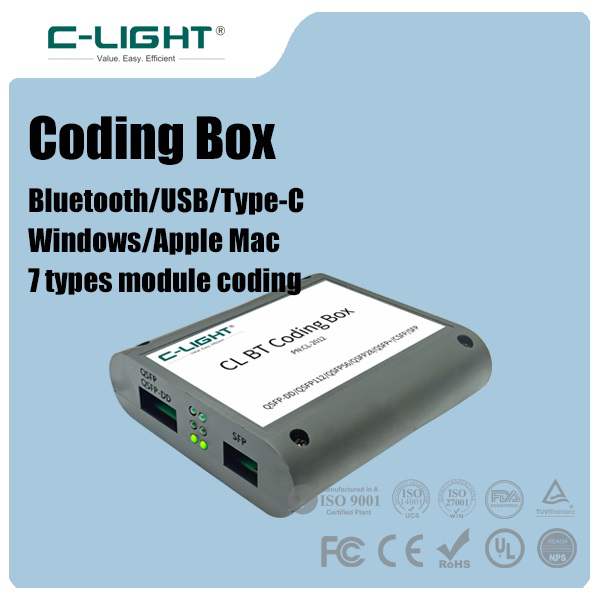
| Device compatibility | Confirm switch model, port capabilities, module coding, supported protocols and interoperability. |
For mission-critical industrial systems, redundancy and recovery behavior require particular attention. Ring protection, redundant uplinks, network segmentation, managed-switch features, and power redundancy should be evaluated as part of the complete architecture rather than treated as properties of the optical transceiver alone.
8. Industrial Ethernet vs Fiber Ethernet: Which Should You Choose?
Industrial Ethernet and fiber Ethernet solve different parts of the network design problem. Industrial Ethernet provides the communication framework for automation and control systems. Fiber Ethernet provides an optical physical connection that can extend Ethernet across longer distances and electrically noisy environments.
Connections are short and within the supported channel distance.
Devices provide native RJ45 ports.
Local machine or control-cabinet connections are required.
Installation conditions allow suitable cable routing and grounding.
Links extend beyond conventional copper channel distances.
Communication paths pass through high-EMI environments.
Electrical isolation between network segments is required.
Inter-building or remote-site connectivity is needed.
Higher-capacity optical backbone links are part of the network plan.
For many factories and industrial facilities, the most practical architecture combines both. Copper Ethernet connects local automation devices, while fiber Ethernet provides backbone connectivity between switches, buildings, and remote network locations. Industrial fiber media converters and compatible SFP transceivers make this hybrid architecture easier to implement.
9. Industrial Ethernet and Fiber Connectivity Solutions
Reliable industrial communication depends on the complete link design, from the Ethernet interface and optical transceiver to the fiber route, power supply, and network topology. Selecting the correct media converter or SFP module helps maintain interoperability between existing industrial equipment and optical network infrastructure.
C-LIGHT provides industrial fiber media converters and a broad range of optical transceivers for Ethernet and fiber connectivity applications. Product selection can be matched to the required interface, data rate, transmission distance, fiber type, and environmental conditions.
Industrial Fiber Ethernet Connectivity
For industrial fiber media converters, SFP optical transceivers, and customized fiber connectivity requirements, contact C-LIGHT for product information and technical support.
 >

 >
 >
 >
 >
 >
 >
 >