TEL:+86 132 6656 7067


●Industry Trends & Product Positioning
With 5G densification, cloud resource pooling, and enterprise digitalization, legacy optical networks face three critical challenges:
Bandwidth Wall: Live streaming/AI training demands 400G/channel transmission.
Space Constraints: Metro sites require 1RU high-density design to save 70% rack space.
Multi-service Convergence: Legacy SDH and modern 25G/400G Ethernet coexistence.
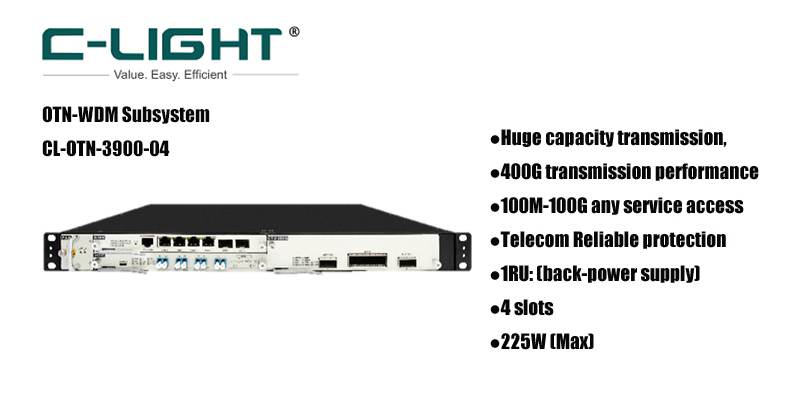
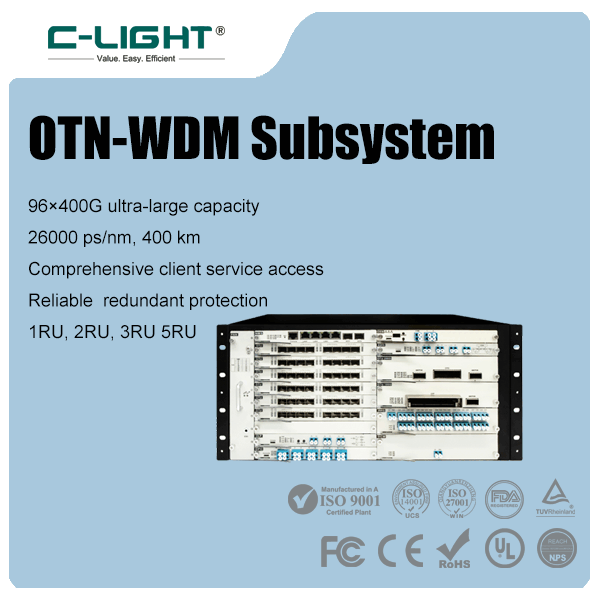
The CL-OTN-3900-04 addresses these needs through Opto-Electronic Co-Design:
✓ 96λ×400G=38.4T total capacity
✓ Smooth evolution from 10G/100G networks
✓ 30% OPEX reduction via multi-protocol integration
●Technological Innovations
1.Ultra-Compact Hardware
3D Thermal Design: Aerodynamic guide slots + intelligent fans improve cooling by 40%
Hybrid PSU: AC/DC/HDC compatibility with global certifications (EN 61000-4-5)
Front-access Maintenance: 45° angled ports reduce maintenance space by 40%
2.Intelligent Optical Layer
Dynamic Power Equalization: SOA amplifiers control fluctuation ≤0.5dB
Auto-Tuning Lasers: ITU-T G.694.1 compliance, wavelength switching < 2ms
Dispersion Compensation: Built-in DCM modules (±1000ps/nm range)
●Deployment Scenarios
| Scenario | Solution | Value Proposition |
| 5G Fronthaul | Ring topology + 1+1 protection | 3μs latency for eCPRI interfaces |
| Finance | Dual-star + SNCP | Zero-loss failover for active-active DCs |
| Smart City | Multi-level OSU pipes | Isolate government/traffic/medical flows |
| Submarine | Repeater + Enhanced FEC | BER<1e-15 |
●Lifecycle Management
Deployment: CL-Toolkit generates optical power budget reports.
Operations: AI predicts laser degradation 48hrs in advance.
Evolution: Hardware-ready for 800G, SDN control via OpenDaylight.
The CL-OTN-3900-04 OTN-WDM subsystem embodies the philosophy of "Maximum Density, Full-service Support, Zero Compromise", converging optical and data technologies to deliver end-to-end 400G solutions for 5G fronthaul, cloud-network convergence, and mission-critical networks. With its modular design, intelligent optical layer, and lifecycle services, it not only addresses today's 38.4T capacity demands but also paves the way for 800G/1.6T evolution, serving as the foundational infrastructure for next-generation elastic optical networks.
Explore regional deployment cases on [www.c-light.com] or consult our engineers for customized migration plans.
OTN WDM Subsystem FAQ
Q1: What is an OTN WDM subsystem?
A: An OTN WDM subsystem is an integrated optical transport platform that combines Optical Transport Network (OTN) and Dense Wavelength Division Multiplexing (DWDM) technologies to deliver high-capacity, long-distance optical transmission.
It provides:
High-speed optical transport
Multi-service aggregation
Wavelength multiplexing
Carrier-grade protection
Centralized network management
Modern OTN-WDM systems support services ranging from 100Mbps to 400Gbps per channel, making them suitable for next-generation transport networks.
Q2: Why is an OTN WDM subsystem important for modern optical networks?
A: As AI, cloud computing, 5G, and hyperscale data centers generate massive traffic, traditional transport networks struggle to meet bandwidth demands.
An OTN WDM subsystem provides:
Ultra-large transmission capacity
Long-distance optical transport
Multiple service convergence
Simplified network expansion
Carrier-grade reliability
It enables operators to build scalable optical infrastructures while protecting existing network investments.
Q3: What are the key features of the C-LIGHT CL-OTN-3900 series?
A: The CL-OTN-3900 Series is designed for high-capacity optical transport with flexible deployment options.
Ultra-High Capacity
Up to 96 DWDM wavelengths
Maximum 38.4Tbps transmission capacity
Supports 10G, 100G, 200G, and 400G hybrid services
Multi-Service Access
Supports:
Ethernet
Fibre Channel
STM/OTN services
CPRI/eCPRI
Carrier-Grade Protection
Supports:
Optical channel 1+1 protection
Optical line 1+1 protection
Dual power redundancy
Flexible Chassis
Available in:
1RU
2RU
3RU
5RU
to meet different deployment requirements.
Q4: What is the difference between an OTN WDM subsystem and a traditional DWDM system?
A: Although both technologies use wavelength division multiplexing, OTN adds intelligent transport capabilities.
| Feature | Traditional DWDM | OTN WDM Subsystem |
|---|---|---|
| Wavelength Multiplexing | Yes | Yes |
| OTN Grooming | No | Yes |
| Multi-Service Support | Limited | Extensive |
| Network Management | Basic | Advanced |
| Protection Mechanisms | Limited | Carrier-grade |
| Scalability | Moderate | High |
An OTN WDM subsystem combines optical transport, service grooming, monitoring, and protection into a unified platform.
Q5: What applications are suitable for an OTN WDM subsystem?
A: OTN WDM systems are widely deployed in bandwidth-intensive networks.
Data Center Interconnect (DCI)
High-capacity data center connectivity
Cloud resource synchronization
5G Transport Networks
Fronthaul
Midhaul
Backhaul
Telecom Networks
National backbone
Metro aggregation
Enterprise Networks
Financial institutions
Government agencies
Broadcasting networks
Cloud & AI Infrastructure
AI training clusters
Big data transmission
Cloud computing platforms
These scenarios require reliable, high-capacity optical transport.
Q6: What technologies are supported by the CL-OTN-3900 platform?
A: The CL-OTN-3900 integrates advanced optical transport technologies.
Supported capabilities include:
400G coherent transmission
DWDM multiplexing
OTN encapsulation
IEEE 1588v2 clock synchronization
SNMP, Web, CLI, and Telnet management
Point-to-point, ring, chain, and star topologies
Smooth migration toward 800G optical networks
These technologies improve transmission efficiency, reliability, and future scalability.
Q7: How do you choose the right OTN WDM subsystem?
A: Selecting an OTN platform requires evaluating several factors.
1. Network Capacity
Determine whether the network requires:
10G
100G
200G
400G services
2. Service Types
Consider support for:
Ethernet
OTN
Fibre Channel
CPRI/eCPRI
3. Deployment Scale
Choose the appropriate chassis:
1RU
2RU
3RU
5RU
based on service slot requirements.
4. Future Expansion
Select a platform that supports higher-capacity wavelengths and smooth evolution toward 800G transport networks.
Q8: Why is the OTN WDM subsystem a future-ready optical transport solution?
A: Future optical networks require greater capacity, intelligent management, and seamless scalability.
The OTN WDM subsystem delivers:
Up to 38.4Tbps transmission capacity
High-density optical integration
Carrier-grade protection
Multi-service convergence
AI-ready transport infrastructure
Smooth migration to 800G and beyond
These capabilities make it an ideal platform for next-generation optical transport supporting AI, cloud computing, hyperscale data centers, and 5G networks.
 >
>

 >
>
 >
>
 >
>
 >
>
 >
>
 >
>
 >
>