TEL:+86 132 6656 7067


In the digital age, the demand for higher bandwidth has been constantly increasing. With the surge of data intensive applications such as cloud computing, high-definition video streaming, and big data analysis, traditional low-speed optical transceivers are no longer able to meet the requirements. The development of the 100G QSFP28 BIDI ZR4 is to meet the demand for high-speed data transmission of 100 gigabits per second.
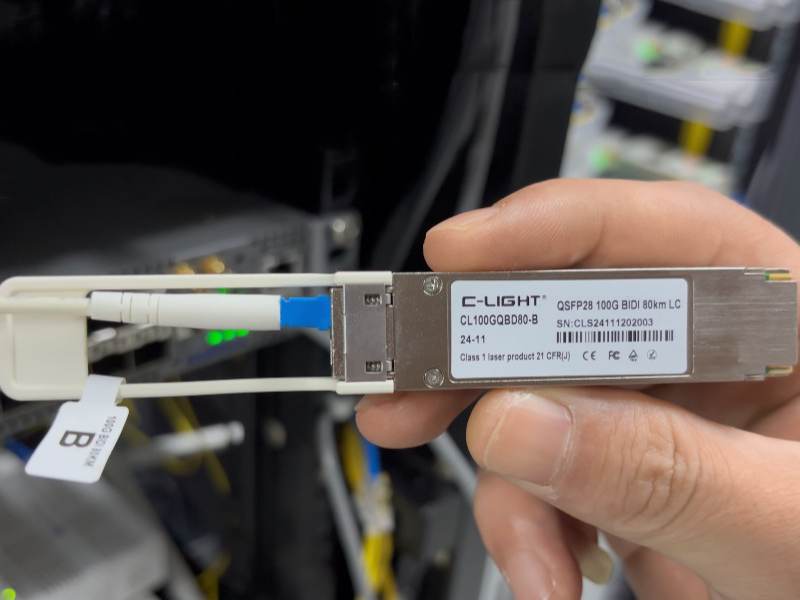
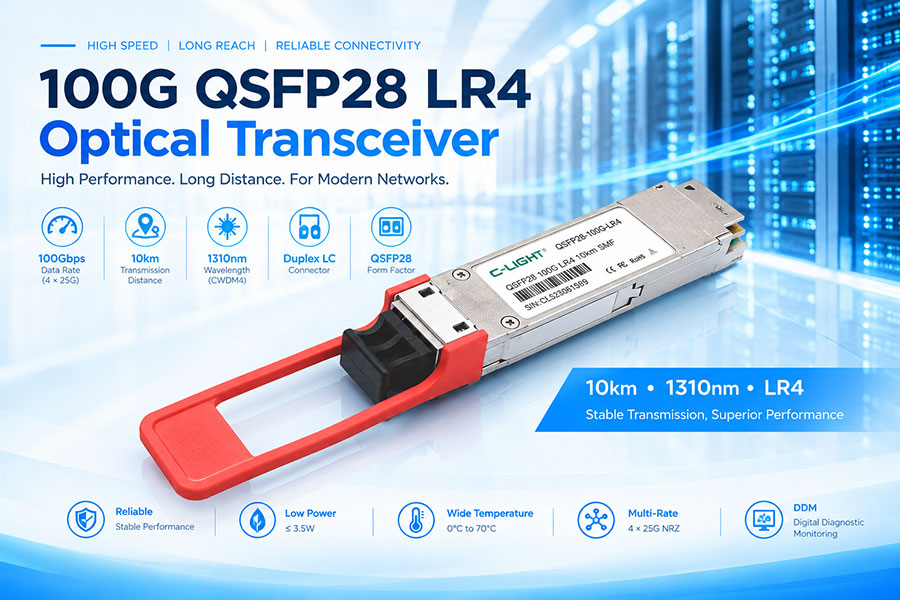
The standardized appearance of QSFP28 (Quad Small Form Factor Pluggable 28) provides a compact and efficient method for achieving high-speed optical interfaces. QSFP28 modules typically have lower power consumption and better energy efficiency compared to older 100G modules, making them suitable for high-density deployment needs in data centers.
BIDI allows bidirectional data transmission through a single optical fiber, which is different from traditional four channel (four wavelength) modules. Data is transmitted through dual wavelengths, and sending and receiving are done through different wavelengths, enabling bidirectional communication on a single optical fiber
Thereby improving the efficiency of fiber optic usage.
The ZR4 module uses single-mode fiber to transmit data, which is suitable for long-distance transmission due to its low signal loss and large bandwidth, especially for transmission needs from 80km to 100km.
The CL100GQBD80 of C-LIGHT is designed specifically for commercial grade 80km optical communication applications. The single-mode fiber has low transmission loss and is suitable for long-distance communication. The module includes a 4-channel optical transmitter, a 4-channel optical receiver, and a module management block, including 2-wire serial I/O. The optical signal is multiplexed onto single-mode fiber through industry standard LC connectors.
As a high-performance optical module, the C-LIGHT 100G QSFP28 BIDI ZR4 provides high bandwidth while having low power consumption, which helps reduce power consumption and cooling needs in data centers
The C-LIGHT 100G QSFP28 BIDI ZR4 has a wide range of application scenarios
In data centers, it plays a crucial role.Thanks to cloud computing, virtualization, and large-scale data storage, the data traffic within data centers has experienced exponential growth. The 100G QSFP28 BIDI ZR4 enables high-speed interconnection between servers, switches, and storage systems. It ensures fast and efficient data transmission, minimizes latency, and maximizes the overall performance of data center infrastructure.
For telecommunications networks, it is highly suitable for both urban and long-distance transmission. In metropolitan area networks, it can support high-speed communication between different network nodes in cities or regions. In long-distance transmission, it can transmit large amounts of data over long distances, such as between different cities or countries. This is particularly important for telecommunications operators who need to transmit voice, video, and data traffic over their extensive networks.
The enterprise network also benefits from C-LIGHT 100G QSFP28 BIDI ZR4. As enterprises increasingly rely on high-speed data communication for business operations, whether it's video conferencing, file sharing, or running enterprise level applications, this transceiver can provide the necessary high bandwidth connectivity to connect different offices or branches together, ensuring seamless communication and efficient business processes.
Long distance performance and cost-effectiveness of 80 kilometers
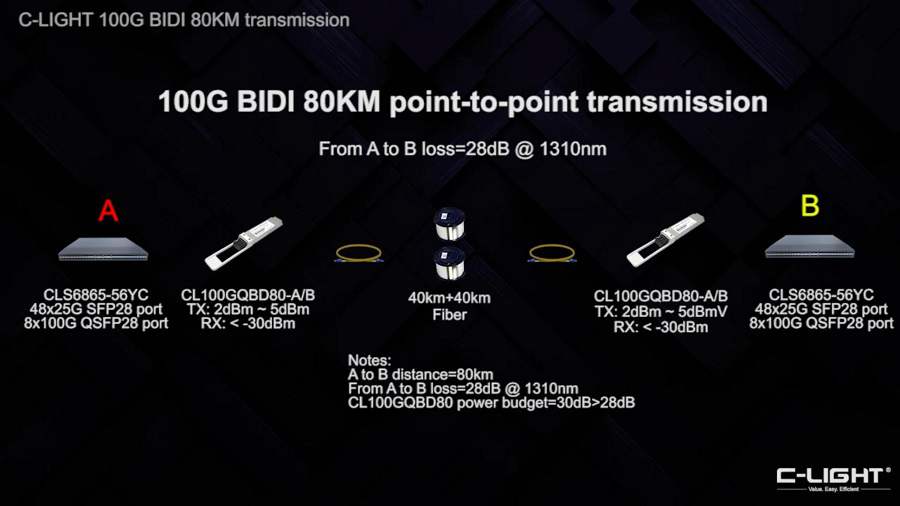
C-LIGHT adopts a self-made 100G QSFP28 BIDI ZR4 80km optical module, using a single fiber, and is used in conjunction with the C-LIGHT CLS6865-56YC 100G port switch, providing a total link budget of 30dB. Implemented 100G P2P 80KM data communication from point A to point B.
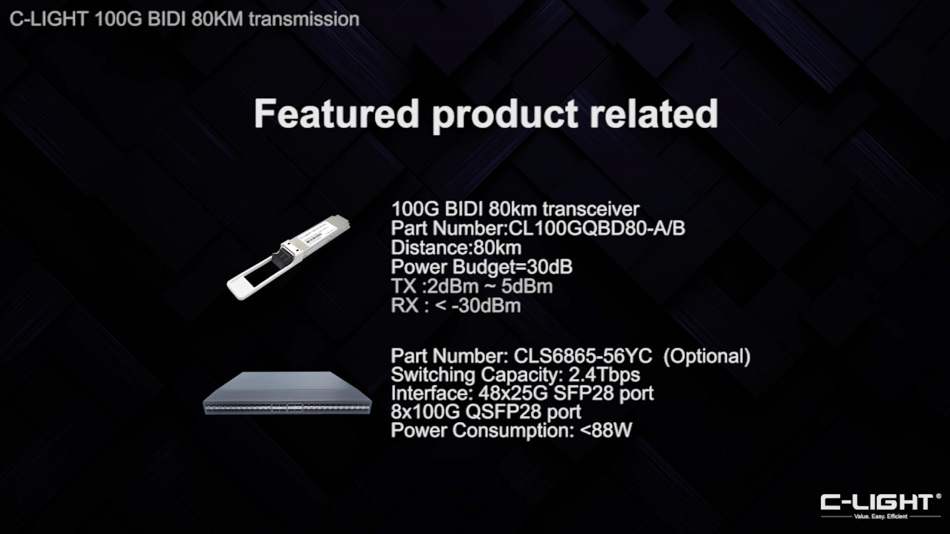
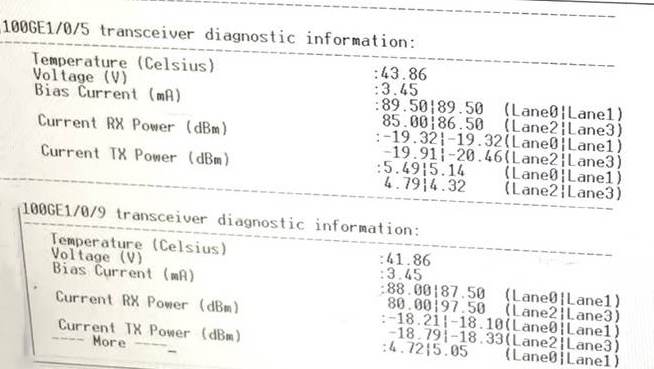
In this scheme, the 100G QSFP28 BIDI 80km ZR4 transceiver of C-LIGHT can provide a maximum transmit optical power of 5dBm per channel and ensure a sensitivity of -28dBm per channel, which can provide a total link budget of over 30dB per channel for this scheme.
The 100G QSFP28 BIDI ZR4 itself is a powerful component. The 100G QSFP28 BIDI ZR4 module supports bidirectional transmission technology and long-distance support. It can support high-speed data transmission of 100 gigabits per second, which is crucial for modern data intensive applications. It is suitable for long-distance and metropolitan area network applications, and can achieve reliable data transmission over long distances. This makes it highly suitable for use in data centers, telecommunications networks, and enterprise networks that require seamless and high-speed data communication.
100G QSFP28 BiDi ZR4 Optical Transceiver FAQ
A 100G QSFP28 BiDi ZR4 optical transceiver is a long-distance 100Gbps optical module that uses bidirectional transmission technology over a single strand of single-mode fiber.
Unlike traditional 100G optical modules that require separate fibers for transmission and reception, BiDi ZR4 combines two-way communication through different wavelengths on one fiber.
Key features include:
100Gbps Ethernet transmission
QSFP28 compact form factor
Single-fiber bidirectional transmission
80km long-distance reach
LC simplex optical interface
It is designed for applications such as:
Data Center Interconnect (DCI)
Metro optical networks
Telecom networks
Enterprise backbone links
A 100G QSFP28 BiDi ZR4 module uses wavelength division technology to transmit and receive signals through the same optical fiber.
The working principle includes:
The transmitter sends optical signals using one wavelength.
The receiver receives signals using another wavelength.
Both directions share one single-mode fiber.
The optical module performs electrical-optical conversion.
For example:
Side A: TX 1310nm / RX 1290nm
Side B: TX 1290nm / RX 1310nm
The paired modules communicate through wavelength separation, enabling bidirectional 100G transmission over a single fiber.
Single Fiber Transmission
Requires only one fiber strand
Saves valuable fiber resources
Long Distance Connectivity
Supports up to 80km transmission over single-mode fiber
Lower Deployment Cost
Reduces fiber infrastructure requirements
Simplifies network expansion
High Bandwidth
Provides 100Gbps Ethernet connectivity
Compact Design
Uses standard QSFP28 packaging
These advantages make BiDi ZR4 suitable for operators and enterprises with limited fiber resources.
The main difference is the fiber transmission method.
| Feature | 100G BiDi ZR4 | Traditional 100G ZR4 |
| Fiber Usage | Single Fiber | Duplex Fiber |
| Transmission Method | Bidirectional wavelength transmission | Separate TX/RX fibers |
| Distance | 80km class | 80km class |
| Connector | LC Simplex | LC Duplex |
| Fiber Efficiency | Higher | Standard |
Both solutions provide long-distance 100G transmission, but BiDi ZR4 improves fiber utilization by using only one fiber.
Fiber resources are becoming increasingly valuable as network bandwidth requirements continue growing.
Single-fiber BiDi technology helps network operators:
Maximize existing fiber infrastructure
Reduce new fiber deployment costs
Simplify long-distance connections
Improve network flexibility
This is especially valuable in:
Metro networks
Dense urban environments
Existing fiber networks
Data center interconnect applications
For operators with limited fiber availability, BiDi provides an efficient upgrade path to 100G connectivity.
100G QSFP28 BiDi ZR4 is designed for high-bandwidth and long-distance optical communication scenarios.
Typical applications include:
Data Center Interconnect (DCI)
Connecting distributed data centers and supporting cloud infrastructureTelecom Networks
Metro aggregation and long-distance Ethernet linksEnterprise Networks
Campus backbone connections and private network expansionFiber-Limited Environments
Locations where additional fiber deployment is difficult
The combination of 100G bandwidth and single-fiber transmission makes BiDi ZR4 an efficient long-distance solution.
The main cost advantage comes from reducing fiber infrastructure requirements.
Traditional duplex fiber solutions require:
Two fiber strands
Additional fiber management resources
BiDi ZR4 requires:
One fiber strand
Simpler fiber deployment
Additional benefits include:
Lower cabling cost
Easier maintenance
Better fiber resource utilization
Reduced network expansion complexity
For existing fiber networks, BiDi technology can provide a cost-effective 100G upgrade solution.
Selecting the correct 100G BiDi optical module requires evaluating several factors.
1. Fiber Infrastructure
Single-mode fiber availability
Existing fiber resources
2. Transmission Distance
10km
40km
80km requirements
3. Wavelength Pairing
Correct Side A and Side B matching
Compatible wavelength configuration
4. Equipment Compatibility
Switches
Routers
Optical transport equipment
Proper selection ensures stable long-distance 100G optical communication.
 >
>

 >
>
 >
>
 >
>
 >
>
 >
>
 >
>
 >
>