TEL:+86 132 6656 7067


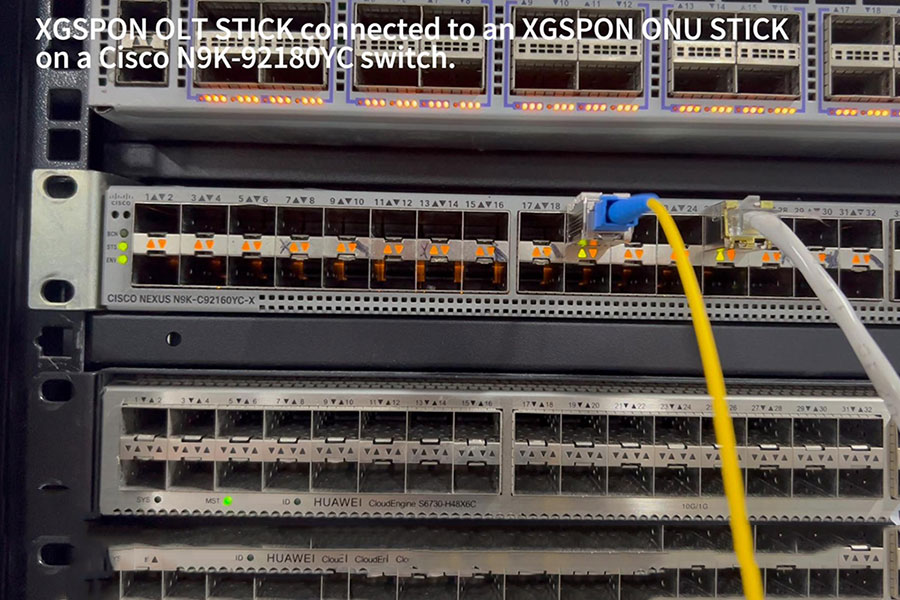
A practical demonstration of XGS-PON optical connectivity, Cisco switch transceiver recognition, and real-time DDM diagnostics.
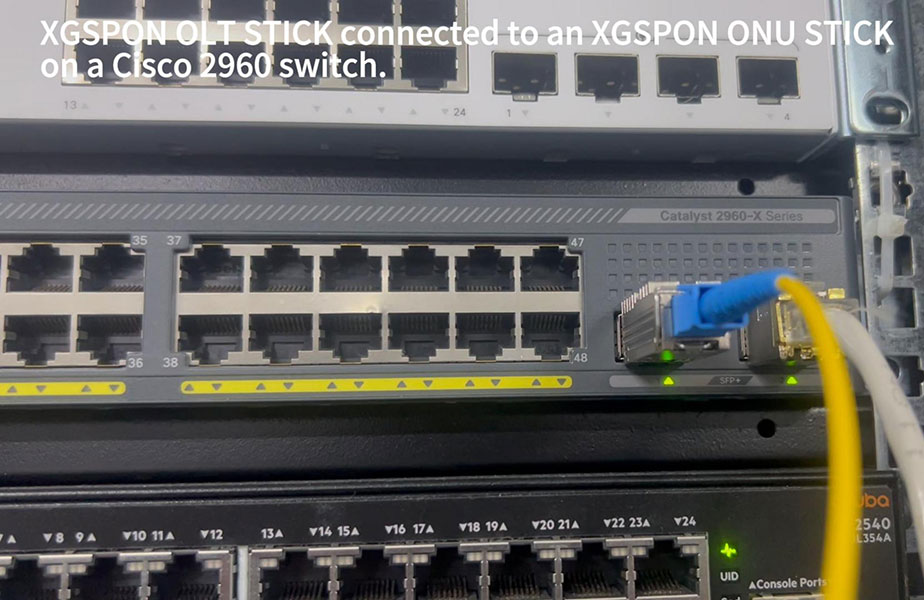
XGS-PON Stick solutions provide a compact approach to integrating passive optical network technology with existing Ethernet infrastructure. By using an OLT Stick and an ONU Stick, network engineers can explore optical access connectivity through pluggable interfaces rather than relying entirely on conventional standalone optical network equipment.
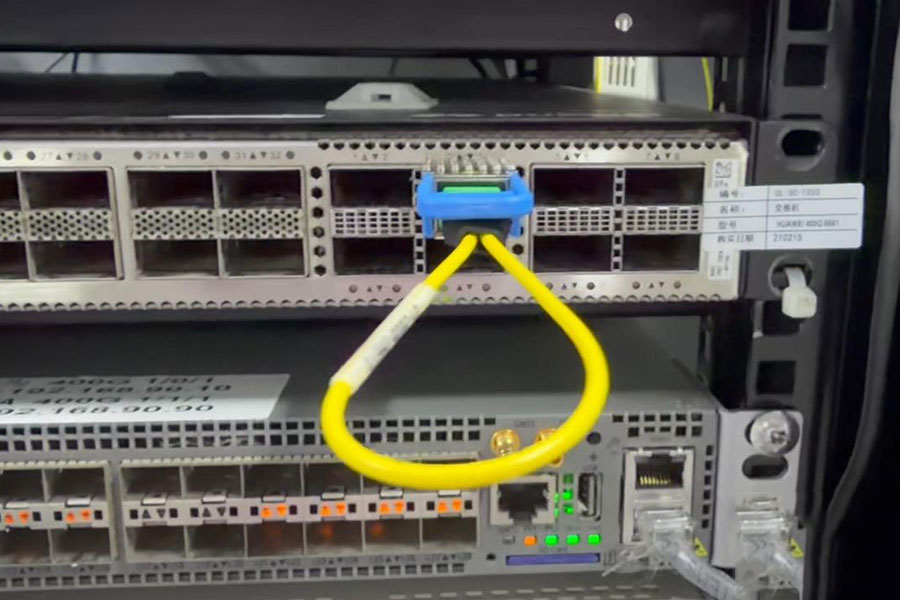
In this practical demonstration, an XGS-PON OLT Stick and an XGS-PON ONU Stick are connected to a Cisco Nexus 92180YC switch. The switch CLI is used to retrieve transceiver identification and Digital Diagnostic Monitoring (DDM) information, providing visibility into the operating conditions of both optical interfaces.
1. XGS-PON Stick Connection Architecture
The test setup uses two optical modules: an XGS-PON OLT Stick installed in Ethernet1/19 and an XGS-PON ONU Stick installed in Ethernet1/25. Both interfaces are inspected through the Cisco Nexus switch command-line interface.
XGS-PON OLT Stick
The OLT-side module is identified by the part number SFP+OLTSTICK. The switch reports a 10GBASE-LR transceiver type and a nominal bit rate of 10,000 Mbit/s.
Reported link length: 2 km over single-mode fiber.
XGS-PON ONU Stick
The ONU-side interface reports part number SFP-10G-SR-C and a 10GBASE-SR transceiver type, with a nominal bit rate of 10,300 Mbit/s.
Reported link length: 82 m over OM2 and 300 m over OM3 multimode fiber.
This configuration demonstrates how the Cisco platform reads the identification information exposed by the installed modules. The reported 10GBASE-LR and 10GBASE-SR classifications are the switch's transceiver identification results and should not be confused with proof of complete XGS-PON protocol interoperability.
2. DDM Monitoring and Optical Performance
Digital Diagnostic Monitoring provides important information about optical module operating conditions. The Cisco command show interface ethernet transceiver details retrieves diagnostic readings, including temperature, supply voltage, laser current, transmit power, and receive power.
The diagnostic readings show that both modules provide temperature and voltage information to the switch. These measurements help engineers observe operating conditions and identify potential deviations from configured alarm and warning thresholds.
Receive Power: A Key Diagnostic Indicator
| DDM Parameter | OLT Stick | ONU Stick |
|---|---|---|
| Receive Power | -23.97 dBm | -3.97 dBm |
| Transmit Fault Count | 0 | 0 |
| Temperature | 48.68°C | 44.50°C |
The receive power readings are particularly useful for evaluating the optical signal conditions reported at each interface. The OLT Stick reports -23.97 dBm, while the ONU Stick reports -3.97 dBm. This difference highlights the importance of examining each optical interface independently rather than assuming that both ends will report identical receive power.
DDM values should be evaluated against the actual module specifications, optical power budget, receiver sensitivity, and configured alarm thresholds. A zero transmit fault count does not independently confirm successful PON registration or end-to-end data transmission. The OLT TX power is displayed as 8 in the supplied CLI screenshot without an explicit unit, so it is not converted into dBm here.
3. Why Cisco Switch DDM Monitoring Matters
Reading optical diagnostics directly from a Cisco Nexus switch offers a convenient way to inspect module operating conditions during deployment and troubleshooting. Engineers can retrieve useful information without relying exclusively on external optical measurement equipment for routine module monitoring.
For XGS-PON Stick applications, this is particularly relevant when evaluating module recognition, monitoring interface conditions, and investigating potential optical-layer issues in a network environment.
4. Practical Applications of XGS-PON Stick Solutions
Pluggable PON modules can provide an alternative approach to integrating optical access functions into compact network equipment, subject to platform and system compatibility.
XGS-PON technology supports high-capacity symmetrical broadband access, making it suitable for fiber-to-the-home and fiber-to-the-building deployment scenarios.
OLT and ONU Stick configurations allow engineers to evaluate module recognition, optical diagnostics, PON interoperability, and network integration in controlled test environments.
DDM monitoring helps network operators observe temperature, voltage, and optical receive power when investigating interface conditions and potential link issues.
5. Compatibility and Deployment Considerations
Although the Cisco Nexus 92180YC can retrieve transceiver identification and DDM information from the two installed modules, complete XGS-PON interoperability requires additional verification.
Engineers should consider the following factors before deploying an OLT Stick and ONU Stick combination:
Host compatibility: Verify the switch hardware, firmware, port configuration, and supported transceiver operating modes.
PON interoperability: Confirm that the OLT and ONU support compatible XGS-PON specifications, wavelengths, registration procedures, and provisioning requirements.
Optical budget: Check transmit power, receiver sensitivity, fiber attenuation, splitter loss, and connector loss.
DDM thresholds: Evaluate temperature, voltage, TX power, and RX power against the module's specified operating limits.
End-to-end testing: Verify ONU registration, PON link status, and actual bidirectional data transmission.
6. Conclusion
The XGS-PON OLT Stick and ONU Stick demonstration on the Cisco Nexus 92180YC highlights the practical value of pluggable optical access solutions and switch-based DDM monitoring.
By retrieving transceiver identification, temperature, voltage, and receive power information from both interfaces, engineers gain useful visibility into optical module operating conditions. These capabilities support laboratory evaluation, compatibility assessment, and optical network troubleshooting.
For network equipment manufacturers, system integrators, and broadband access providers, XGS-PON Stick solutions offer an interesting approach to compact optical connectivity and flexible network integration.
Explore Optical Connectivity Solutions
C-LIGHT provides optical transceivers, PON solutions, and customized optical connectivity products for enterprise networks, broadband access, and data center applications.
Contact C-LIGHT >

 >
 >
 >
 >
 >
 >
 >