TEL:+86 132 6656 7067


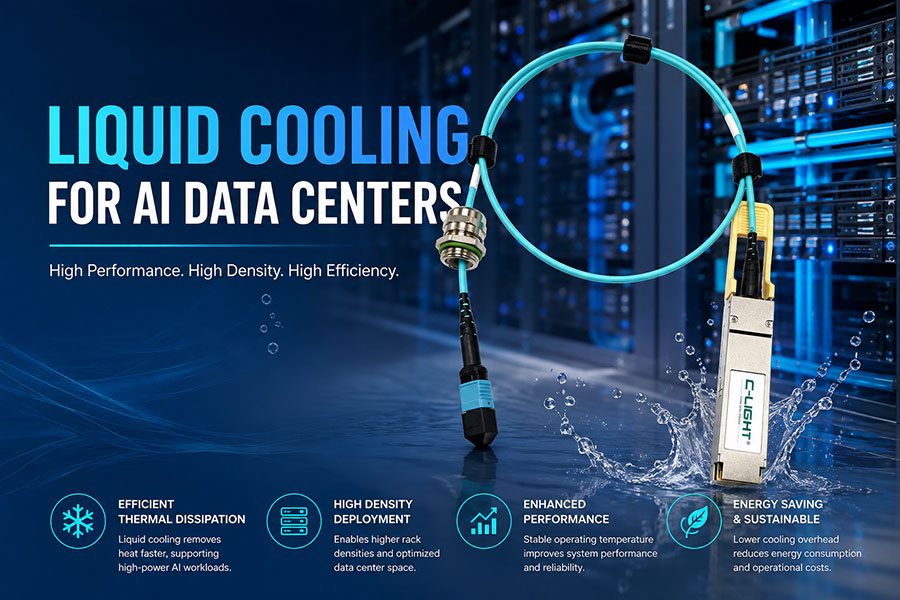
Liquid cooling is becoming an important technology for modern AI data centers as GPU performance and rack power density continue to increase. Compared with traditional air cooling, liquid cooling can remove heat more efficiently from high-power processors, enabling data centers to support increasingly dense GPU and networking infrastructure.
At the same time, higher rack density places greater demands on data center connectivity. High-speed optical transceivers, active optical cables, and other optical interconnect solutions are becoming increasingly important for connecting GPUs, switches, servers, and network fabrics in liquid-cooled AI infrastructure.
1. What Is Liquid Cooling?
Liquid cooling is a thermal management method that uses a liquid coolant to transfer heat away from high-power electronic components. Because liquids generally provide much higher heat-transfer capability than air, liquid cooling can handle thermal loads that are increasingly difficult for conventional air-cooled systems.
In AI data centers, liquid cooling is mainly used for GPUs, CPUs, memory systems, and other high-power components. It can be implemented at the server, rack, or facility level depending on the system architecture.
2. Why Do AI Data Centers Need Liquid Cooling?
AI computing systems use powerful GPUs and accelerators to process large amounts of data. As accelerator performance increases, electrical power consumption and heat generation also increase.
High-density GPU servers can generate significantly more heat than traditional enterprise servers. When many GPU servers are installed in the same rack, the resulting thermal load can exceed the practical capability of conventional air cooling.
Liquid cooling provides a more efficient way to remove heat and allows data center operators to build higher-density computing environments without relying entirely on increasingly large airflow systems.
3. Liquid Cooling vs Air Cooling
| Feature | Air Cooling | Liquid Cooling |
|---|---|---|
| Heat Transfer | Uses airflow | Uses liquid coolant |
| High-Power GPU Support | More challenging at high density | Better suited for high thermal loads |
| Rack Density | More limited by airflow | Supports higher-density configurations |
| Cooling Efficiency | Lower for extremely high heat loads | Higher heat-transfer capability |
| Infrastructure | Air handling and cooling systems | Cooling loops and liquid distribution systems |
| AI Data Center Use | Suitable for lower-density systems | Increasingly important for high-density AI systems |
4. Main Types of Liquid Cooling
4.1 Direct-to-Chip Liquid Cooling
Direct-to-chip liquid cooling uses cold plates mounted directly on high-power processors such as GPUs and CPUs. Coolant flows through the cold plate and absorbs heat generated by the chip.
This approach is particularly attractive for AI servers because it can directly target the components responsible for most of the system's heat generation.
4.2 Immersion Cooling
Immersion cooling places electronic components or complete servers in a specially engineered non-conductive liquid. Heat is transferred directly from the components to the coolant.
Immersion cooling can provide excellent thermal performance and high rack density, although it requires specialized hardware, fluid management, maintenance procedures, and facility infrastructure.
4.3 Spray Cooling
Spray cooling uses controlled streams or droplets of coolant to remove heat from electronic components. It is an emerging approach that can provide highly efficient thermal transfer for specialized high-density computing systems.
5. Liquid Cooling and GPU Clusters
GPU clusters are among the strongest drivers of liquid cooling adoption. AI training and inference workloads often distribute computing tasks across large numbers of accelerators connected through high-speed network fabrics.
As more GPUs are installed in each rack, both computing power and thermal density increase. Liquid cooling can help maintain stable operating temperatures while allowing higher computing density.
However, cooling is only one part of the infrastructure. The network connecting these GPUs must also provide sufficient bandwidth and low latency to prevent communication from becoming a bottleneck.
6. Liquid Cooling and Optical Connectivity
Liquid cooling does not replace optical networking. Instead, the two technologies address different parts of AI data center infrastructure.
Liquid cooling manages the thermal requirements of high-density computing equipment, while optical connectivity provides high-bandwidth communication between GPUs, servers, switches, and data center networks.
As AI clusters move toward 400G, 800G, 1.6T, and future higher-speed interfaces, optical transceivers and active optical cables can provide the bandwidth required for large-scale GPU networking.
7. Why Optical Modules Matter in Liquid-Cooled AI Data Centers
High-density AI infrastructure requires both efficient thermal management and high-speed connectivity. Optical modules are particularly important for connections where electrical copper links become difficult to scale because of distance, signal loss, power consumption, or bandwidth requirements.
High Bandwidth: Optical interfaces support high-speed links required by modern AI clusters.
Longer Reach: Optical fiber can support connectivity beyond the practical reach of many high-speed copper links.
Lower Cable Weight: Fiber-based interconnects can reduce cabling weight and improve cable management.
High Port Density: High-speed optical modules help support dense switch and GPU connectivity.
AI Network Scaling: 400G, 800G, and emerging 1.6T solutions support the evolution of AI fabrics.
8. 400G and 800G Optical Connectivity for AI Data Centers
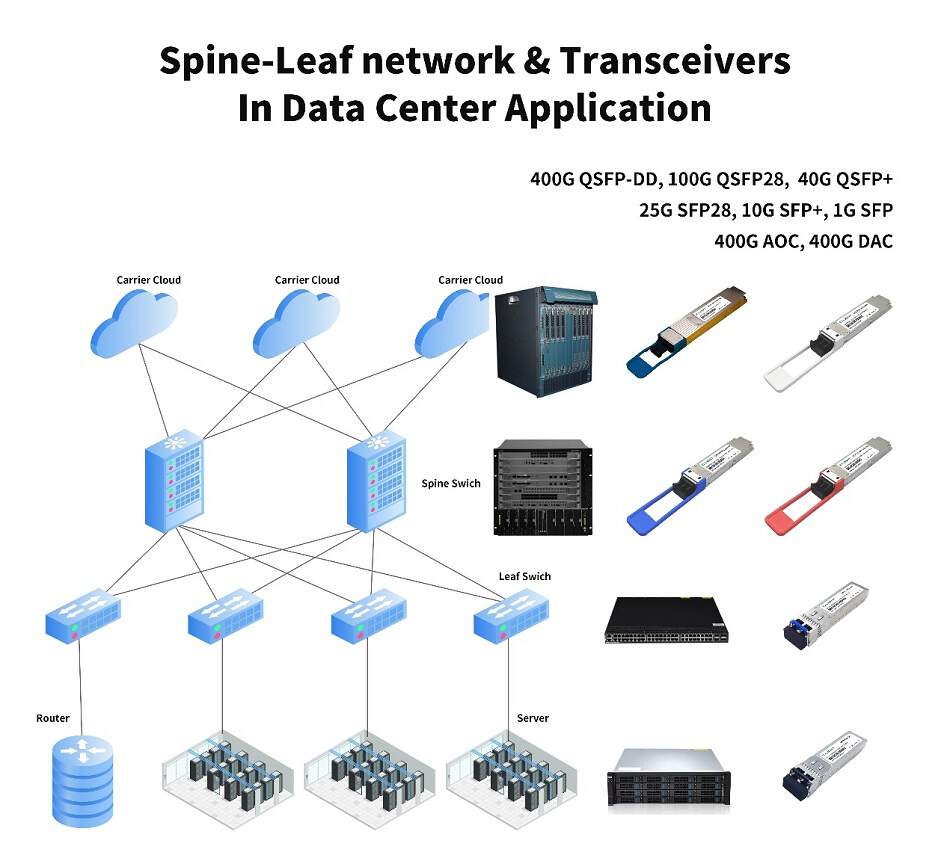
As AI clusters scale, network bandwidth requirements continue to increase. 400G optical transceivers are already widely relevant to high-speed data center networking, while 800G is becoming increasingly important for next-generation AI and cloud infrastructure.
800G optical transceivers can provide high-bandwidth connections between switches and other network equipment. Depending on the application, different form factors and optical configurations can be used to meet reach, power, density, and system compatibility requirements.
For shorter connections, 800G AOC and other high-speed optical interconnect solutions can provide a practical alternative to longer-reach optical transceiver and fiber deployments.
9. Liquid Cooling Changes Data Center Infrastructure
The adoption of liquid cooling affects more than the server itself. Data center operators must consider cooling distribution, rack design, power delivery, cable management, maintenance, monitoring, and physical space.
High-density AI racks can require significantly more power and cooling capacity than conventional enterprise racks. This creates a need for coordinated infrastructure design in which compute, power, cooling, and network connectivity are considered together.
10. Liquid Cooling and Network Reliability
AI workloads are highly dependent on network communication. A GPU cluster may contain hundreds or thousands of accelerators that continuously exchange model parameters, training data, and intermediate results.
Therefore, network reliability is essential. Optical transceivers used in AI data centers need stable electrical and optical performance, appropriate thermal characteristics, and compatibility with the target switching and computing platforms.
For high-speed optical connectivity, testing can include eye diagrams, BER testing, optical power, receiver sensitivity, insertion loss, return loss, jitter, and other electrical and optical parameters.
11. Liquid Cooling, LPO and CPO
As data rates increase, liquid cooling is also becoming relevant to the overall thermal design of high-speed networking equipment. Technologies such as Linear-drive Pluggable Optics (LPO) and Co-Packaged Optics (CPO) are being explored to address power and signal integrity challenges at very high bandwidths.
LPO retains a pluggable architecture while reducing the role of digital signal processing in the optical module. CPO goes further by placing optical engines much closer to the switch ASIC.
These technologies are not replacements for liquid cooling. Instead, they represent different approaches to managing power, signal integrity, and optical connectivity as AI networking speeds continue to increase.
12. Benefits of Liquid Cooling for AI Data Centers
12.1 Higher Compute Density
Liquid cooling enables data centers to manage higher thermal loads and can support higher-density GPU deployments.
12.2 Improved Thermal Management
Liquid-based heat transfer can remove heat more efficiently from high-power processors than conventional airflow-based systems.
12.3 Support for Future Accelerators
As accelerator power and performance continue to increase, liquid cooling provides an infrastructure path for handling higher thermal requirements.
12.4 Better Rack-Level Scalability
High-density cooling solutions can help data centers scale AI computing capacity within constrained rack and facility environments.
13. Challenges of Liquid Cooling
Infrastructure Investment: Liquid cooling requires specialized cooling distribution equipment and facility design.
Maintenance: Coolant systems require monitoring and appropriate maintenance procedures.
System Integration: Servers, racks, cooling systems, power systems, and network equipment must be designed as an integrated infrastructure.
Leak Management: Direct liquid cooling systems require appropriate safeguards and monitoring.
Deployment Complexity: Retrofitting existing air-cooled facilities can be more complicated than designing a new liquid-cooled data center.
14. C-LIGHT Optical Connectivity for AI Infrastructure
C-LIGHT provides high-speed optical transceivers and active optical connectivity solutions for data center and AI networking applications. As AI infrastructure evolves toward higher bandwidth and greater rack density, optical connectivity becomes an increasingly important part of the overall system architecture.
C-LIGHT solutions covering 400G, 800G, and other high-speed optical interfaces can be used for switch-to-switch, server-to-switch, and other high-bandwidth data center connections.
Combined with advanced thermal management technologies such as liquid cooling, high-speed optical connectivity can help build scalable infrastructure for modern cloud computing, AI training, inference, and GPU clusters.
15. Frequently Asked Questions
Q1. What is liquid cooling in a data center?
Answer: Liquid cooling is a thermal management technology that uses liquid coolant to remove heat from high-power computing components such as GPUs and CPUs.
Q2. Why is liquid cooling important for AI data centers?
Answer: AI GPUs generate substantial amounts of heat, especially when deployed at high density. Liquid cooling provides an efficient method for managing these thermal loads.
Q3. What are the main types of liquid cooling?
Answer: The main approaches include direct-to-chip liquid cooling, immersion cooling, and spray cooling. Direct-to-chip cooling is particularly relevant to high-density GPU servers.
Q4. Does liquid cooling replace optical networking?
Answer: No. Liquid cooling manages heat, while optical networking provides high-speed communication between computing and networking equipment. They solve different infrastructure challenges.
Q5. Why do AI data centers need 800G optical connectivity?
Answer: Large GPU clusters require high-bandwidth communication between switches and computing systems. 800G optical connectivity provides a higher-bandwidth option for next-generation AI network fabrics.
Q6. Is liquid cooling suitable for GPU clusters?
Answer: Yes. Liquid cooling is particularly suitable for high-density GPU clusters because it can efficiently remove heat from high-power accelerators.
Q7. What is the difference between liquid cooling and immersion cooling?
Answer: Liquid cooling is a broad category. Direct-to-chip cooling uses cold plates attached to components, while immersion cooling places components or servers in a non-conductive cooling liquid.
Q8. How does liquid cooling affect data center design?
Answer: Liquid cooling affects server configuration, rack architecture, cooling distribution, facility infrastructure, maintenance, power planning, and overall data center design.
16.Conclusion
Liquid cooling is becoming a key technology for high-density AI data centers as GPU performance, power consumption, and rack-level thermal loads continue to increase. Direct-to-chip cooling, immersion cooling, and other liquid-based approaches provide different ways to manage the thermal requirements of next-generation computing infrastructure.
At the same time, AI data centers require increasingly powerful optical networks. 400G and 800G optical transceivers, AOC solutions, LPO, CPO, and other optical technologies are helping data center networks scale alongside GPU computing capacity.
The future AI data center will therefore depend on the coordinated development of computing, cooling, power, and optical connectivity. Efficient thermal management and high-speed optical interconnects will both be essential for building scalable and reliable AI infrastructure.
 >
>

 >
>
 >
>
 >
>
 >
>
 >
>
 >
>
 >
>