TEL:+86 132 6656 7067


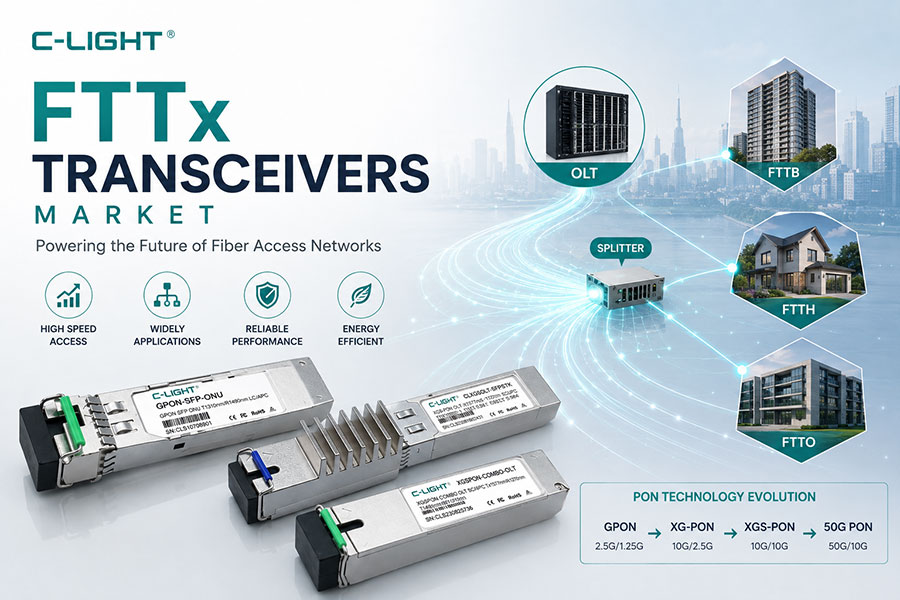
The global broadband communication industry is undergoing a major transformation driven by increasing demand for high-speed internet, cloud services, video streaming, smart homes, enterprise connectivity, and digital infrastructure. FTTx networks have become a fundamental technology for delivering high-capacity fiber access services to residential, business, and industrial users.
FTTx transceivers are critical components in these networks. They convert electrical and optical signals and enable communication between Optical Line Terminal (OLT) systems, Optical Network Units (ONU), Optical Network Terminals (ONT), and fiber infrastructure. As the industry evolves from GPON toward XG-PON, XGS-PON, and 50G PON, the FTTx transceivers market is also moving toward higher bandwidth, lower power consumption, improved integration, and greater deployment flexibility.
1. What Are FTTx Transceivers?
FTTx transceivers are optical communication modules designed for fiber access networks. They perform electrical-to-optical and optical-to-electrical conversion, allowing data to travel efficiently through fiber optic infrastructure.
The term FTTx represents different fiber deployment models:
FTTH: Fiber to the Home
FTTB: Fiber to the Building
FTTC: Fiber to the Curb
FTTO: Fiber to the Office
FTTx transceivers can be found on both sides of the optical access network. OLT optical modules are typically installed in operator-side equipment, while ONU and ONT devices are deployed closer to end users.
2. FTTx Transceivers Market Overview
2.1 Growing Demand for Fiber Broadband
Increasing internet traffic is one of the primary drivers of the FTTx transceivers market. Online video, cloud applications, remote work, smart home systems, gaming, and enterprise digital services are all increasing the need for high-speed broadband access.
Telecom operators are therefore expanding fiber networks and upgrading older access infrastructure to support higher bandwidth and better service quality.
2.2 PON Technology Drives Market Development
Passive Optical Network technology is one of the most important technologies supporting FTTx deployment. PON allows multiple subscribers to share an optical fiber infrastructure through passive optical splitters, reducing deployment complexity and cost.
Major PON generations include:
GPON
XG-PON
XGS-PON
NG-PON2
50G PON
3. Evolution of FTTx Optical Transceiver Technology
3.1 GPON: The Foundation of Fiber Access
GPON has been widely deployed for residential broadband because of its mature technology, broad ecosystem, and cost efficiency. It established fiber as a mainstream access technology and remains important in many existing networks.
3.2 XG-PON: Moving Toward 10G Access
XG-PON increased downstream capacity to the 10Gbps class and provided operators with a practical upgrade path from GPON networks.
Its higher capacity supports applications such as high-speed broadband, enterprise access, and emerging network transport requirements.
3.3 XGS-PON: Symmetrical 10G Broadband
XGSPON OLT/ONU SFP+/SFP-DD丨C-LIGHT
XGS-PON provides symmetrical 10Gbps-class upstream and downstream transmission. This makes it particularly attractive for applications that require substantial upstream bandwidth in addition to fast downloads.
Typical applications include:
Premium FTTH services
Business broadband
Enterprise access
5G transport and access infrastructure
3.4 50G PON: The Next Access Technology
As broadband requirements continue increasing, 50G PON is emerging as a future technology for next-generation fiber access. Higher-speed PON requires more advanced optical components, improved signal processing, and tighter power and thermal management.
4. Key Components of FTTx Optical Networks
4.1 OLT Optical Transceivers
The OLT is located at the service provider side and controls communication with multiple ONUs or ONTs. OLT optical transceivers must provide stable performance, high optical budget, long operating life, and efficient power consumption.
4.2 ONU and ONT Optical Modules
ONU and ONT equipment is deployed closer to subscribers. These devices convert optical signals into electrical Ethernet signals and provide broadband services to homes, businesses, and other end users.
4.3 OLT Stick Solutions
OLT Stick technology integrates OLT functionality into a compact pluggable optical module. This architecture provides a flexible alternative for smaller access networks, enterprise deployments, edge applications, and specialized FTTx scenarios.
5. Main Applications of FTTx Transceivers
5.1 Fiber-to-the-Home
FTTH is one of the largest application areas for FTTx optical transceivers. Fiber connections provide high bandwidth and long-distance transmission for residential broadband.
Typical services include:
High-speed internet
4K and 8K video
Cloud services
Online gaming
Smart home applications
5.2 Fiber-to-the-Business
Businesses require reliable fiber access for cloud applications, video conferencing, enterprise software, and secure data communication. XGS-PON and higher-speed technologies can provide stronger upstream performance for these environments.
5.3 5G Network Infrastructure
Fiber access technology is increasingly connected with 5G infrastructure. High-capacity optical access networks can support aggregation and transport requirements around wireless sites and edge locations.
5.4 Smart City and Industrial Connectivity
FTTx technologies can also support smart city networks, industrial campuses, security systems, and other distributed applications where reliable high-bandwidth fiber connectivity is required.
6. Major Challenges in the FTTx Transceivers Market
6.1 Cost and Large-Scale Deployment
FTTx networks often involve millions of optical connections. Operators therefore need optical transceivers that balance cost, reliability, optical performance, and long-term availability.
6.2 Power Consumption
As PON speeds increase, optical components and signal processing become more sophisticated. Reducing power consumption without sacrificing optical performance is becoming an important design objective.
6.3 Network Migration
Operators must balance existing GPON infrastructure with new XGS-PON and future 50G PON deployments. Compatibility, coexistence, and upgrade costs are important considerations when planning migration strategies.
6.4 Environmental Reliability
Telecom optical equipment may operate in a wide range of environmental conditions. Temperature stability, optical performance, and long-term reliability are especially important for outdoor, access, and industrial deployments.
7. Future Trends of the FTTx Transceivers Market
7.1 Higher-Speed PON
The market will continue moving toward higher-speed technologies, including 25G PON and 50G PON, as operators respond to growing bandwidth demand.
7.2 Higher Integration
Optical modules will continue becoming smaller and more integrated. Integrated optical engines, compact OLT solutions, and pluggable PON technologies will help reduce equipment size and simplify deployment.
7.3 Intelligent Optical Access
Future FTTx infrastructure will increasingly integrate intelligent monitoring, remote management, and automated diagnostics. These capabilities can improve network maintenance efficiency and reduce operational costs.
7.4 Integration with 5G and Edge Networks
Fiber access networks will become increasingly interconnected with 5G and edge computing infrastructure, creating demand for flexible optical modules that can serve residential, enterprise, and distributed network applications.
8. C-LIGHT FTTx Optical Connectivity Solutions
C-LIGHT provides optical connectivity solutions for broadband access networks and next-generation PON applications.
Relevant solutions include:
XGS-PON OLT Stick
PON Optical Transceivers
ONU/ONT Optical Solutions
Customized Fiber Access Modules
These solutions are designed to support flexible deployment, high-speed optical access, and scalable network architectures for telecom operators, system integrators, and enterprise customers.
9. How to Choose the Right FTTx Transceiver
9.1 Select the Appropriate PON Technology
The choice between GPON, XG-PON, XGS-PON, and future PON technologies should be based on required bandwidth, network architecture, subscriber density, and upgrade plans.
9.2 Consider Optical Budget and Reach
Transmission distance, splitter ratio, fiber loss, connector loss, and receiver sensitivity all affect the required optical budget. The optical transceiver should be selected according to the complete link design rather than speed alone.
9.3 Evaluate Temperature and Reliability Requirements
For telecom and outdoor applications, temperature range and long-term reliability are critical. Industrial-grade solutions may be required for more demanding environments.
9.4 Consider Network Compatibility
Compatibility with OLT platforms, ONU/ONT devices, management systems, and network standards should be verified before deployment.
10. FTTx Transceivers and the Future of Fiber Access
The FTTx transceivers market is evolving together with broadband infrastructure. As users demand faster access, operators require optical modules that provide higher bandwidth while remaining cost-effective and energy efficient.
The evolution from GPON to XGS-PON and eventually 50G PON represents more than a simple increase in optical speed. It reflects a broader transformation toward highly integrated, intelligent, and scalable fiber access networks.
For C-LIGHT, this evolution creates opportunities across PON optical modules, XGS-PON OLT Stick products, and customized fiber access solutions.
11. Conclusion: FTTx Transceivers Are the Foundation of Next-Generation Broadband
FTTx transceivers remain essential components in the global transition toward fiber-based broadband. From residential FTTH to enterprise access and 5G infrastructure, optical transceivers provide the physical connectivity required for high-speed digital services.
As the market moves from GPON and XG-PON toward XGS-PON, 25G PON, and 50G PON, optical transceiver technology will continue to evolve toward higher bandwidth, greater integration, lower power consumption, and improved reliability.
11.FAQ: FTTx Transceivers Market
Q1: What are FTTx transceivers?
Answer: FTTx transceivers are optical modules used in fiber access networks to convert electrical and optical signals between networking equipment and fiber infrastructure.
Q2: What are the main FTTx applications?
Answer: Major applications include FTTH, FTTB, FTTC, FTTO, enterprise broadband, smart city networks, and telecom infrastructure.
Q3: What PON technologies are used in FTTx networks?
Answer: Common technologies include GPON, XG-PON, XGS-PON, NG-PON2, and emerging 50G PON solutions.
Q4: Why is XGS-PON important for the FTTx market?
Answer: XGS-PON provides symmetrical 10Gbps-class transmission, making it suitable for high-speed residential broadband, business services, and applications that require higher upstream bandwidth.
Q5: What is the role of an OLT optical transceiver?
Answer: An OLT optical transceiver provides the optical interface between the service provider's OLT equipment and the passive optical network, supporting communication with multiple ONU or ONT devices.
Q6: What is an XGS-PON OLT Stick?
Answer: An XGS-PON OLT Stick is a compact pluggable module that integrates OLT functionality into an optical module form factor, providing a flexible solution for compatible switches, routers, and access platforms.
Q7: What factors should be considered when selecting an FTTx transceiver?
Answer: Important factors include PON technology, transmission distance, optical budget, splitter ratio, wavelength, temperature range, power consumption, network compatibility, and required bandwidth.
Q8: How will the FTTx transceivers market develop in the future?
Answer: The market is expected to move toward higher-speed PON technologies, greater optical integration, lower power consumption, intelligent monitoring, and closer integration with 5G and edge networks.
Q9: What is the difference between GPON and XGS-PON transceivers?
Answer: GPON provides lower access bandwidth, while XGS-PON is designed for symmetrical 10Gbps-class transmission and supports more demanding broadband and business applications.
Q10: How does C-LIGHT support the FTTx transceivers market?
Answer: C-LIGHT provides PON optical transceivers, XGS-PON OLT Stick solutions, ONU/ONT optical solutions, and customized optical connectivity products for fiber access networks.
 >
>

 >
>
 >
>
 >
>
 >
>
 >
>
 >
>
 >
>