TEL:+86 132 6656 7067


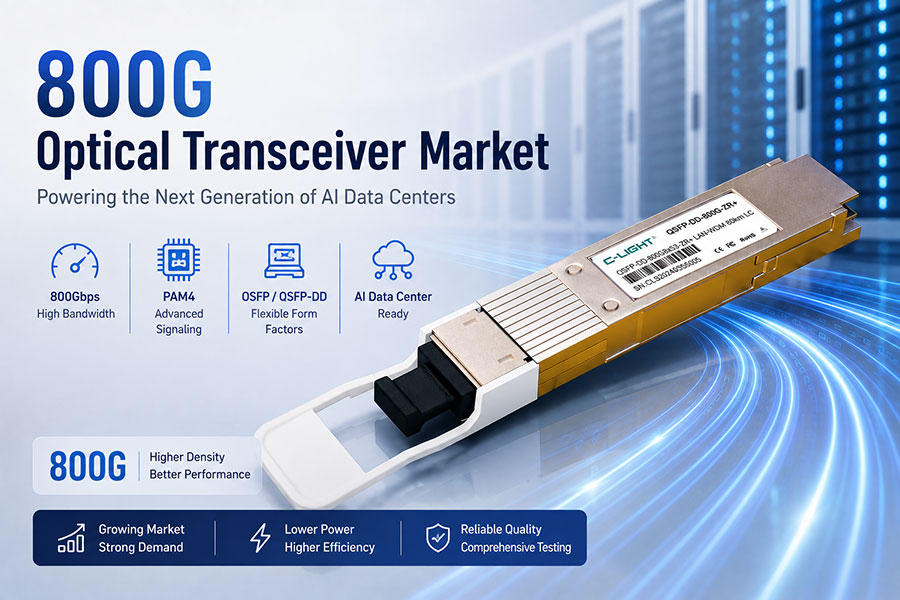
The 800G optical transceiver market is becoming an important segment of the high-speed optical networking industry as AI clusters, hyperscale data centers, cloud computing, and high-performance computing continue to expand. Compared with previous 400G deployments, 800G optical transceivers provide higher bandwidth per port and support higher-density network architectures.
In 2026, 800G is moving into a broader deployment phase, while 1.6T optical modules are beginning to expand as the next step in the bandwidth upgrade cycle. Industry research from LightCounting indicates that 800G optical transceiver shipments are expected to more than double in 2026, reflecting continued investment in AI infrastructure and high-speed data center networking.
1. 800G Optical Transceiver Market Overview
An 800G optical transceiver is a high-speed networking device designed to provide up to 800Gbps of aggregate data transmission. It integrates optical transmit and receive functions into a pluggable module and is commonly used in high-density Ethernet switches, AI clusters, data center networks, and other high-bandwidth applications.
800G solutions are available in different form factors and optical configurations, including OSFP and QSFP-DD800. Depending on the application, modules can support multimode or single-mode fiber and different transmission distances.
The market is developing around several major technology directions, including 800G PAM4, silicon photonics, EML-based optical engines, higher-density packaging, improved thermal management, and the transition toward 1.6T optical connectivity.
2. Why 800G Optical Transceivers Are Growing
2.1 AI Data Center Expansion
AI training and inference systems require large numbers of GPUs and accelerators to exchange data continuously. As the scale of GPU clusters increases, network bandwidth becomes an increasingly important part of overall system performance.
This is one of the main reasons high-speed optical connectivity is gaining importance in AI data centers. Industry analysis shows that demand for 800G-and-above optical transceivers is increasing rapidly as AI server clusters scale.
2.2 Higher Network Port Bandwidth
Moving from 400G to 800G allows network operators to increase bandwidth per switch port while maintaining high-density network architectures. An 800G interface can also support breakout configurations such as 2×400G or 8×100G, depending on the transceiver and switch platform.
2.3 Growth of East-West Data Traffic
Modern AI and cloud environments generate substantial east-west traffic between servers, GPUs, switches, storage systems, and accelerator clusters. High-speed optical transceivers help provide the bandwidth required for these intensive interconnect environments.
3. 800G Optical Transceiver Technology
3.1 PAM4 Signaling
Many 800G optical transceivers use PAM4 signaling to increase the amount of information transmitted per electrical or optical lane. PAM4 uses four signal levels and carries two bits per symbol, enabling higher data rates without simply doubling the signaling frequency.
A common 800G architecture uses eight lanes operating around 100Gbps per lane at the data level. The electrical implementation may use higher baud rates to accommodate protocol overhead and FEC requirements.
3.2 DSP and FEC
At 800G speeds, signal integrity becomes more challenging. Digital signal processing and forward error correction are therefore important technologies in many 800G transceiver implementations.
The DSP can perform functions such as signal equalization and compensation, while FEC helps improve the overall link error performance. These technologies become increasingly important as lane speeds increase and optical links operate at higher data rates.
3.3 Silicon Photonics and EML
Silicon photonics and EML-based optical technologies are both used in high-speed optical transceiver development. Silicon photonics can integrate multiple optical functions onto photonic integrated circuits, while EML technology remains an important solution for high-performance optical transmission.
The choice between optical technologies depends on transmission distance, power requirements, manufacturing considerations, system architecture, and the specific transceiver design.
4. 800G OSFP vs QSFP-DD
OSFP and QSFP-DD are two important form factors used for 800G optical transceivers.
| Feature | 800G OSFP | 800G QSFP-DD |
|---|---|---|
| Form Factor | OSFP | QSFP-DD800 |
| Typical Application | High-density data center and AI networking | Data center and Ethernet networking |
| Bandwidth | Up to 800Gbps | Up to 800Gbps |
| Common Signaling | PAM4 | PAM4 |
| Deployment Focus | High-density switch platforms | High-density Ethernet and data center platforms |
The appropriate form factor depends on the switch platform, port design, thermal requirements, power budget, and interoperability requirements. OSFP and QSFP-DD should therefore be selected according to the target networking equipment rather than simply by data rate.
5. 800G Optical Transceiver Applications
5.1 AI Data Centers
AI data centers are one of the most important application areas for 800G optical transceivers. Large GPU clusters require high-bandwidth connections between servers and network switches, making 800G an important option for next-generation AI fabrics.
5.2 Hyperscale Cloud Networks
Hyperscale cloud providers continuously upgrade network infrastructure to support cloud computing, storage, AI services, and distributed applications. 800G optical transceivers can provide higher bandwidth while supporting high-density switch architectures.
5.3 High-Performance Computing
HPC systems generate large volumes of data between computing nodes and storage systems. High-speed optical interconnects can help support the bandwidth requirements of scientific computing, simulation, modeling, and other data-intensive workloads.
5.4 Data Center Interconnect
800G optical technology can also be used in data center interconnect environments where high-capacity links are required between data center facilities. Depending on the application, different optical technologies and transmission distances can be selected.
6. 800G Optical Transceiver Market Trends
6.1 800G Becomes a Major High-Speed Deployment
The market is moving from earlier 400G deployments toward 800G connectivity for many high-density AI and data center applications. LightCounting reported that 800G PAM4 chipset shipments nearly tripled in 2025 and expects 800G optical transceiver shipments to more than double in 2026.
6.2 Increasing Demand for 800G-and-Above Optics
Market research indicates that AI-focused optical transceiver demand is growing rapidly, with 800G and higher-speed products becoming an increasingly important part of AI data center networking. This trend is closely connected with the expansion of GPU clusters and hyperscale infrastructure.
6.3 Transition Toward 1.6T
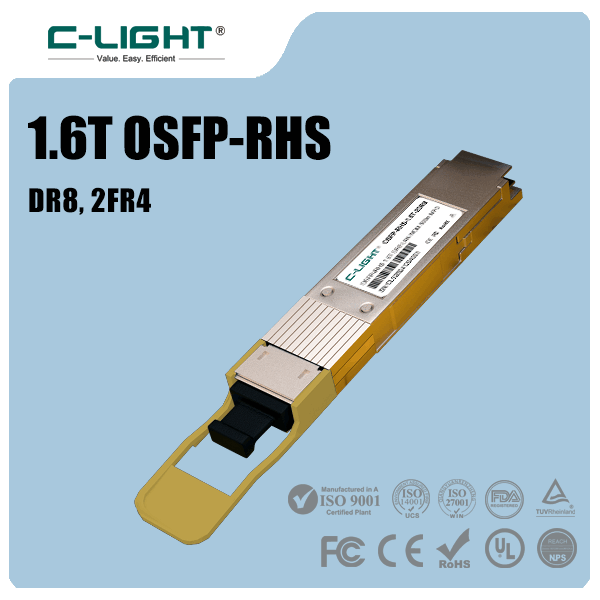
800G is not the final step in the optical networking roadmap. As switch bandwidth and AI cluster scale continue to increase, the industry is developing 1.6T optical modules and higher-speed electrical and optical interfaces.
The transition from 800G to 1.6T will require improvements in optical engines, DSPs, electrical interfaces, thermal management, packaging, and manufacturing processes. As a result, 800G and 1.6T are expected to coexist during the next stage of network upgrades.
6.4 Increasing Importance of Power Efficiency
Higher bandwidth also creates greater power and thermal challenges. For large AI clusters, the power consumed by thousands of optical ports can become a significant part of the overall network infrastructure.
As a result, the market is increasingly focused on improving optical efficiency, reducing module power consumption, optimizing thermal design, and developing alternative architectures such as LPO and CPO.
7. Key Challenges in the 800G Optical Transceiver Market
7.1 Thermal Management
Higher-speed optical modules generally require careful thermal design. High-density switches may contain large numbers of 800G ports, making module power consumption and airflow important considerations for system designers.
7.2 Signal Integrity
PAM4-based high-speed interfaces have smaller signal margins than traditional lower-speed NRZ systems. PCB design, connector performance, insertion loss, return loss, crosstalk, jitter, and equalization therefore become critical factors in 800G system design.
7.3 Optical Component Supply
The rapid expansion of AI infrastructure is increasing demand for optical components, DSPs, lasers, photonic integrated circuits, and other critical components. Supply-chain capacity and manufacturing scalability remain important considerations for the 800G market.
7.4 Interoperability and Compatibility
800G deployments require compatibility between optical transceivers, switches, fiber infrastructure, connectors, and host platforms. Testing and validation are therefore important before large-scale deployment.
8. 800G Optical Transceiver Testing
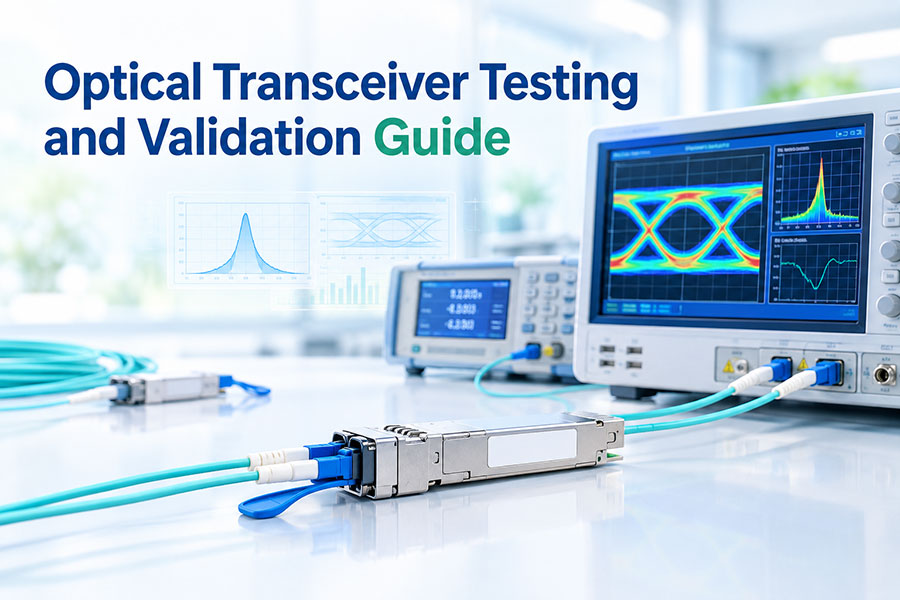
Testing is an essential part of 800G optical transceiver development and deployment. Electrical testing can include eye diagrams, insertion loss, return loss, crosstalk, and jitter measurements. Optical testing can include transmit optical power, receiver sensitivity, extinction ratio, OMA, and TDECQ measurements.
BER testing with suitable PRBS patterns is also commonly used to evaluate high-speed link performance. Compatibility testing with target switch and networking platforms is important for practical deployment.
9. 800G Optical Transceiver Market Outlook
The 800G optical transceiver market is entering an important stage of expansion as AI infrastructure and high-density data center networks continue to grow. The technology is moving beyond early adoption toward broader deployment across AI clusters, hyperscale cloud networks, and high-performance computing environments.
At the same time, the development of 1.6T optical modules is creating the next upgrade cycle. 800G is therefore expected to remain an important generation of high-speed optical connectivity while the industry continues to develop higher-speed solutions.
10. C-LIGHT 800G Optical Transceiver Solutions
C-LIGHT develops high-speed optical transceiver solutions for data center and optical networking applications, including 800G optical modules designed for high-bandwidth connectivity.
C-LIGHT's 800G portfolio can support different form factors and optical configurations for data center applications. Product selection can be based on transmission distance, fiber type, connector configuration, host platform, power requirements, and network architecture.
11. Frequently Asked Questions
Q1: What is an 800G optical transceiver?
Answer: An 800G optical transceiver is a high-speed optical networking module designed to provide up to 800Gbps of aggregate bandwidth. It is widely associated with high-density data center, AI, cloud, and HPC networking.
Q2: Is 800G optical transceiver technology based on PAM4?
Answer: Many 800G pluggable optical transceivers use PAM4 signaling. A common architecture uses multiple 100G-class lanes to achieve an aggregate 800G data rate.
Q3: What are the common 800G optical transceiver form factors?
Answer: OSFP and QSFP-DD800 are two important form factors for 800G optical transceivers. The appropriate option depends on the switch platform, thermal design, power budget, and deployment requirements.
Q4: Where are 800G optical transceivers used?
Answer: Major applications include AI data centers, hyperscale cloud networks, high-performance computing, high-density Ethernet networks, and data center interconnects.
Q5: What comes after 800G optical transceivers?
Answer: 1.6T optical modules are the next major bandwidth generation being developed for high-speed data center and AI networking. Future development will also focus on higher-speed electrical lanes, improved optical engines, lower power consumption, and advanced packaging.
12. Summary
The 800G optical transceiver market is being shaped by AI data center expansion, hyperscale cloud infrastructure, higher network port speeds, and increasing east-west traffic. PAM4 signaling, DSP technology, silicon photonics, EML solutions, OSFP, and QSFP-DD are important parts of the current 800G ecosystem.
As 800G deployment continues to expand, the industry is also preparing for the transition toward 1.6T and higher-speed optical connectivity. For data center operators and network designers, selecting the right 800G optical transceiver requires consideration of bandwidth, transmission distance, optical interface, power consumption, thermal conditions, compatibility, and overall network architecture.
 >
>

 >
>
 >
>
 >
>
 >
>
 >
>
 >
>
 >
>