TEL:+86 132 6656 7067


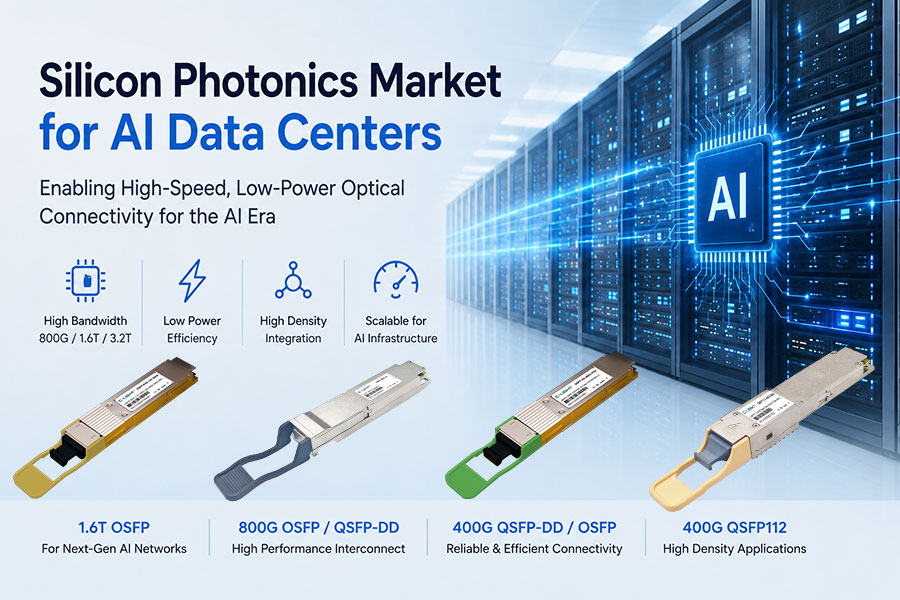
The rapid expansion of artificial intelligence (AI) infrastructure is creating unprecedented demand for high-bandwidth, low-latency, and energy-efficient optical connectivity. As AI clusters scale from hundreds to thousands of GPUs, traditional electrical interconnects face increasing limitations in bandwidth, distance, power consumption, and thermal management.
Silicon photonics is emerging as one of the key technologies for addressing these challenges. By integrating optical functions with silicon-based semiconductor manufacturing, silicon photonics enables high-speed optical transmission in compact and scalable architectures. The technology is increasingly being used in optical transceivers, active optical cables, optical engines, and next-generation co-packaged optics for AI data centers.
Market research indicates that data centers and high-performance computing are becoming the largest application areas for silicon photonics. The global silicon photonics market is expected to experience strong growth throughout the second half of the 2020s, supported by AI infrastructure expansion, hyperscale data centers, 800G and 1.6T optical connectivity, and the transition toward advanced optical interconnect architectures.
1. Silicon Photonics Market Overview
Silicon photonics combines optical communication technologies with silicon-based semiconductor manufacturing processes. Instead of relying entirely on conventional discrete optical components, silicon photonic platforms integrate components such as optical waveguides, modulators, photodetectors, and other photonic functions into compact photonic integrated circuits.
This architecture is particularly attractive for AI data centers because modern GPU clusters require massive amounts of data to move between GPUs, switches, servers, and racks. As network speeds increase from 400G to 800G and 1.6T, optical interconnects become increasingly important for maintaining bandwidth and reducing the limitations associated with copper connectivity.
According to Grand View Research, the global silicon photonics market was valued at approximately USD 3.1 billion in 2025 and is estimated to reach about USD 3.8 billion in 2026. The market is projected to reach approximately USD 16.2 billion by 2033, representing a CAGR of about 22.9%.
The market outlook is particularly strong in data centers and high-performance computing, where AI workloads are accelerating the adoption of high-speed optical connectivity.
2. Why AI Data Centers Need Silicon Photonics
AI workloads are fundamentally changing data center networking requirements. Large-scale AI training and inference systems generate enormous east-west traffic between accelerators and networking devices. The network therefore becomes a critical part of overall AI system performance.
Silicon photonics provides several advantages for these environments:
Higher bandwidth: Silicon photonic technologies can support high-speed optical transmission required by 400G, 800G, and emerging 1.6T networks.
Lower power consumption: Optical connectivity can reduce the electrical transmission burden associated with long and high-bandwidth connections.
High density: Photonic integration allows more optical functions to be implemented within a compact package.
Longer reach: Optical links provide significantly greater reach than conventional short-distance electrical connections.
Scalability: Silicon-based manufacturing processes provide a potential path toward high-volume production of photonic devices.
Improved thermal management: Reducing electrical interconnect losses can become increasingly valuable as AI rack power density continues to increase.
These advantages make silicon photonics particularly relevant as AI data centers move toward increasingly dense GPU clusters and higher-speed network fabrics.
3. Silicon Photonics and the 800G to 1.6T Transition
The evolution of AI data center networking is moving rapidly from 400G toward 800G and 1.6T connectivity. This transition is creating new requirements for optical transceiver architectures and photonic integration.
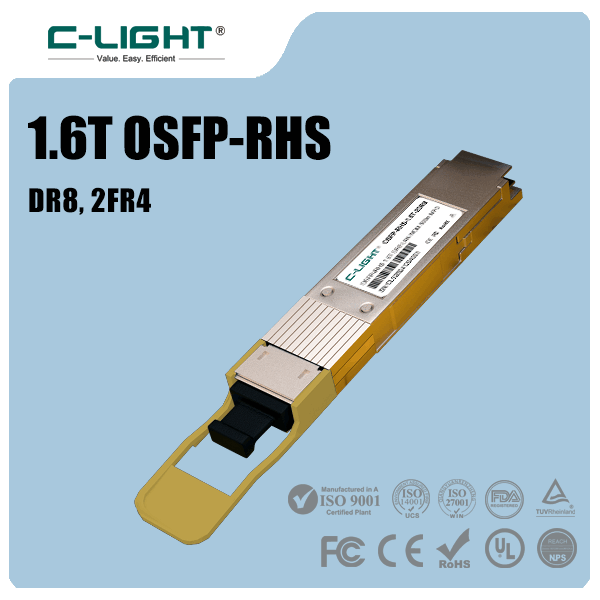
800G optical transceivers have become an important building block for current-generation AI networks, while 1.6T optical modules are moving into commercial deployment as next-generation AI infrastructure expands.
Silicon photonics is well positioned for this transition because integrated photonic platforms can support multiple high-speed optical channels while maintaining compact form factors and scalable manufacturing processes.
| Data Rate | Typical Application | Market Direction |
|---|---|---|
| 400G | Data Center Networking | Large installed base |
| 800G | AI Clusters and Hyperscale Data Centers | Rapid deployment |
| 1.6T | Next-Generation AI Networks | Fast-growing emerging market |
| 3.2T | Future AI Infrastructure | Long-term development |
LightCounting reported that 800G optical transceiver shipments were expected to more than double in 2026, while 1.6T shipments are expected to grow from a relatively small base to tens of millions of ports. This indicates that the transition to higher-speed optical connectivity is becoming a major driver for the optical component supply chain.
4. Silicon Photonics in AI Data Center Optical Interconnects
Optical interconnects are becoming a critical infrastructure layer in AI data centers. As GPU clusters become larger, communication between accelerators and network switches requires high bandwidth with predictable latency and power efficiency.
Silicon photonics can be deployed across several layers of the optical interconnect architecture, including:
Optical transceivers: High-speed pluggable modules for switch-to-switch and switch-to-server connectivity.
Active optical cables: Integrated optical connectivity for high-density data center environments.
Optical engines: Compact optical components designed for next-generation networking architectures.
Near-packaged optics: Optical connectivity positioned closer to high-speed electronic components.
Co-packaged optics: Integration of optical engines with switching or computing devices to reduce electrical interconnect distances.
The expansion of these architectures is creating a broader silicon photonics market that extends beyond conventional optical transceivers.
5. Silicon Photonics and Co-Packaged Optics
Co-packaged optics (CPO) is one of the most important long-term opportunities for silicon photonics in AI infrastructure.
Traditional pluggable optical modules place the optical interface at the front panel of a switch. As electrical signaling speeds increase, however, the electrical path between the switching ASIC and optical module becomes increasingly challenging from a power, signal integrity, and thermal perspective.
CPO moves optical components closer to the switching ASIC, reducing the length of high-speed electrical connections. Silicon photonics is well suited to this architecture because photonic integrated circuits can provide a compact platform for optical engines and related functions.
The industry is therefore moving toward multiple optical architectures rather than a single replacement technology. Pluggable optics remain important for flexibility and serviceability, while near-packaged and co-packaged optics are being developed for future high-density AI networking systems.
6. Key Drivers of the Silicon Photonics Market
6.1 AI and Generative AI Infrastructure
The expansion of generative AI is one of the strongest drivers of optical connectivity demand. Large AI clusters require high-speed connections between GPUs, CPUs, switches, storage systems, and other infrastructure.
6.2 Increasing Network Speeds
The transition from 400G to 800G and 1.6T creates additional demand for advanced optical technologies capable of supporting higher bandwidth within practical power and thermal constraints.
6.3 Hyperscale Data Center Expansion
Hyperscale cloud providers continue to expand AI-oriented data center capacity. The resulting increase in optical port counts directly supports demand for optical transceivers and silicon photonic components.
6.4 Power and Thermal Efficiency
AI data centers face increasing rack power density and cooling requirements. As electrical interconnect losses become more significant, optical connectivity offers an important path toward improving overall network efficiency.
6.5 Semiconductor Manufacturing Compatibility
One of the fundamental advantages of silicon photonics is its compatibility with established semiconductor manufacturing concepts. This provides the potential for higher production volumes, improved integration, and lower costs as the technology matures.
7. Silicon Photonics Market Segmentation
The silicon photonics market can be analyzed across several major dimensions.
By Product: Optical transceivers, optical engines, active optical cables, optical attenuators, and other photonic components.
By Data Rate: 400G, 800G, 1.6T, and future higher-speed optical solutions.
By Application: AI data centers, hyperscale cloud, telecommunications, high-performance computing, and other networking applications.
By Architecture: Pluggable optics, LPO/LRO, near-packaged optics, and co-packaged optics.
By Region: North America, Europe, Asia Pacific, and other regional markets.
Among these segments, AI data centers and high-performance computing are expected to remain some of the most important growth areas during the next several years.
8. Regional Silicon Photonics Market Outlook
North America
North America is currently one of the most important markets for silicon photonics because of its concentration of hyperscale cloud providers, AI infrastructure companies, semiconductor manufacturers, and advanced data center operators.
Asia Pacific
Asia Pacific is expected to remain an important growth region due to expanding data center capacity, semiconductor manufacturing capabilities, telecommunications infrastructure, and AI investment.
Europe
Europe has strong capabilities in photonic research, semiconductor manufacturing, optical communications, and advanced packaging. These capabilities provide a foundation for further development of silicon photonics technologies.
9. Silicon Photonics Market Challenges
Despite its strong growth outlook, silicon photonics still faces several technical and commercial challenges.
Manufacturing complexity: Integrating optical and electronic functions can require sophisticated manufacturing and packaging processes.
Laser integration: Silicon itself is not an efficient light source, so external or heterogeneous laser technologies remain important.
Advanced packaging: Packaging becomes increasingly important as optical and electrical components become more tightly integrated.
Testing requirements: High-speed optical devices require comprehensive optical, electrical, thermal, and reliability testing.
Supply chain capacity: Rapid AI infrastructure expansion can create shortages across wafers, photonic components, lasers, packaging, and other parts of the supply chain.
Recent industry developments demonstrate that supply-chain capacity is becoming an important consideration. Demand for silicon photonics substrates and optical interconnect components has increased significantly as AI data center deployment accelerates.
10. Silicon Photonics Market Forecast 2026–2030
The silicon photonics market is expected to maintain strong growth through 2030. The primary driver is the continuing expansion of AI computing infrastructure and the resulting requirement for higher-speed optical connectivity.
The market is expected to evolve across several stages:
2026: Rapid expansion of 800G optical connectivity and increasing commercial deployment of 1.6T solutions.
2027: Greater adoption of 1.6T optical modules and increasing development of higher-density optical architectures.
2028: Broader adoption of silicon photonics, LPO, NPO, and CPO technologies in AI infrastructure.
2029: Continued scaling of photonic integration and higher-volume manufacturing.
2030: Silicon photonics is expected to become an increasingly important foundation for high-speed AI data center optical connectivity.
Industry forecasts differ in market size because research firms use different definitions, product categories, and forecasting methodologies. However, the direction is consistent: AI data centers, high-speed optical transceivers, and integrated photonic technologies are becoming major growth engines for silicon photonics.
11. C-LIGHT and Silicon Photonics-Based Optical Connectivity
C-LIGHT focuses on optical communication products and high-speed interconnect solutions for data center and networking applications. As data center networks transition toward higher bandwidth, optical transceivers and high-speed interconnect products are becoming increasingly important components of modern AI infrastructure.
The evolution from 400G to 800G and 1.6T is creating new opportunities for optical connectivity providers. C-LIGHT continues to develop solutions covering high-speed optical transceivers and data center interconnect applications, supporting the growing requirements of cloud computing, AI infrastructure, and high-performance networking.
Silicon photonics is expected to play an increasingly important role in this market evolution, particularly for high-density optical transceivers, optical engines, and next-generation optical interconnect architectures.
12. Future Outlook for Silicon Photonics in AI Data Centers
Silicon photonics is moving from a specialized optical technology toward a core component of next-generation computing infrastructure. The combination of AI workload growth, increasing network speeds, rising rack power density, and the need for scalable optical connectivity is creating a strong long-term market opportunity.
The next stage of development will likely focus on higher-speed optical transceivers, improved photonic integration, advanced laser integration, optical engines, LPO, near-packaged optics, and CPO.
As AI clusters continue to scale, optical connectivity will become increasingly important to overall system performance. Silicon photonics therefore has the potential to become one of the key technologies supporting the transition from conventional data center networking toward high-density AI optical infrastructure.
13. Frequently Asked Questions
Q1:What is silicon photonics?
Answer: Silicon photonics is a technology that integrates optical communication functions onto silicon-based photonic integrated circuits. It enables compact, high-speed optical transmission for data center and networking applications.
Q2:Why is silicon photonics important for AI data centers?
Answer: AI data centers require extremely high bandwidth between GPUs, switches, servers, and racks. Silicon photonics can provide high-speed optical connectivity while supporting high density and improved power efficiency.
Q3:What is driving the silicon photonics market?
Answer: Major drivers include AI data center expansion, hyperscale cloud infrastructure, increasing optical transmission speeds, 800G and 1.6T adoption, power efficiency requirements, and the development of CPO and other advanced optical architectures.
Q4:Is silicon photonics used in 800G optical transceivers?
Answer: Yes. Silicon photonics is increasingly used in high-speed optical transceiver architectures, including 800G solutions designed for hyperscale data centers and AI networking environments.
Q5:Will silicon photonics support 1.6T optical transceivers?
Answer: Silicon photonics is one of the important technology platforms for next-generation 1.6T optical connectivity. Its integration capabilities can support higher bandwidth and optical density as data center networks scale.
Q6:What is the relationship between silicon photonics and CPO?
Answer: Silicon photonics can provide the photonic integrated circuits and optical engines used in co-packaged optics. CPO places optical connectivity closer to the switching or computing ASIC, reducing electrical interconnect distance and potentially improving power and signal performance.
Q7:What are the main challenges of silicon photonics?
Answer: Key challenges include photonic and electronic integration, laser integration, advanced packaging, manufacturing complexity, testing, thermal management, and supply-chain capacity.
Q8:What is the outlook for the silicon photonics market?
Answer: The outlook is strongly positive. AI data center expansion and the transition toward 800G, 1.6T, and future higher-speed optical connectivity are expected to remain major growth drivers for silicon photonics through 2030.
14. Summary
The silicon photonics market is entering an important growth phase driven by AI data centers, hyperscale infrastructure, and the rapid evolution of optical networking. The transition from 400G to 800G and 1.6T is increasing demand for higher-density and more power-efficient optical connectivity.
Silicon photonics is positioned to support this evolution through integrated optical transceivers, optical engines, active optical cables, LPO, near-packaged optics, and CPO. As AI clusters continue to scale, silicon photonics is expected to become an increasingly important technology for next-generation data center optical interconnects.
C-LIGHT provides optical communication and high-speed interconnect solutions for data center and networking applications, supporting the continued evolution of optical connectivity from conventional data center networks toward AI-oriented, high-bandwidth infrastructure.
 >
>

 >
>
 >
>
 >
>
 >
>
 >
>
 >
>
 >
>