TEL:+86 132 6656 7067


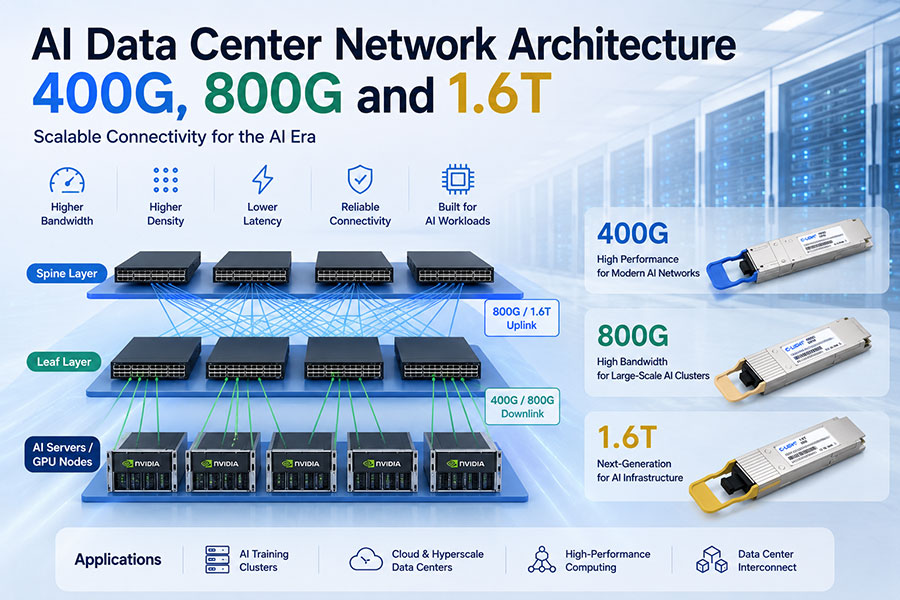
Artificial intelligence is changing the architecture of modern data centers. As GPU clusters become larger and AI workloads generate massive amounts of east-west traffic, the network must provide higher bandwidth, lower latency, greater port density, and reliable connectivity between servers, switches, and accelerator systems.
This evolution is driving a rapid transition from 400G to 800G and 1.6T optical connectivity. While 400G remains widely deployed, 800G has become an important bandwidth level for large AI and hyperscale environments, and 1.6T is emerging as a next-generation solution for higher-density AI networks.
Understanding the role of 400G, 800G, and 1.6T requires more than comparing transmission speeds. The complete AI data center architecture includes GPU servers, leaf and spine switches, network fabrics, optical transceivers, DAC/AOC/AEC interconnects, fiber infrastructure, and the underlying electrical and optical interfaces.
1. What Is AI Data Center Network Architecture?
AI data center network architecture is the network infrastructure designed to connect large numbers of GPUs, AI servers, storage systems, and networking devices.
Unlike traditional enterprise applications, AI training and inference workloads can generate extremely high levels of communication between compute nodes. A large GPU cluster may require continuous data exchange during distributed training, model synchronization, parameter updates, and collective communication operations.
As a result, the network becomes an important part of overall AI system performance.
Key Point: AI data center networking must scale bandwidth together with compute density. Higher-speed optical connectivity helps prevent the network from becoming a bottleneck as GPU clusters grow.
2. Basic AI Data Center Network Architecture
A simplified AI data center network can be divided into several major layers.
GPU / AI Servers
AI servers contain GPUs or other accelerators and generate large volumes of east-west traffic.
Leaf / Top-of-Rack Switches
Leaf switches provide connectivity between servers and the higher-level network fabric.
Spine Network
Spine switches provide high-capacity connections between leaf switches and form the core of the AI network fabric.
Optical Interconnect
Optical transceivers, DAC, AOC, AEC, and fiber infrastructure provide physical connectivity throughout the network.
In large AI clusters, the network can contain thousands or even tens of thousands of high-speed optical connections. Therefore, optical module bandwidth, power consumption, port density, and reliability become critical system-level considerations.
3. Why AI Data Centers Need Higher-Speed Networking
AI workloads are highly distributed. Instead of performing computation on a single server, modern AI systems distribute workloads across many GPUs and servers.
During training, these GPUs continuously exchange data. Network performance can therefore directly affect GPU utilization and overall cluster efficiency.
Large GPU Clusters: More GPUs require more network capacity between compute nodes.
High East-West Traffic: AI workloads generate substantial traffic inside the data center.
Distributed Training: GPUs need to communicate efficiently during collective operations.
Higher GPU Performance: Faster accelerators increase the pressure on the network.
Network Scale: Large AI clusters require high-density switching and optical connectivity.
These requirements are accelerating the transition from traditional 100G and 200G networks toward 400G, 800G, 1.6T, and future higher-speed architectures.
4. 400G in AI Data Center Networks
400G optical connectivity represents an important stage in the development of high-speed data center networks.
A common 400G architecture uses multiple high-speed lanes to achieve an aggregate 400Gbps data rate. Depending on the implementation, 400G solutions can use configurations such as 4 × 100G lanes.
400G optical transceivers are available in different form factors and optical configurations, supporting applications ranging from short-reach data center links to longer-distance data center interconnects.
4.1 Typical 400G Applications
AI server-to-switch connectivity
Leaf-to-spine networking
Data center switch interconnects
Cloud computing infrastructure
High-performance computing
Data center upgrades from 100G and 200G
400G remains important because it offers a balance between bandwidth, deployment maturity, ecosystem availability, and system cost.
5. 800G in AI Data Center Networks
800G has become an important bandwidth level for next-generation AI and hyperscale data center networks.
An 800G optical transceiver provides an aggregate bandwidth of approximately 800Gbps. Depending on the architecture, 800G solutions can be implemented using different lane configurations, including 8 × 100G or newer architectures based on 200G-per-lane technology.
The transition to 800G is particularly important for AI networking because it allows switch ports to provide significantly higher bandwidth while maintaining practical physical port densities.
5.1 Why 800G Is Important for AI
Higher Bandwidth: Approximately twice the aggregate bandwidth of 400G.
Higher Port Density: More network capacity can be provided within a similar physical switch footprint.
AI Fabric Scaling: Suitable for larger GPU clusters and high-performance network fabrics.
High-Speed Switches: Supports the continuing evolution of high-radix data center switching.
Network Upgrade: Provides a path beyond 400G for high-bandwidth AI deployments.
6. 1.6T in Next-Generation AI Data Centers
1.6T optical connectivity represents another major step in AI data center bandwidth scaling.
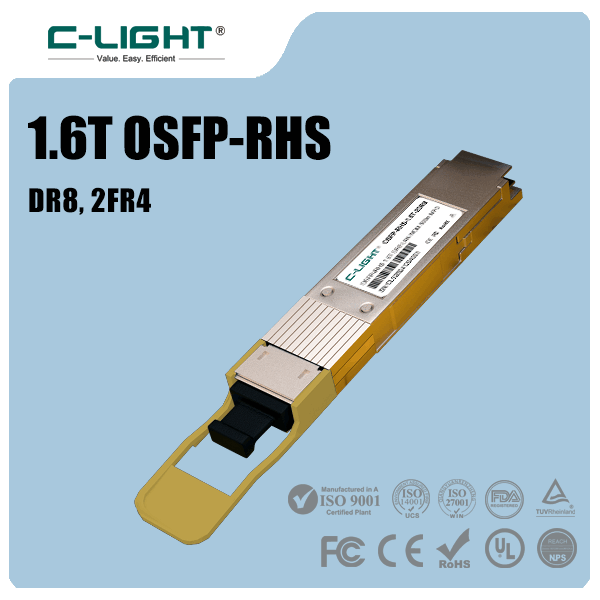
With an aggregate bandwidth of approximately 1.6Tbps, a 1.6T optical transceiver can provide twice the bandwidth of an 800G module.
One important technology direction is the use of 200G-per-lane electrical and optical architectures. A simplified configuration can be represented as:
400G: 4 × 100G = 400G
800G: 8 × 100G = 800G
800G: 4 × 200G = 800G
1.6T: 8 × 200G = 1.6T
These examples are simplified representations. Actual optical modules can use different electrical and optical lane architectures depending on the switch platform, DSP, optical engine, modulation technology, and application.
The move toward 1.6T is especially important for high-density AI systems where network bandwidth requirements are increasing faster than physical rack space and port availability.
7. 400G vs 800G vs 1.6T
| Feature | 400G | 800G | 1.6T |
|---|---|---|---|
| Aggregate Data Rate | 400Gbps | 800Gbps | 1.6Tbps |
| Typical Lane Technology | 100G/lane | 100G/lane or 200G/lane | 200G/lane |
| Relative Bandwidth | 1× | 2× | 4× |
| AI Network Position | Established high-speed connectivity | Current high-bandwidth AI networking | Next-generation AI networking |
| Port Density | High | Higher | Very high |
| Deployment Maturity | High | Increasing rapidly | Emerging |
| Typical Applications | Data centers, AI, cloud, HPC | AI, hyperscale, cloud, HPC | Large AI clusters, hyperscale, HPC |
8. AI Network Architecture: Leaf-Spine Design
The leaf-spine architecture is widely used as a foundation for scalable data center networks.
In an AI environment, AI servers are typically connected to leaf or top-of-rack switches. Leaf switches then connect to multiple spine switches through high-bandwidth links.
A simplified architecture can be represented as:
AI Servers / GPU Nodes
GPU 01 GPU 02 GPU 03 GPU 04
Leaf / ToR Switches
400G / 800G Server Connections
Spine Switches
800G / 1.6T High-Capacity Links
AI Network Fabric
High-Bandwidth East-West Connectivity
As the number of GPUs increases, the links between leaf and spine switches can become a major bandwidth requirement. This is one reason why 800G and 1.6T optical interfaces are increasingly important in large AI network architectures.
9. Optical Transceivers in the AI Network
Optical transceivers provide the optical interface between high-speed switches and the fiber infrastructure.
Different parts of the AI data center can use different optical technologies depending on distance, bandwidth, topology, and cost.
| Network Segment | Typical Connectivity | Key Requirement |
|---|---|---|
| GPU Server to ToR | DAC / AOC / AEC / Optical Transceiver | Low latency and short reach |
| Leaf to Spine | 400G / 800G / 1.6T Optical | High bandwidth and density |
| Spine to Spine | 800G / 1.6T Optical | High aggregate capacity |
| Data Center Interconnect | High-speed optical transceivers | Longer reach and reliability |
10. 400G, 800G and 1.6T: The Role of PAM4
PAM4 has become an important signaling technology for high-speed optical networking.
Compared with traditional NRZ signaling, PAM4 uses four signal levels to transmit two bits per symbol. This increases the amount of information transmitted per symbol and enables higher data rates while keeping the electrical and optical lane count within practical limits.
However, higher lane rates also introduce greater signal integrity challenges.
Higher insertion loss sensitivity
Greater crosstalk requirements
More demanding jitter performance
Higher requirements for PCB and connector design
More demanding DSP and equalization technology
Higher optical performance requirements
As the industry moves toward 200G-per-lane technologies, these challenges become increasingly important for both switch and optical module design.
11. Power and Thermal Considerations
Bandwidth is only one factor in AI data center network design. Power consumption and thermal management are becoming equally important.
A large AI switch may contain many high-speed optical modules. As the number of modules increases, even a small increase in module power can significantly affect total switch power and rack-level thermal requirements.
For 800G and 1.6T systems, designers must consider:
Optical Module Power: Power consumption of the complete transceiver.
DSP Efficiency: Electrical processing and signal conditioning can contribute significantly to system power.
Thermal Design: High-density modules require effective heat dissipation.
Rack Cooling: Increasing switch and GPU power can place additional requirements on rack-level cooling.
Power per Gb/s: Efficiency should be evaluated relative to the bandwidth delivered.
Important: The highest-speed optical module is not always the best choice. Network operators should evaluate bandwidth, power, thermal performance, reach, compatibility, and total cost together.
12. 400G to 800G to 1.6T: Network Evolution
The transition between generations can be viewed as a continuous increase in network bandwidth density.
The progression is not simply about replacing one optical module with another. Each generation requires corresponding advances in switch ASICs, SerDes, PCB design, connectors, DSPs, lasers, photonic components, thermal management, and network architecture.
13. 400G vs 800G vs 1.6T: Which Is Right for AI Data Centers?
There is no universal answer because the appropriate optical speed depends on the size and architecture of the AI cluster.
| Deployment Requirement | Recommended Direction |
|---|---|
| Existing 400G infrastructure | 400G |
| New high-speed AI network | 800G |
| Large GPU cluster | 800G / 1.6T |
| Maximum network bandwidth density | 1.6T |
| Cost-sensitive high-speed deployment | 400G / 800G |
| Next-generation 200G-per-lane infrastructure | 1.6T |
| Long-term AI network expansion | Evaluate 800G and 1.6T |
14. Network Migration from 400G to 800G and 1.6T
AI data center operators do not necessarily need to upgrade every network connection at the same time.
A staged migration strategy can allow operators to increase bandwidth as AI clusters and switch platforms evolve.
Stage 1: 400G Deployment
400G can provide a practical high-speed foundation for AI and cloud data center networks. It is particularly suitable where existing switching infrastructure and optical ecosystems are based around 400G.
Stage 2: 800G Expansion
As AI cluster sizes increase, 800G can provide higher bandwidth between switches and help increase network capacity without requiring a proportional increase in physical connections.
Stage 3: 1.6T Deployment
For next-generation AI infrastructure, 1.6T can provide significantly higher bandwidth density. It is particularly relevant where switch platforms, electrical interfaces, cooling systems, and optical infrastructure are designed for next-generation speeds.
15. C-LIGHT Optical Solutions for AI Data Centers
C-LIGHT develops optical transceivers and high-speed interconnect solutions for modern data center and AI networking applications.
The C-LIGHT portfolio supports the evolution of data center connectivity across multiple bandwidth generations, including 400G, 800G, and 1.6T.
These solutions can be applied to different network layers depending on transmission distance, switch architecture, fiber infrastructure, and system requirements.
400G Optical Connectivity
Designed for high-speed data center networking, AI infrastructure, cloud computing, and switch-to-switch applications.
800G Optical Connectivity
Designed for high-bandwidth AI data centers, hyperscale networks, high-performance computing, and next-generation switch interconnects.
1.6T Optical Connectivity
Designed for next-generation high-density AI networks where higher bandwidth per port and advanced lane-rate technologies are required.
For specific deployments, optical module selection should be based on the host switch, form factor, electrical interface, optical lane configuration, fiber type, transmission distance, power consumption, FEC requirements, and interoperability.
16. Future of AI Data Center Network Architecture
AI networking will continue to evolve as GPU performance, cluster size, and model complexity increase.
The development of higher-speed optical connectivity is expected to continue alongside advances in switch ASICs, SerDes, silicon photonics, co-packaged optics, linear pluggable optics, advanced lasers, and optical engines.
The future architecture will likely require more bandwidth while simultaneously improving energy efficiency and reducing the physical and thermal cost of network infrastructure.
This means that future optical networking will not be defined by bandwidth alone. Bandwidth density, power efficiency, latency, thermal performance, reliability, interoperability, and total cost of ownership will all become important factors.
17. FAQ: AI Data Center Network Architecture
Q1: Why do AI data centers need high-speed optical transceivers?
Answer: AI workloads generate large amounts of east-west traffic between GPUs, servers, and switches. High-speed optical transceivers provide the bandwidth required to connect large AI clusters and reduce network bottlenecks.
Q2: What is the difference between 400G, 800G and 1.6T?
Answer: The primary difference is aggregate bandwidth. 400G provides 400Gbps, 800G provides 800Gbps, and 1.6T provides approximately 1.6Tbps. Higher-speed generations also require corresponding advances in lane rates, electrical interfaces, optical components, and thermal design.
Q3: Is 800G better than 400G for AI data centers?
Answer: 800G provides higher bandwidth and can be advantageous for larger AI clusters. However, 400G can remain the better choice when existing infrastructure, cost, compatibility, or deployment requirements favor it.
Q4: Why is 1.6T important for AI networking?
Answer: 1.6T provides approximately twice the bandwidth of 800G and can significantly increase network bandwidth density. This makes it relevant to next-generation AI clusters and high-density data center switching.
Q5: Does 1.6T always use 200G per lane?
Answer: A common 1.6T architecture is based on eight 200G lanes, but actual implementations can vary. The electrical and optical lane configuration depends on the switch, DSP, optical engine, and module architecture.
Q6: What optical technologies are used in AI data centers?
Answer: AI data centers can use optical transceivers as well as DAC, AOC, and AEC solutions. The appropriate technology depends on link distance, bandwidth, power, cost, latency, and the specific network architecture.
Q7: Will 1.6T replace 800G?
Answer: 1.6T is expected to expand as next-generation AI networks require higher bandwidth, but 800G will remain important across many deployments. The two technologies are likely to coexist during the transition to higher-speed data center networking.
18. Summary
The architecture of AI data center networks is evolving rapidly as GPU clusters become larger and AI workloads generate increasingly high levels of network traffic.
400G, 800G, and 1.6T represent important stages in this evolution. 400G provides an established high-speed foundation, 800G enables higher bandwidth for current large-scale AI and hyperscale deployments, and 1.6T is emerging as a next-generation solution for high-density AI infrastructure.
The transition from 400G to 800G and 1.6T involves much more than increasing optical bandwidth. It requires advances in SerDes, PAM4, 200G-per-lane technology, DSPs, optical components, switch ASICs, thermal management, and network architecture.
For AI data center operators, the optimal strategy is to select optical connectivity according to current cluster requirements while maintaining a clear roadmap for future bandwidth expansion.
C-LIGHT provides 400G, 800G, 1.6T optical transceivers and high-speed interconnect solutions to support the continuing evolution of AI data center networking.
 >
>

 >
>
 >
>
 >
>
 >
>
 >
>
 >
>
 >
>