TEL:+86 132 6656 7067


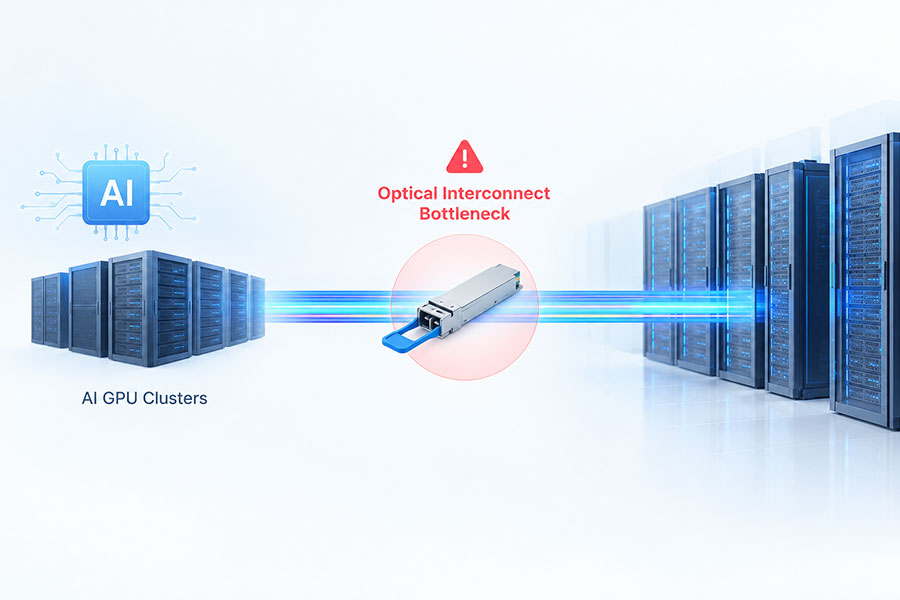
800G optical transceivers can support radically different network requirements. AI infrastructure typically prioritizes high-density connectivity between accelerators, switches, and distributed computing resources, while telecom transport systems must move large volumes of traffic across metropolitan, regional, and long-haul fiber networks. Both may use an 800G interface, but optical reach, modulation, link engineering, power limits, and system integration can differ substantially.
The distinction is not simply AI optics versus telecom optics. It is primarily a distinction between application-specific link designs. Short-reach AI links commonly use parallel optics or multiple optical wavelengths with direct detection, whereas longer-reach transport links may use coherent technology and wavelength-division multiplexing (WDM). Some products overlap these categories, so the specific transceiver architecture and supported application matter more than the market label.
1. What Are 800G AI Optics?
800G AI optics are optical transceivers designed for high-bandwidth connections within AI training and inference infrastructure. They may connect GPU or accelerator servers to leaf switches, leaf switches to spine switches, or different sections of a large-scale data-center fabric.
AI clusters generate sustained east-west traffic as accelerators exchange gradients, model parameters, activations, and other data during distributed workloads. Collective operations such as AllReduce and AllGather can make communication performance a major factor in overall job completion time. The optical link must therefore provide adequate bandwidth and reliability while fitting within the network's power, cooling, density, and latency requirements.
Common 800G optical approaches include:
800G SR8: A short-reach parallel-optics architecture typically using eight optical transmit lanes and eight receive lanes over multimode fiber. The actual reach depends on the specified fiber grade and transceiver.
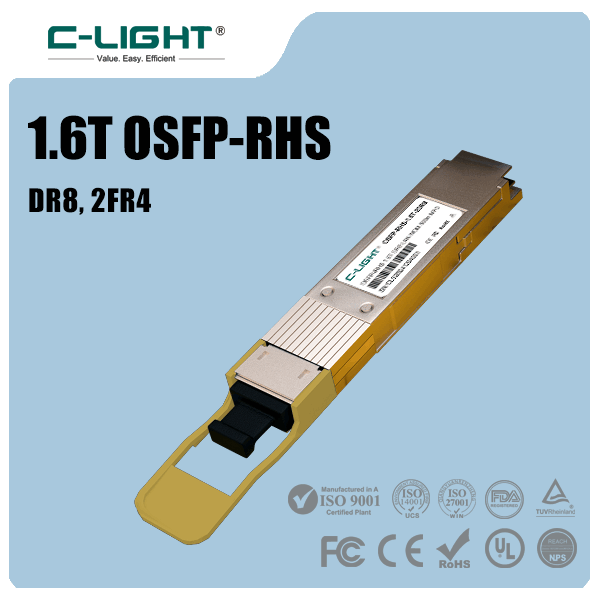
800G DR8: A parallel single-mode design using eight optical lanes, commonly intended for reaches around 500 meters under applicable specifications.
800G 2FR4: A design using two groups of four wavelength channels, commonly targeting single-mode links around 2 km, depending on the product and applicable specification.
Other single-mode and breakout-oriented designs: Available implementations vary by form factor, host electrical interface, optical lane arrangement, and target distance.
These examples represent different optical implementations, not interchangeable modules. Fiber type, connector configuration, wavelength plan, host port capability, and link budget must match the selected transceiver at both ends.
2. What Are 800G Telecom Optics?
800G telecom optics are designed for high-capacity optical transport in carrier networks, metro aggregation, data-center interconnect (DCI), and other transmission systems. In these environments, the main challenge may be transporting 800G-class traffic over a fiber route that is much longer or more optically demanding than a typical in-building data-center link.
For longer reaches, coherent optical technology is an important approach. Coherent transmitters encode information using controlled properties of an optical carrier, while coherent receivers detect amplitude and phase information. Digital signal processing (DSP) compensates for impairments and enables advanced modulation and transmission over engineered optical paths.
Telecom-oriented 800G solutions may include:
800G coherent pluggable optics: Coherent modules intended for compatible transport platforms, routers, or switches. Supported reach depends on the module, line system, modulation, and operating mode.
DWDM-compatible transmission: Dense wavelength-division multiplexing allows multiple optical channels to share a fiber pair or fiber infrastructure, subject to the system's wavelength plan and engineering limits.
Amplified optical transport: Longer links may use optical amplifiers, dispersion-related engineering, or other line-system components according to the design and required performance.
High-capacity DCI links: Coherent technology can connect geographically separated data centers where direct-detection links may not meet the required reach or capacity.
Not every telecom optic is coherent, and not every coherent optic is intended for long-haul transmission. Some telecom applications use direct-detection modules for shorter distances. Likewise, some AI data-center interconnects may use coherent optics when reach and network architecture justify them.
3. 800G AI Optics vs 800G Telecom Optics: Main Differences
| Comparison Factor | 800G AI Optics | 800G Telecom Optics |
|---|---|---|
| Primary environment | AI clusters, hyperscale data centers, accelerator fabrics, and high-density switching systems | Metro transport, carrier networks, DCI, and regional or long-haul optical systems |
| Typical link objective | High-bandwidth connectivity across many short and medium-reach links | High-capacity transport across engineered optical fiber routes |
| Common optical approaches | Parallel optics and multi-wavelength direct-detection designs | Coherent transmission for many longer-reach applications; direct detection also used for shorter links |
| Typical reach priorities | In-rack, inter-rack, and data-center fabric distances, depending on the optical type | Metro, DCI, regional, or longer routes, depending on the module and line system |
| Fiber infrastructure | Multimode or single-mode fiber, depending on the transceiver | Predominantly engineered single-mode fiber for telecom transport applications |
| Wavelength architecture | Parallel lanes or multiple wavelengths, depending on the module | May use coherent wavelengths and DWDM channel plans for transport |
| Latency priorities | Low and predictable end-to-end communication latency for cluster workloads | Transport performance, service requirements, and reach; latency remains important but depends on route and system design |
| Power and density | Port density, power per port, airflow, and thermal management are major design constraints | Module power, line-system power, rack density, cooling, and total transport efficiency are important |
| Signal processing | Often optimized for short-reach link economics and power; DSP or retiming depends on architecture | Coherent DSP is common in longer-reach coherent systems, with complexity depending on modulation and reach |
| System dependencies | Host electrical interface, switch ASIC, fiber plant, breakout design, and cluster topology | Host platform, coherent mode, optical line system, wavelength plan, and end-to-end optical budget |
4. Direct Detection vs Coherent Transmission
Direct-Detection Optics for Data-Center Links
Many short-reach 800G data-center modules use intensity modulation and direct detection (IM-DD). The transmitter varies optical intensity to encode data, and a photodetector converts received optical power into an electrical signal. Depending on the design, the module may use PAM4 signaling across multiple optical lanes or wavelength channels.
Parallel single-mode designs such as DR8 distribute the aggregate rate across multiple optical lanes. Wavelength-multiplexed designs such as FR4-family approaches carry several wavelength channels over fewer fiber strands. The exact architecture depends on the transceiver specification.
Direct-detection designs are attractive for many data-center applications because they can provide high bandwidth over the intended reach with a suitable balance of module cost, power, and complexity. They are not automatically lower-power or lower-cost in every implementation; comparisons must use actual products and system conditions.
Coherent Optics for Transport Networks
Coherent optics detect the optical field using a local oscillator and receiver processing that recovers information encoded in the signal's amplitude and phase. Coherent DSP can compensate for transmission impairments and support modulation formats suited to different reach and capacity objectives.
For 800G transport, achievable performance depends on factors such as modulation format, symbol rate, optical signal-to-noise ratio (OSNR), fiber characteristics, amplifier configuration, filtering, and the receiver's capabilities. A module advertised for one reach in a particular system cannot be assumed to achieve the same reach on every fiber route.
Coherent optics can support longer and more spectrally efficient transport than many conventional short-reach direct-detection solutions, but this often comes with more demanding power, thermal, and system-integration considerations. Actual trade-offs vary across coherent module generations and operating modes.
5. How Reach Changes the Optical Design
Optical reach influences the choice of transmitter, receiver, fiber, wavelength plan, modulation, and signal-processing architecture. A short in-building connection may need only a straightforward optical link budget. A longer telecom route may require detailed OSNR analysis and coordination with the optical line system.
| Link Scenario | Possible Optical Approach | Key Engineering Checks |
|---|---|---|
| Short in-rack or adjacent-rack connection | Short-reach parallel optics or a suitable copper interconnect where supported | Port compatibility, cable routing, connector density, and power |
| Data-center fabric across a room or building | Single-mode DR8, FR4-family, or other distance-appropriate optics | Reach, fiber type, optical lane mapping, loss budget, and host support |
| Data-center interconnect over a longer fiber route | Direct-detection or coherent optics, selected according to distance and system conditions | Fiber attenuation, dispersion, OSNR, line-system compatibility, and FEC requirements |
| Metro or regional transport | Coherent transceivers and a compatible optical transport system where required | Modulation, channel spacing, amplifier design, filtering, and end-to-end performance |
These scenarios are indicative rather than universal distance rules. A 2 km direct-detection module may be appropriate for a particular data-center link, while another route of similar length may require a different solution because of connectors, intermediate panels, fiber quality, or system requirements.
6. Power Consumption and Thermal Design
Power consumption is a major factor in both AI and telecom networks, but the constraints are not identical. AI data centers can deploy very large numbers of high-speed optical ports in dense switch and accelerator systems. Even a modest difference in per-port power can become significant when multiplied across an entire cluster.
Thermal management must account for the transceiver, host ASIC, surrounding components, airflow, heatsink design, and rack-level cooling strategy. A module's power rating alone does not determine its actual temperature or cooling requirements.
Telecom systems also face power and thermal constraints, particularly when high-capacity coherent modules are deployed in compact router or transport platforms. Coherent DSP and optical performance requirements can increase module power relative to some short-reach designs, but exact consumption depends on the product and operating mode.
When comparing products, review:
Maximum and typical module power, where specified.
Host cage and heatsink compatibility.
Operating temperature range and required airflow.
Power and thermal behavior at the intended data rate and optical mode.
Whether the module requires host firmware, software configuration, or specific platform support.
A lower-power module is not necessarily the best choice if it cannot meet the required reach or interoperability requirements. System-level efficiency should be assessed alongside the optical performance needed for the application.
7. FEC, Signal Integrity, and Link Reliability
Forward error correction (FEC) is important in high-speed optical communication, but its implementation depends on the interface and module architecture. FEC adds redundancy so that supported error patterns can be corrected, helping a link meet its required error performance under specified conditions.
AI data-center links and telecom transport links may use different FEC schemes and performance targets. Coherent systems commonly integrate substantial digital signal processing and error correction, while Ethernet-based 800G interfaces use the FEC mechanisms defined by their applicable standards or implementation.
FEC should not be treated as a substitute for a properly engineered optical link. Insufficient received power, excessive channel loss, poor connector condition, incompatible optical specifications, or unsuitable OSNR can still cause link problems or push a system outside its operating margin.
For reliable deployment, verify the module's supported interface, optical specifications, transmit and receive limits, host compatibility, and required FEC behavior. For telecom transport, also validate the intended optical line system and operating mode. For AI networks, check the end-to-end path and confirm that the transceiver supports the selected switch port and fiber configuration.
8. How to Choose Between 800G AI and Telecom Optics
Choose by Network Architecture, Not the Label
Start with the actual network role. A switch-to-switch link inside an AI cluster and an 800G wavelength carried across a metro transport system can have very different requirements, even if their nominal rates match.
For AI clusters: Prioritize port density, reach appropriate to the fabric, latency behavior, fiber management, thermal design, and compatibility with the host electrical interface.
For telecom transport: Prioritize required reach, coherent or direct-detection architecture, wavelength plan, optical line-system compatibility, OSNR, and end-to-end link budget.
For DCI: Compare both approaches based on route distance, fiber availability, capacity, power, operational requirements, and whether a compatible coherent transport system is available.
Confirm Form Factor and Host Compatibility
QSFP-DD and OSFP are important form factors in high-speed networking, but the form factor does not determine whether a module is suitable for AI or telecom use. The module must match the host port's electrical interface, supported data rate, lane configuration, management interface, thermal limits, and software requirements.
Similarly, two modules with the same aggregate rate and connector type are not necessarily interoperable. Their optical lane arrangement, wavelengths, modulation, reach specification, and transmitter-receiver characteristics must be compatible.
Review Optical Budget and Operational Requirements
Calculate the expected path loss and compare it with the transmitter and receiver specifications. Include fiber attenuation, connector losses, splices, patch panels, and any other components in the optical path. For coherent transport, include the relevant OSNR and line-system constraints rather than relying solely on a simple power budget.
Before deployment, verify supported distances, fiber types, connector types, host-platform qualification, FEC behavior, and the vendor's operating conditions. For critical networks, confirm interoperability through testing under the intended configuration.
9. C-LIGHT 800G Optical Product Options
C-LIGHT offers 800G optical transceiver options for high-speed data-center connectivity and coherent optical applications. The appropriate model depends on the specific interface, optical architecture, transmission distance, and host platform.
Explore 800G QSFP-DD options for data-center and other high-bandwidth network applications. Select the exact variant based on reach, fiber type, optical architecture, and host compatibility.
View 800G QSFP-DD ProductsFor optical transport and DCI, review coherent DWDM product options and confirm the supported data rate, module form factor, tunability, reach, and line-system requirements for the exact model.
View DWDM Coherent ProductsFor network designs using mixed port speeds or staged capacity upgrades, review the 400G family and verify whether the specific module supports the intended link and platform.
View 400G QSFP-DD ProductsProduct families can include multiple optical designs, so do not assume that every model supports every reach or transport architecture. Check the current datasheet and qualification requirements for the exact part number before selecting it for an AI fabric, DCI link, or telecom transport deployment.
10. Conclusion
800G AI optics and 800G telecom optics share a nominal data-rate class but often solve different networking problems. AI clusters commonly need dense, power-conscious optical links across data-center fabrics, with parallel optics and multi-wavelength direct-detection designs serving many short- and medium-reach connections. Telecom transport frequently places greater emphasis on reach, coherent transmission, DWDM integration, and end-to-end optical performance.
Neither category is universally superior. The correct solution depends on link distance, host interface, fiber infrastructure, optical architecture, power and thermal limits, and operational requirements. Selecting by the actual module specification and network role—not by the 800G label alone—helps ensure that the link meets its capacity, reliability, and interoperability objectives.
Identify the required reach, fiber type, host port, and network architecture to narrow down suitable transceiver options.
Contact C-LIGHT >

 >
 >
 >
 >
 >
 >
 >