TEL:+86 132 6656 7067


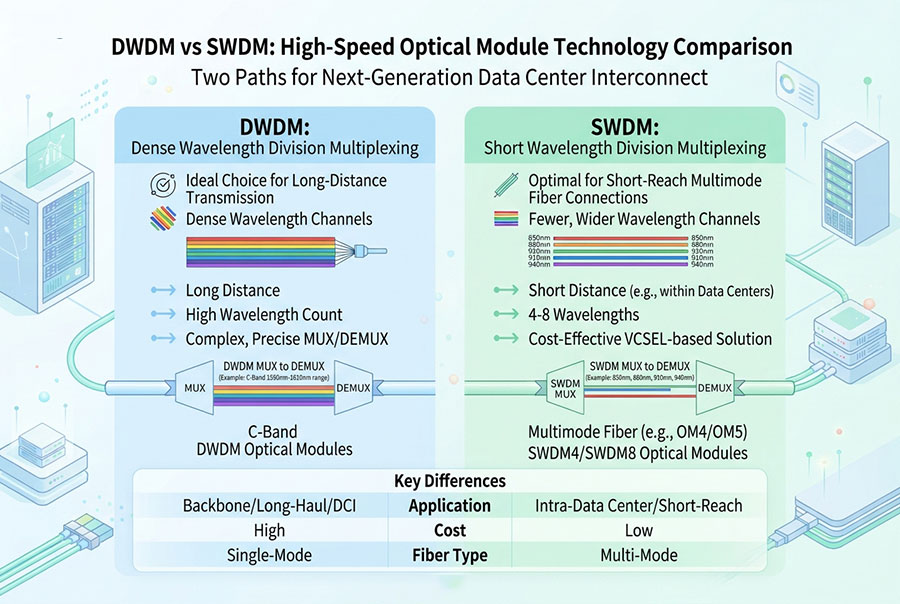
DWDM (Dense Wavelength Division Multiplexing) and SWDM (Short Wavelength Division Multiplexing) both use multiple optical wavelengths to transmit data, but they are designed for different fiber environments and link requirements. DWDM is commonly deployed over single-mode fiber to increase fiber capacity, while SWDM uses multiple short wavelengths over multimode fiber to support short-reach data center connectivity.
Choosing between DWDM and SWDM requires more than comparing wavelength spacing. Fiber type, transmission distance, channel configuration, transceiver compatibility, and the existing cabling infrastructure all influence the decision.
1. What Is DWDM?
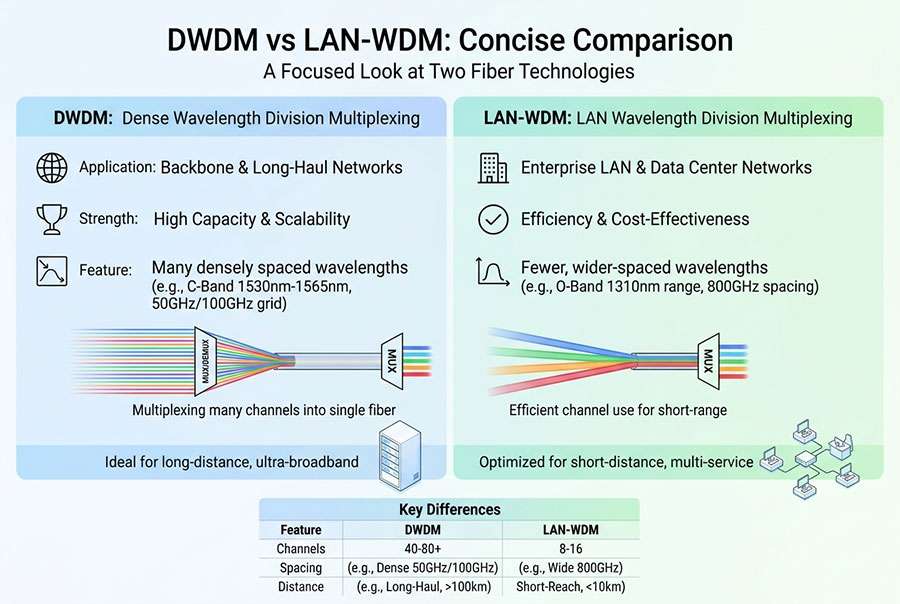
Dense Wavelength Division Multiplexing combines multiple optical signals at different wavelengths onto a single fiber. At the receiving end, a demultiplexer separates the wavelengths so that each signal can be delivered to its destination.
DWDM is widely used in high-capacity optical transport networks, metropolitan networks, data center interconnects (DCI), and other applications that require multiple channels over single-mode fiber.
1.1 How DWDM Works
Each DWDM channel operates at a designated wavelength. An optical multiplexer combines the channels, and a demultiplexer separates them at the destination. Depending on the system design, optical amplifiers and additional transport equipment can be used to support longer links and higher aggregate capacity.
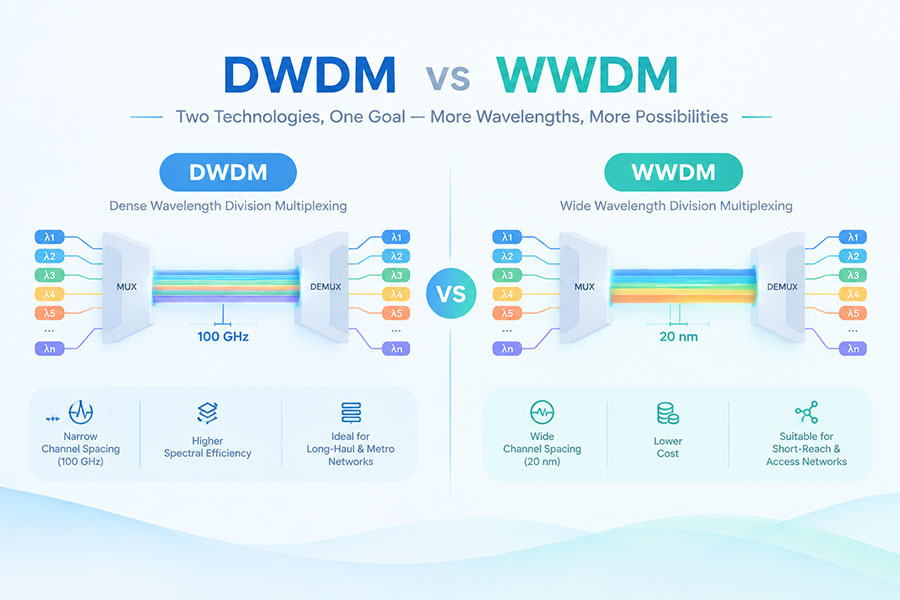
DWDM channel plans can use closely spaced wavelengths, including frequency grids defined by ITU-T G.694.1. Narrow channel spacing enables many wavelengths to occupy a defined optical spectrum, but it also places greater demands on wavelength accuracy, filtering, and system engineering.
1.2 Typical DWDM Applications
Data center interconnects between geographically separated facilities.
Metro and regional optical transport networks.
High-capacity enterprise and service-provider networks.
Network upgrades that increase capacity over existing single-mode fiber infrastructure.
2. What Is SWDM?
Short Wavelength Division Multiplexing uses multiple wavelengths in the short-wavelength region of the optical spectrum, typically around 850–940 nm in SWDM4 implementations. It is designed to transmit multiple optical channels over multimode fiber, making it useful for certain short-reach data center connections.
SWDM can increase the capacity carried over a duplex multimode fiber connection compared with approaches that use separate fiber pairs for parallel optical lanes. It can also help make use of existing multimode cabling, depending on the transceiver specifications and supported reach.
2.1 How SWDM Works
In a typical SWDM4 implementation, four wavelength lanes are combined for transmission over one multimode fiber, with the corresponding receiver separating the wavelengths. A duplex link uses one fiber for transmission and the other for reception.
The 100G-SWDM4 MSA specifies four wavelength ranges centered approximately at 850, 880, 910, and 940 nm. The transceiver uses multimode fiber and wavelength-selective optical components to carry the multiple lanes over a duplex connection.
2.2 Typical SWDM Applications
Short-reach server-to-switch and switch-to-switch connections in data centers.
100G connectivity over supported OM3, OM4, or OM5 multimode fiber links.
Multimode cabling upgrades where reducing the number of fibers is beneficial.
Applications that require compatibility with a specific SWDM transceiver and its supported fiber infrastructure.
3. DWDM vs SWDM: Key Differences
| Feature | DWDM | SWDM |
|---|---|---|
| Full name | Dense Wavelength Division Multiplexing | Short Wavelength Division Multiplexing |
| Typical wavelength region | Commonly around the 1550 nm region in many transport systems; other wavelength bands are also possible | Typically around 850–940 nm for SWDM4 |
| Fiber type | Primarily single-mode fiber in common transport applications | Multimode fiber |
| Wavelength arrangement | Closely spaced channels arranged according to a defined frequency grid or system channel plan | Multiple discrete short-wavelength lanes, such as the four lanes used by SWDM4 |
| Typical application | High-capacity optical transport, metro networks, and DCI | Short-reach data center interconnects over multimode fiber |
| Transmission distance | Depends on the transceiver, optical budget, amplification, and network design | Depends on the SWDM implementation and multimode fiber grade |
| Optical components | DWDM transceivers, wavelength multiplexers and demultiplexers, and potentially optical amplifiers | SWDM transceivers designed for multiple short wavelengths over multimode fiber |
| Main design consideration | Channel density, optical performance, capacity, and link budget | Multimode fiber bandwidth, supported reach, wavelength compatibility, and fiber utilization |
The most important distinction is the intended optical environment. DWDM is associated with dense wavelength channels over single-mode fiber in many transport systems. SWDM is designed to use multiple short wavelengths over multimode fiber. The two technologies therefore require different optical interfaces and should not be treated as interchangeable.
4. Wavelengths and Channel Spacing
4.1 DWDM Wavelength Planning
DWDM systems use a defined channel grid to position multiple wavelengths within an optical band. ITU-T G.694.1 specifies the DWDM frequency grid, including channel spacings such as 100 GHz and 50 GHz, as well as finer spacing options. The exact number of usable channels depends on the selected grid, operating band, equipment, and system design.
Closely spaced channels help maximize spectral utilization, but they also require suitable wavelength control and filtering. Channel planning must account for the supported transceivers and the characteristics of the optical multiplexing system.
4.2 SWDM Wavelength Planning
SWDM4 uses four short-wavelength lanes rather than a dense channel grid spanning a large number of closely spaced wavelengths. In the 100G-SWDM4 MSA, the nominal lane centers are 850, 880, 910, and 940 nm.
These wavelengths are designed for use with multimode fiber and compatible SWDM optics. OM5 wideband multimode fiber is optimized to support multiple wavelengths across this region, while the actual reach must be checked against the transceiver's specifications and the selected fiber type.
5. Fiber Compatibility and Transmission Distance
DWDM: Single-Mode Fiber
Single-mode fiber is commonly used for DWDM transport because it supports optical links across a wide range of distances and network capacities.
Suitable for metro and inter-building links.
Supports system designs ranging from short-reach links to long-haul transport.
Requires compatible DWDM wavelengths and optical components.
SWDM: Multimode Fiber
SWDM uses multiple short wavelengths to improve fiber utilization for selected short-reach links.
Designed for supported multimode fiber types.
Can use duplex LC connectivity in SWDM4 implementations.
Reach depends on the SWDM specification and fiber grade.
For reference, the 100G-SWDM4 MSA specifies operating ranges of 2–75 m on OM3, 2–100 m on OM4, and 2–150 m on OM5 multimode fiber. These figures apply to that particular 100G implementation and should not be generalized to every SWDM product.
DWDM has no single universal reach value. The supported distance depends on the transceiver, optical power budget, fiber attenuation, dispersion, and whether the system includes amplification or regeneration.
6. DWDM vs SWDM Optical Transceivers
6.1 DWDM Optical Transceivers
DWDM transceivers operate at specific wavelengths aligned with the intended channel plan. Depending on the application, they may be used with passive MUX/DEMUX equipment or integrated into a larger optical transport system.
When selecting a DWDM transceiver, check the wavelength or channel number, data rate, transmission distance, optical budget, connector type, and compatibility with the network equipment and multiplexing system.
6.2 SWDM Optical Transceivers
SWDM transceivers combine multiple short-wavelength lanes over multimode fiber. A 100G-SWDM4 module is one example, carrying four optical wavelength lanes through a duplex multimode connection.
Before deployment, confirm the supported OM3, OM4, or OM5 fiber type, link distance, connector configuration, host compatibility, and whether both ends use compatible SWDM interfaces.
7. DWDM vs SWDM: Advantages and Limitations
7.1 DWDM Advantages
Supports high channel density over a single fiber pair or a designed fiber path.
Fits metro, transport, and data center interconnect architectures that need scalable optical capacity.
Can work with optical amplification and transport equipment in suitable system designs.
7.2 DWDM Considerations
Requires accurate wavelength and channel planning.
Multiplexers, demultiplexers, and other transport components add design and deployment considerations.
System cost and complexity vary with capacity, reach, and optical performance requirements.
7.3 SWDM Advantages
Uses multiple short wavelengths over supported multimode fiber.
Can reduce the number of fibers needed compared with certain parallel-optics implementations.
May allow reuse of existing multimode cabling when the link meets the transceiver requirements.
7.4 SWDM Considerations
Its reach is limited by the particular SWDM implementation and multimode fiber characteristics.
It requires compatible SWDM transceivers at both ends.
It is not a general replacement for single-mode DWDM transport systems.
8. When Should You Choose DWDM or SWDM?
Choose DWDM when:
You need to aggregate multiple optical channels over single-mode fiber.
Your network requires metro transport, DCI, or other higher-capacity optical transport functions.
Your design benefits from a defined DWDM channel grid and compatible optical multiplexing equipment.
Choose SWDM when:
You need short-reach connectivity over compatible multimode fiber.
You want to use multiple short wavelengths over a duplex multimode connection.
Your existing cabling and network equipment support the selected SWDM transceiver specification.
For data center projects, the decision should be based on the required data rate, link distance, installed fiber type, port density, and total deployment cost. For transport networks, channel capacity, optical budget, wavelength planning, and future expansion are usually more important than the technology name alone.
9. Frequently Asked Questions
Q1: What is the main difference between DWDM and SWDM?
DWDM uses densely spaced wavelength channels, commonly over single-mode fiber. SWDM uses multiple short wavelengths over multimode fiber for selected short-reach links.
Q2: Does DWDM support longer distances than SWDM?
DWDM systems can be designed for much longer distances, but actual reach depends on the equipment and link budget. SWDM is intended for short-reach multimode applications.
Q3: Which fiber is used for SWDM?
SWDM uses compatible multimode fiber. OM3, OM4, and OM5 support depends on the specific transceiver specification and required reach.
Q4: What wavelengths does 100G-SWDM4 use?
The 100G-SWDM4 MSA specifies four wavelength lanes centered approximately at 850, 880, 910, and 940 nm.
Q5: Can DWDM and SWDM transceivers work with the same MUX/DEMUX?
Not by default. Their wavelength ranges and optical interfaces differ. The MUX/DEMUX must be designed for the specific wavelengths and system architecture.
Q6: Is SWDM suitable for long-haul optical networks?
SWDM is primarily intended for short-reach multimode links, not as a general long-haul transport solution.
Q7: Does SWDM always require OM5 fiber?
No. Some SWDM specifications support OM3 and OM4 as well as OM5. The supported distance varies by fiber grade and transceiver model.
Q8: What should I check before choosing a DWDM or SWDM transceiver?
Verify the data rate, wavelength plan, fiber type, link distance, connector, optical budget, and equipment compatibility.
10. Conclusion
DWDM and SWDM solve different optical networking problems. DWDM increases channel capacity over single-mode fiber through dense wavelength planning, making it suitable for optical transport and DCI applications. SWDM uses multiple short wavelengths over multimode fiber to support selected short-reach data center links.
The right choice depends on the required capacity, distance, fiber infrastructure, and compatible optical components. Confirming these parameters before selecting transceivers and connectivity components helps avoid interoperability issues and unnecessary deployment costs.
Need Help Selecting Optical Transceivers?
C-LIGHT provides optical transceivers and fiber connectivity solutions for data center and optical networking applications. Contact our team with your data rate, transmission distance, fiber type, and equipment model to identify a suitable solution.
References
SWDM Alliance — SWDM technology and MSA information.
Fiber Optics Tech Consortium — FAQs — Background on SWDM, OM5 fiber, and multimode optical links.
Fiber Optics Tech Consortium — Optical Fiber Types — Overview of multimode fiber types and wideband multimode fiber.
NVIDIA — Cable and Connector Definitions — Overview of DWDM, SWDM, fiber types, and optical transceivers.
 >

 >
 >
 >
 >
 >
 >
 >