TEL:+86 132 6656 7067


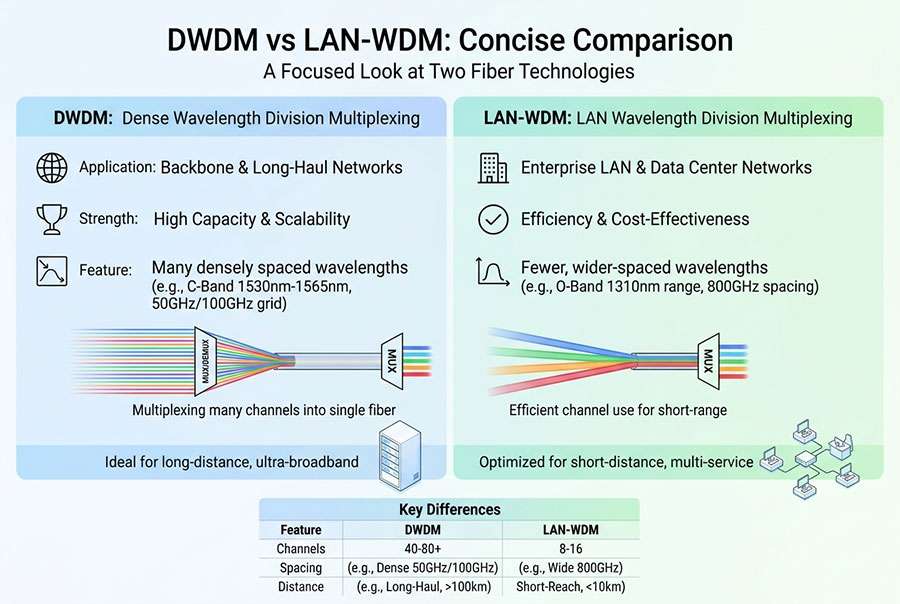
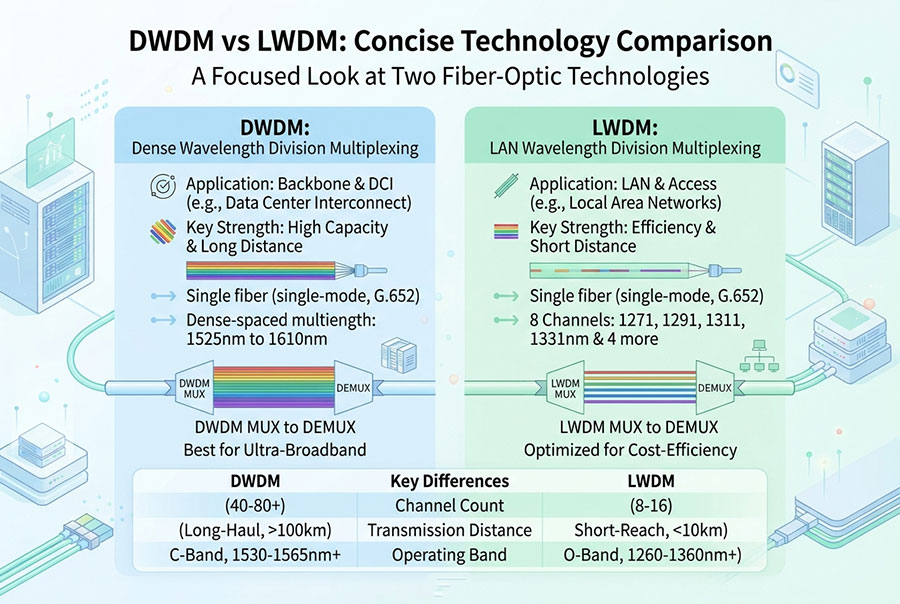
DWDM and LAN-WDM both use multiple optical wavelengths to carry data, but they are designed around different transmission requirements. Dense wavelength division multiplexing (DWDM) is widely used to increase the capacity of optical transport systems by placing multiple channels within a defined optical spectrum. LAN-WDM, by contrast, is commonly associated with multi-wavelength Ethernet transceivers, where several optical lanes are combined into a single fiber pair.
The main differences involve wavelength spacing, channel configuration, optical source requirements, system architecture, and deployment scenarios. Understanding these distinctions helps network engineers select suitable optical transceivers and multiplexing equipment for data center, enterprise, and transport networks.
1. What Is DWDM?
Dense wavelength division multiplexing combines multiple optical channels at closely spaced wavelengths onto a shared fiber. At the receiving end, a demultiplexer separates the channels so that each can be processed independently.
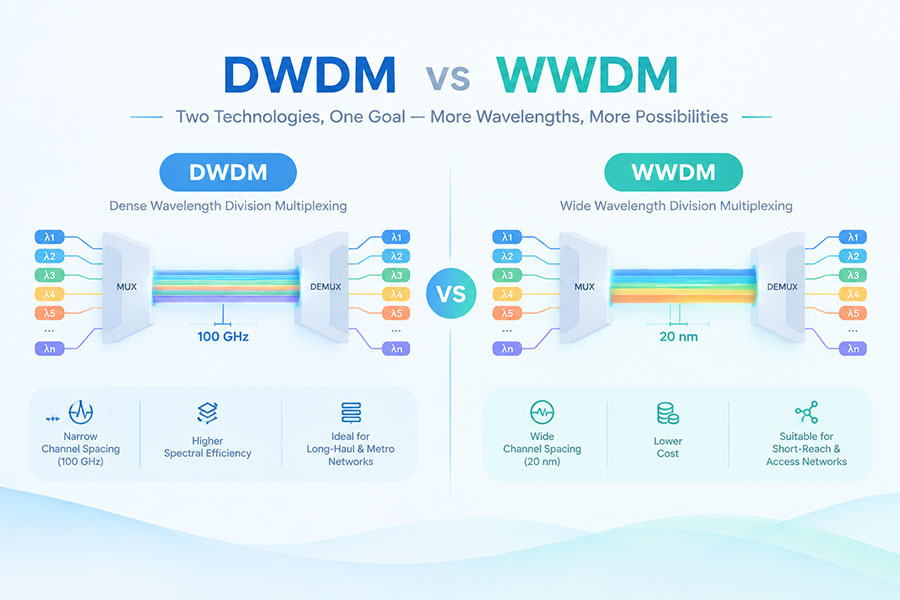
DWDM systems commonly use standardized frequency grids defined by ITU-T G.694.1. Typical channel spacings include 100 GHz and 50 GHz, with other spacing options available. Tighter spacing allows more channels to occupy a given spectral range, subject to the optical system design and signal characteristics.
1.1 Main Characteristics of DWDM
Dense channel spacing: Supports many optical channels within a limited spectrum.
Scalable fiber capacity: Multiple data streams can share the same fiber infrastructure.
Flexible channel configuration: Channel plans can be selected according to the optical line system and application.
Optical transport integration: DWDM can be used with multiplexers, demultiplexers, optical amplifiers, and other transport components where required.
Wavelength control: Transmitters must meet the wavelength or frequency tolerances specified for the particular system.
1.2 Common DWDM Applications
DWDM is widely used in metro and backbone transport, data center interconnect (DCI), enterprise optical networks, and other applications that require high aggregate capacity over shared fiber. Actual channel count and reach depend on the transceivers, optical line system, modulation format, amplification, and link budget.
2. What Is LAN-WDM?
LAN-WDM is a wavelength plan commonly used in high-speed Ethernet optical transceivers. A typical four-wavelength LAN-WDM arrangement operates in the O-band, with nominal wavelengths around 1295.56 nm, 1300.05 nm, 1304.58 nm, and 1309.14 nm.
These four wavelengths are approximately 800 GHz apart in frequency. Within a transceiver, an optical multiplexer combines the wavelength lanes for transmission over a duplex single-mode fiber link. At the receiving end, the optical signals are separated into their respective lanes.
2.1 Why LAN-WDM Uses the O-Band
The O-band is near the zero-dispersion region of standard single-mode fiber. This makes it useful for Ethernet optical interfaces that need to transmit multiple wavelength lanes over specified distances without excessive chromatic-dispersion penalties.
2.2 LAN-WDM in Optical Transceivers
LAN-WDM is associated with optical interfaces such as 100GBASE-LR4 and ER4, which use four wavelength lanes. Similar wavelength-grid concepts are also used in certain higher-speed multi-wavelength designs. However, not every LR4 or multi-wavelength transceiver uses LAN-WDM; the exact optical specification must be checked for each module.
3. DWDM vs LAN-WDM: Key Differences
| Comparison | DWDM | LAN-WDM |
|---|---|---|
| Primary purpose | Increase aggregate capacity across optical transport links | Combine multiple wavelength lanes in specific high-speed optical interfaces |
| Typical wavelength region | Commonly C-band in transport systems; other bands and applications also exist | Typically O-band for common four-wavelength Ethernet implementations |
| Channel spacing | Commonly 100 GHz or 50 GHz; other standardized grids are available | Typically around 800 GHz for the classic four-wavelength plan |
| Channel configuration | Can support many channels across a defined optical band | Commonly four wavelength lanes in classic Ethernet implementations |
| Wavelength management | Depends on the grid, transceiver design, and optical line system | Uses a defined wavelength plan for the relevant optical interface |
| Optical architecture | Often uses external MUX/DEMUX equipment in transport networks | Wavelength multiplexing is commonly integrated into the transceiver |
| Typical application | Metro transport, backbone networks, and DCI | Multi-wavelength Ethernet links and compatible optical interfaces |
| Capacity scaling | Add channels or use higher-capacity channels, subject to system limits | Depends on the lane count, lane rate, and supported transceiver interface |
These are typical implementation patterns, not absolute rules. DWDM can also be used in access and mobile transport networks, while LAN-WDM terminology refers to a particular wavelength plan rather than a general-purpose transport architecture.
4. Wavelength Spacing and Optical Spectrum
Wavelength spacing affects how optical channels fit within a spectral range and how precisely their wavelengths must be controlled. The comparison is most meaningful when channel spacing is considered together with the intended system architecture.
4.1 DWDM Channel Spacing
DWDM grids define channel positions in frequency. For example, a 100 GHz grid provides wider separation than a 50 GHz grid, allowing more tolerance between neighboring channels but fewer channels within the same spectrum. Narrower grids can increase spectral density, although the required optical performance and system complexity depend on the signal format and equipment.
4.2 LAN-WDM Channel Spacing
The classic LAN-WDM four-lane grid uses approximately 800 GHz frequency spacing. This is wider than common 100 GHz and 50 GHz DWDM grids, but much narrower than the 20 nm spacing commonly associated with CWDM.
Because the wavelength plan and application differ, LAN-WDM should not be selected simply because its channel spacing is wider than that of a particular DWDM grid. Compatibility with the optical interface and receiving equipment remains essential.
5. Optical Transceiver Design
DWDM Transceivers
DWDM transceivers generate or receive signals on defined optical channels. Depending on the design, they may use fixed wavelengths or tunable transmitters. Channel-grid compatibility, wavelength stability, optical power, and receiver specifications are important selection factors.
LAN-WDM Transceivers
LAN-WDM modules typically combine multiple optical lanes into one duplex fiber link. Their design must maintain the required wavelength plan, lane performance, and optical characteristics defined for the relevant Ethernet interface.
5.1 Fixed-Wavelength and Tunable Options
Some DWDM transceivers are fixed to a specific channel, while tunable models can operate on multiple supported channels within their tuning range. Tunability can simplify channel allocation and spare management, but compatibility with the host platform and optical line system must be verified.
LAN-WDM transceivers generally follow the wavelength plan specified for their interface. Their wavelengths and lane configuration are not automatically compatible with a DWDM mux simply because both use wavelength multiplexing.
5.2 Important Compatibility Checks
Supported Ethernet standard or application specification
Data rate and optical lane configuration
Center wavelengths and channel spacing
Transmission distance and optical power budget
Single-mode fiber and connector requirements
Host equipment compatibility and supported diagnostics
Compatibility with any external MUX/DEMUX or optical line system
6. DWDM vs LAN-WDM: Applications
6.1 When DWDM Is Appropriate
DWDM is a strong option when a network must carry multiple independent optical channels over shared fiber and needs room for channel-based capacity expansion. Typical applications include metro transport, backbone connectivity, and DCI links that use a compatible DWDM optical system.
Engineers should evaluate channel availability, transmission reach, optical amplification, dispersion management, and interoperability when designing a DWDM link.
6.2 When LAN-WDM Is Appropriate
LAN-WDM is appropriate when the required Ethernet interface specifically uses a LAN-WDM wavelength plan. In this case, the wavelength lanes are part of the optical transceiver's design and are intended to work with a compatible receiving interface.
For example, a 100GBASE-LR4 link uses four optical wavelength lanes over duplex single-mode fiber. The correct choice is a transceiver that complies with the required interface specification, rather than a generic DWDM module with an unrelated channel plan.
7. Can DWDM and LAN-WDM Be Used Together?
They can coexist within a broader optical network, but their wavelengths and interfaces must be engineered for compatibility. A LAN-WDM transceiver's optical output does not automatically match a DWDM channel grid or an external DWDM multiplexer.
Where an application requires interconnection between different optical systems, engineers must check the exact center wavelengths, passbands, insertion loss, optical power levels, and supported interfaces. A suitable optical conversion or transport design may be required if the systems use incompatible wavelength plans.
8. Frequently Asked Questions
Q1: What is the main difference between DWDM and LAN-WDM?
DWDM commonly provides multiple closely spaced channels for optical transport systems, while LAN-WDM is a wavelength plan used in specific multi-wavelength Ethernet transceivers.
Q2: Is LAN-WDM the same as DWDM?
No. Both use multiple wavelengths, but they differ in typical channel spacing, wavelength plans, and intended system applications.
Q3: What is the typical LAN-WDM wavelength spacing?
The classic four-wavelength LAN-WDM plan uses approximately 800 GHz frequency spacing, with wavelengths near 1295.56, 1300.05, 1304.58, and 1309.14 nm.
Q4: What channel spacing does DWDM use?
Common DWDM grids use 100 GHz or 50 GHz spacing. Other standardized frequency spacings are available depending on the application and optical system.
Q5: Which technology supports more channels?
DWDM transport systems can support many channels across a defined spectrum. Classic LAN-WDM Ethernet interfaces typically use four wavelength lanes. Actual capacity depends on the specific system and interface.
Q6: Does 100GBASE-LR4 use LAN-WDM?
Yes. The classic 100GBASE-LR4 interface uses four optical wavelength lanes in the LAN-WDM region over duplex single-mode fiber.
Q7: Can a LAN-WDM transceiver connect directly to a DWDM MUX?
Not necessarily. The transceiver wavelengths and passbands must match the multiplexer channel plan, and the optical link budget must also be satisfied.
Q8: Which is better for data center interconnect?
It depends on the link design. DWDM is useful for channel-based transport over shared fiber, while LAN-WDM is relevant when the selected Ethernet interface uses that wavelength plan.
9.Conclusion
DWDM and LAN-WDM solve related but different optical networking problems. DWDM increases aggregate fiber capacity through closely spaced channels, making it useful for transport systems that need scalable wavelength-based connectivity. LAN-WDM supports specific high-speed Ethernet interfaces by combining multiple wavelength lanes into a single duplex fiber link.
For network designers, the deciding factors are the required interface standard, wavelength plan, transmission distance, optical budget, and overall network architecture. Selecting equipment based on these specifications helps ensure reliable operation and avoids incompatibility between transceivers and external optical components.
Looking for optical transceivers or WDM connectivity solutions?
Contact C-LIGHT to discuss optical interfaces and connectivity options for your network design.
 >

 >
 >
 >
 >
 >
 >
 >