TEL:+86 132 6656 7067


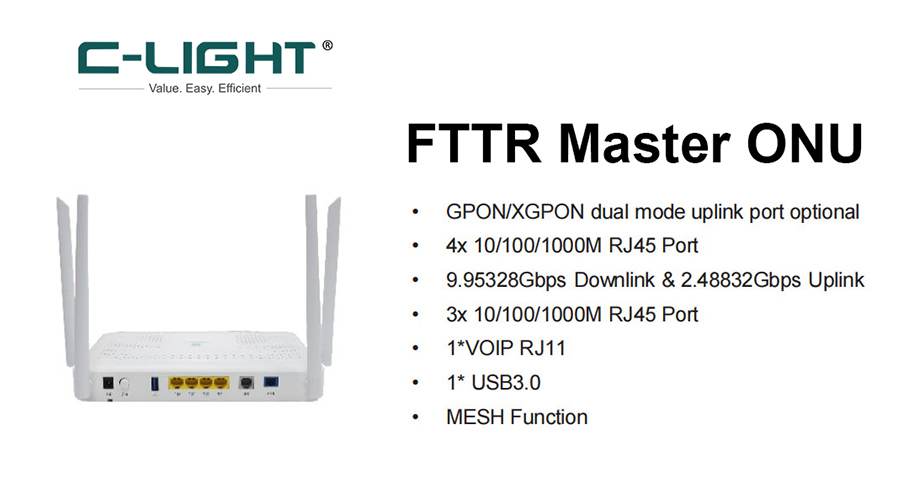
The CLFT3621X-M FTTR Master ONU represents a paradigm shift from copper-based to all-optical home networks. Its dual-mode XGPON/GPON design delivers 2.5Gbps downlink and 1.25Gbps uplink speeds, while the MESH optical backbone eliminates traditional WiFi repeater limitations through distributed fiber architecture.
Core Technological Breakthroughs
●Photonic cascading: Supports up to 32 Sub-Gateway connections via GPON OLT
●Dynamic spectrum management: 160MHz channel bandwidth allocation
●Nano-level synchronization:<10ms
●Energy efficiency: AI-powered algorithm maintains ≤15W consumption
1.Expanded Application Scenarios
Smart Home Ecosystem:
●Enables 8K/VR streaming (requires >200Mbps stable bandwidth)
●Supports >256 concurrent IoT connections
●Optimizes NAS access for distributed storage
2.SMB Solutions
●Cost-effective FTTO (Fiber To Office) deployment
●QoS guarantee for video conferencing systems
●IoT management platform integration
3.New Infrastructure
●Edge computing nodes for smart communities
●5G small cell backhaul networks
●Real-time data acquisition for digital twin systems
4.Industry Trends
●Omdia forecasts the global FTTR market to reach $7.8B by 2025 (29.3% CAGR). Emerging trends include:
●Power-over-Fiber (PoF) integration
●AI-driven network optimization
●Optical-wireless convergence (OWC)
The CLFT3621X-M model combines XGPON/GPON interfaces and four Gigabit Ethernet ports, ensuring ultra-low latency and future-proof fiber-to-room (FTTR) deployment. Its compact 34mm design and ≤15W power consumption make it ideal for smart homes.
FTTR (Fiber to the Room) FAQ
Q1: What is FTTR (Fiber to the Room)?
A: FTTR (Fiber to the Room) is an all-optical home networking solution that extends optical fiber from the home gateway into every room, replacing traditional Ethernet or Wi-Fi-only distribution.
Unlike conventional home networks, FTTR combines fiber optics with distributed Wi-Fi access points to deliver consistent Gigabit connectivity throughout the home.
Typical components include:
FTTR Master ONU
FTTR Slave ONU
Invisible optical fiber
Optical splitters
Wi-Fi 6 / Wi-Fi 7 access points
FTTR is designed to provide stable, high-speed connectivity for modern smart homes and small offices.
Q2: How does an FTTR solution work?
A: An FTTR network uses a Master ONU as the central gateway and connects multiple Slave ONUs through optical fiber.
The basic workflow is:
The Master ONU receives broadband service from the GPON/XGPON network.
Optical fiber extends the connection to each room.
Slave ONUs convert optical signals into Wi-Fi and Ethernet services.
Users enjoy seamless roaming and full-home wireless coverage.
Compared with traditional Wi-Fi extenders, FTTR uses fiber as the backbone, reducing signal loss and maintaining consistent bandwidth across all rooms.
Q3: What are the key features of the C-LIGHT FTTR solution?
A: The C-LIGHT FTTR solution combines optical networking and Wi-Fi technologies to deliver high-performance home connectivity.
Key features include:
Dual-Mode GPON/XGPON Access
Compatible with GPON and XGPON networks
Smooth migration toward higher-speed broadband
Whole-Home Optical MESH
Fiber backbone between rooms
Stable wireless coverage
Seamless roaming
Wi-Fi 6 Connectivity
High throughput
Low latency
Better performance in high-density environments
Smart Network Management
Supports centralized management
Low power consumption
Remote maintenance capability
These features provide reliable broadband for both residential and small business environments.
Q4: What are the advantages of FTTR compared with traditional Wi-Fi networking?
A: FTTR solves many limitations of traditional router-and-repeater deployments.
| Feature | Traditional Wi-Fi | FTTR |
|---|---|---|
| Backbone | Wireless / Ethernet | Optical Fiber |
| Coverage | Limited by walls | Whole-home coverage |
| Roaming | May disconnect | Seamless roaming |
| Bandwidth | Decreases with distance | Stable Gigabit performance |
| Scalability | Limited | Easy room-by-room expansion |
By using fiber as the in-home backbone, FTTR delivers more stable performance and better user experience, especially in large homes.
Q5: What applications are suitable for FTTR?
A: FTTR is ideal for environments requiring reliable, high-bandwidth wireless coverage.
Typical applications include:
Smart Homes
4K/8K video streaming
Smart appliances
Home automation
Security cameras
Remote Work
Video conferencing
Cloud collaboration
Stable VPN connectivity
Online Gaming & Entertainment
Low-latency gaming
VR/AR applications
Cloud gaming
Small Business & SOHO
FTTO (Fiber to the Office)
Multi-user wireless access
High-density device connectivity
FTTR is particularly suitable for villas, large apartments, and multi-room office environments.
Q6: Why is FTTR becoming the future of home networking?
A: As broadband speeds continue increasing, traditional Wi-Fi architectures are becoming a bottleneck.
FTTR addresses this challenge by providing:
Fiber connectivity to every room
Gigabit or multi-gigabit performance
Low latency
Better Wi-Fi roaming
Support for hundreds of connected devices
The growing adoption of smart homes, IoT devices, AI applications, and ultra-high-definition streaming is accelerating the transition toward all-optical home networks.
Q7: How do you choose the right FTTR solution?
A: When selecting an FTTR solution, consider the following factors.
1. Broadband Technology
Ensure compatibility with:
GPON
XGPON
Future XGS-PON upgrades
2. Home Size
Determine:
Number of rooms
Number of Slave ONUs required
3. Wireless Performance
Look for:
Wi-Fi 6 or Wi-Fi 7 support
MESH networking
Seamless roaming
4. Network Management
Choose solutions supporting:
Remote management
Automatic configuration
Easy maintenance
Selecting the appropriate FTTR architecture ensures reliable, long-term home networking performance.
Q8: Why is the C-LIGHT FTTR solution a future-ready networking platform?
A: The C-LIGHT FTTR solution is designed to support the next generation of home and small business connectivity.
It provides:
GPON/XGPON compatibility
Whole-home optical MESH networking
Wi-Fi 6 high-speed wireless access
Low-latency roaming
Support for large numbers of connected devices
Easy migration toward future high-speed fiber networks
Combined with C-LIGHT FTTR Master ONU and FTTR Slave ONU products, the solution delivers scalable, reliable, and future-ready all-optical networking for modern digital lifestyles.
 >
>

 >
>
 >
>
 >
>
 >
>
 >
>
 >
>
 >
>