TEL:+86 132 6656 7067


Optical transceivers have become a critical part of modern data center networking, but the requirements of AI clusters are increasingly different from those of traditional enterprise and cloud data centers. Large AI systems connect thousands of GPUs, accelerators, NICs, and switches through high-bandwidth networks that generate intensive East-West traffic.
AI optical transceivers are therefore increasingly optimized around bandwidth density, power efficiency, signal integrity, low latency, thermal management, and high-volume deployment. Traditional data center transceivers remain important for enterprise applications, cloud services, storage, server connectivity, and general network traffic.
The distinction should not be interpreted as two completely separate optical technologies. Both can use the same basic optical principles, form factors, wavelengths, and signaling technologies. The difference is primarily in how the optical solution is optimized for the network workload and system architecture.
1. What Is an AI Optical Transceiver?
An AI optical transceiver is an optical module designed or optimized for high-performance AI and machine learning networking environments.
These environments can require extremely high bandwidth between GPUs, SuperNICs, switches, and other compute resources. AI optical modules therefore place strong emphasis on high lane rates, low power per bit, high optical density, thermal stability, low latency, and interoperability with AI networking platforms.
AI optical transceivers can support both Ethernet and InfiniBand environments depending on the specific module and host platform.
2. What Is a Traditional Data Center Transceiver?
A traditional data center optical transceiver is a pluggable optical module used for general-purpose data center connectivity.
Typical applications include server-to-switch connections, switch-to-switch links, storage networks, enterprise applications, cloud services, and data center interconnect.
Traditional modules can support a wide range of data rates and reaches, including 10G, 25G, 100G, 200G, 400G, and 800G-class solutions. Therefore, the term "traditional" describes the application context rather than a fixed maximum speed.
3. AI Optical Transceiver vs Traditional Data Center Transceiver at a Glance
| Factor | AI Optical Transceiver | Traditional Data Center Transceiver |
|---|---|---|
| Primary Environment | GPU and accelerator clusters | Enterprise, cloud, storage, and general data centers |
| Traffic Pattern | Heavy East-West and many-to-many traffic | Mixed East-West and North-South traffic |
| Bandwidth | 400G, 800G, 1.6T and higher-speed development | Wide range from lower-speed to high-speed interfaces |
| Lane Rate | Increasingly 200G and 400G-class | Depends on generation and application |
| Power per Bit | Strong optimization requirement | Important but workload dependent |
| Latency | Highly important | Application dependent |
| Thermal Density | Very high | Varies by deployment |
| Protocol | Ethernet or InfiniBand depending on platform | Primarily Ethernet, with other protocols possible |
| Interconnect Scale | Thousands or more high-speed links | Small to very large deployments |
| Primary Design Priority | Bandwidth, efficiency, density, reliability | Flexibility, interoperability, cost, and application fit |
4. AI Networks Require Much Higher Aggregate Bandwidth
AI workloads create large amounts of communication between accelerators. Distributed training can require collective communication operations in which many GPUs exchange information simultaneously.
This produces large amounts of East-West traffic and can make network bandwidth a significant factor in overall system performance.
As accelerator and switch capabilities increase, the optical network needs to scale accordingly. This is one of the major drivers behind the transition from 400G to 800G and toward 1.6T optical connectivity.
5. 400G, 800G, and 1.6T in AI Optical Networking
Higher-speed optical modules allow more aggregate traffic to pass through a single network interface.
| Optical Generation | Representative Role | AI Networking Relevance |
|---|---|---|
| 400G | High-speed data center connectivity | Widely relevant to AI scale-out and switch networking |
| 800G | High-density switch and accelerator connectivity | Major AI networking interface generation |
| 1.6T | Next-generation high-bandwidth connectivity | Emerging for higher-density AI fabrics |
| 3.2T | Future high-density optical connectivity | Under active development |
The move toward higher aggregate bandwidth is accompanied by improvements in lane rate, DSP technology, optical integration, thermal design, and packaging.
6. 200G per Lane vs 400G per Lane
Lane rate is becoming one of the most important parameters in AI optical module development.
A simplified 1.6T architecture can use either eight 200G-class optical lanes or four 400G-class optical lanes:
8 × 200G = 1.6T
4 × 400G = 1.6T
Using fewer, higher-speed lanes can increase optical density and reduce the number of parallel optical channels that must be integrated into the module.
However, 400G-class lanes introduce much greater requirements for signal integrity, DSP performance, optical components, packaging, and thermal management.
7. PAM4 Is Important for AI Optical Transceivers
PAM4 has become a fundamental signaling technology in modern high-speed optical communication.
NRZ uses two signal levels and carries one bit per symbol, while PAM4 uses four signal levels and carries two bits per symbol.
This allows higher data rates without requiring the symbol rate to increase at the same proportion.
The tradeoff is a smaller eye opening and greater sensitivity to noise, distortion, crosstalk, insertion loss, and other signal impairments.
As AI optical modules move toward 200G- and 400G-class lanes, PAM4 performance becomes increasingly important to the complete system.
8. Optical DSP Requirements
AI optical transceivers increasingly depend on advanced DSP technology to maintain link performance at high lane rates.
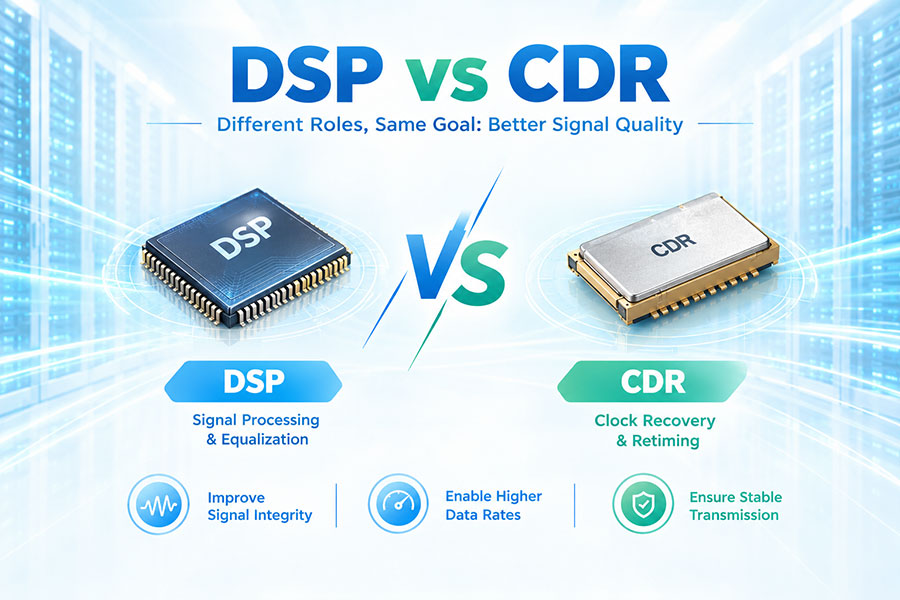
DSP functions can include equalization, signal recovery, FEC processing, diagnostics, lane conversion, and other signal-conditioning functions depending on the architecture.
At high-speed AI interconnects, DSP power and latency become system-level considerations because a large cluster can contain a very large number of optical modules.
Recent 2026 industry developments have pushed 400G-per-lane PAM4 DSPs toward 1.6T optical modules, demonstrating how higher lane rates are being used to increase bandwidth density.
9. AI Optical Transceiver Power Consumption
Power efficiency is one of the most important differences in the design priorities of AI optical networking.
An AI cluster can contain thousands of optical interfaces. A small increase in power consumption per module can therefore become a substantial cluster-level energy and cooling requirement.
| Power Consideration | AI Optical Transceiver | Traditional Data Center Transceiver |
|---|---|---|
| Power per Bit | Highly optimized | Important but more application dependent |
| Module Density | Very high | Varies |
| Aggregate Power | Major cluster-level concern | Depends on data center scale |
| Thermal Management | Critical | Important |
| Efficiency Target | High bandwidth with low energy per bit | Balance performance, cost, and power |
AI optical design therefore increasingly focuses on power per gigabit rather than simply the absolute module power.
10. Thermal Management in AI Optical Modules
Higher bandwidth creates higher thermal density because more advanced DSPs, drivers, lasers, photonic devices, and electrical components are integrated into compact packages.
The thermal behavior of an AI optical module must be considered together with switch ASIC power, airflow, heatsink design, rack density, and data center cooling.
As AI infrastructure moves toward higher-density architectures, liquid cooling and other advanced thermal technologies can become increasingly relevant at the system level.
11. AI Optical Transceiver vs Traditional Module: Latency
Latency is important in both environments, but AI clusters can be particularly sensitive to communication delay because distributed workloads frequently synchronize many compute nodes.
A small delay on one communication path can affect collective operations involving many accelerators.
AI optical systems therefore need to minimize latency across the optical module, DSP, host interface, cable, switch, and network fabric.
This does not mean every AI optical module has a lower absolute latency than every conventional module. The actual latency depends on the complete implementation.
12. AI Networks Use Different Traffic Patterns
Traditional data centers often carry a mixture of North-South traffic, East-West application traffic, storage traffic, and management traffic.
AI clusters generate especially large volumes of East-West traffic between accelerators and networking devices.
| Traffic Pattern | Traditional Data Center | AI Data Center |
|---|---|---|
| North-South | Important | Still important |
| East-West | Increasingly important | Extremely important |
| GPU-to-GPU | Limited | Core workload traffic |
| Collective Communication | Not usually dominant | Major traffic pattern |
| Traffic Synchronization | Application dependent | Highly relevant to distributed workloads |
This traffic pattern encourages AI networks to use highly parallel, low-latency fabrics and high-density optical connectivity.
13. AI Optical Transceivers and InfiniBand
InfiniBand is widely used in high-performance computing and AI environments where low-latency communication and RDMA-based networking are important.
AI optical modules designed for InfiniBand must match the required InfiniBand generation, host interface, lane architecture, optical reach, form factor, and firmware or coding requirements.
This is different from a generic Ethernet optical module that may be designed primarily for conventional IP traffic.
However, the optical transmission technology itself can be similar. The distinction is often determined by the complete host and network ecosystem.
14. AI Optical Transceivers and Ethernet
Ethernet is also a major networking technology for AI clusters.
AI-oriented Ethernet fabrics can use high-speed NICs, congestion management, load balancing, adaptive routing, telemetry, and RDMA technologies such as RoCE.
This creates an environment where optical transceivers must support not only high bandwidth but also predictable behavior across large numbers of interconnected devices.
Modern AI Ethernet systems therefore use optical modules at 400G, 800G, and emerging 1.6T rates depending on the platform.
15. Reach Requirements Are Different
AI optical transceivers are not necessarily long-reach modules. Many of the highest-volume AI connections are short-reach links within a data center.
| Reach | Typical AI Application | Representative Optical Approach |
|---|---|---|
| Very Short | Adjacent rack or system connections | DAC, AEC, AOC, short-reach optics |
| Short | Rack-to-rack and switch-to-server | SR, DR-class optical solutions |
| Medium | Data hall or campus connectivity | FR and other single-mode optics |
| Long | AI DCI and distributed computing sites | Coherent optics and WDM |
The appropriate optical architecture depends on the physical topology rather than on whether the application is labeled "AI."
16. Wavelengths in AI Optical Transceivers
AI optical transceivers can operate across multiple wavelength regions.
850nm is common in short-reach multimode applications, particularly where VCSEL technology is used. 1310nm is widely used for short- and medium-reach single-mode links such as DR and FR architectures.
1550nm-region optics become especially important for longer-reach and coherent systems, including DCI and DWDM architectures.
| Wavelength Region | Typical Fiber | Typical Application |
|---|---|---|
| 850nm | MMF | Short-reach data center connectivity |
| 1310nm | SMF | Short- and medium-reach high-speed optics |
| 1550nm | SMF | Long-reach, DWDM, coherent and DCI applications |
There is therefore no single "AI wavelength." The wavelength is selected according to reach, fiber, optical architecture, and system requirements.
17. AI Optical Transceiver Form Factors
AI data centers use several optical module form factors depending on switch, NIC, and accelerator architecture.
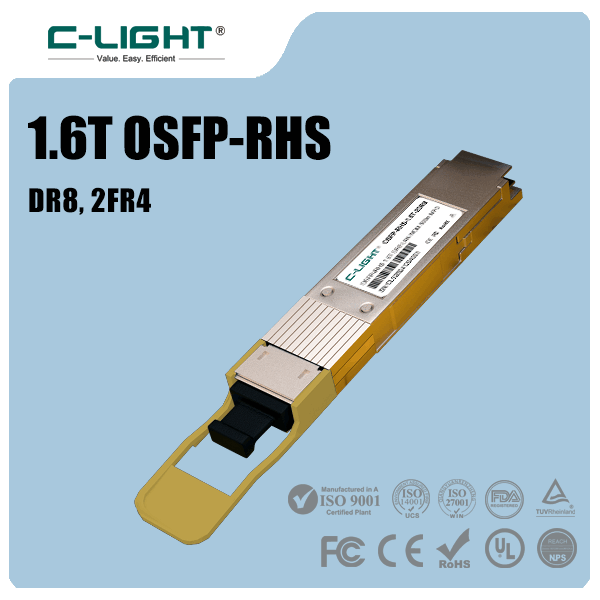
OSFP is particularly important for high-bandwidth AI networking because its mechanical and thermal characteristics support high-density 800G and emerging 1.6T architectures.
QSFP-DD remains important for a broad range of data center connectivity, while other form factors can be used depending on the host platform.
The form factor should be selected together with the host electrical interface and thermal design rather than based solely on nominal optical speed.
18. AI Optical Transceiver and Breakout Architecture
Breakout connectivity is frequently used in high-performance AI networks.
An 800G interface can, depending on the platform, be divided into multiple lower-rate connections. This can support different network topologies, rail structures, and connectivity requirements.
Breakout designs increase the importance of fiber polarity, lane mapping, connector density, cable length, optical budget, and host compatibility.
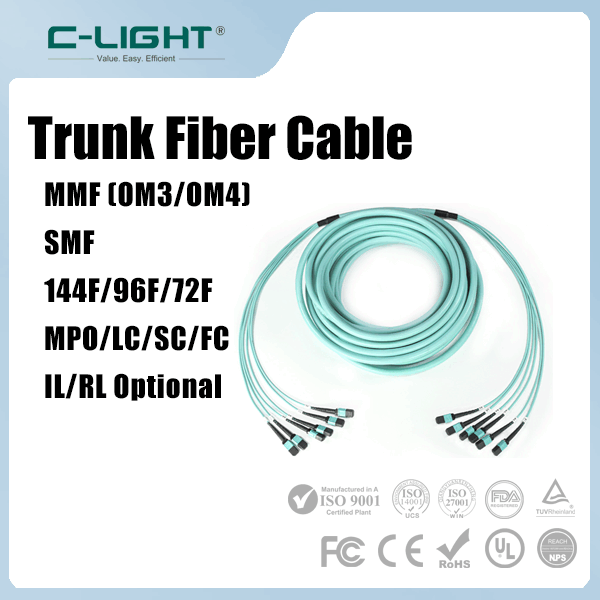
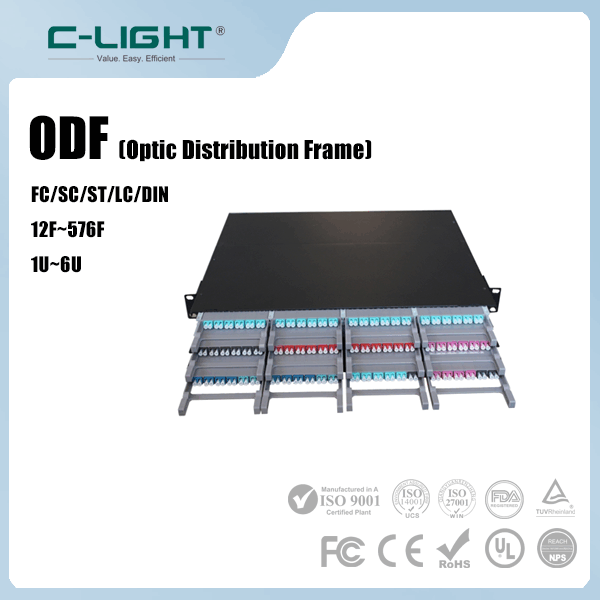
AI optical infrastructure therefore includes more than individual transceivers. A complete system can contain optical modules, DACs, AECs, AOCs, breakout cables, MPO/MTP® connectivity, patch systems, and optical transport equipment.
19. AI Optical Transceiver and Silicon Photonics
Silicon photonics is increasingly important in the development of high-density AI optical connectivity.
Silicon photonics can integrate optical functions such as waveguides, modulators, and photodetectors into compact photonic integrated circuits.
This can support higher levels of optical integration and provide a path toward reducing the physical and electrical distance between high-speed switch interfaces and optical engines.
Silicon photonics can be used in pluggable modules as well as more integrated NPO and CPO architectures.
20. Pluggable Optics vs CPO for AI Networking
| Factor | AI Pluggable Optics | CPO/NPO |
|---|---|---|
| Optical Location | Front panel or removable module | Near or integrated with switching silicon |
| Serviceability | High | Lower at individual optical-engine level |
| Electrical Reach | Longer host electrical path | Shorter electrical path |
| Density | High | Potentially higher |
| Deployment Flexibility | High | More architecture dependent |
| AI Scaling Role | Important current architecture | Important future high-density direction |
AI optical transceivers are not synonymous with CPO. High-speed pluggable optics remain an important deployment architecture, while NPO and CPO are being developed to address future bandwidth, power, and electrical-channel constraints.
21. Reliability and Interoperability
Large AI clusters can contain enormous numbers of optical components. A small failure rate can therefore translate into a meaningful number of link-level issues across a large installation.
AI optical modules require careful validation of BER, optical power, receiver sensitivity, FEC behavior, temperature performance, host compatibility, firmware, and network interoperability.
Multi-vendor interoperability is particularly important when switches, NICs, optical modules, cables, and network operating systems come from different suppliers.
22. AI Optical Transceiver vs Traditional Data Center Transceiver: Key Differences
| Category | AI Optical Transceiver | Traditional Data Center Transceiver |
|---|---|---|
| Definition | Application-optimized optical transceiver for AI/ML infrastructure | General-purpose data center optical transceiver |
| Bandwidth | Strong focus on 400G, 800G, 1.6T and beyond | Wide range of speeds |
| Lane Rate | 200G and 400G-class development is highly important | Depends on product generation |
| Traffic | GPU-heavy East-West communication | Mixed application traffic |
| Latency | Highly important | Application dependent |
| Power per Bit | Critical | Important |
| Thermal Density | Very high | Varies |
| Protocol | InfiniBand or AI Ethernet | Primarily Ethernet |
| Optical Technology | VCSEL, EML, silicon photonics, coherent and other architectures | Broad range of optical technologies |
| Topology | AI scale-up, scale-out, multi-plane and high-radix fabrics | Enterprise, cloud and conventional data center topologies |
| Cooling | Strong system-level thermal consideration | Generally less demanding at equivalent density |
| Upgrade Direction | Higher lane rates and optical integration | Application-dependent bandwidth evolution |
23. How to Select an AI Optical Transceiver
Selection should begin with the complete network architecture rather than the "AI" label on the module.
| Selection Parameter | Key Question |
|---|---|
| Bandwidth | Is the interface 400G, 800G, 1.6T, or another rate? |
| Host Platform | Which switch, NIC, accelerator, or optical engine is being used? |
| Protocol | InfiniBand, Ethernet, RoCE, or another network architecture? |
| Reach | What is the actual fiber distance including patching? |
| Lane Rate | 100G, 200G, 400G-class or another architecture? |
| Fiber | MMF or SMF? |
| Wavelength | 850nm, 1310nm, 1550nm, or WDM architecture? |
| Power | Can the host and rack support the module power? |
| Thermal | Can the cooling architecture maintain operating margins? |
| Compatibility | Has the module been validated with the target switch and NIC? |
| Future Scaling | Can the cabling infrastructure support higher-speed upgrades? |
For large-scale AI deployments, compatibility and reliability testing are particularly important because the optical network may contain a very large number of identical links.
24. Why AI Optical Transceivers Are Becoming More Important
The emergence of AI optical transceivers reflects the changing architecture of data centers.
AI clusters require much more internal communication between compute nodes than many traditional workloads. At the same time, accelerator and switch bandwidth is increasing rapidly, making optical connectivity a larger part of the overall system design.
400G and 800G optics provide the current foundation for high-bandwidth AI networking, while 1.6T modules and 400G-per-lane technologies are being developed to increase bandwidth density further.
Advanced DSPs, PAM4 signaling, silicon photonics, improved lasers, high-density packaging, and thermal innovations are all contributing to this evolution.
The main difference between AI optical transceivers and traditional data center transceivers is therefore not simply speed. AI optics are increasingly optimized as components of a tightly integrated compute and networking system where bandwidth, latency, power, thermal performance, density, and reliability must be considered together.
C-LIGHT's optical connectivity portfolio can support different layers of these infrastructures, including 400G and 800G optical transceivers, emerging 1.6T optical connectivity, InfiniBand and Ethernet interconnects, DAC, AEC, AOC, and high-density MPO/MTP® fiber systems.
 >
>

 >
>
 >
>
 >
>
 >
>
 >
>
 >
>
 >
>