TEL:+86 132 6656 7067


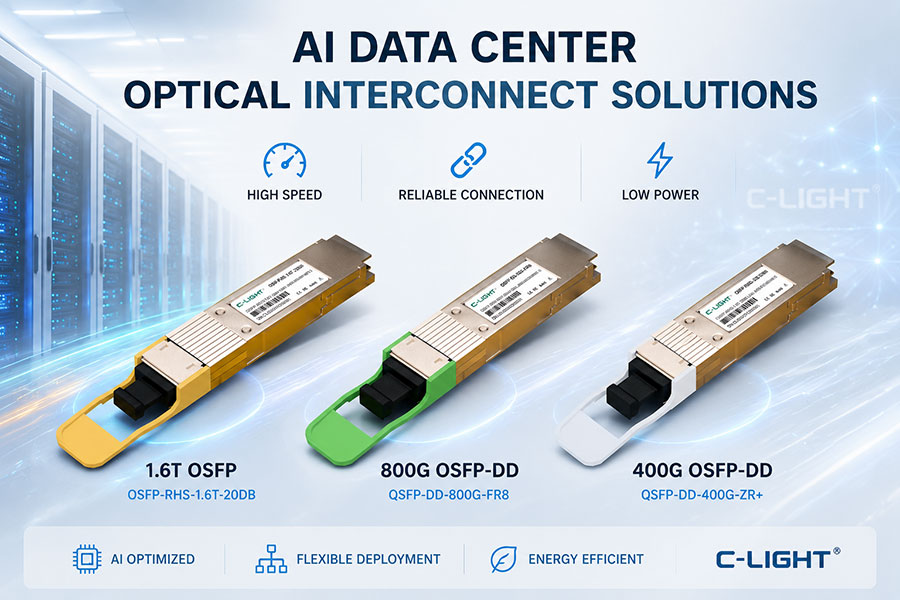
AI infrastructure is moving rapidly from 400G to 800G and toward 1.6T connectivity. As GPU clusters become larger and AI workloads generate more east-west traffic, optical interconnects are becoming a critical part of data center network architecture.
C-LIGHT provides optical transceivers, DAC/AOC cables, and high-speed interconnect solutions designed for AI data centers, supporting network upgrades from 400G to 800G and next-generation 1.6T architectures.
1. Why Optical Interconnects Matter for AI Data Centers
AI training and inference require high-speed communication between GPUs, switches, storage systems, and data center networks.
Workloads such as:
Large Language Model (LLM) training
Distributed AI inference
Mixture of Experts (MoE)
AllReduce communication
Model and checkpoint synchronization
can generate massive east-west traffic inside the data center.
As GPU clusters scale, traditional lower-speed connections can become network bottlenecks. Higher-speed optical interconnects help increase bandwidth, reduce network congestion, and support scalable AI cluster architectures.
2. 400G: The Foundation for High-Speed AI Networks
400G optical interconnects are widely used in modern data center and AI network deployments.
Typical 400G solutions include:
400G QSFP-DD SR8 for short-distance connections
400G QSFP-DD DR4 for data center interconnects
400G QSFP-DD FR4 for medium-distance links
400G QSFP-DD LR4 for longer-distance transmission
400G DAC and AOC for short-range server and switch connections
400G can be deployed between GPU servers, Top-of-Rack (ToR) switches, leaf switches, and spine switches, depending on network architecture and transmission distance.
3. 800G: Scaling AI Network Bandwidth
As AI clusters continue to expand, 800G is becoming an important step in network evolution.
Compared with 400G, an 800G link can provide twice the bandwidth while helping reduce the number of physical connections required for the same aggregate capacity.
Common 800G solutions include:
A typical AI data center architecture may use 800G DAC or AOC for short GPU-to-switch connections, while 800G DR8 or 2×FR4 optical transceivers can be used for higher-speed switch-to-switch links.
4. 1.6T: The Next Generation of AI Connectivity
The rapid development of AI accelerators and large-scale GPU clusters is driving the industry toward 1.6T interconnects.
1.6T solutions are expected to support higher-density switch architectures and increasingly demanding AI fabrics.
Potential 1.6T interconnect technologies include:
1.6T OSFP-XD optical transceivers
1.6T DAC and AEC solutions
1.6T optical modules
Next-generation silicon photonics
LPO and other low-power optical technologies
At 1.6T, power consumption, thermal management, signal integrity, and port density become increasingly important considerations. Optical interconnect design therefore needs to balance bandwidth, reach, power efficiency, and deployment cost.
5. AI Data Center Optical Interconnect Architecture
A high-speed AI data center can be divided into several connectivity layers:
GPU Layer
GPU servers connect to ToR or leaf switches using high-speed DAC, AOC, or optical transceivers.
Leaf Layer
Leaf switches aggregate traffic from multiple GPU servers and connect to the spine network using 400G or 800G optical interconnects.
Spine Layer
Spine switches provide high-bandwidth connectivity across the AI fabric. 800G and future 1.6T solutions can increase network capacity while supporting higher-density architectures.
Data Center Interconnect
For longer-distance connections between data centers, coherent optical technology, DWDM, and high-speed optical modules can provide scalable bandwidth.
6. C-LIGHT AI Optical Interconnect Solutions
C-LIGHT supports multiple generations of high-speed data center interconnect technologies.
400G Solutions
C-LIGHT 400G portfolio includes:
400G SR8
400G DR4
400G FR4
400G LR4
400G DAC
400G AOC
These solutions can be used for GPU clusters, Ethernet data centers, storage networks, and high-performance computing environments.
800G Solutions
The 800G portfolio includes:
800G OSFP SR8
800G OSFP DR8
800G OSFP 2×FR4
800G QSFP-DD800 DR8
800G QSFP-DD800 2×FR4
800G DAC
800G AOC
These products are designed for high-bandwidth AI and data center networks where bandwidth density and low-latency connectivity are important.
1.6T Solutions
For next-generation AI infrastructure, C-LIGHT is also developing solutions around 1.6T architectures, including OSFP-XD-based optical connectivity and high-speed DAC/AEC interconnects.
The goal is to provide a practical upgrade path from 400G and 800G to 1.6T without requiring a complete redesign of the network architecture.
7. Optical Interconnect Selection Guide
The appropriate interconnect depends on transmission distance, network architecture, port density, power budget, and deployment cost.
| Network Scenario | Recommended Solution |
|---|---|
| GPU server to ToR | 400G/800G DAC or AOC |
| Short-range switch connection | 400G/800G SR |
| Leaf-to-spine | 400G/800G DR or FR |
| High-density AI fabric | 800G |
| Next-generation AI clusters | 1.6T |
| Data center interconnect | 400G/800G coherent or DWDM |
| Long-distance optical links | DR/FR/LR or coherent solutions |
8. From 400G to 1.6T
The evolution of AI networking can be summarized as:
400G → 800G → 1.6T
400G provides the foundation for high-speed AI networking. 800G increases bandwidth density and becomes increasingly important as GPU clusters scale. 1.6T represents the next stage for large-scale AI fabrics, where bandwidth, power efficiency, thermal performance, and port density must be optimized together.
For data center operators and system integrators, planning an upgrade path early can help avoid network bottlenecks and simplify future expansion.
9. Conclusion
AI data center networking is entering a new high-bandwidth era. From 400G to 800G and eventually 1.6T, optical interconnects will play an increasingly important role in connecting GPUs, switches, storage systems, and data centers.
C-LIGHT provides a scalable portfolio of optical transceivers, DAC, AOC, and next-generation interconnect solutions to support different AI networking architectures and deployment requirements.
Whether building a 400G Ethernet network, upgrading to an 800G AI fabric, or preparing for 1.6T connectivity, choosing the right optical interconnect technology is essential for building a high-performance and scalable data center network.
10.AI Data Center Optical Interconnect Solutions Q&A
Q1: Why are optical interconnects important for AI data centers?
A: AI workloads generate massive amounts of east-west traffic between GPUs, switches, and storage systems. High-speed optical interconnects provide the bandwidth, low latency, and scalability required for large-scale AI clusters and next-generation data center networks.
Q2: Is 800G better than 400G for AI networks?
A: 800G optical interconnects provide twice the bandwidth of 400G per link and enable higher network density. However, the right solution depends on switch port capability, GPU architecture, transmission distance, power consumption, and overall deployment requirements.
400G: Suitable for current high-performance data center deployments
800G: Designed for higher-density AI clusters and next-generation networks
Selection depends on network architecture and upgrade plans
Q3: What is the role of 1.6T optical interconnects?
A: 1.6T optical interconnects represent the next evolution of high-speed networking. They are designed to support future AI GPU clusters, hyperscale data centers, and higher-density switching architectures that require increased bandwidth capacity.
Up to 1.6Tbps aggregate bandwidth
Designed for next-generation AI infrastructure
Supports higher-density network expansion
Q4: What interconnect should be used between GPU servers and switches?
A: The choice of interconnect depends on transmission distance, bandwidth requirements, and network architecture.
DAC cables: Suitable for short-distance, low-cost, low-power connections
AOC cables: Suitable for flexible cabling and longer-distance connections inside data centers
Optical transceivers: Suitable for higher bandwidth and longer-distance network deployments
Q5: What does C-LIGHT provide for AI data centers?
A: C-LIGHT provides complete optical interconnect solutions for AI data centers, including high-speed optical transceivers, DAC, AOC, and next-generation 1.6T connectivity solutions.
400G optical transceiver solutions
800G QSFP-DD and OSFP optical modules
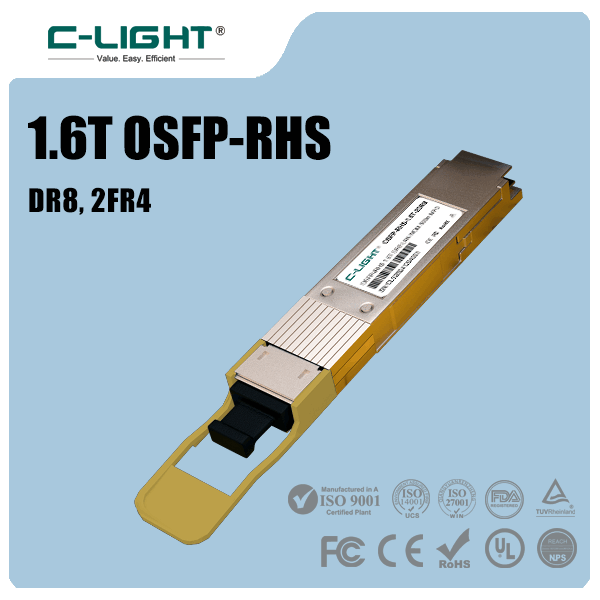
1.6T OSFP-RHS next-generation optical solutions
DAC and AOC high-speed interconnect cables
Solutions for AI data centers, HPC, cloud computing, and high-bandwidth networks
 >
>

 >
>
 >
>
 >
>
 >
>
 >
>
 >
>
 >
>