TEL:+86 132 6656 7067


The C-LIGHT CLCWMUX4CHD is a 4-channel dual-fiber CWDM (Coarse Wavelength Division Multiplexing) module designed for high-density fiber optic networks. It supports flexible deployment in 1U rack, LGX box, or ABS housing. Utilizing CWDM technology, this module enables efficient multi-wavelength signal transmission over a single fiber, significantly reducing network complexity and costs. Its unique 1310nm EXP./MON. port further enhances network operation flexibility and manageability.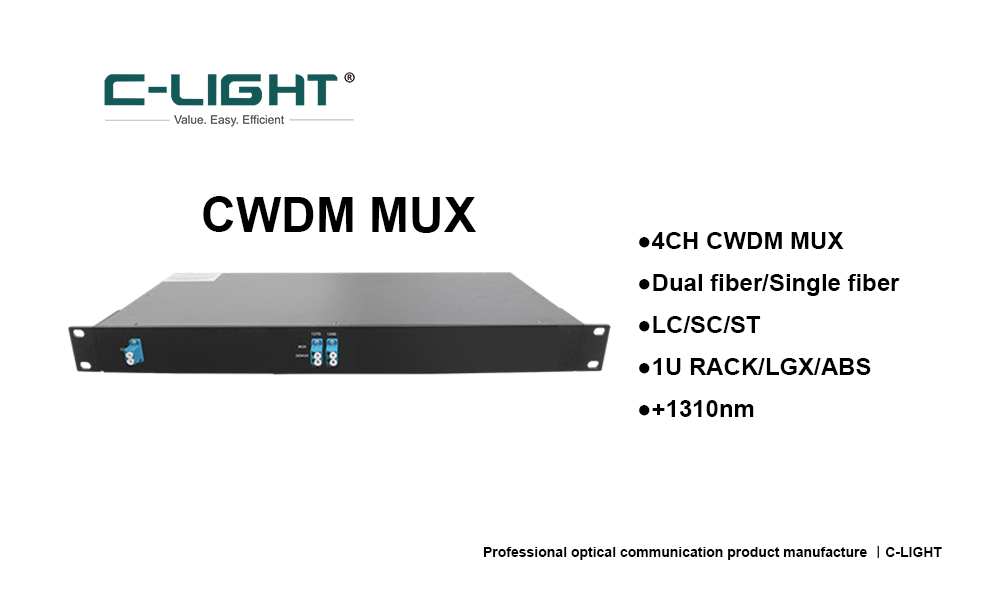 Core Technical Advantages
Dual-Fiber Architecture & Multi-Wavelength Support
Dual-Fiber Design: Enables bidirectional transmission, minimizing physical link complexity for metro area networks (MAN) and data center interconnects (DCI).
4-Channel Configuration: Covers ITU-T standard wavelengths (e.g., 1470nm, 1490nm, 1510nm, 1530nm), boosting single-module capacity to 4×10G/25G.
Universal Connector Compatibility
Supports LC/SC/ST interfaces, ensuring seamless integration with existing network infrastructure and avoiding upgrade costs.
Flexible Deployment & Scalability
Modular Design: Choose from 1U rack, LGX, or ABS housing to meet diverse deployment needs in data centers, telecom rooms, and enterprise networks.
High Reliability
Low insertion loss (<2.5db) and="" isolation="">30dB) ensure stable long-distance transmission.
Industrial temperature range (-40°C to +85°C) suits harsh environments.
●Key Application Scenarios
5G Fronthaul Networks
Delivers cost-effective, high-bandwidth transmission between base stations (AAU) and core networks, meeting 5G low-latency requirements.
Data Center Interconnect (DCI)
Expands capacity over limited fiber resources, supporting 10G/25G cross-data-center traffic.
Enterprise WAN
Simplifies branch network architecture with dual-fiber parallel transmission for video, voice, and data services.
Fiber Resource Optimization
Reuses legacy fiber infrastructure to avoid redundant cabling, reducing CAPEX.
Why Choose C-LIGHT 4 Channel CWDM MUX?
Standardization & Compatibility
Compliant with ITU-T G.694.2 standards, interoperable with mainstream CWDM modules
Cost Efficiency
Reduces deployment costs by over 50% compared to DWDM systems, eliminating the need for cooled lasers.
Operational Simplicity
Hot-swappable modular design minimizes network downtime.
●Installation & Maintenance
Installation Tips:
Avoid excessive fiber bending (bend radius >30mm) to prevent signal attenuation.
Regularly clean connector end faces to maintain low insertion loss.
Monitoring Configuration:
Connect OTDR or optical power meters via the 1310nm port for real-time link performance analysis.
If you are interested in the 4ch dual fiber CWDM MUX, please contact us
4CH CWDM MUX FAQ
Q1: What is a 4CH CWDM MUX?
A: A 4CH CWDM MUX (4-Channel Coarse Wavelength Division Multiplexer) is a passive optical device that combines four independent optical wavelengths onto a single fiber for transmission and separates them at the receiving end.
Instead of deploying multiple fiber pairs, a 4-channel CWDM MUX allows multiple services to share the same optical fiber, significantly improving fiber utilization.
Typical features include:
Passive operation (no power required)
Four CWDM wavelength channels
Single-fiber or dual-fiber versions
Low insertion loss
Compact LGX, ABS, or 1U rack packaging
It is widely used in enterprise, telecom, metro, and data center networks.
Q2: How does a 4CH CWDM MUX work?
A: A 4CH CWDM MUX assigns each optical service a unique CWDM wavelength.
The operating process is:
Four optical transceivers generate signals at different CWDM wavelengths.
The multiplexer combines all wavelengths onto one transmission fiber.
At the remote site, the DEMUX separates each wavelength.
Each signal is delivered to its corresponding network device.
Because each wavelength carries an independent service, multiple data channels can operate simultaneously without interference.
Q3: What is the difference between single-fiber and dual-fiber 4CH CWDM MUX?
A: Both solutions expand network capacity, but they use fiber differently.
| Feature | Single-Fiber CWDM | Dual-Fiber CWDM |
|---|---|---|
| Fiber Requirement | One fiber | Two fibers |
| Transmission | Bidirectional | Separate TX/RX fibers |
| Fiber Utilization | Higher | Standard |
| Deployment Cost | Lower | Higher |
| Best For | Limited fiber resources | Existing dual-fiber infrastructure |
Single-fiber CWDM is ideal where fiber resources are limited, while dual-fiber CWDM is often used in traditional optical networks.
Q4: What are the advantages of a 4CH CWDM MUX?
A: A 4-channel CWDM MUX offers several important benefits.
Higher Fiber Utilization
Multiple optical services share a single fiber.
Lower Infrastructure Cost
Reduces the need for additional fiber installation.
Passive Operation
Requires no electrical power, resulting in high reliability.
Easy Network Expansion
Additional wavelengths can be deployed without replacing existing fiber infrastructure.
Low Maintenance
Passive optical components provide long service life and stable performance.
Q5: What applications are suitable for a 4CH CWDM MUX?
A: 4-channel CWDM solutions are commonly deployed in medium-distance optical communication networks.
Typical applications include:
Enterprise Networks
Campus backbone
Building interconnection
Data Center Interconnect (DCI)
Multi-service aggregation
Storage network connectivity
Telecom Networks
Metro access
Enterprise leased lines
Industrial Networks
Smart manufacturing
Utility communication systems
Video Surveillance Networks
High-definition video transmission
Multi-site monitoring
These applications benefit from increased bandwidth while minimizing fiber consumption.
Q6: Why is a passive CWDM MUX an efficient fiber expansion solution?
A: Passive CWDM technology expands network capacity without requiring powered equipment.
Its key advantages include:
No external power supply
Low operating cost
High reliability
Simple installation
Excellent compatibility with CWDM optical transceivers
It enables network operators to maximize existing fiber infrastructure while reducing deployment complexity.
Q7: How do you choose the right 4CH CWDM MUX?
A: Consider the following factors before selecting a 4-channel CWDM MUX.
1. Fiber Architecture
Choose:
Single-fiber
Dual-fiber
2. Wavelength Plan
Ensure compatibility with the CWDM transceiver wavelengths used in the network.
3. Package Type
Available options include:
LGX Cassette
ABS Box
1U Rack Mount
4. Future Expansion
Consider whether additional channels may be required in the future, such as:
8CH CWDM MUX
16CH CWDM MUX
18CH CWDM MUX
Q8: Why is a 4CH CWDM MUX a future-ready optical networking solution?
A: As bandwidth demand continues to increase, organizations need to maximize existing fiber resources before investing in new infrastructure.
A 4CH CWDM MUX provides:
Cost-effective bandwidth expansion
Efficient wavelength multiplexing
High network reliability
Flexible deployment
Smooth migration toward higher-channel CWDM and DWDM systems
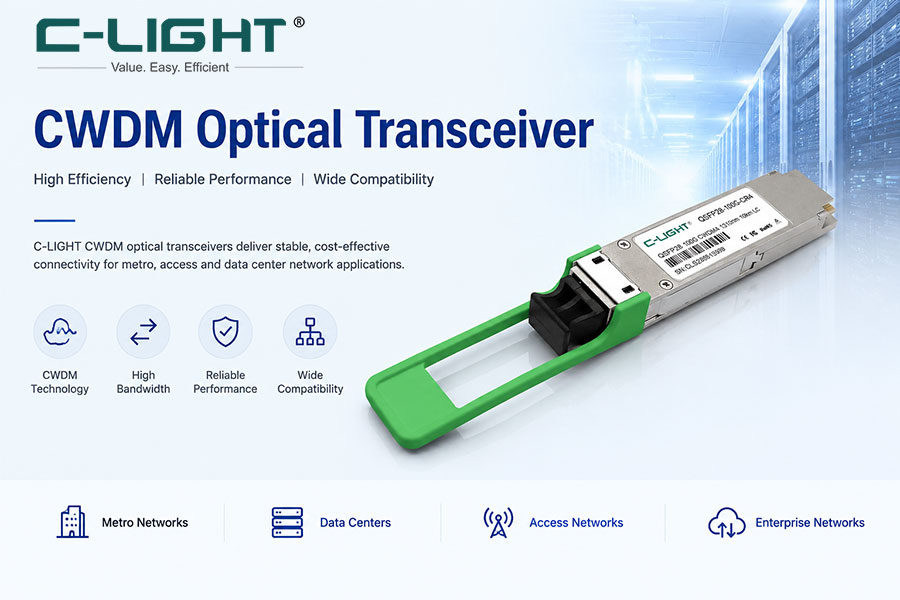
Combined with C-LIGHT CWDM optical transceivers, it delivers a scalable, economical, and future-ready optical transport solution for enterprise, carrier, metro, and data center networks.
 >
>

 >
>
 >
>
 >
>
 >
>
 >
>
 >
>
 >
>