TEL:+86 132 6656 7067


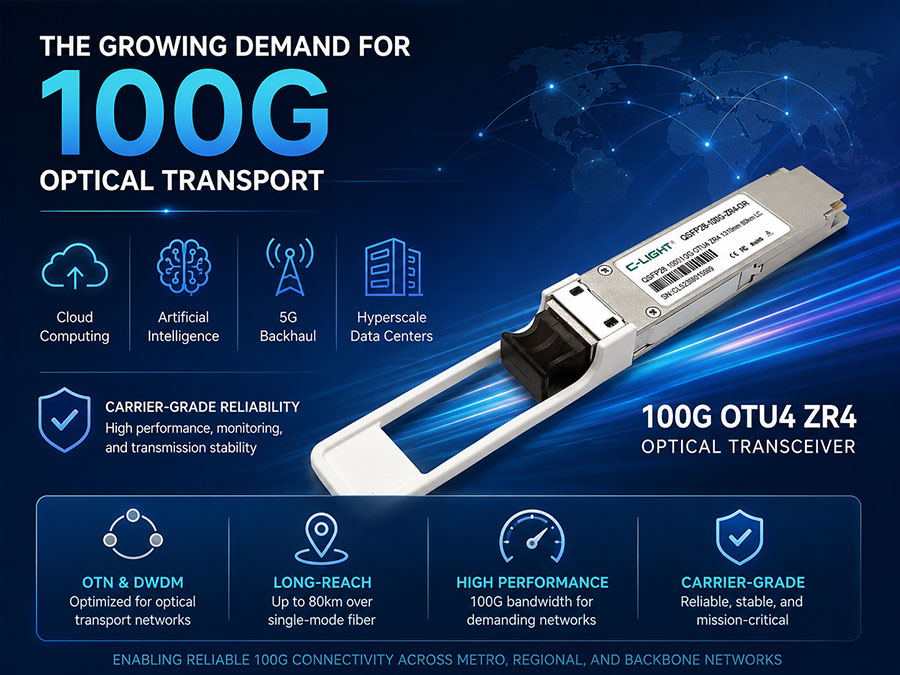
1. The Growing Demand for 100G Optical Transport
As cloud computing, artificial intelligence, 5G backhaul, and hyperscale data centers continue to drive bandwidth consumption, network operators are under increasing pressure to deliver higher-capacity transport services over longer distances.
While native 100 Gigabit Ethernet is widely used within data centers, carrier and enterprise transport networks require enhanced reliability, performance monitoring, and transmission stability. This is where the 100G OTU4 ZR4 Optical Transceiver becomes essential.
Designed for Optical Transport Network (OTN) and Dense Wavelength Division Multiplexing (DWDM) environments, the C-LIGHT 100G OTU4 ZR4 Optical Transceiver combines carrier-grade transport capabilities with long-reach optical transmission, enabling reliable 100G connectivity across metro, regional, and backbone networks.
2. Understanding OTU4 and Why It Matters
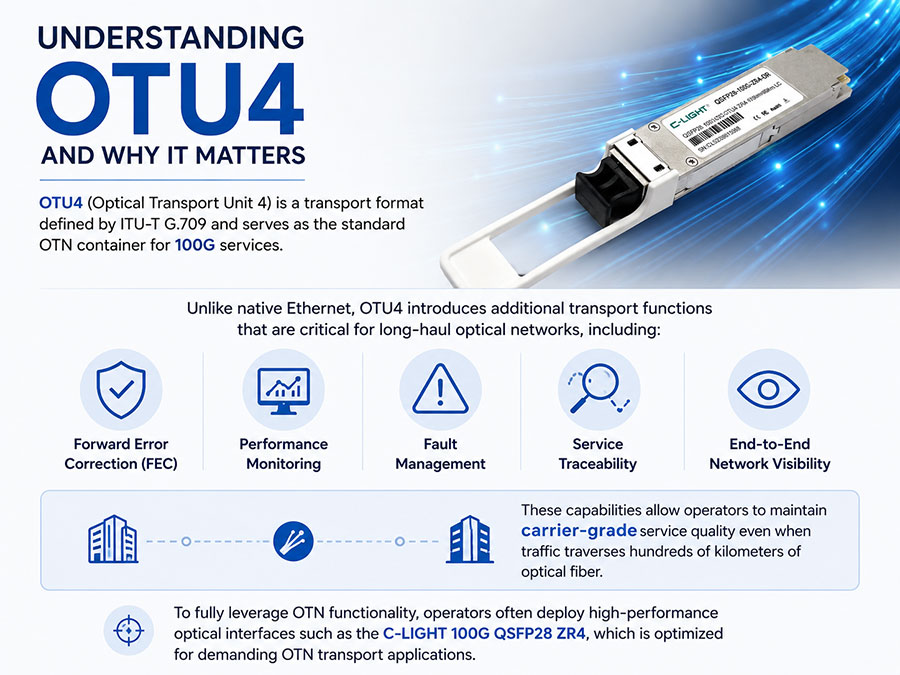
OTU4 (Optical Transport Unit 4) is a transport format defined by ITU-T G.709 and serves as the standard OTN container for 100G services.
Unlike native Ethernet, OTU4 introduces additional transport functions that are critical for long-haul optical networks, including:
Forward Error Correction (FEC)
Performance monitoring
Fault management
Service traceability
End-to-end network visibility
These capabilities allow operators to maintain carrier-grade service quality even when traffic traverses hundreds of kilometers of optical fiber.
To fully leverage OTN functionality, operators often deploy high-performance optical interfaces such as the C-LIGHT 100G QSFP28 ZR4, which is optimized for demanding OTN transport applications.
3. What Is ZR4 Technology?
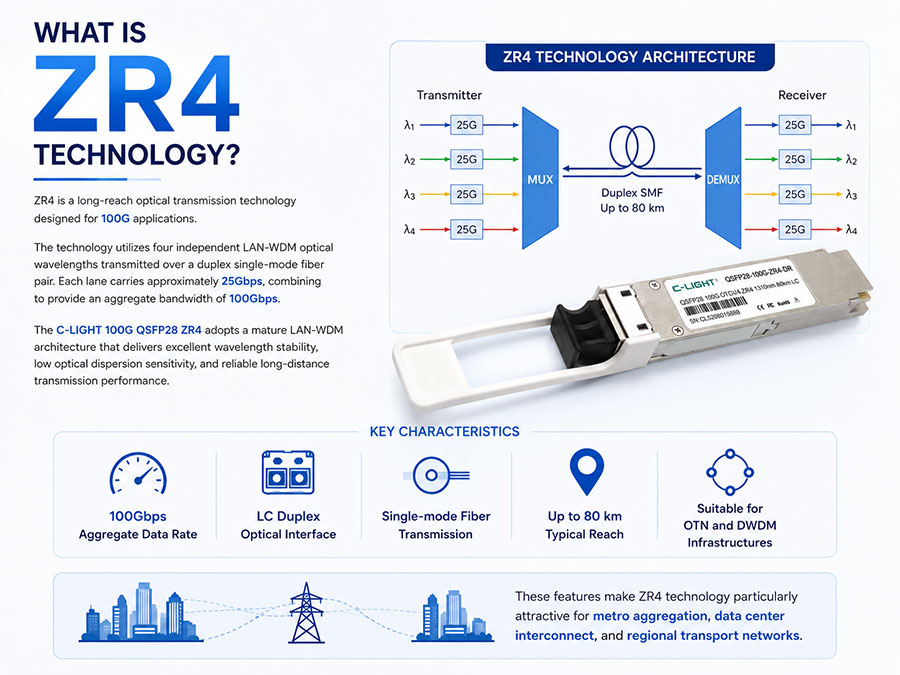
ZR4 is a long-reach optical transmission technology designed for 100G applications.
The technology utilizes four independent LAN-WDM optical wavelengths transmitted over a duplex single-mode fiber pair. Each lane carries approximately 25Gbps, combining to provide an aggregate bandwidth of 100Gbps.
The C-LIGHT 100G QSFP28 ZR4 adopts a mature LAN-WDM architecture that delivers excellent wavelength stability, low optical dispersion sensitivity, and reliable long-distance transmission performance.
Key characteristics include:
100Gbps aggregate data rate
LC duplex optical interface
Single-mode fiber transmission
Typical reach up to 80 km
Suitable for OTN and DWDM infrastructures
These features make ZR4 technology particularly attractive for metro aggregation, data center interconnect, and regional transport networks.
4. Architecture of 100G OTU4 ZR4 Optical Transceiver
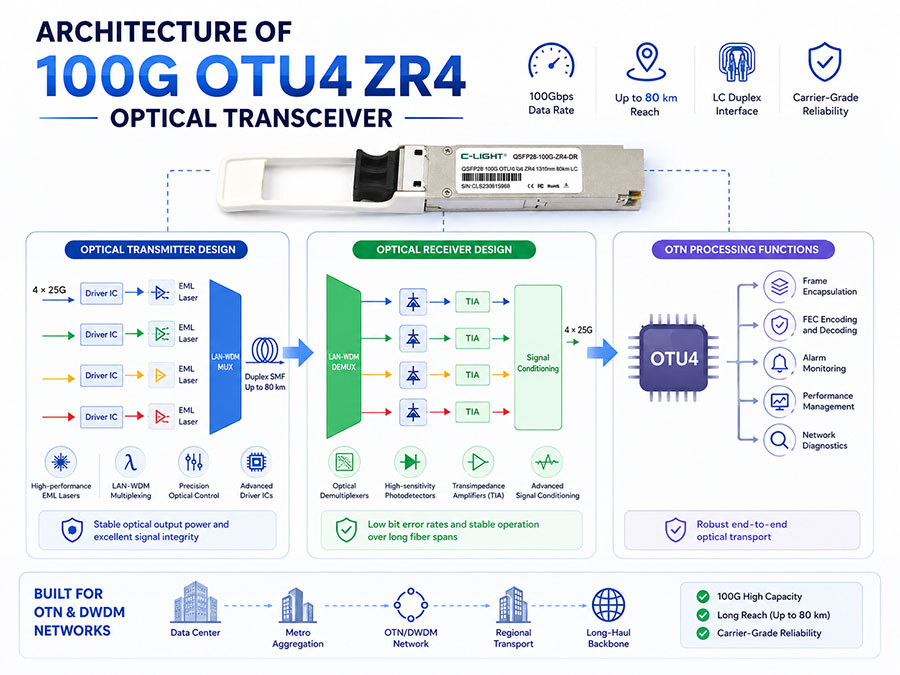
The performance of a 100G OTU4 ZR4 module depends on the integration of advanced optical and electrical components.
Optical Transmitter Design
In the C-LIGHT 100G OTU4 ZR4 Optical Transceiver, the transmitter section incorporates:
High-performance EML lasers
LAN-WDM multiplexing technology
Precision optical control circuits
Advanced driver ICs
This architecture ensures stable optical output power and excellent signal integrity throughout the transmission path.
Optical Receiver Design
On the receive side, signal quality is maintained through:
Optical demultiplexers
High-sensitivity photodetectors
Transimpedance amplifiers (TIA)
Advanced signal conditioning circuitry
The optimized receiver architecture used in C-LIGHT ZR4 solutions helps maintain low bit error rates and stable operation over long fiber spans.
OTN Processing Functions
At the transport layer, OTU4 processing provides:
Frame encapsulation
FEC encoding and decoding
Alarm monitoring
Performance management
Network diagnostics
Together, these technologies enable robust end-to-end optical transport.
5. Why OTU4 Is Preferred for Long-Haul Networks
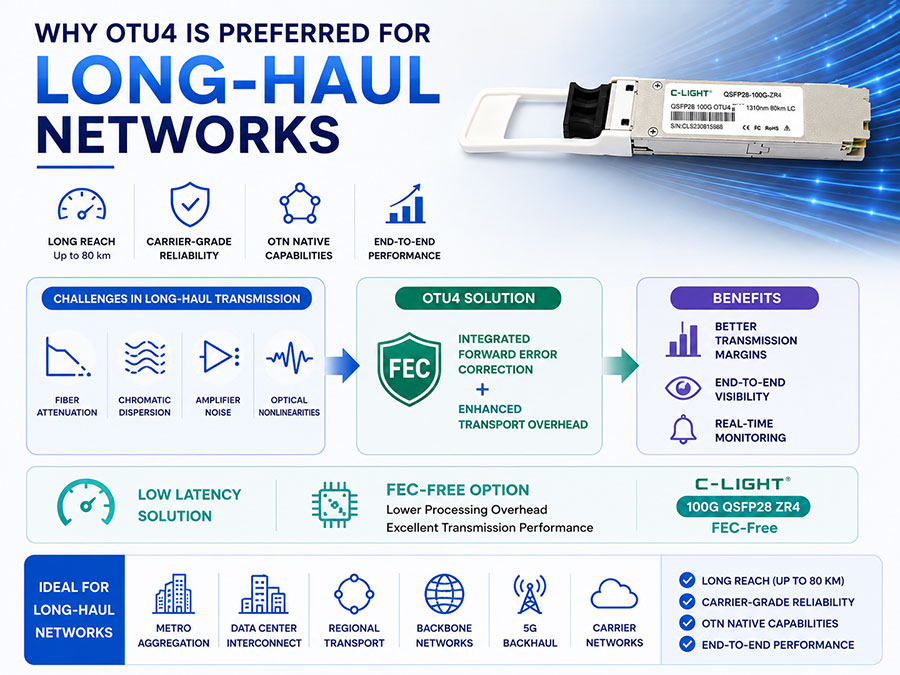
As transmission distance increases, optical signals encounter a variety of impairments that can affect service quality.
These include:
Fiber attenuation
Chromatic dispersion
Amplifier noise
Optical nonlinearities
OTU4 addresses these challenges through integrated Forward Error Correction and enhanced transport overhead.
For network operators deploying C-LIGHT 100G OTU4 ZR4 modules, OTN functionality helps improve transmission margins while providing comprehensive network monitoring capabilities.
In scenarios where network conditions are optimized and ultra-low latency is required, the C-LIGHT 100G QSFP28 ZR4 FEC-Free solution can further reduce processing overhead while maintaining excellent transmission performance.
6. Data Center Interconnect (DCI) Applications
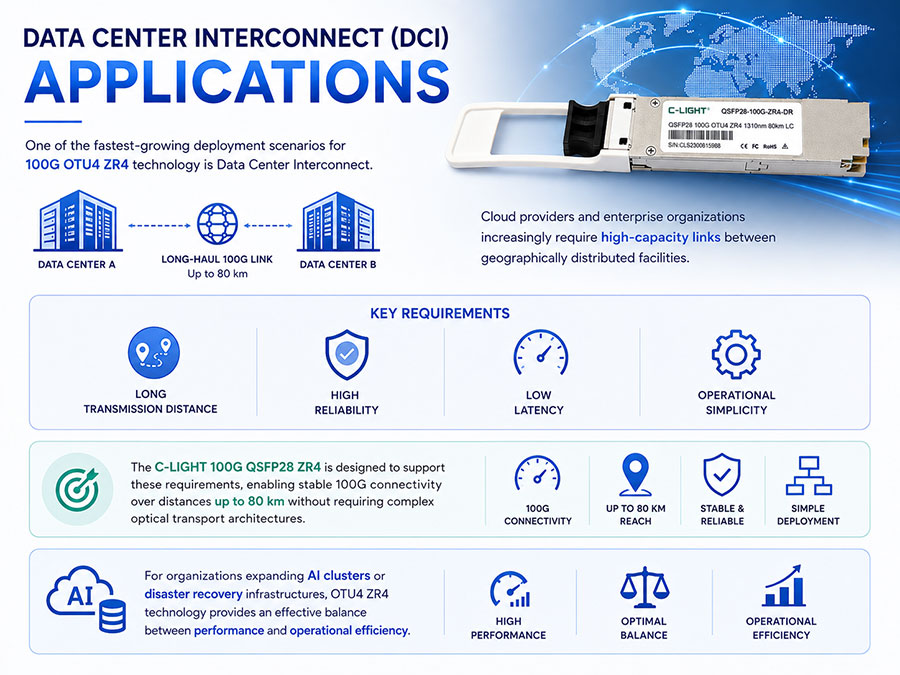
One of the fastest-growing deployment scenarios for 100G OTU4 ZR4 technology is Data Center Interconnect.
Cloud providers and enterprise organizations increasingly require high-capacity links between geographically distributed facilities.
Key requirements include:
Long transmission distance
High reliability
Low latency
Operational simplicity
The C-LIGHT 100G QSFP28 ZR4 is designed to support these requirements, enabling stable 100G connectivity over distances up to 80 km without requiring complex optical transport architectures.
For organizations expanding AI clusters or disaster recovery infrastructures, OTU4 ZR4 technology provides an effective balance between performance and operational efficiency.
7. OTN Backbone Network Deployments
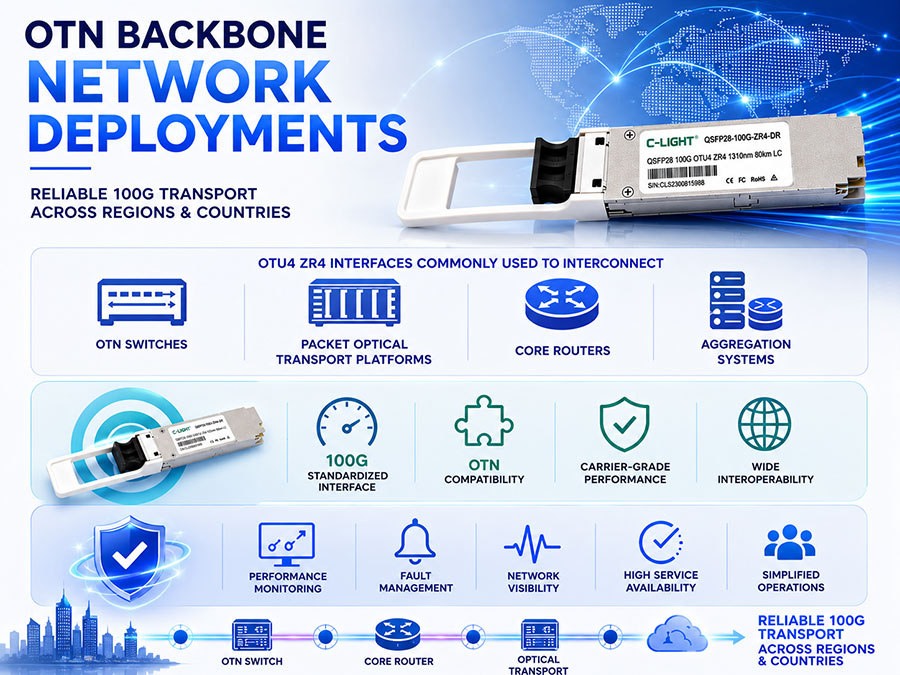
Carrier backbone networks transport enormous volumes of traffic across cities, regions, and countries.
Within these environments, OTU4 ZR4 interfaces are commonly used to interconnect:
OTN switches
Packet optical transport platforms
Core routers
Aggregation systems
The C-LIGHT 100G OTU4 ZR4 Optical Transceiver enables operators to deploy standardized 100G transport interfaces while maintaining compatibility with existing OTN infrastructures.
Its support for carrier-grade monitoring and fault management helps simplify network operations and improve service availability.
8. Metro Network Expansion and Aggregation
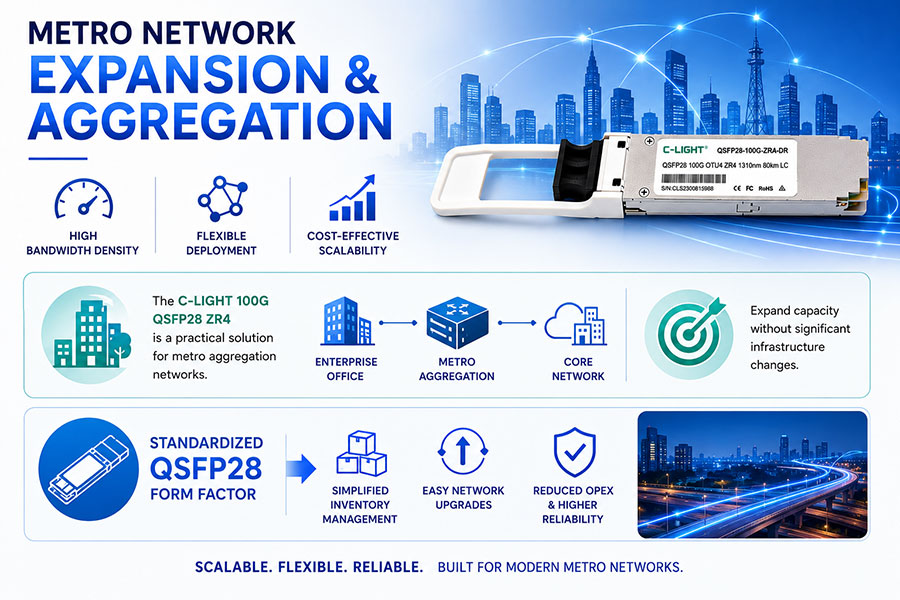
Metro networks must continuously evolve to accommodate growing traffic generated by enterprises, residential broadband users, and mobile subscribers.
In these environments, network operators require optical solutions that offer:
High bandwidth density
Flexible deployment
Cost-effective scalability
The C-LIGHT 100G QSFP28 ZR4 provides a practical solution for metro aggregation networks, allowing operators to expand capacity without significant infrastructure changes.
Its standardized QSFP28 form factor also simplifies inventory management and network upgrades.
9. DWDM Network Integration
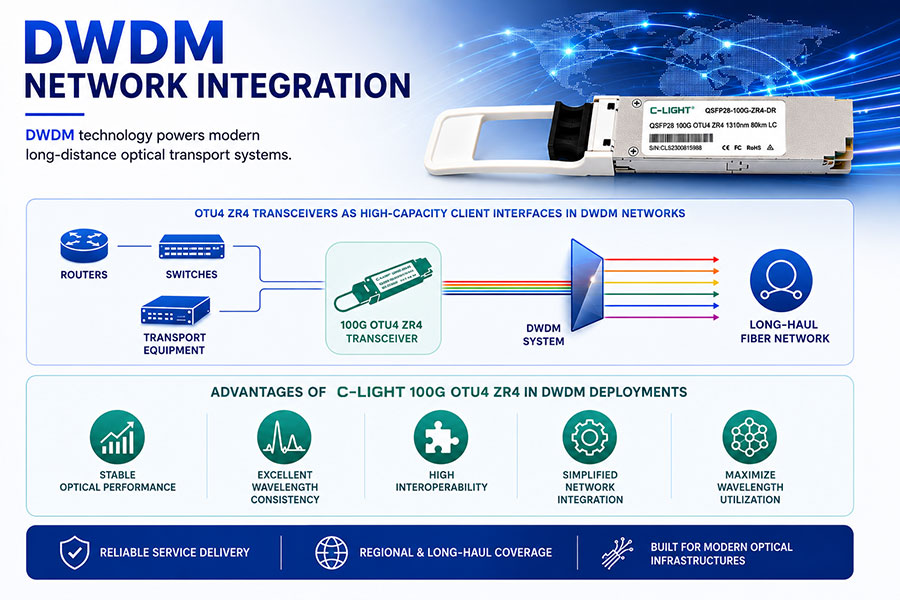
DWDM technology remains the foundation of modern long-distance optical transport systems.
When integrated into DWDM environments, OTU4 ZR4 transceivers function as high-capacity client-side interfaces connecting routers, switches, and transport equipment.
The C-LIGHT 100G OTU4 ZR4 solution offers several advantages in DWDM deployments:
Stable optical performance
Excellent wavelength consistency
High interoperability
Simplified network integration
These characteristics help operators maximize wavelength utilization while maintaining reliable service delivery across regional and long-haul optical infrastructures.
10. Key Benefits of C-LIGHT 100G OTU4 ZR4 Optical Transceivers
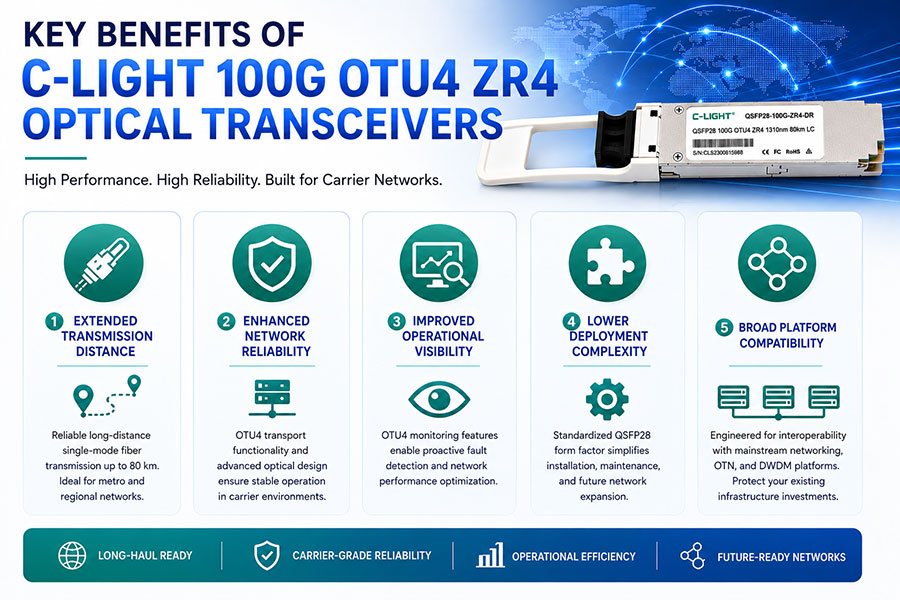
Extended Transmission Distance
Leveraging mature LAN-WDM optical technology, C-LIGHT ZR4 modules support reliable transmission over long-distance single-mode fiber links, making them ideal for metro and regional networks.
Enhanced Network Reliability
The combination of OTU4 transport functionality and advanced optical design enables stable operation in demanding carrier environments.
Improved Operational Visibility
OTU4 monitoring features allow operators to proactively identify faults and optimize network performance.
Lower Deployment Complexity
The standardized QSFP28 form factor simplifies installation, maintenance, and future network expansion.
Broad Platform Compatibility
C-LIGHT optical transceivers are engineered for interoperability with mainstream networking, OTN, and DWDM platforms, helping operators protect existing infrastructure investments.
11. Future Outlook for 100G OTU4 ZR4 Technology
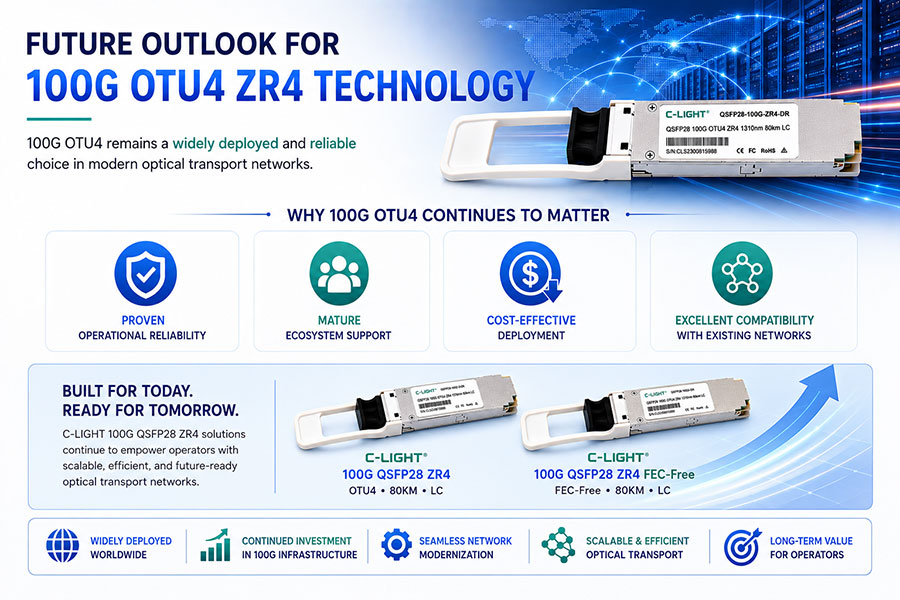
Although 400G and 800G transport technologies are rapidly gaining momentum, 100G OTU4 remains one of the most widely deployed optical transport formats worldwide.
Many service providers continue to invest in 100G infrastructure because it offers:
Proven operational reliability
Mature ecosystem support
Cost-effective deployment
Excellent compatibility with existing networks
As operators modernize their infrastructures, solutions such as the C-LIGHT 100G QSFP28 ZR4 and C-LIGHT 100G QSFP28 ZR4 FEC-Free will continue to play a vital role in supporting scalable and efficient optical transport networks.
12. Conclusion
The 100G OTU4 ZR4 Optical Transceiver combines the reliability of OTN transport with the long-distance capabilities of ZR4 optical technology, making it a key building block for modern optical communication networks.
Whether deployed in data center interconnect, metro aggregation, OTN backbone, or DWDM transport environments, the C-LIGHT 100G OTU4 ZR4 Optical Transceiver delivers the performance, stability, and operational visibility required for today's high-capacity networks.
By integrating advanced optical architecture, carrier-grade OTN functionality, and proven long-reach transmission technology, C-LIGHT helps operators build scalable, resilient, and future-ready optical transport infrastructures.
 >
>

 >
>
 >
>
 >
>
 >
>
 >
>
 >
>
 >
>