TEL:+86 132 6656 7067


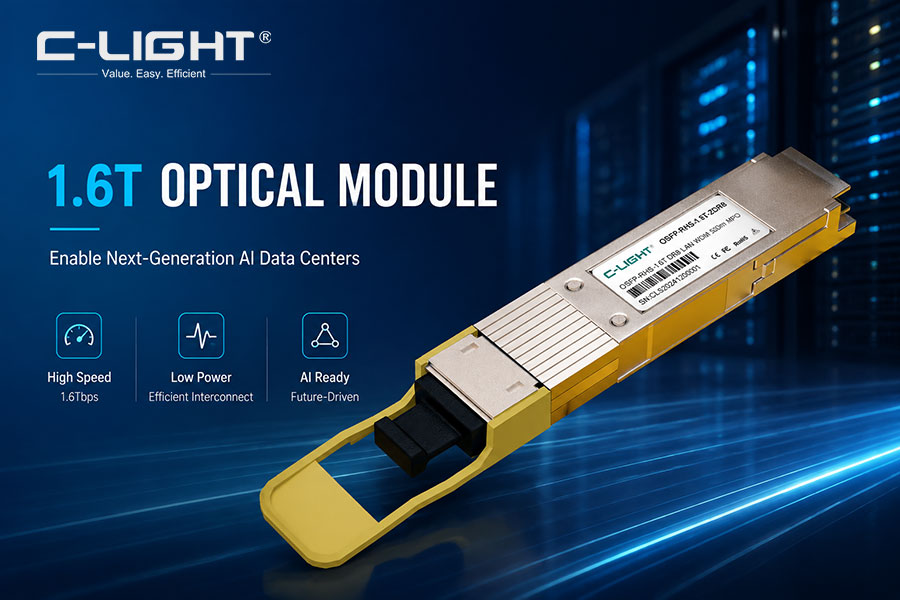
The rapid growth of AI computing, GPU clusters, and hyperscale data centers is accelerating the transition from 800G to 1.6T optical connectivity. As AI networks require higher bandwidth, lower latency, and greater port density, 1.6T optical modules are becoming an important technology for next-generation data center networks.
The transition is also moving from technology development toward commercial deployment. Industry developments in 2026 show increasing adoption of 1.6T optical DSP platforms and pluggable solutions for AI data center connectivity.
1. What Is a 1.6T Optical Module?
A 1.6T optical module is a high-speed optical transceiver designed to provide up to 1.6Tbps aggregate bandwidth.
Compared with 800G, a 1.6T module doubles the bandwidth per optical connection. This helps data centers increase network capacity without simply doubling the number of physical ports and connections.
Typical applications include:
AI data centers
GPU clusters
Hyperscale cloud networks
High-performance computing (HPC)
1.6T Ethernet
High-density switch-to-switch connections
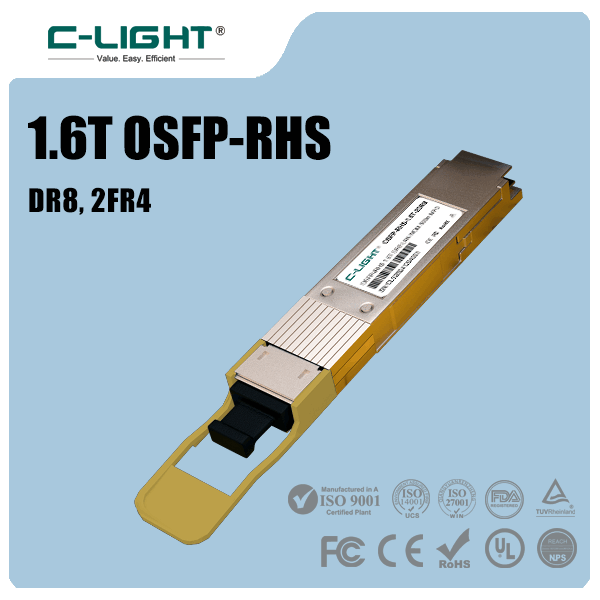
C-LIGHT's 1.6T OSFP-RHS is designed specifically for these high-density environments and supports AI clusters, hyperscale data centers, and next-generation Ethernet networks.
2. Why Is the Market Moving to 1.6T?
AI workloads are generating increasingly large amounts of network traffic. GPU-to-GPU communication, distributed AI training, model synchronization, and large-scale data transfers all require higher network bandwidth.
The evolution can be summarized as:
400G → 800G → 1.6T
800G has become an important generation for high-speed AI networking, while 1.6T provides additional bandwidth for larger GPU clusters and next-generation switch architectures.
The key drivers of the 1.6T optical module market include:
Higher GPU Density
Modern AI systems can connect large numbers of GPUs within a single computing cluster. As GPU density increases, network bandwidth must scale accordingly.
Higher Switch Capacity
Next-generation switches are moving toward higher total switching capacity. 1.6T optical interfaces help connect these switches without requiring excessive numbers of lower-speed ports.
Lower Network Port Count
A 1.6T connection can provide twice the bandwidth of an 800G connection. This can help simplify high-density network architectures and reduce the number of physical optical connections required for the same aggregate bandwidth.
Advanced Cooling Requirements
Higher-speed optical modules generate significant thermal challenges. As module power and system density increase, optical module design must work closely with the data center's cooling architecture.
3. 1.6T Optical Module Technology
One of the key technologies behind 1.6T optical modules is 200G-per-lane PAM4.
C-LIGHT's 1.6T OSFP-RHS uses an 8 × 200G PAM4 architecture, providing an aggregate data rate of 1.6Tbps. Integrated DSP and FEC technologies help maintain signal integrity and transmission reliability.
The basic architecture can be represented as:
8 × 200G = 1.6Tbps
This represents an important evolution from the 100G-per-lane architectures commonly used in earlier high-speed optical generations.
4. OSFP-RHS: Thermal Design for 1.6T
Thermal management is one of the major challenges facing 1.6T optical modules.
C-LIGHT addresses this with its OSFP-RHS (Reduced Height Sink) design. The reduced-height heatsink is designed to improve airflow compatibility and allow integration with advanced cooling architectures, including cold plates and liquid cooling systems.
This is particularly important for AI data centers, where high-density GPU systems and high-speed switches can create substantial thermal loads.
The 1.6T OSFP-RHS therefore combines:
1.6Tbps bandwidth
8 × 200G PAM4
Integrated DSP and FEC
Reduced-height heatsink
High-density OSFP packaging
AI and HPC applications
5. C-LIGHT 1.6T Optical Transceiver
1.6T OSFP-RHS DR8 2FR4 Optical Transceiver | AI Data Center
C-LIGHT has introduced its 1.6T OSFP-RHS optical transceiver as part of its next-generation data center optical portfolio. The product is designed for AI data centers, GPU clusters, HPC networks, and hyperscale cloud infrastructure.
C-LIGHT currently provides different 1.6T OSFP-RHS configurations for different data center distances.
1.6T 2DR4 — 500m
1.6T 2DR4 500m OSFP RHS Transceiver.pdf
The C-LIGHT 1.6T 2DR4 OSFP-RHS supports 1.6Tbps transmission over single-mode fiber with a reach of up to 500m.
It is designed for high-speed connections between AI server clusters and switches and uses eight 200G Ethernet channels. The product supports IEEE 802.3dj 1.6TBASE-DR8 and OSFP MSA specifications.
1.6T 2×FR4 — 2km
1.6T 2FR4 2km OSFP RHS Transceiver.pdf
C-LIGHT also provides a 1.6T 2×FR4 OSFP-RHS configuration for longer data center connections, supporting up to 2km over single-mode fiber.
This configuration uses LAN-WDM technology and a dual LC/APC interface, making it suitable for longer high-speed optical links within data center environments.
6. 800G to 1.6T Migration
The transition to 1.6T does not mean that 800G will immediately disappear.
800G remains an important building block for current AI networks, while 1.6T provides a higher-capacity path for new deployments.
C-LIGHT's portfolio covers both generations:
| Generation | C-LIGHT Solution | Typical Application |
|---|---|---|
| 400G | 400G OSFP / QSFP-DD / QSFP112 | Data center networks |
| 800G | 800G QSFP-DD / OSFP | AI clusters, HPC, cloud |
| 1.6T | 1.6T OSFP-RHS | Next-generation AI data centers |
C-LIGHT's optical transceiver portfolio currently includes 1.6T OSFP-RHS, 800G QSFP-DD, 800G OSFP, 400G OSFP, 400G QSFP112 and other high-speed products.
This allows customers to select optical modules according to their existing switch architecture, transmission distance, bandwidth requirements, and upgrade plans.
7. Market Outlook
The 1.6T optical module market is closely connected to the expansion of AI infrastructure.
As AI clusters become larger and network architectures become more bandwidth-intensive, the demand for high-speed optical interconnects is expected to continue increasing.
Several technology trends will shape the market:
200G-per-lane optical technology
1.6T Ethernet
Higher-density OSFP designs
Advanced DSP and FEC
Liquid and hybrid cooling
Silicon photonics and advanced optical engines
AI cluster interconnects
800G-to-1.6T network migration
At the same time, power consumption, thermal management, optical reach, reliability, and system compatibility will remain important considerations when deploying 1.6T modules.
8. C-LIGHT 1.6T Optical Solution
C-LIGHT is developing its high-speed optical portfolio around the evolution of AI and data center networks.
The current portfolio covers 400G, 800G and 1.6T, providing customers with optical connectivity options for different stages of network deployment. C-LIGHT also provides AOC, DAC, AEC, ACC, WDM and other fiber connectivity products to support broader data center networking requirements.
For customers moving from 800G toward 1.6T, the C-LIGHT 1.6T OSFP-RHS provides a high-bandwidth option with optimized thermal design and multiple optical configurations.
9.Conclusion
The development of AI infrastructure is pushing optical networking toward higher bandwidth and greater density. 1.6T optical modules represent the next major step after 800G, combining 200G-per-lane signaling, advanced DSP technology, and new thermal-management designs.
C-LIGHT's 1.6T OSFP-RHS DR8 and 2×FR4 solutions address different high-speed data center connectivity requirements, with configurations supporting 500m and 2km transmission.
As AI data centers continue to scale, the combination of 1.6T bandwidth, efficient thermal design, and flexible optical configurations will become increasingly important for next-generation network architectures.
1.6T Optical Module Q&A
Q1: What is a 1.6T optical module?
A: A 1.6T optical module is a next-generation high-speed optical transceiver capable of supporting up to 1.6Tbps aggregate bandwidth. It is designed for AI data centers, HPC, hyperscale networks, and next-generation Ethernet infrastructures requiring ultra-high bandwidth connectivity.
Q2: Why is 1.6T important for AI data centers?
A: AI clusters generate massive amounts of east-west traffic between GPUs, switches, and computing resources. A 1.6T optical module provides twice the aggregate bandwidth of 800G, enabling higher-density AI networks, larger GPU clusters, and more efficient data center architectures.
Q3: What technology does a 1.6T optical module use?
A: C-LIGHT's 1.6T OSFP-RHS optical module uses 8 × 200G PAM4 electrical signaling with integrated DSP and FEC technology to achieve high-speed, reliable optical transmission for advanced AI networking applications.
8 × 200G PAM4 lanes
Integrated DSP signal processing
Advanced FEC error correction technology
Designed for high-density AI data center networks
Q4: What is OSFP-RHS?
A: OSFP-RHS stands for Reduced Height Sink. It is an optimized OSFP package design that reduces heatsink height while improving thermal integration, making it suitable for high-density systems and advanced cooling architectures in next-generation AI data centers.
Reduced-height heatsink design
Improved thermal management
Optimized for high-density optical systems
Compatible with advanced cooling solutions
Q5: What 1.6T optical modules does C-LIGHT provide?
A: C-LIGHT provides advanced 1.6T OSFP-RHS DR8 and 2×FR4 optical module solutions designed for different data center transmission requirements.
1.6T OSFP-RHS DR8 optical module supporting transmission distances up to 500m
1.6T OSFP-RHS 2×FR4 optical module supporting transmission distances up to 2km
Designed for AI clusters, HPC systems, and hyperscale data centers
Q6: What is the difference between 800G and 1.6T optical modules?
A: An 800G optical module provides up to 800Gbps aggregate bandwidth, while a 1.6T optical module doubles the capacity to 1.6Tbps. The 1.6T generation is designed to meet the rapidly increasing bandwidth requirements of AI computing, GPU clusters, and next-generation data center networks.
800G: Up to 800Gbps bandwidth
1.6T: Up to 1.6Tbps bandwidth
1.6T provides higher port density and network scalability
Q7: Can 1.6T modules be used in AI clusters?
A: Yes. 1.6T optical modules are designed for high-bandwidth AI cluster interconnects, GPU networking, HPC systems, and hyperscale data centers. C-LIGHT's 1.6T OSFP-RHS solutions are optimized for next-generation AI networking environments requiring high throughput and efficient thermal management.
Q8: How does C-LIGHT support the transition from 800G to 1.6T?
A: C-LIGHT provides a complete high-speed optical portfolio covering 400G, 800G, and 1.6T solutions, helping customers upgrade their network infrastructure according to current requirements and future scalability needs.
400G optical transceiver solutions
800G QSFP-DD and OSFP solutions
1.6T OSFP-RHS next-generation optical modules
Solutions for AI data centers and hyperscale networks
 >
>

 >
>
 >
>
 >
>
 >
>
 >
>
 >
>
 >
>