TEL:+86 132 6656 7067


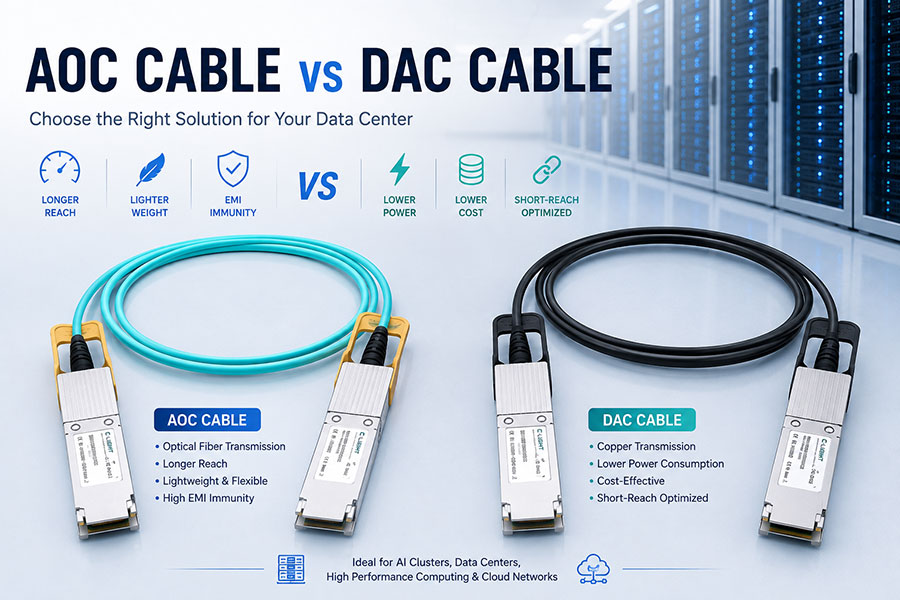
Active Optical Cables (AOC) and Direct Attach Copper (DAC) cables are widely used for high-speed data center connectivity. Both solutions integrate transceiver interfaces with a cable assembly, providing a simple way to connect switches, servers, GPUs, NICs, and other networking equipment.
The main difference is the transmission medium. DAC uses copper conductors to carry electrical signals, while AOC converts electrical signals into optical signals for transmission through optical fiber. This difference affects transmission distance, power consumption, cable weight, electromagnetic interference, cost, and deployment flexibility.
1. What Is a DAC Cable?
800G/400G/200G/100G/50G/40G/25G/10G DAC Cable丨C-LIGHT
A Direct Attach Copper (DAC) cable is a high-speed cable assembly that uses copper conductors for electrical signal transmission. The transceiver interfaces are integrated directly into the cable ends, eliminating the need for separate optical transceivers and fiber patch cables.
DAC cables are commonly used for short-distance connections inside data centers. They are particularly suitable for switch-to-server, switch-to-NIC, and rack-level connections where the transmission distance is relatively short.
Passive DAC cables do not require active signal processing inside the cable assembly. Active DAC versions can include electronic components to improve signal performance and extend the practical reach compared with passive designs.
2. What Is an AOC Cable?
800G/400G/200G/100G/50G/40G/25G/10G AOC丨C-LIGH
An Active Optical Cable (AOC) combines optical transceiver technology with a fiber cable assembly. Electrical signals are converted into optical signals at one end of the cable and converted back into electrical signals at the other end.
Because AOC uses optical fiber rather than copper as the transmission medium, it can support longer connections while maintaining relatively low cable weight and strong resistance to electromagnetic interference.
AOC cables are commonly used in data centers, high-performance computing environments, storage networks, and high-speed server interconnects where longer reach or improved cable flexibility is required.
3. AOC Cable vs DAC Cable
| Feature | AOC Cable | DAC Cable |
|---|---|---|
| Transmission Medium | Optical fiber | Copper |
| Signal Type | Optical transmission | Electrical transmission |
| Typical Reach | Longer than DAC for comparable high-speed applications | Primarily short-reach connections |
| Power Consumption | Higher than passive DAC in many applications | Very low for passive DAC |
| Cable Weight | Generally lighter | Generally heavier, especially at longer lengths |
| EMI Resistance | High | More susceptible to electromagnetic interference |
| Flexibility | Suitable for higher-density cabling | Less flexible as cable length and gauge increase |
| Cost | Generally higher | Generally lower for short connections |
| Best Use | Longer high-speed data center connections | Short rack-level connections |
4. Transmission Distance
Transmission distance is one of the most important factors when selecting between AOC and DAC.
DAC is optimized for short connections. Its practical reach depends on the data rate, cable construction, passive or active design, and the electrical characteristics of the host equipment. As signaling speeds increase, maintaining signal integrity over copper becomes increasingly challenging.
AOC uses optical fiber and therefore provides greater flexibility for longer high-speed connections. It is particularly useful when the required cable length exceeds the practical range of a copper solution.
For very short connections within the same rack, DAC can be an efficient and economical choice. For longer connections between racks or across larger equipment layouts, AOC can provide a more practical solution.
5. Power Consumption
Power consumption is another important difference between AOC and DAC.
Passive DAC has very low power consumption because it primarily provides a direct electrical connection without optical conversion. This makes passive DAC attractive for short connections where minimizing power is a priority.
AOC requires electrical-to-optical and optical-to-electrical conversion at the cable ends. As a result, AOC generally consumes more power than passive DAC, although the actual power level depends on the data rate, architecture, and implementation.
In large-scale AI and data center deployments, the power consumption of individual cables becomes more important as the number of high-speed links increases. Therefore, the balance between cable reach and power consumption should be evaluated at the system level.
6. Cable Weight and Installation
Copper cables become relatively thick and heavy as bandwidth and transmission distance increase. A large number of high-speed copper cables can therefore create challenges for cable management, airflow, and equipment installation.
AOC uses optical fiber, which allows the cable assembly to remain relatively lightweight and flexible. This can be beneficial in high-density racks where hundreds or thousands of high-speed connections may be installed.
Better cable management can also help improve airflow around networking equipment and simplify maintenance in dense data center environments.
7. Electromagnetic Interference
DAC transmits electrical signals through copper conductors, making the cable more sensitive to electromagnetic interference and electrical noise than an optical connection.
AOC uses optical fiber for the transmission path. Optical fiber does not carry the high-speed data signal as an electrical current through the cable, providing strong immunity to electromagnetic interference.
This characteristic makes AOC useful in environments where electromagnetic compatibility and signal isolation are important considerations.
8. AOC vs DAC for 400G Networks
400G networking has become an important bandwidth level for modern data centers, AI infrastructure, cloud computing, and high-performance networking.
400G DAC solutions can be attractive for short-reach connections because of their low cost and low power consumption. They are especially suitable when the switch and server or accelerator are located within a relatively short distance.
400G AOC provides greater flexibility when the connection requires longer reach, lower cable weight, or improved electromagnetic immunity. It can be useful for connections where passive copper is no longer the most practical option.
9. AOC vs DAC for 800G Networks
800G networking introduces more demanding requirements for electrical signaling, power efficiency, thermal management, and cable density.
800G DAC can still be valuable for short-reach applications, particularly inside high-density racks. However, the physical size and weight of high-speed copper assemblies can become increasingly important as cable counts increase.
800G AOC can provide an optical alternative for applications requiring greater reach and improved cabling flexibility. Its lower cable weight and optical transmission characteristics can be valuable in large AI clusters and high-performance data center networks.
10. AOC vs DAC in AI Data Centers
AI data centers can contain large numbers of GPUs, accelerators, switches, and NICs connected through high-bandwidth network fabrics. The resulting cable density makes transmission distance, power, weight, and cable management important design considerations.
DAC is well suited to short-distance connections where low cost and low power are the primary priorities. AOC becomes more attractive when connections are longer or when cable weight, flexibility, and electromagnetic immunity become more important.
For AI clusters, there is no single cable technology that fits every connection. DAC and AOC can coexist within the same infrastructure, with each being selected according to the distance and physical requirements of the specific link.
11. AOC vs DAC: Cost Considerations
DAC generally has a cost advantage for short connections because its construction is relatively simple and it does not require optical conversion.
AOC integrates optical components and fiber transmission technology, so its cost is generally higher than a comparable passive DAC. However, the initial cable price should not be the only consideration.
For high-density deployments, cable management, rack space, installation complexity, airflow, power consumption, and required transmission distance can also affect the overall infrastructure cost.
12. AOC vs DAC: Signal Integrity
Signal integrity becomes increasingly important as network speeds move from 400G toward 800G and 1.6T.
DAC relies on electrical transmission, so insertion loss, return loss, crosstalk, connector quality, PCB design, and cable characteristics can affect the overall link performance.
AOC converts the signal to optical form for transmission through the fiber. This avoids the same type of long electrical transmission path and can provide advantages for longer connections.
However, AOC also contains active optical components that require proper design, testing, thermal management, and compatibility validation. Both solutions therefore require careful system-level testing before deployment.
13. When to Choose DAC Cable
DAC is generally a good choice when the connection is short and cost and power efficiency are important.
Short-distance connections: Suitable for connections within the same rack or between closely positioned devices.
Low power requirements: Passive DAC provides very low power consumption.
Cost-sensitive deployments: DAC is generally economical for short high-speed links.
High-density server connections: Useful for direct switch-to-server or switch-to-NIC connectivity.
Simple deployment: Integrated connectors reduce the need for separate optical transceivers and patch cables.
14. When to Choose AOC Cable
AOC is generally more suitable when the connection requires greater reach, lower cable weight, or strong electromagnetic immunity.
Longer high-speed links: AOC can provide greater reach than typical passive DAC solutions.
High cable density: Lightweight optical cables can simplify cable management.
EMI-sensitive environments: Optical transmission provides strong electromagnetic immunity.
AI and HPC networks: Suitable for high-bandwidth interconnects where longer reach and cable density are important.
400G and 800G connectivity: AOC can be considered for high-speed connections where copper becomes less practical.
15. AOC vs DAC vs Optical Transceiver
AOC and DAC should also be distinguished from conventional pluggable optical transceivers.
A DAC is an integrated copper cable assembly, while an AOC is an integrated optical cable assembly. A conventional optical transceiver is a separate pluggable module that connects to a fiber optic cable through a connector such as LC or MPO.
| Solution | Medium | Typical Advantage | Typical Application |
|---|---|---|---|
| DAC | Copper | Low cost and low power | Short-reach rack connections |
| AOC | Optical fiber | Longer reach and lower cable weight | High-speed data center connections |
| Pluggable Optical Transceiver | Optical fiber | Flexible reach and cable selection | Data center and telecom networks |
16. AOC and DAC in Next-Generation Data Centers
The evolution toward 800G and 1.6T connectivity is increasing the importance of efficient physical interconnects. Network designers must consider not only bandwidth but also power, thermal performance, cable density, signal integrity, and installation requirements.
DAC remains valuable for short and cost-sensitive connections. AOC provides an optical alternative when longer reach, lighter cabling, and electromagnetic immunity are required.
As AI clusters continue to increase in scale, data center networks are likely to use a combination of DAC, AOC, optical transceivers, and other interconnect technologies rather than relying on a single solution.
17. Frequently Asked Questions
Q1: What is the main difference between AOC and DAC cables?
Answer: DAC uses copper for electrical signal transmission, while AOC uses optical fiber and active optical conversion. This creates differences in reach, power consumption, cable weight, EMI performance, and cost.
Q2: Is DAC cheaper than AOC?
Answer: In most short-reach applications, DAC is generally less expensive than AOC, particularly when passive DAC is sufficient. The overall cost should also consider installation, cable management, power, and required reach.
Q3: Which has lower power consumption, AOC or DAC?
Answer: Passive DAC generally has lower power consumption because it does not require optical conversion. AOC contains active optical components and therefore normally consumes more power than passive DAC.
Q4: Is AOC better than DAC for long-distance connections?
Answer: AOC is generally more suitable when a high-speed connection requires greater reach than a typical passive DAC can practically provide. The exact supported distance depends on the specific AOC design and data rate.
Q5: Is DAC suitable for 800G networks?
Answer: Yes. 800G DAC can be used for suitable short-reach applications. The choice depends on the required distance, cable density, electrical channel performance, power budget, and system architecture.
Q6: Is AOC suitable for AI data centers?
Answer: Yes. AOC can be useful in AI data centers where high bandwidth, longer reach, low cable weight, and electromagnetic immunity are important. It can complement DAC and pluggable optical transceivers within the same infrastructure.
Q7: Which cable is better for high-density data centers?
Answer: The answer depends on the connection distance and system requirements. DAC is attractive for short connections because of its low cost and low power, while AOC can provide advantages in longer or highly dense cabling environments because optical cables are generally lighter and more flexible.
Q8: Can AOC and DAC be used in the same data center?
Answer: Yes. AOC and DAC are complementary technologies. DAC can be used for short rack-level connections, while AOC can be selected for connections requiring greater reach or different physical cabling characteristics.
Summary
AOC and DAC cables provide different approaches to high-speed data center connectivity. DAC uses copper and is particularly attractive for short connections because of its low cost and low power consumption. AOC uses optical fiber and provides advantages in longer high-speed connections, cable weight, flexibility, and electromagnetic immunity.
For 400G and 800G networks, the choice between AOC and DAC should be based on transmission distance, power consumption, cable density, signal integrity, cost, and deployment environment. In next-generation AI data centers, both technologies can coexist with pluggable optical transceivers to build efficient and scalable high-speed interconnect infrastructure.
 >
>

 >
>
 >
>
 >
>
 >
>
 >
>
 >
>
 >
>