TEL:+86 132 6656 7067


SFP is short for Small Form-factor Pluggables, which is a small package pluggable optical transceiver module. SFP can be regarded as a pluggable version of SFF. Its electrical interface is 20pin gold finger, and the data signal interface is basically the same as the SFF module. The SFP module also provides an I2C control interface that is compatible with the optical interface diagnostics of the SFP-8472 standard.C-Light takes you familiar with SFP modules and hopes to help you.
Components of an SFP module
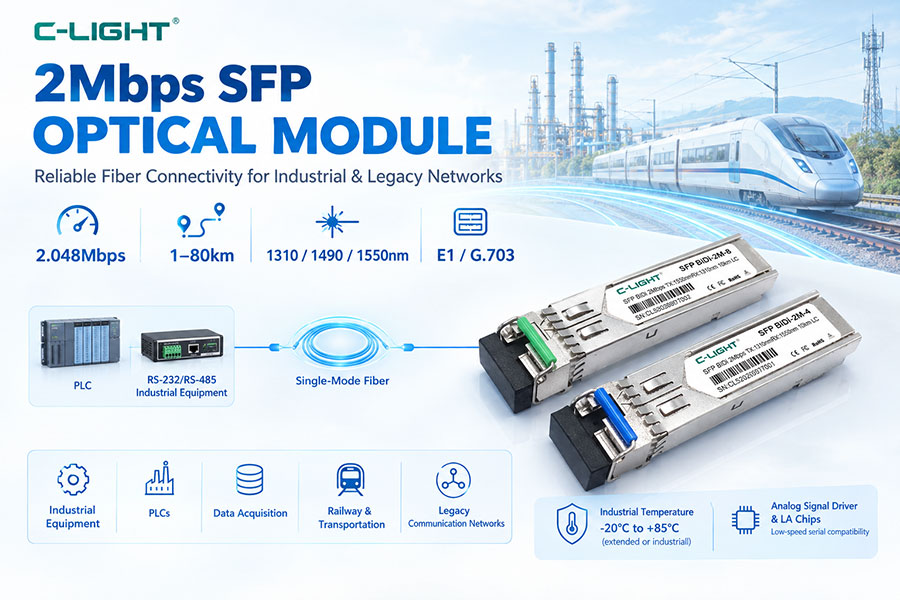
SFP modules consist of: laser: including transmitter TOSA and receiver ROSA ,circuit board IC, and the external parts include: shell, base, PCBA, pull ring, clasp, unlocking piece, rubber plug.In addition, for the convenience of identification, the color of the ring is generally used to identify the module's parameter types. For example, the black pull ring is multimode, the wavelength is 850 nm; the blue is the module with the wavelength of 1310 nm; the yellow is the module with the wavelength of 1550 nm; the purple is the module with the wavelength of 1490 nm.

Interface indicators of the SFP modul
●Output optical power refers to the output optical power of the light source at the transmitting end of the module.
●Received optical power refers to the received optical power at the receiving end of the module.
●Receive sensitivity refers to the minimum received optical power of SFP module at a certain rate and bit error rate. Under normal conditions, the higher the rate, the worse the receiving sensitivity.The larger the minimum received optical power, the higher the requirement for the receiving device of the optical module.
●Saturated optical power, also known as light saturation, refers to the maximum input optical power at a certain transmission rate while maintaining a certain bit error rate (10-10~10-12).

It should be noted that the photodetector will have photocurrent saturation under strong light. When this phenomenon occurs, the detector needs a certain time to recover. At this time, the receiving sensitivity decreases, and the received signal may be misjudged. It causes bit error, and it is very easy to damage the receiver detector. It should be prevented from exceeding its saturated optical power during operation.
Note that for a long-distance optical transceiver, since the average output optical power is generally greater than its saturated optical power, please pay attention to the length of the optical fiber when using the device to ensure that the received optical power is less than the saturated optical power. Otherwise, it may cause damage to the SFP module.
C-Light is an industry-leading manufacturer of optical transceiver modules that combines R&D, production, sales and service. The company's business areas range from optical devices and modular products to subsystem development, production and sales. The company currently has 155M-100G optical transceiver modules, high-speed interconnect products 40G QSFP+ AOC/DAC Cable, 10G SFP+ AOC/DAC Cable, and provides the best optical communication module solutions for customers in the fields of cloud computing and big data centers, data communications, storage networks, long-distance transmission, and wireless access.
SFP Optical Module FAQ
Q1: What is an SFP optical module?
Answer: SFP (Small Form-factor Pluggable) is a compact, hot-pluggable optical transceiver module designed for high-speed data communication over fiber optic networks.
An SFP module converts electrical signals from networking equipment into optical signals and converts received optical signals back into electrical data.
SFP modules are widely used in:
Ethernet switches
Routers
Network servers
Fiber access equipment
Enterprise networks
Data centers
The compact design allows network operators to easily upgrade and maintain fiber connectivity without replacing entire network devices.
Q2: How does an SFP optical module work?
Answer: An SFP module works by converting electrical signals into optical signals for fiber transmission and converting optical signals back into electrical signals at the receiving end.
The basic working process includes:
Network equipment sends electrical data signals to the SFP module.
The transmitter converts electrical signals into optical signals through a laser.
Optical signals travel through fiber cables.
The receiver detects optical signals and converts them back into electrical signals.
This process enables high-speed communication between different network devices through optical fiber.
Q3: What are the main components of an SFP module?
Answer: An SFP optical module consists of several key components that work together to achieve reliable optical communication.
The main components include:
Optical Components
TOSA (Transmitter Optical Sub-Assembly)
ROSA (Receiver Optical Sub-Assembly)
Laser diode
Photodetector
Electronic Components
PCBA circuit board
Driver IC
Control circuits
Monitoring interface
Mechanical Components
Metal housing
Pull ring
Latch mechanism
Optical connector interface
These components enable signal conversion, monitoring, protection, and mechanical compatibility with networking equipment.
Q4: What is the difference between SFP and SFP+ modules?
Answer: The main difference between SFP and SFP+ modules is transmission speed and application requirements.
| Feature | SFP | SFP+ |
| Data Rate | Up to 1.25Gbps | Up to 10Gbps |
| Application | Gigabit Ethernet | 10 Gigabit Ethernet |
| Power Consumption | Lower | Higher |
| Network Usage | Access networks | Data centers and high-speed networks |
SFP modules are commonly used for Gigabit Ethernet applications, while SFP+ modules are designed for higher-speed 10G networking environments.
The choice depends on required bandwidth, network equipment compatibility, and application scenarios.
Q5: What are the common applications of SFP optical modules?
Answer: SFP modules are widely deployed across different networking environments because of their flexibility and compact design.
Common applications include:
Enterprise Networks
Switch-to-switch connections
Campus networks
Office fiber networks
Data Centers
Server uplinks
Network aggregation
Storage networking
Telecom Networks
Fiber access networks
Metro networks
Communication infrastructure
SFP modules provide a reliable and flexible solution for extending network connectivity through fiber optic communication.
 >
>

 >
>
 >
>
 >
>
 >
>
 >
>
 >
>
 >
>