TEL:+86 132 6656 7067


Disaggregated computing changes the traditional server architecture by separating compute, memory, storage and accelerator resources into independently managed pools. Instead of permanently assigning every resource to a specific server, infrastructure operators can allocate capacity according to workload requirements. This approach can improve resource utilization, simplify capacity expansion and support more flexible AI and high-performance computing deployments.
The architecture also changes the role of the interconnect. Memory access, accelerator communication and resource sharing increasingly depend on connections that extend beyond conventional motherboard and server boundaries. Electrical interfaces remain essential for short-distance, protocol-sensitive communication, while optical interconnects offer a path toward higher bandwidth density, longer reach and more flexible connectivity across racks and equipment zones.
1. Disaggregated Computing and the Shift Away from Fixed Server Resources
Conventional servers combine CPUs, DRAM, accelerators, storage interfaces and network adapters within a fixed hardware configuration. Resource allocation is therefore constrained by the installed components and the physical capacity of each machine. A server with insufficient memory may require additional hardware even when nearby systems have unused memory capacity.
Disaggregated computing separates selected resources from their original server boundaries. Compute nodes can access shared or independently allocated resource pools through a high-speed interconnect fabric. The system can then assign resources according to workload demand rather than relying exclusively on fixed server configurations.
Memory disaggregation is particularly relevant to workloads with uneven memory requirements. AI inference, large databases, virtualization, analytics and in-memory computing can have different capacity and bandwidth profiles. Separating memory resources from compute nodes creates opportunities to allocate capacity more dynamically.
| Architecture | Resource Organization | Scaling Method | Interconnect Requirement |
|---|---|---|---|
| Traditional Server | Compute and memory are installed within individual servers | Upgrade or replace complete server configurations | Internal electrical interfaces and Ethernet connectivity |
| Memory Expansion | Additional memory is accessed through a dedicated expansion interface | Increase memory capacity beyond local DIMM configuration | High-bandwidth, low-latency memory interface |
| Memory Pooling | Multiple hosts access a shared or partitioned memory resource pool | Allocate memory capacity among compatible compute nodes | Fabric connectivity with memory access and coherence support |
| Full Resource Disaggregation | Compute, memory, accelerators and storage operate as separate resource domains | Scale resource categories independently | Multi-protocol fabric with high bandwidth and flexible topology |
Disaggregation does not mean that every component must be connected through an optical link. The architecture can combine electrical interfaces inside servers, high-speed electrical connections within racks and optical links between larger resource domains.
2. Why Optical Interconnects Matter for Disaggregated Systems
As resource pools become larger and more geographically distributed, electrical interconnects face increasing challenges involving channel loss, signal integrity, power consumption and physical reach. High-speed electrical signals are affected by conductor resistance, dielectric loss, reflections, crosstalk and connector discontinuities. Maintaining signal quality at higher data rates can require additional equalization, retiming and more complex board or cable design.
Optical transmission converts electrical data into light for transport through fiber. Fiber offers low transmission loss over distance, immunity to electromagnetic interference and high aggregate bandwidth through wavelength or spatial multiplexing. These characteristics make optical links attractive for rack-to-rack, row-to-row and larger system-level connections.
Several system-level characteristics make optical connectivity relevant:
Bandwidth density: Multiple optical lanes or wavelengths can carry high aggregate data rates through compact fiber infrastructure.
Reach flexibility: Optical links can connect equipment across distances that are difficult to support with conventional high-speed electrical channels.
Electrical isolation: Fiber eliminates conductive signal paths between connected equipment.
EMI immunity: Optical transmission is not directly affected by electromagnetic interference along the fiber path.
Topology flexibility: Optical switching and wavelength routing can support configurable connections between resource domains.
Design distinction: Optical transmission improves the physical transport layer, but it does not automatically provide memory semantics, cache coherency or resource allocation. Those functions remain dependent on the system protocol, fabric architecture and software control plane.
3. CXL and the Role of Memory Disaggregation
Compute Express Link (CXL) is an important technology for memory expansion, memory pooling and heterogeneous computing. Built on PCI Express physical and electrical foundations, CXL supports protocols for communication between hosts and compatible devices. Its architecture includes CXL.io, CXL.cache and CXL.mem, which serve different roles in device access, cache coherency and memory transactions.
CXL enables a host to access memory resources beyond its directly attached DRAM configuration, provided the platform, device and fabric support the required operating mode. CXL switching and fabric management can support more flexible resource allocation in compatible system architectures.
However, standard CXL connectivity should not be confused with a generic optical Ethernet link. A conventional Ethernet transceiver does not independently transport CXL.mem transactions or preserve CXL cache-coherence behavior. Optical extension requires a compatible system architecture, protocol-aware conversion or an optical physical-layer implementation designed for the relevant interface.
| CXL Component | Primary Function | Relevance to Disaggregation |
|---|---|---|
| CXL.io | Device discovery, configuration and I/O transactions | Supports device management and connectivity |
| CXL.cache | Enables device access to host memory with defined coherency mechanisms | Supports coherent device and accelerator architectures |
| CXL.mem | Enables host access to device-attached memory | Supports memory expansion and pooling architectures |
| CXL Switch / Fabric | Connects compatible hosts and devices through a managed fabric | Enables flexible resource attachment and sharing |
For optical system designers, the important question is where the optical conversion occurs and which protocol layers remain intact across the link. A solution that transports Ethernet packets between two locations is not automatically equivalent to a transparent CXL extension.
4. Optical Connectivity at Different Disaggregation Levels
Optical links can be introduced at several points in a disaggregated infrastructure. The appropriate implementation depends on the required reach, bandwidth, latency, protocol and physical integration constraints.
Board-level and package-level connectivity: Short electrical connections remain common between processors, memory controllers and nearby components. Optical technologies such as co-packaged optics and silicon photonics are being developed to address bandwidth density and energy challenges at increasingly compact integration levels.
Rack-level connectivity: Optical links can connect compute trays, memory shelves, accelerator systems and top-of-rack switching equipment. This approach provides more flexibility when resource domains are not installed in the same chassis.
Row-level connectivity: Fiber infrastructure can connect multiple racks and resource groups across a data-center row. Higher-speed transceivers and structured fiber systems support dense connections between switching and compute domains.
Data-center-level connectivity: When resource pools are distributed across separate halls or facilities, optical Ethernet and DCI technologies provide the transport capacity required for inter-site communication. At these distances, wavelength multiplexing and coherent transmission may become relevant.
| Connectivity Level | Typical Interface Approach | Primary Engineering Focus |
|---|---|---|
| Package / Board | Electrical links, advanced packaging and emerging photonic integration | Signal integrity, energy per bit and integration density |
| Rack | High-speed electrical cables and pluggable optical transceivers | Reach, port density, thermal design and serviceability |
| Row | 400G, 800G and next-generation optical Ethernet | Fiber management, aggregate bandwidth and link availability |
| Facility / Campus | Single-mode optical links and optical switching | Path diversity, optical budget and network topology |
| Metro / Regional | Coherent optics and DWDM transport | OSNR, wavelength management, latency and amplification |
5. Optical Switching and Dynamic Resource Connectivity
Disaggregated infrastructure benefits from the ability to assign resources dynamically. If compute nodes, memory shelves and accelerators are separated into independent domains, the network must provide connectivity that can adapt to changing resource requirements.
Optical switching offers a way to establish or reconfigure physical light paths between endpoints. Optical circuit switches can connect selected ports without requiring every data stream to undergo optical-to-electrical conversion at each switching stage. Wavelength-selective switching can also route different optical channels through a shared fiber infrastructure.
These approaches can be useful when traffic patterns are predictable or when large bandwidth demands justify dedicated optical paths. For example, a system may establish a high-capacity connection between a compute group and a memory resource pool for a particular allocation period, then reconfigure the connection when the workload changes.
Optical circuit switching also introduces trade-offs. Circuit setup time, topology reconfiguration, path contention, control-plane coordination and the need for buffering or packet switching must be considered. Optical circuit switching is not a direct substitute for every function of an electronic packet switch.
A practical architecture may therefore combine:
Electrical packet switches for fine-grained, dynamic packet forwarding.
Optical circuit switches for configurable high-capacity connections.
DWDM systems for wavelength aggregation over shared fiber infrastructure.
Software-defined control for resource allocation and topology coordination.
6. Silicon Photonics and Co-Packaged Optics
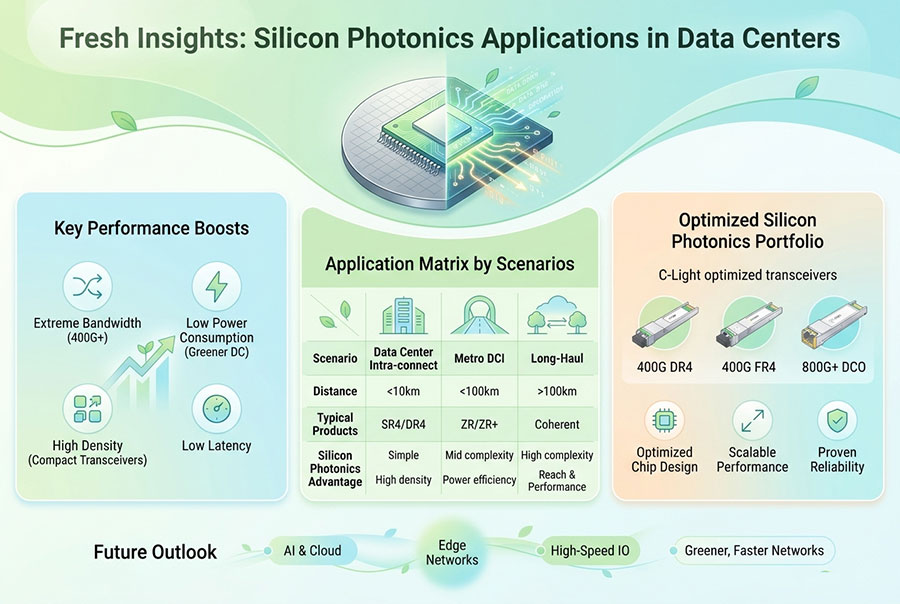
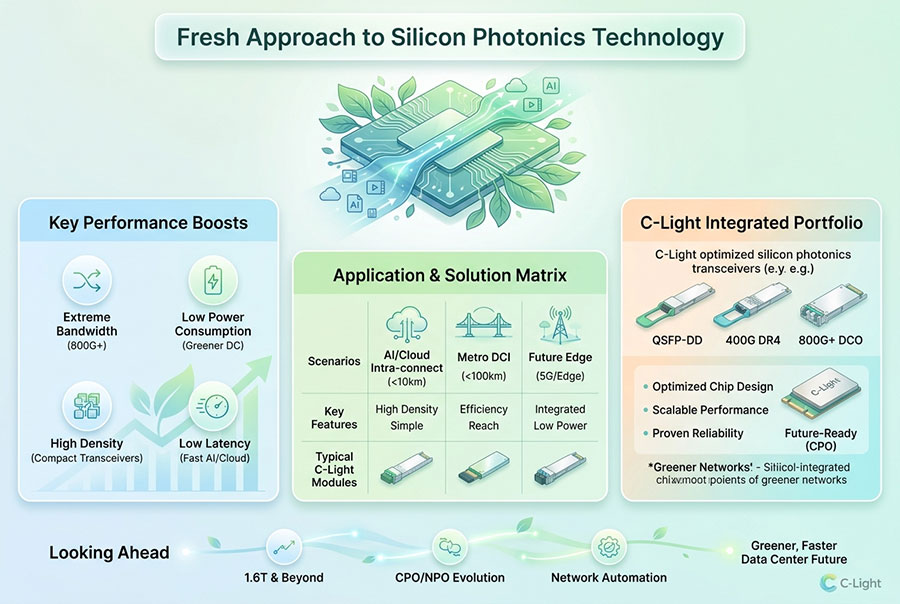
Silicon photonics integrates optical components and functions onto photonic integrated circuits. By combining optical waveguides, modulators, detectors and other photonic structures on a compact platform, silicon photonics can reduce the need for large collections of discrete optical components.
Co-packaged optics (CPO) places optical engines close to switching or computing ASICs within a shared package or closely integrated assembly. The objective is to reduce the length of high-speed electrical connections between the ASIC and optical conversion components. Shorter electrical paths can help address channel-loss and power challenges as aggregate bandwidth increases.
For disaggregated computing, these technologies are relevant because the interconnect fabric must support growing bandwidth without allowing electrical interface power and signal-integrity constraints to scale at the same rate.
| Technology | Integration Approach | Potential System Benefit | Engineering Challenge |
|---|---|---|---|
| Pluggable Optics | Removable optical module installed in a host port | Serviceability and flexible port configuration | Electrical reach, module power and front-panel density |
| Near-Packaged Optics | Optical engine placed close to the host ASIC | Shorter high-speed electrical paths | Thermal, packaging and service integration |
| Co-Packaged Optics | Optical engines integrated within the ASIC package environment | High bandwidth density and reduced electrical channel length | Manufacturing yield, fiber attachment and field serviceability |
| Photonic Integrated Circuits | Multiple optical functions integrated on a photonic chip | Compact optical functionality and potential scaling | Process integration, coupling efficiency and thermal stability |
CPO is not automatically the best option for every disaggregated system. Pluggable optics remain useful where module replacement, independent upgrades and flexible port configuration are important. The integration choice depends on system density, power targets, maintenance requirements and the maturity of the platform.
7. Bandwidth, Latency and Energy Efficiency
Disaggregated memory systems are particularly sensitive to the performance of the interconnect. A remote memory resource may offer additional capacity, but its practical value depends on the time required to access data and the sustained bandwidth available to the host.
Optical links can provide high bandwidth over longer physical distances, but optical transmission does not eliminate protocol processing, serialization delay, switching latency or memory-controller overhead. The complete access path must be evaluated from the requesting processor to the target memory device.
Important performance metrics include:
Bandwidth: The aggregate data rate available between compute and memory resource domains.
Latency: The time required for a request and its corresponding response to traverse the complete system.
Tail latency: Delays at high percentiles that can affect workload consistency.
Energy per bit: The energy consumed to transmit each bit across the interconnect.
Port density: The amount of aggregate bandwidth supported within a defined physical space.
Availability: The ability to maintain resource connectivity under link, module or equipment failures.
Energy efficiency should be evaluated across the complete link rather than by comparing optical module power alone. Electrical SerDes, retimers, DSP, laser sources, optical engines, cooling and switching equipment all contribute to system-level energy consumption.
Energy calculation:
Energy per Bit (pJ/bit) = Link Power (W) × 1000 ÷ Data Rate (Gbps)
For a fair comparison, use the same measurement boundary and operating conditions. A module-level figure should not be compared directly with a complete link or system-level power measurement.
8. High-Speed Optical Transceivers for Disaggregated Infrastructure
Pluggable optical transceivers provide a practical way to scale bandwidth between switches, compute systems and equipment zones. Different optical configurations address different distances and fiber types, allowing network designers to select an interface according to the physical layout.
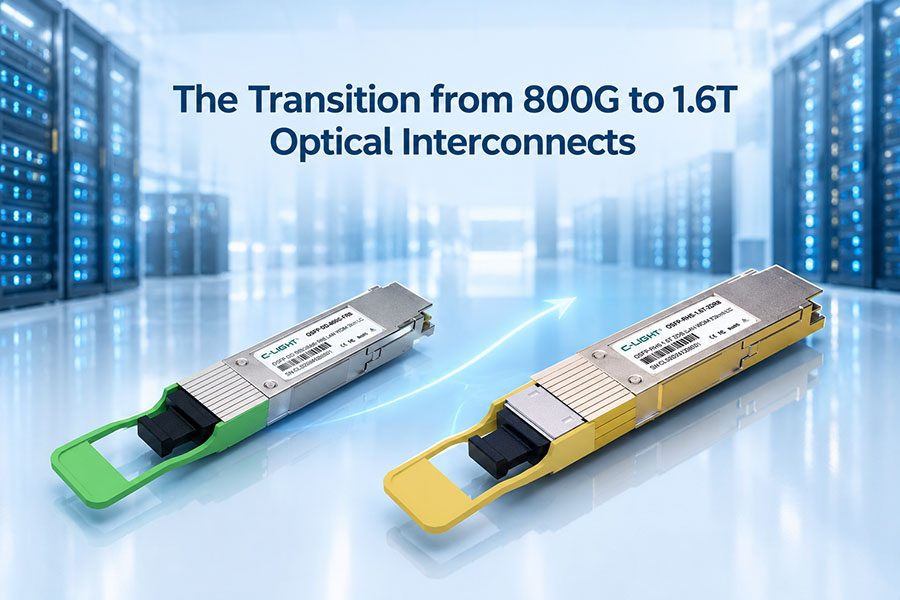
For rack and row connectivity, 400G and 800G interfaces can support high-density Ethernet fabrics. As port bandwidth increases, 1.6T modules provide a higher aggregate rate per port and can help reduce the number of physical interfaces required for a given switching capacity.
C-LIGHT 800G OSFP Optical Transceiver
The C-LIGHT 800G OSFP portfolio includes several optical configurations for high-bandwidth data-center and HPC networks:
SR8: multimode fiber, 850nm, up to 100m, MPO-16.
DR8: single-mode fiber, up to 500m, MPO connectivity.
2×FR4: single-mode fiber, up to 2km, duplex LC connectivity.
Additional long-reach coherent options are available within the product family.
These configurations address different physical link requirements and should be selected according to the host interface, fiber plant and target reach.
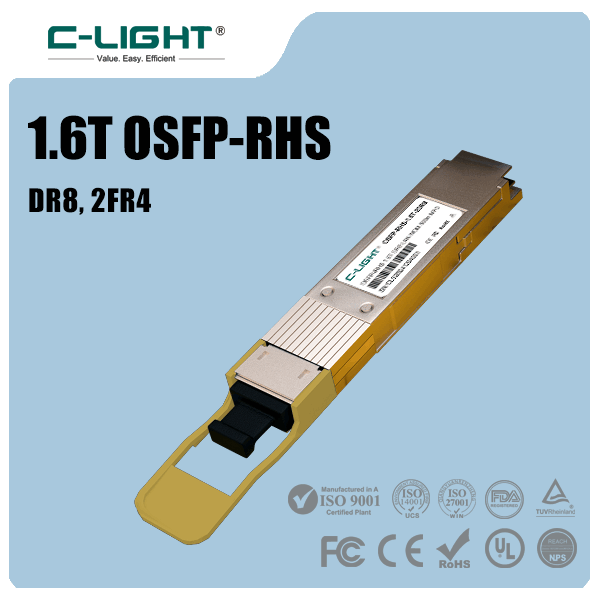
C-LIGHT 1.6T OSFP-RHS Optical Transceiver
The C-LIGHT 1.6T OSFP-RHS portfolio supports high-density 1.6Tbps connectivity for next-generation data-center networks.
CL1.6TOSFP2DR4-RHS: single-mode fiber, 2×800G, LAN-WDM, up to 500m, dual MPO-12.
CL1.6TOSFP2FR4-RHS: single-mode fiber, 2×800G, LAN-WDM, up to 2km, dual LC/APC.
The reduced-height heatsink design supports integration into high-density systems where thermal and mechanical constraints are important.
These pluggable modules are relevant to the Ethernet and optical transport layers of disaggregated infrastructure. Their presence in a network does not by itself establish compatibility with CXL.mem or another memory-access protocol. The system architecture must provide the required protocol handling and endpoint functionality.
9. Optical DCI for Distributed Resource Pools
Disaggregated computing can extend beyond a single rack or data hall. Large facilities may distribute compute, memory and storage resources across separate equipment zones or buildings. In some architectures, resource domains may also be located in separate data centers.
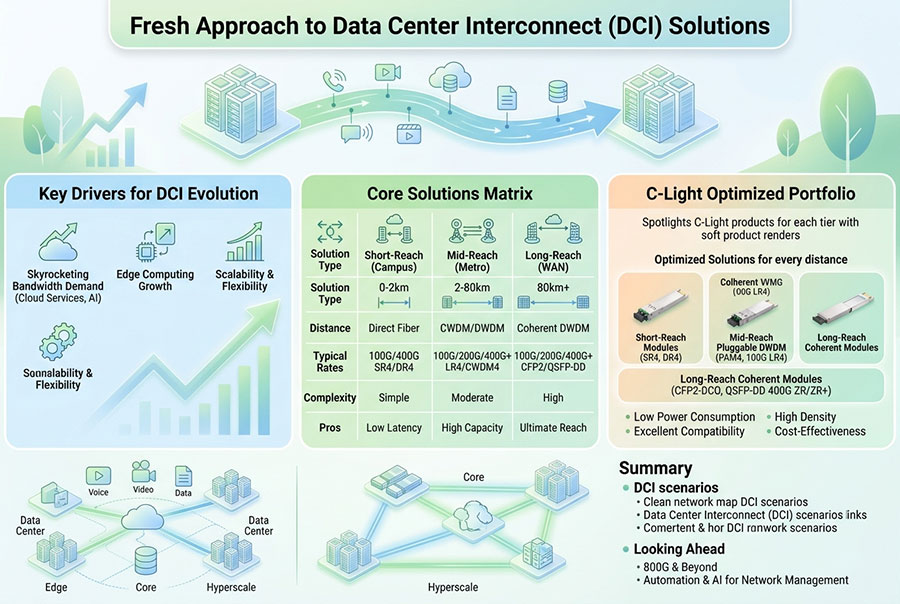
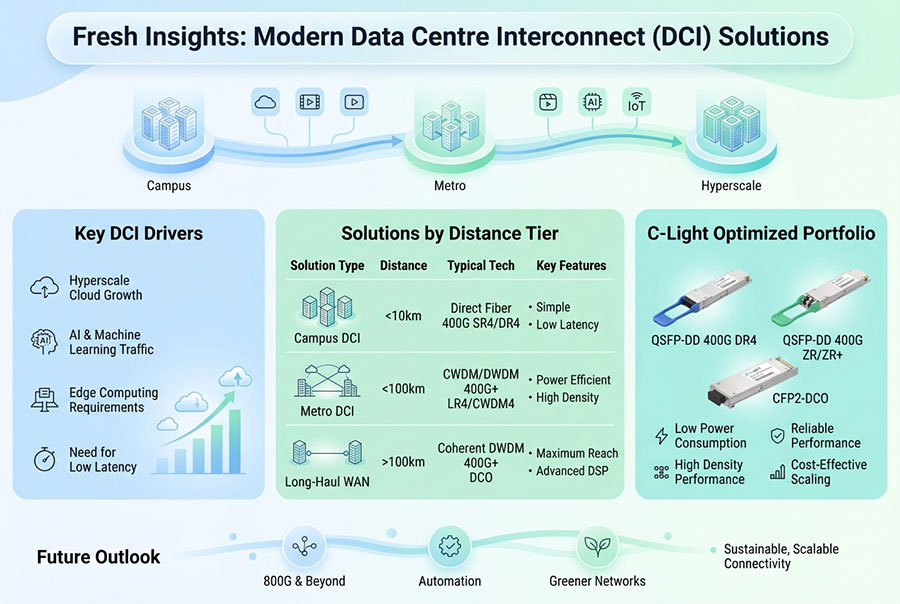
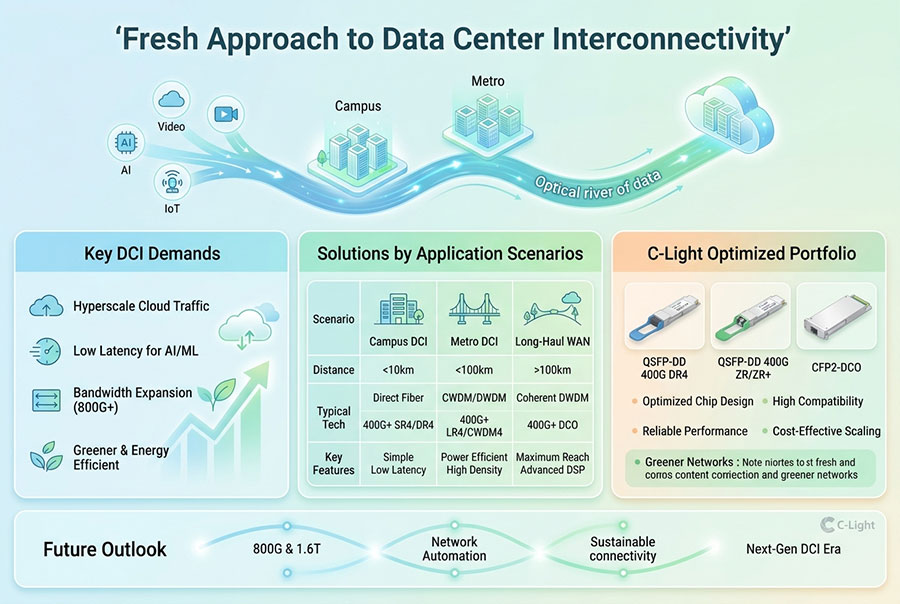
At these distances, optical data-center interconnect becomes important. Direct single-mode optical links can serve shorter campus connections, while DWDM systems provide a way to aggregate multiple channels over shared fiber infrastructure.
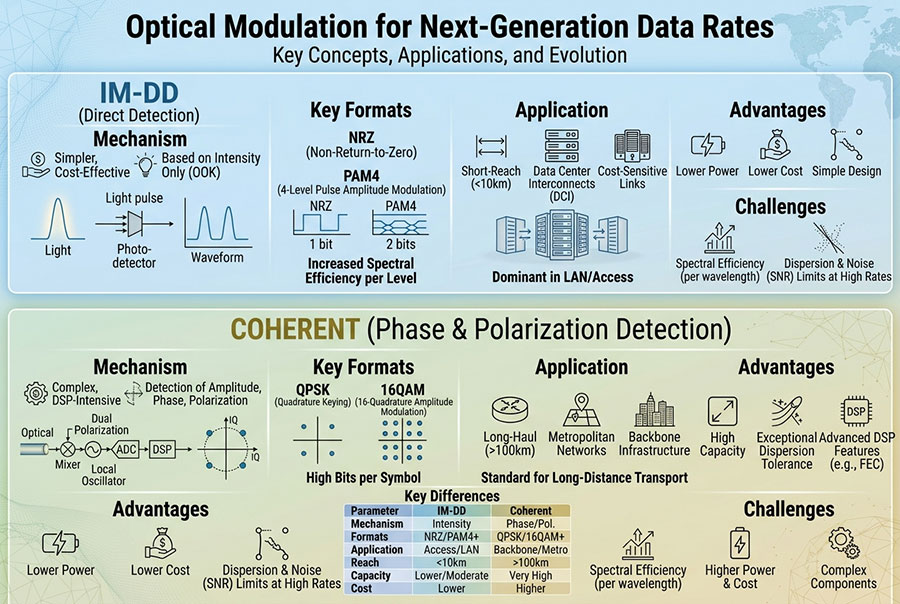
Coherent DCO modules can support higher-capacity wavelength services across metro and regional paths, depending on the selected implementation and line-system design. These modules use coherent modulation and digital signal processing to manage optical impairments and support transmission over engineered fiber routes.
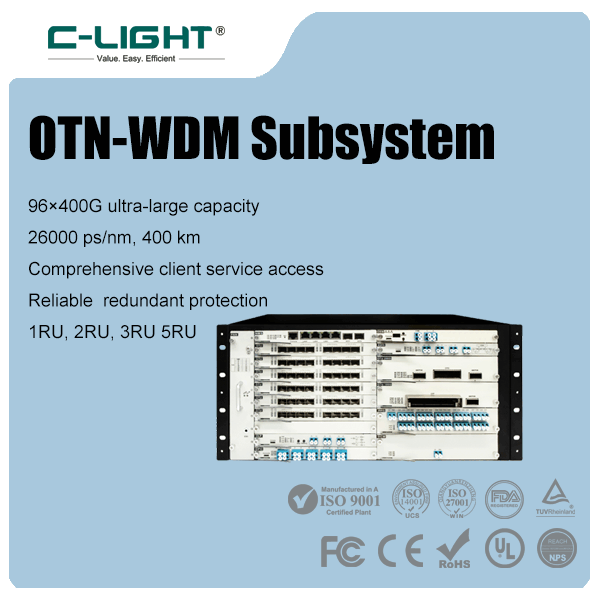
C-LIGHT DWDM DCO Coherent Transceivers
The C-LIGHT DWDM DCO portfolio covers coherent optical transceivers across multiple data rates and form factors, including 100G, 200G, 400G and 800G options.
These products can be evaluated for high-capacity DCI links connecting separate compute and resource facilities. Final selection requires matching the transceiver's optical characteristics with the host platform, wavelength plan, fiber route and optical line system.
For memory access, however, physical reach is only one consideration. The latency of the complete protocol path must remain within the application and system architecture's requirements. A regional DCI link suitable for bulk storage replication may not be suitable for latency-sensitive remote memory access.
10. Reliability, Monitoring and Resource Management
Disaggregated infrastructure creates additional dependencies between compute nodes and external resource pools. A failure in an optical link or switching domain may affect multiple hosts simultaneously. Network resilience must therefore be considered as part of resource availability rather than as an isolated transport concern.
Important design measures include:
Redundant optical paths: Use physically diverse routes where the availability target requires protection against fiber cuts or pathway failures.
Port and equipment redundancy: Avoid single points of failure in optical modules, switches and transport equipment.
Capacity reservation: Ensure alternate paths can carry the traffic that must be restored after a failure.
Resource-aware routing: Coordinate connectivity changes with compute and memory allocation policies.
Failure-domain isolation: Prevent a fault in one resource group from unnecessarily affecting unrelated workloads.
Monitoring should cover both optical and system-level performance. Transceiver diagnostics can report parameters such as transmit power, receive power, module temperature, supply voltage and laser bias where supported. Optical transport monitoring adds channel-level measurements, while packet and fabric telemetry provides throughput, congestion, errors and latency information.
For memory disaggregation, monitoring should also include resource allocation status, access latency, bandwidth utilization and host-to-device communication errors. This correlation helps operators distinguish optical degradation from protocol, memory-controller or software-level problems.
11. Engineering Challenges Before Large-Scale Deployment
Optical interconnects provide a strong foundation for scalable resource fabrics, but several challenges must be resolved before they can support broad disaggregated computing deployments.
Protocol compatibility: Ethernet, PCIe, CXL and proprietary accelerator fabrics have different link, transaction and flow-control requirements. Optical connectivity must preserve or correctly translate the protocol behavior required by the endpoints.
Latency control: Remote memory access is sensitive to the complete round-trip path. Optical conversion, switching, buffering and protocol processing must be included in the latency budget.
Thermal integration: High-speed optical engines and host ASICs generate heat in dense systems. Module selection and packaging must account for airflow, heatsink geometry, cold-plate placement and operating temperature.
Topology management: Dynamic resource allocation requires coordinated control of network paths and compute resources. Reconfiguring an optical path without considering active workloads can interrupt communication or create congestion.
Serviceability: Pluggable optics provide replaceable interfaces, while tightly integrated photonic solutions can introduce different maintenance and repair requirements. Operators must balance integration density with field replacement and system lifecycle needs.
Cost and utilization: Disaggregation is beneficial only when the additional fabric, switching and management costs are justified by improved resource utilization and operational flexibility.
12. The Evolution of Optical Resource Fabrics
The next stage of disaggregated infrastructure is likely to combine several optical technologies rather than rely on one universal interconnect architecture. Pluggable transceivers will continue to support flexible rack and data-center connectivity, while silicon photonics, near-packaged optics and co-packaged optics address increasingly demanding bandwidth-density requirements.
Optical circuit switching and wavelength-based fabrics may provide additional flexibility for systems that need to connect independent resource pools dynamically. Meanwhile, CXL and other protocol technologies will continue to define how hosts access memory and devices across compatible fabrics.
The key development is the separation of resource capacity from fixed server boundaries. Optical connectivity can make larger and more flexible physical fabrics practical, but its value depends on protocol integration, latency management, control-plane coordination and system-level reliability.
Conclusion: Optical interconnects are becoming an important part of disaggregated computing and memory infrastructure as bandwidth requirements extend beyond conventional server and rack boundaries. High-speed pluggable optics, coherent DCI, silicon photonics and optical switching each address different parts of the connectivity challenge. The most effective architectures combine these technologies with protocol-aware fabric design, predictable latency, thermal management and coordinated resource allocation.
For high-speed optical transceiver selection and connectivity requirements across data-center and AI infrastructure, Contact C-LIGHT.
 >

 >
 >
 >
 >
 >
 >
 >