TEL:+86 132 6656 7067


1. What Is the Difference Between DWDM and CWDM?
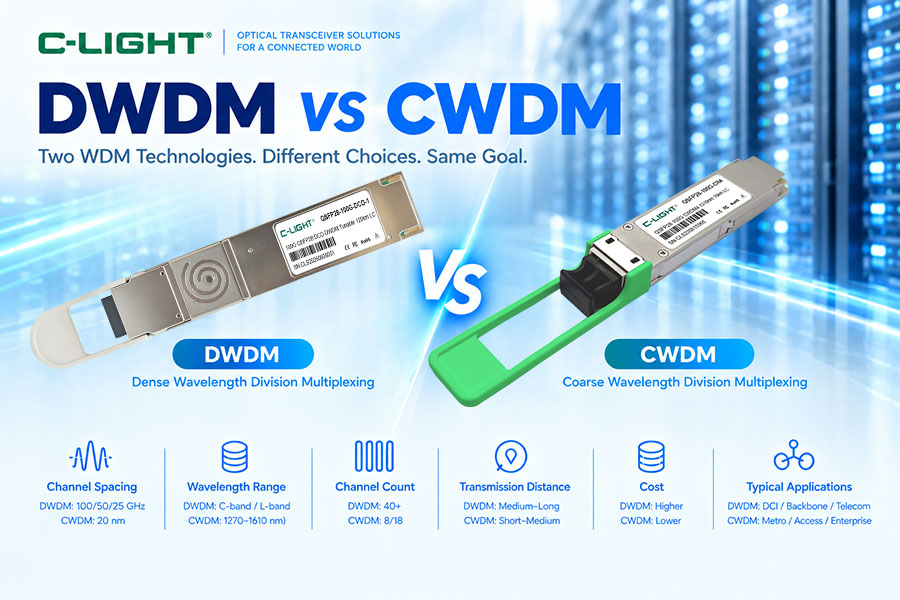
DWDM (Dense Wavelength Division Multiplexing) and CWDM (Coarse Wavelength Division Multiplexing) are both optical wavelength-division multiplexing technologies that allow multiple independent optical channels to share a single fiber. The major differences are channel spacing, available wavelength range, channel density, transmission distance, optical budget, thermal requirements, and system complexity.
2. What Is CWDM?
CWDM is a wavelength-division multiplexing technology based on relatively wide wavelength spacing. The CWDM wavelength plan is commonly associated with 20 nm channel spacing, which provides relatively high tolerance to laser wavelength drift and simplifies the optical design.
CWDM is commonly used in metro access, enterprise networks, mobile fronthaul and backhaul, surveillance networks, and moderate-capacity optical links where fiber utilization needs to be improved without the complexity of a dense wavelength system.
3. What Is DWDM?
DWDM uses much narrower wavelength spacing than CWDM, allowing a significantly larger number of optical channels to operate within the same fiber spectrum. DWDM systems are widely used in high-capacity telecom networks, data center interconnects, backbone networks, and long-distance transmission systems.
Because DWDM channels are closely spaced, the system requires tighter control of transmitter wavelength, optical power, filtering, channel isolation, and wavelength stability.
4. DWDM vs CWDM Channel Spacing
Channel spacing is one of the most fundamental differences between DWDM and CWDM. CWDM typically uses 20 nm wavelength spacing, while DWDM commonly uses frequency-based channel grids such as 100 GHz, 50 GHz, and 25 GHz.
In a DWDM system, smaller channel spacing allows more wavelengths to be transmitted within the same optical spectrum. However, narrower spacing also increases the requirements for wavelength accuracy, optical filtering, and system engineering.
5. DWDM vs CWDM Wavelength Range
CWDM generally covers a broad wavelength range from approximately 1270 nm to 1610 nm depending on the wavelength plan and equipment design. DWDM systems are commonly concentrated in the C-band around 1530–1565 nm, with some systems also using the extended L-band.
The C-band is particularly important for long-distance DWDM because erbium-doped fiber amplifiers (EDFAs) can provide efficient optical amplification within this spectral region.
6. DWDM vs CWDM Channel Count
CWDM normally provides a smaller number of wavelengths because its wide channel spacing consumes more optical spectrum per channel. A typical CWDM architecture can support up to 8 or 18 channels depending on the wavelength plan and implementation.
DWDM can support substantially more channels because of its narrow frequency spacing. Depending on the grid and system design, DWDM platforms can scale from several wavelengths to tens of channels or more.
7. DWDM vs CWDM Transmission Distance
CWDM is generally used for short- to medium-distance optical links. Its relatively simple architecture makes it suitable for metro and access applications where transmission distance is limited.
DWDM is designed for higher-capacity and longer-distance networks. With optical amplification, dispersion compensation or management, forward error correction, and appropriate transceiver technology, DWDM systems can support much longer optical links.
8. DWDM vs CWDM Optical Budget
Optical budget represents the amount of optical loss that a link can tolerate while maintaining the required receiver performance. CWDM links are usually designed with relatively straightforward optical budgets.
DWDM systems may require more comprehensive optical power engineering because multiple channels share the same fiber and optical components. Connector loss, splice loss, multiplexer loss, demultiplexer loss, fiber attenuation, amplifier gain, and channel power balance must all be considered.
9. DWDM vs CWDM Optical Amplification
One major advantage of DWDM is its compatibility with optical amplification technologies such as EDFAs. An EDFA can amplify multiple DWDM channels simultaneously without converting the signals back into the electrical domain.
CWDM systems generally do not rely on EDFAs in the same way because their wavelength range and typical transmission distances are different. For longer CWDM links, other optical engineering approaches may be required depending on the system.
10. DWDM vs CWDM Laser Technology
CWDM optical transceivers can use relatively cost-effective laser technologies with wider wavelength tolerance. DFB lasers are commonly used for many CWDM optical modules.
DWDM transceivers require more precise wavelength control because adjacent channels may be separated by only a small frequency interval. Depending on the application, cooled or uncooled DFB, EML, tunable laser, or other wavelength-controlled laser technologies may be used.
11. DWDM vs CWDM Wavelength Stability
Wavelength stability is more critical in DWDM systems because a transmitter must remain within its designated channel to avoid excessive interference with neighboring wavelengths.
CWDM provides wider wavelength spacing, so it generally has greater tolerance to wavelength drift caused by temperature and operating conditions. This simplifies transceiver design and thermal management.
12. DWDM vs CWDM Multiplexer and Demultiplexer
Both systems use optical MUX/DEMUX components to combine and separate wavelengths. CWDM MUX/DEMUX devices use wider wavelength spacing and relatively relaxed filter requirements.
DWDM MUX/DEMUX devices require tighter wavelength selectivity and lower insertion loss because the channels are much closer together. Optical isolation and passband characteristics are also more critical in high-density DWDM systems.
13. DWDM vs CWDM Fiber Compatibility
Both DWDM and CWDM can operate over single-mode optical fiber. The difference is primarily the wavelength plan and the optical components used in the system rather than the basic fiber type.
However, link design must consider fiber attenuation, chromatic dispersion, connector loss, splice loss, and nonlinear effects, particularly for high-capacity DWDM networks.
14. DWDM vs CWDM Chromatic Dispersion
Chromatic dispersion causes different optical wavelengths or spectral components to propagate at different velocities through the fiber. Its impact becomes increasingly important as transmission distance and data rate increase.
DWDM long-haul systems therefore require careful dispersion engineering. Depending on the architecture, dispersion compensation may be implemented through fiber selection, dispersion-compensating components, coherent technology, or digital signal processing.
15. DWDM vs CWDM Optical Power Management
In a multi-channel WDM system, optical power cannot be considered only at the total fiber level. The power of individual wavelengths must also be balanced to maintain receiver performance and prevent excessive nonlinear effects.
This is particularly important in DWDM systems with many channels, optical amplifiers, ROADMs, and long transmission spans.
16. DWDM vs CWDM Optical Transceivers
CWDM optical transceivers are designed around specific coarse wavelength channels, such as 1270 nm, 1290 nm, 1310 nm, and 1330 nm. DWDM transceivers use much more closely spaced wavelengths based on the selected DWDM grid.
Typical interfaces can include SFP+, SFP28, QSFP+, QSFP28, QSFP-DD, and other form factors depending on data rate and application.
17. DWDM vs CWDM Data Rate
WDM technology itself does not define the transmission rate of each optical channel. A CWDM or DWDM channel may carry different Ethernet, OTN, Fibre Channel, or other protocols depending on the transceiver and system architecture.
For example, CWDM can be deployed with 10G and 25G optical interfaces, while DWDM systems can support 10G, 25G, 100G, 200G, 400G, and higher-capacity coherent channels.
18. DWDM vs CWDM in 100G Networks
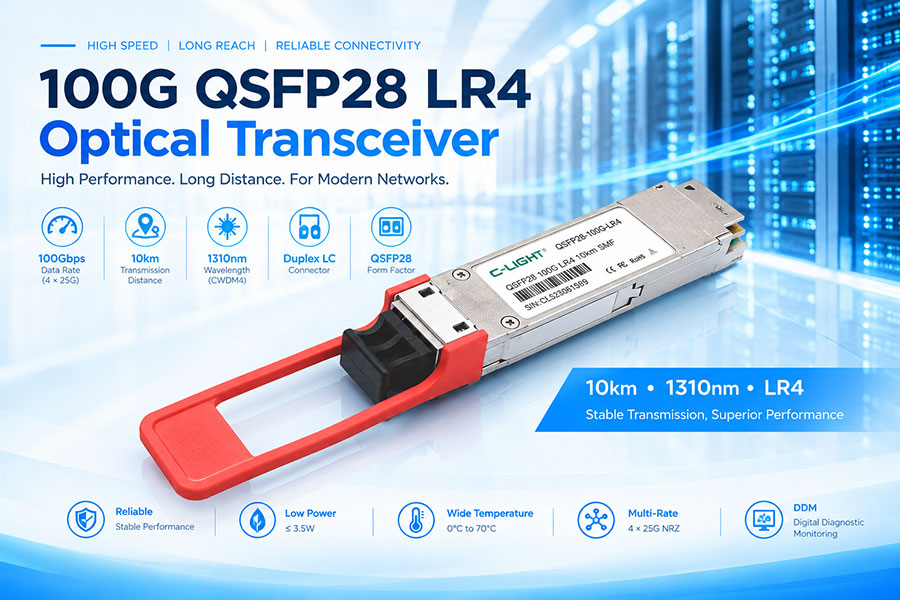
For 100G networking, CWDM is commonly implemented using multiple optical wavelengths to transport parallel 25G-class lanes over a single fiber pair. DWDM can also carry 100G traffic, particularly when higher fiber capacity or longer transmission distance is required.
For long-distance 100G transport, coherent DWDM technology provides substantially greater reach and spectral efficiency than conventional short-reach CWDM architectures.
19. DWDM vs CWDM in Data Center Interconnect
CWDM can be used for relatively short and cost-sensitive data center interconnect applications where wavelength capacity requirements are moderate.
DWDM becomes more attractive for DCI applications requiring high aggregate capacity over existing single-mode fiber. Multiple wavelengths can be transported across the same fiber infrastructure, allowing operators to scale bandwidth without deploying additional fiber pairs.
20. DWDM vs CWDM in Telecom Networks
CWDM is well suited to metro access and aggregation networks where lower complexity and lower optical cost are important.
DWDM is widely used in backbone, metro transport, DCI, OTN, and high-capacity telecom networks because its higher spectral efficiency allows substantial bandwidth to be transported over limited fiber resources.
21. DWDM vs CWDM Cost
CWDM generally has a lower system cost because of its wider channel spacing, simpler optical filtering requirements, and less demanding wavelength control.
DWDM usually has a higher deployment cost because it may require higher-precision optical modules, tighter wavelength management, optical amplification, advanced monitoring, and more sophisticated network equipment.
22. DWDM vs CWDM Power Consumption
CWDM optical modules generally have relatively simple optical architectures and can provide lower power consumption for short- and medium-reach applications.
DWDM power consumption depends strongly on system architecture. The use of coherent DSPs, tunable lasers, optical amplifiers, wavelength control, and advanced monitoring can significantly increase system power compared with simple CWDM links.
23. DWDM vs CWDM Scalability
DWDM provides significantly greater wavelength scalability. Additional channels can be provisioned within the available frequency grid as traffic requirements increase.
CWDM has less wavelength capacity because its wider channel spacing consumes more spectrum per channel. It is therefore better suited to networks with relatively stable and moderate capacity requirements.
24. DWDM vs CWDM: Technical Comparison
| Parameter | CWDM | DWDM |
|---|---|---|
| Typical Channel Spacing | 20 nm | 100 GHz / 50 GHz / 25 GHz and other grids |
| Typical Wavelength Region | Broad wavelength range | Primarily C-band, also L-band |
| Channel Density | Lower | Higher |
| Wavelength Stability Requirement | Relatively relaxed | Strict |
| Optical Filtering | Less demanding | More demanding |
| Optical Amplification | Less common | Common in long-haul systems |
| Transmission Distance | Short to medium | Medium to very long |
| System Complexity | Lower | Higher |
| Deployment Cost | Generally lower | Generally higher |
| Scalability | Moderate | High |
| Typical Applications | Access, enterprise, metro | Backbone, DCI, OTN, telecom |
25. When Should You Choose CWDM?
CWDM is a practical choice when the network requires multiple optical channels but does not need very high channel density or extremely long transmission distance. It is particularly suitable when deployment simplicity, lower optical cost, and relatively low system complexity are important.
26. When Should You Choose DWDM?
DWDM is better suited to networks where fiber capacity, transmission distance, and future scalability are the primary requirements. It is especially appropriate for high-capacity DCI, telecom transport, backbone networks, and systems where adding new fiber is costly or difficult.
27. DWDM vs CWDM for High-Capacity Optical Networks
As network traffic continues to increase, maximizing the capacity of existing fiber becomes increasingly important. CWDM provides an economical solution for moderate-capacity networks, while DWDM offers much higher spectral efficiency and a stronger upgrade path for high-capacity optical transport.
28. DWDM vs CWDM FAQ
Q1. What is the main difference between DWDM and CWDM?
Q2. What is the typical channel spacing of CWDM?
Q3. What channel spacing is used in DWDM?
Q4. Why is DWDM better for long-distance transmission?
Q5. Is DWDM more expensive than CWDM?
Q6. Is CWDM or DWDM better for data center interconnect?
29. Summary
DWDM and CWDM use the same fundamental WDM principle but target different network requirements. CWDM relies on wider wavelength spacing and a simpler optical architecture, making it attractive for access, enterprise, and metro networks. DWDM uses a dense frequency grid to achieve higher channel density and is better suited to high-capacity, long-distance, and scalable optical transport systems.
 >
>

 >
>
 >
>
 >
>
 >
>
 >
>
 >
>
 >
>