TEL:+86 132 6656 7067


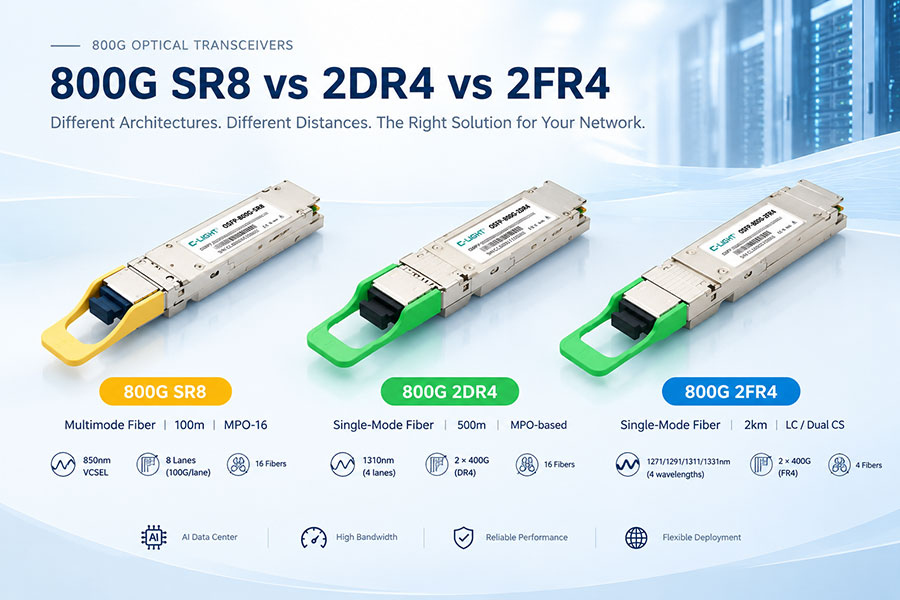
As 800G Ethernet continues to expand across AI data centers, cloud computing, and high-performance computing networks, different optical transceiver architectures are being used to support different transmission distances and cabling requirements. Among the most important options are 800G SR8, 800G 2DR4, and 800G 2FR4.
All three are designed for 800G-class connectivity, but their optical technologies are different. 800G SR8 is optimized for short-reach multimode fiber, 800G 2DR4 uses parallel single-mode fiber for medium-distance transmission, while 800G 2FR4 uses WDM technology to achieve longer reach with fewer fibers.
1. What Is 800G SR8?
800G SR8 is a short-reach optical transceiver designed primarily for multimode fiber connections in data centers. The SR8 architecture typically uses eight parallel optical lanes, with each lane carrying approximately 100Gbps.
800G SR8 commonly operates around 850nm and uses VCSEL-based optical technology. Because the transmission relies on parallel fibers, an MPO-16 interface is commonly used.
The typical reach is up to approximately 100m, making 800G SR8 suitable for short-distance connections between switches, servers, and GPU systems inside a data center.
2. What Is 800G 2DR4?
800G 2DR4 combines two 400G DR4 optical sections into an 800G transceiver. Unlike SR8, it uses single-mode fiber and parallel optical transmission.
A typical 400G DR4 architecture uses four optical lanes operating around the 1310nm region. Two 400G sections provide the overall 800G capacity.
800G 2DR4 is generally designed for transmission distances of up to approximately 500m. It is therefore suitable for medium-distance intra-data-center links where single-mode fiber is preferred.
3. What Is 800G 2FR4?
800G 2FR4 is another 800G architecture based on two 400G FR4 sections. Its key difference from 2DR4 is the use of wavelength division multiplexing (WDM).
Each 400G FR4 section typically uses four LAN-WDM wavelengths around 1271nm, 1291nm, 1311nm, and 1331nm. Multiple optical wavelengths are combined onto the same fiber pair.
This architecture allows 800G 2FR4 to reach approximately 2km over single-mode fiber while using significantly fewer fibers than parallel-fiber solutions.
4. 800G SR8 vs 2DR4 vs 2FR4
| Feature | 800G SR8 | 800G 2DR4 | 800G 2FR4 |
|---|---|---|---|
| Architecture | 8-lane parallel optics | 2 × 400G DR4 | 2 × 400G FR4 |
| Fiber Type | Multimode Fiber | Single-Mode Fiber | Single-Mode Fiber |
| Wavelength | 850nm | Around 1310nm | 1271/1291/1311/1331nm |
| Optical Technology | Parallel transmission | Parallel transmission | WDM |
| Typical Reach | Up to 100m | Up to 500m | Up to 2km |
| Typical Fiber Count | 16 fibers | 16 fibers | 4 fibers |
| Typical Connector | MPO-16 | MPO-based | Dual LC or Dual CS |
| Typical Application | Short-reach data center links | Medium-distance intra-data-center links | Longer intra-data-center links |
5. Transmission Distance Comparison
Transmission distance is one of the clearest differences between the three 800G solutions.
800G SR8 is generally intended for links of up to around 100m. Its short-reach design is well suited to dense connections inside GPU clusters and data center racks.
800G 2DR4 extends the reach to around 500m by using single-mode fiber. This provides greater flexibility for connections between racks, rows, or different areas of a data center.
800G 2FR4 can typically reach around 2km. It is therefore more appropriate for longer intra-data-center links where SR8 and 2DR4 may not provide sufficient reach.
Simple comparison: 100m → SR8 | 500m → 2DR4 | 2km → 2FR4.
6. MMF vs SMF: Fiber Type
800G SR8 uses multimode fiber (MMF), while 800G 2DR4 and 2FR4 use single-mode fiber (SMF).
Multimode fiber is widely used for short-reach data center connections. Its combination with 850nm VCSEL technology makes SR8 practical for relatively short optical paths.
Single-mode fiber is preferred for longer distances. This is why both 2DR4 and 2FR4 are designed around SMF infrastructure.
When selecting a transceiver, the existing fiber infrastructure should therefore be considered before choosing the optical technology.
7. Parallel Optics vs WDM
The main technical difference between 2DR4 and 2FR4 is how the optical channels are transmitted.
2DR4 uses parallel optics. Individual optical lanes are carried over separate fibers. This architecture is straightforward but requires more fibers.
2FR4 uses WDM. Multiple optical wavelengths are multiplexed onto the same fiber, allowing more data channels to share fewer fibers.
This difference is particularly important in high-density data centers, where fiber management and patch-panel capacity can become major infrastructure considerations.
8. Fiber Count and Connector Differences
Fiber count has a direct impact on the physical design of an optical network.
800G SR8 and 2DR4 use parallel optical transmission, so their optical interfaces require multiple fibers. MPO-based connectors are therefore commonly associated with these architectures.
800G 2FR4 reduces the fiber requirement through WDM. Depending on the implementation, dual LC or dual CS connectors may be used.
The lower fiber count of 2FR4 can simplify cabling, reduce congestion, and make high-density optical infrastructure easier to manage.
9. 2DR4 vs 2FR4: What Is the Difference?
2DR4 and 2FR4 are often compared because both are based on two 400G optical sections and use single-mode fiber.
The key difference is the optical architecture. 2DR4 uses parallel optical lanes, while 2FR4 uses wavelength multiplexing.
As a result, 2FR4 typically provides a longer reach and requires fewer optical fibers. 2DR4, on the other hand, maintains a more direct parallel-fiber architecture and is commonly used for approximately 500m links.
Therefore, the choice between them is mainly determined by transmission distance, fiber density, cabling architecture, and deployment requirements.
10. 800G SR8, 2DR4 and 2FR4 for AI Data Centers
AI data centers require high-bandwidth optical interconnects because large GPU clusters generate substantial east-west traffic between servers, switches, and accelerator systems.
800G SR8 is suitable for short optical links inside high-density GPU clusters, especially when multimode fiber is already installed.
800G 2DR4 is better suited to medium-distance connections where single-mode fiber is used and approximately 500m reach is sufficient.
800G 2FR4 is more suitable for longer optical paths and high-density environments where reducing fiber count is an important consideration.
There is therefore no single solution that is best for every AI data center. The appropriate module depends on the physical network topology and fiber infrastructure.
11. 800G Breakout and 2 × 400G Connectivity
The 2DR4 and 2FR4 architectures are based on two 400G optical sections, making them relevant to network designs involving 2 × 400G connectivity.
In compatible systems, an 800G port can potentially connect to two 400G endpoints through an appropriate breakout configuration.
However, actual breakout support depends on the switch, optical transceiver, cable assembly, optical interface, and software configuration. The module name alone does not guarantee breakout compatibility.
12. How to Choose the Right 800G Transceiver
The most practical selection method is to start with transmission distance and fiber type.
Choose 800G SR8 for short links using multimode fiber, especially when the required distance is around 100m or less.
Choose 800G 2DR4 for medium-distance single-mode links of around 500m where a parallel optical architecture is suitable.
Choose 800G 2FR4 for longer single-mode links approaching 2km, especially when reducing the number of optical fibers is important.
Other parameters such as connector type, optical budget, power consumption, host compatibility, operating temperature, and breakout requirements should also be checked before deployment.
13. 800G Optical Transceivers from C-LIGHT
C-LIGHT provides high-speed optical transceiver solutions for AI data centers, cloud networks, high-performance computing, and Ethernet applications.
The C-LIGHT 800G product family supports different optical architectures and transmission distances, allowing customers to select the appropriate solution according to network topology, fiber infrastructure, and link requirements.
For specific applications, the corresponding product datasheet should be reviewed to confirm optical specifications, connector configuration, compatibility, operating conditions, and transmission performance.
14. Conclusion
800G SR8, 2DR4, and 2FR4 are designed for different 800G optical networking scenarios. SR8 uses multimode fiber for short-reach connectivity, 2DR4 uses parallel single-mode fiber for approximately 500m transmission, and 2FR4 uses WDM over single-mode fiber for longer links of up to around 2km.
The simplest way to distinguish them is by their transmission distance and optical architecture: SR8 for short MMF links, 2DR4 for medium-distance parallel SMF links, and 2FR4 for longer SMF links with lower fiber count.
 >
>

 >
>
 >
>
 >
>
 >
>
 >
>
 >
>
 >
>