TEL:+86 132 6656 7067


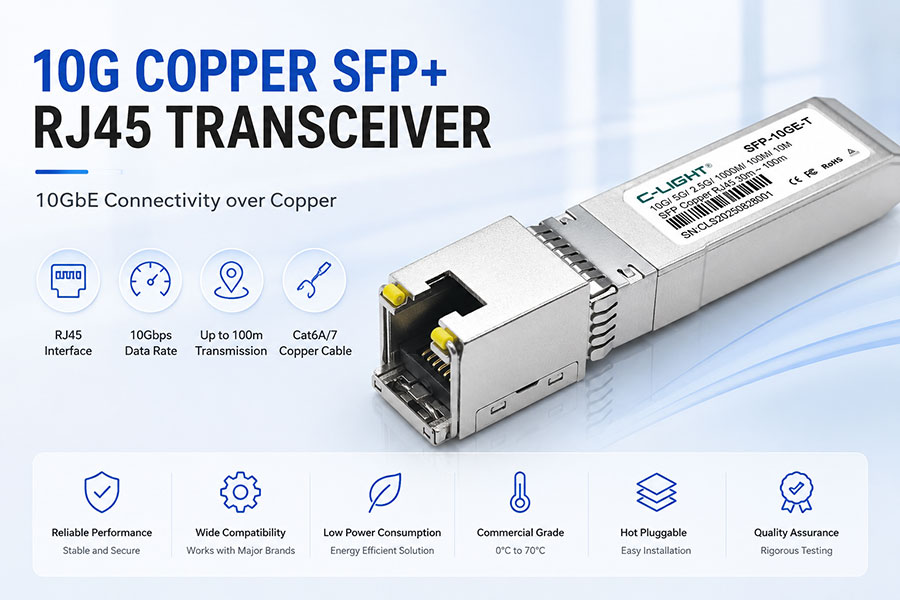
10G Copper SFP+ transceivers provide a practical way to connect network switches, servers, routers, and other Ethernet equipment using standard RJ45 copper cabling. Unlike optical SFP+ modules that use fiber, a 10GBASE-T SFP+ transceiver converts the SFP+ interface into a copper Ethernet connection.
With support for 10Gbps Ethernet over twisted-pair cabling, 10G SFP+ RJ45 transceivers are useful for upgrading existing copper-based networks while maintaining the flexibility of an SFP+ port. This guide explains how 10G Copper SFP+ transceivers work, their specifications, cabling requirements, applications, advantages, and key factors to consider when selecting a module.
1. What Is a 10G Copper SFP+ Transceiver?
A 10G Copper SFP+ transceiver is a pluggable Ethernet module designed to provide a 10Gbps copper connection through an RJ45 interface. It is installed in an SFP+ port on a compatible switch, router, server network adapter, or other networking device.
The module uses 10GBASE-T technology to transmit Ethernet signals over twisted-pair copper cabling. Instead of optical lasers and photodiodes, a copper SFP+ module contains an integrated copper Ethernet PHY and signal processing circuitry.
This makes a 10G SFP+ RJ45 transceiver particularly useful when existing network infrastructure already uses copper cabling and replacing the entire cabling system with fiber is unnecessary or impractical.
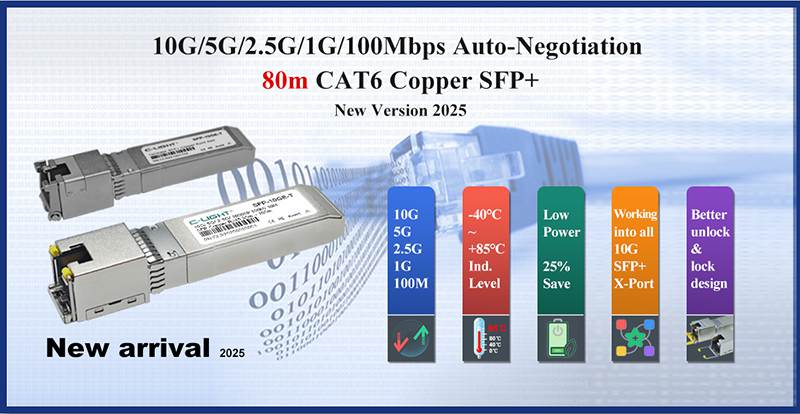
2. How Does a 10G SFP+ RJ45 Transceiver Work?
A 10G Copper SFP+ module provides the electrical and protocol conversion required between the host SFP+ interface and the copper Ethernet link.
When installed in an SFP+ port, the module communicates with the host device through the SFP+ electrical interface. On the network side, its RJ45 connector provides a 10GBASE-T Ethernet interface for connection to twisted-pair copper cable.
The internal PHY performs functions such as signal processing, encoding, equalization, and compensation for the characteristics of copper transmission.
The basic connection can be represented as:
SFP+ Port → 10G Copper SFP+ Transceiver → RJ45 → Cat6A/Cat7 Copper Cable → Network Device
3. 10GBASE-T Technology
10GBASE-T is the IEEE Ethernet technology used to transmit 10Gbps Ethernet over balanced twisted-pair copper cabling. It was defined to support high-speed Ethernet while allowing network operators to continue using structured copper cabling.
Compared with traditional 1G Ethernet, 10GBASE-T significantly increases network bandwidth while maintaining the familiar RJ45 connector and copper cabling architecture.
A typical 10GBASE-T connection can reach up to 100 meters when an appropriate structured cabling system, such as Cat6A, is used and the installation meets the applicable cabling requirements.
4. 10G Copper SFP+ vs Optical SFP+
| Feature | 10G Copper SFP+ | 10G Optical SFP+ |
|---|---|---|
| Connector | RJ45 | LC or other fiber connector |
| Transmission Medium | Twisted-pair copper | Optical fiber |
| Typical Reach | Up to 100m with suitable copper cabling | Depends on optical module and fiber type |
| Installation | Uses existing copper infrastructure | Requires fiber cabling |
| EMI Immunity | More susceptible to electromagnetic interference | Immune to electromagnetic interference |
| Power Consumption | Generally higher | Generally lower, depending on module type |
| Typical Application | Short-distance 10G Ethernet | Data center and longer-distance links |
5. What Cable Is Required for 10G SFP+ RJ45?
Cable selection is important when deploying a 10GBASE-T SFP+ transceiver. Cat6A is commonly recommended for full 100-meter 10GbE links because it provides the bandwidth and transmission characteristics required for 10GBASE-T applications.
Cat7 and other suitable higher-category copper cabling can also be used when supported by the installation. For shorter connections, the required cable category may depend on the actual distance, installation environment, and equipment specifications.
For best results, the cable, patch panels, connectors, and other components should be designed and installed as a compatible structured cabling system rather than evaluating the transceiver alone.
6. 10G SFP+ RJ45 Transmission Distance
The maximum transmission distance depends on the transceiver, cable category, installation quality, and network environment.
For standard 10GBASE-T applications, a properly designed Cat6A structured cabling system can support links up to approximately 100 meters. This makes 10G Copper SFP+ modules suitable for many server-to-switch and switch-to-switch connections within a data center or enterprise network.
For longer distances, optical SFP+ transceivers and fiber optic cabling are generally more appropriate.
7. Key Specifications of a 10G Copper SFP+ Transceiver
When selecting a 10G SFP+ RJ45 transceiver, several specifications should be evaluated:
Data Rate: 10Gbps Ethernet, typically based on 10GBASE-T.
Host Interface: SFP+ electrical interface.
Network Interface: RJ45 copper connector.
Cable Type: Compatible twisted-pair Ethernet cabling, commonly Cat6A for 10G links.
Transmission Distance: Typically up to 100m for suitable 10GBASE-T copper installations.
Operating Temperature: Depends on the module grade and application environment.
Power Consumption: Higher than many passive optical SFP+ modules because of the integrated copper PHY and DSP functions.
Compatibility: The transceiver must be supported by the host switch, router, NIC, or other SFP+ equipment.
8. Power Consumption of 10G Copper SFP+ Modules
Power consumption is one of the most important differences between copper and optical SFP+ transceivers. A 10GBASE-T copper module performs substantial signal processing to transmit high-speed data over twisted-pair copper cable.
As a result, 10G Copper SFP+ modules can consume more power than many 10G optical SFP+ modules. The actual power consumption varies by module design, PHY technology, cable length, temperature, and operating conditions.
This difference should be considered when installing a large number of 10G RJ45 transceivers in a high-density switch, especially in a data center where port density and thermal management are important.
9. 10G Copper SFP+ Compatibility
Not every SFP+ port automatically supports every copper SFP+ transceiver. Host compatibility should always be verified before deployment.
Network equipment vendors may define supported transceiver types through hardware specifications, firmware, EEPROM identification, or compatibility policies. Some switches may also restrict third-party modules.
Before purchasing a 10G SFP+ RJ45 transceiver, check the host device specifications and confirm that the SFP+ port supports 10GBASE-T copper modules.
10. 10G Copper SFP+ Applications
10.1 Data Center Networks
10G Copper SFP+ modules can be used for short-distance connections between switches, servers, storage systems, and network appliances where copper infrastructure is already available.
10.2 Enterprise Networks
Enterprise networks that have existing structured copper cabling can use 10G SFP+ RJ45 transceivers to increase network bandwidth without replacing every copper connection with fiber.
10.3 Server and Storage Connectivity
10GbE copper connections can provide higher bandwidth for servers and storage systems that require faster network access while remaining within a relatively short physical distance.
10.4 Network Upgrades
10G Copper SFP+ modules provide a flexible upgrade path for equipment with SFP+ ports. Existing RJ45-based infrastructure can potentially be reused where the cabling and distance meet the requirements of 10GBASE-T.
11. Advantages of 10G SFP+ RJ45 Transceivers
Uses Standard RJ45: Connects directly to common Ethernet copper cabling.
Easy Network Upgrade: Helps upgrade compatible SFP+ ports to 10GbE copper connectivity.
Existing Cabling Reuse: Can reduce the need for a complete fiber cabling replacement in suitable installations.
Flexible Deployment: Works well for short-distance server, switch, and network equipment connections.
High Bandwidth: Provides 10Gbps Ethernet connectivity for bandwidth-intensive applications.
Pluggable Architecture: Can be installed or replaced without changing the entire networking device.
12. Limitations of 10G Copper SFP+
Although 10GBASE-T SFP+ transceivers are flexible, they are not ideal for every network environment.
Power consumption is generally higher than that of many optical alternatives. Copper links are also more affected by electromagnetic interference and cable characteristics. In addition, the practical transmission distance is much shorter than that of many fiber-based 10G SFP+ solutions.
For high-density data centers, long-distance links, or environments where low power consumption is a priority, optical SFP+ modules may be a better choice.
13. 10G Copper SFP+ vs SFP28
10G Copper SFP+ and SFP28 are different concepts. SFP+ is commonly associated with 10GbE, while SFP28 was developed primarily for 25Gbps Ethernet applications.
A 10G Copper SFP+ module is designed specifically to provide a 10GbE RJ45 interface. SFP28 ports may support different operating modes depending on the host platform, but compatibility should not be assumed simply because the physical form factor is similar.
Always verify the supported data rate, electrical interface, and transceiver compatibility of the host equipment before deployment.
14. 10G Copper SFP+ vs 10GBASE-T Network Ports
A built-in 10GBASE-T network port and a 10G Copper SFP+ transceiver can both provide 10GbE over RJ45 copper cabling, but their physical architecture is different.
A built-in 10GBASE-T port integrates the copper PHY directly into the networking device. A copper SFP+ solution places the PHY and RJ45 interface inside a removable transceiver module.
The modular architecture of SFP+ provides greater flexibility because the same switch port can potentially be used for copper or optical connectivity depending on the supported transceiver.
15. How to Choose a 10G SFP+ RJ45 Transceiver
Choosing the right 10G Copper SFP+ transceiver requires more than checking the 10Gbps data rate. Consider the following factors:
Host Compatibility: Confirm that the switch, router, NIC, or other equipment supports the module.
Transmission Distance: Select a solution appropriate for the required copper link length.
Cable Category: Use suitable copper cabling for the target 10GbE application.
Power Consumption: Consider the thermal and power budget of the host equipment.
Operating Temperature: Select commercial, industrial, or other temperature grades according to the deployment environment.
Network Requirements: Consider whether copper or optical connectivity is more appropriate for the specific application.
Interoperability: Verify module coding, firmware requirements, and vendor compatibility where applicable.
16. Testing 10G Copper SFP+ Transceivers
Reliable 10GBASE-T connectivity requires electrical performance and interoperability testing. Transceiver validation can include signal integrity, data transmission performance, temperature testing, power consumption, and compatibility testing.
Testing may also evaluate BER, jitter, return loss, insertion loss, and other relevant electrical parameters. Real-world interoperability testing with target switches and network adapters is particularly important because host platforms can have different compatibility requirements.
17. 10G Copper SFP+ in Modern Data Center Networks
As data center networks move toward 25G, 100G, 400G, and higher-speed interfaces, 10G remains important for many server, management, storage, and legacy network connections.
10G Copper SFP+ transceivers can therefore continue to provide value in applications where short-distance connectivity, RJ45 compatibility, and existing copper infrastructure are more important than maximum port density or minimum power consumption.
For higher-bandwidth switch-to-switch and server-to-switch links, optical transceivers and active optical cables are increasingly used as network speeds increase.
18. C-LIGHT 10G Copper SFP+ Solutions
C-LIGHT provides optical transceiver and high-speed connectivity solutions for data center and Ethernet networking applications. A 10G Copper SFP+ RJ45 transceiver can complement C-LIGHT's broader transceiver portfolio by providing a copper connectivity option for compatible 10GbE equipment.
For applications requiring short-distance RJ45 connectivity, 10GBASE-T SFP+ provides a practical alternative to optical fiber. For longer-distance or higher-density network connections, C-LIGHT optical transceivers and active optical solutions can provide scalable connectivity options.
19.Conclusion
10G Copper SFP+ RJ45 transceivers provide a flexible solution for 10GbE connectivity over copper cabling. By combining the modularity of the SFP+ form factor with 10GBASE-T and a standard RJ45 interface, they can help network operators upgrade compatible equipment while continuing to use existing copper infrastructure.
For short-distance 10GbE connections, especially those using suitable Cat6A structured cabling, 10G Copper SFP+ can be a practical and cost-effective option. However, power consumption, transmission distance, cable quality, and host compatibility should all be considered when selecting a transceiver.
As data center networks continue to evolve toward 25G, 100G, 400G, and 800G, 10G Copper SFP+ remains useful for specific short-reach Ethernet applications while optical transceivers continue to play a central role in high-bandwidth and longer-distance connectivity.
20. Frequently Asked Questions
Q1. What is a 10G Copper SFP+ transceiver?
Answer: A 10G Copper SFP+ transceiver is a pluggable module that converts an SFP+ port into a 10GbE RJ45 copper interface, typically using 10GBASE-T technology.
Q2. How far can a 10G SFP+ RJ45 transceiver transmit?
Answer: A typical 10GBASE-T copper SFP+ application can support up to approximately 100 meters with suitable structured copper cabling, such as Cat6A.
Q3. What cable is recommended for 10GBASE-T?
Answer: Cat6A is commonly recommended for 10GBASE-T applications requiring up to 100 meters.
Q4. Does a 10G Copper SFP+ use an RJ45 connector?
Answer: Yes. A 10GBASE-T SFP+ copper transceiver normally provides an RJ45 interface for standard twisted-pair Ethernet cabling.
Q5. Does every SFP+ port support 10G RJ45 transceivers?
Answer: No. The host device must support 10GBASE-T or the applicable copper SFP+ transceiver. Compatibility should be confirmed before deployment.
Q6. Is 10G Copper SFP+ better than 10G optical SFP+?
Answer: Neither is universally better. Copper SFP+ is suitable for short-distance RJ45 connectivity, while optical SFP+ is generally better suited to longer distances and fiber-based networks.
Q7. Does 10G Copper SFP+ consume more power than optical SFP+?
Answer: In many designs, yes. 10GBASE-T modules typically require more power for the copper PHY and signal processing than comparable 10G optical modules.
Q8. Where are 10G SFP+ RJ45 transceivers commonly used?
Answer: They are commonly used in data centers, enterprise networks, server rooms, storage networks, and network upgrades where RJ45 copper cabling is preferred.
 >
>

 >
>
 >
>
 >
>
 >
>
 >
>
 >
>
 >
>