TEL:+86 132 6656 7067


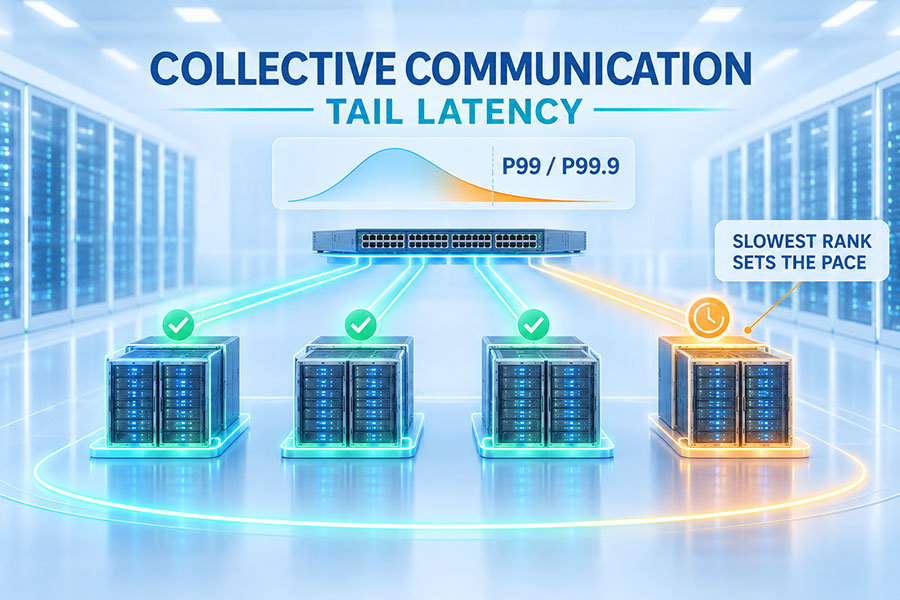
In distributed AI training, a collective operation is only as fast as the time required for all participating ranks to complete their assigned communication and synchronization work. A network can deliver excellent average latency while still producing occasional delays that hold up an entire group of GPUs. As cluster size and communication concurrency increase, these slow events become increasingly important to overall training performance.
Collective communication sensitivity to network tail latency is therefore a system-level concern. It involves network congestion, transport behavior, collective algorithms, GPU execution, synchronization dependencies and the physical connectivity between compute nodes. Optimizing average packet or flow latency alone does not provide a reliable picture of collective completion time.
1. Why Tail Latency Matters in Collective Communication
Collective communication coordinates data exchange among multiple GPUs or compute processes. Operations such as AllReduce, AllGather, ReduceScatter and All-to-All distribute data or results across participating ranks. In synchronous training, ranks often need to finish a communication phase before dependent computation can proceed.
This creates a critical dependency: a delayed participant can extend the completion time observed by the entire group. Other ranks may finish their local transfers earlier, but they cannot necessarily advance to the next dependent stage until the collective's required data and synchronization conditions are satisfied.
Average latency describes typical behavior, whereas tail latency captures unusually slow events. Metrics such as P95, P99 and P99.9 help reveal delays that may have little influence on the mean but a substantial effect on repeated synchronization workloads.
2. How Collective Operations Amplify Slow Events
The sensitivity to tail latency depends on the collective algorithm and its communication dependencies. AllReduce, for example, combines data from multiple ranks and distributes the reduced result. Ring-based implementations divide the operation into communication steps, while tree-based and hierarchical algorithms organize data exchange through different patterns.
Regardless of the algorithm, a delayed transfer can postpone a later step when that step depends on the delayed data. In tightly synchronized phases, a rank that finishes early may have to wait for another rank, link or communication stage.
AllReduce and synchronization dependencies
AllReduce is widely used for aggregating gradients or other distributed values. Each rank contributes input data and receives the reduced result. Its completion time depends on more than the bandwidth available to one GPU: the algorithm must move and combine data across the participating group.
AllGather and ReduceScatter
AllGather distributes data from every rank to all participating ranks, while ReduceScatter combines data and distributes different portions of the result. Their communication patterns create different traffic distributions and synchronization points. A congested link or delayed rank can affect the progress of multiple participants, depending on the algorithm's topology and schedule.
All-to-All communication
All-to-All exchanges different data blocks between rank pairs. It can create high communication concurrency and substantial pressure on network paths, especially in distributed mixture-of-experts workloads. If many flows compete for the same uplinks, a small number of delayed transfers can stretch the completion time of the overall exchange.
| Collective operation | Communication pattern | Potential tail-latency impact |
|---|---|---|
| AllReduce | Combines values across ranks and distributes the result | A delayed reduction or distribution step can postpone completion across the group |
| AllGather | Collects data from all ranks and makes it available to every rank | Late-arriving rank data can delay completion of the gather |
| ReduceScatter | Reduces data and distributes result segments | Slow transfers can delay delivery of required output segments |
| All-to-All | Exchanges data between every source and destination rank | Congestion affecting a subset of flows can extend the overall exchange phase |
3. Why Large GPU Clusters Are More Sensitive
As the number of participating ranks increases, a collective operation involves more endpoints, links and possible contention points. There are more opportunities for an individual rank or transfer to experience an unusually long delay.
A simple statistical model illustrates this effect. Suppose a collective depends on N independent participant completion times, each described by a cumulative distribution function F(t). If the operation completes only after all N participants finish, then the completion-time distribution is approximately:
This simplified model assumes independent and identically distributed participant times and an all-participants completion condition. Real networks have correlated congestion, shared bottlenecks, multiple communication steps and algorithm-specific dependencies, so the equation is illustrative rather than a universal performance predictor.
It nevertheless shows why a percentile measured on one participant cannot automatically represent the same percentile for a large collective. For example, if 1,024 independent participants each have a 99% probability of finishing below a particular latency threshold, the probability that all 1,024 finish below that threshold is only about 0.003%. The collective's actual completion distribution depends on the full system, but the example demonstrates how group size changes the statistical exposure to slow events.
4. Network Sources of Tail Latency
Tail latency can originate from several parts of the communication path. Identifying the source is essential because a routing change will not solve a delay caused by host scheduling, and a faster optical link will not eliminate congestion created by oversubscribed switching paths.
Queueing and congestion
When traffic arrives at a switch port faster than it can be transmitted, packets accumulate in queues. Queueing delay can increase sharply during bursts, incast events or synchronized communication phases. A link may remain lightly utilized on average while experiencing short periods of intense contention.
ECMP path collisions
Equal-Cost Multipath routing distributes eligible flows across paths, commonly using a hash of flow fields. Hash collisions can place multiple large flows on the same path while other available paths remain less utilized. This imbalance can create localized congestion and inconsistent transfer completion times.
Packet loss and retransmission
Packet loss may trigger retransmission, recovery procedures or changes in transport behavior. These mechanisms can increase completion time, particularly when a delayed packet blocks progress for dependent data. In RDMA environments, transport configuration and congestion-control behavior influence how loss and congestion affect application-visible latency.
Pause behavior and head-of-line effects
Lossless Ethernet configurations may use mechanisms such as Priority Flow Control. Although these mechanisms are designed to reduce packet loss for selected traffic classes, poorly controlled congestion propagation can spread delays across connected ports. Head-of-line blocking can also prevent unrelated traffic from making progress when it shares a constrained queue or resource.
Host and endpoint delays
Not every slow collective is caused by the switch fabric. GPU scheduling, CPU contention, NIC processing, PCIe transfers, interrupt handling, memory pressure and software synchronization can all contribute to rank-level delays. A network-only measurement may miss these effects.
5. Network Tail Latency and the Straggler Effect
A straggler is a participant that progresses more slowly than the rest of the distributed workload. In AI training, the cause may be computational or communicational. A GPU can take longer to finish its local computation, or its communication path can be delayed by congestion, retransmission or endpoint processing.
These causes can interact. If a rank finishes computation late, it may enter a communication phase after other ranks have already begun sending data. If the network then experiences congestion, the rank's delay can become even larger. The resulting collective completion time reflects both compute and communication behavior.
A useful conceptual model is:
This is a simplified representation, not an exact timing formula for every collective algorithm. Real implementations can overlap computation and communication, divide data into chunks, and execute multiple communication steps concurrently. The model highlights an important diagnostic point: measuring only network latency cannot explain the entire straggler effect.
6. How Collective Algorithms Influence Tail Sensitivity
Collective algorithms determine how data moves, which ranks depend on one another and how much communication can proceed concurrently. Their performance under average conditions may differ from their behavior under congestion or uneven link utilization.
| Algorithm approach | Typical characteristics | Tail-latency considerations |
|---|---|---|
| Ring AllReduce | Organizes ranks in a logical ring and transfers data through successive steps | A delayed segment can affect later dependent steps; performance depends on ring mapping and link balance |
| Tree-based collective | Uses hierarchical aggregation and distribution | Delays near higher-level aggregation points can affect multiple downstream participants |
| Hierarchical collective | Combines local communication with inter-node communication | Can reduce some cross-network traffic, but inter-node bottlenecks and uneven local groups remain relevant |
| Topology-aware collective | Maps communication to the physical network structure | Can avoid unnecessary path contention when placement and topology information are accurate |
No algorithm is universally best for every message size, rank count and network condition. A ring can provide efficient bandwidth utilization for suitable workloads, while tree-based or hierarchical approaches may reduce the number of communication stages for other configurations. Evaluation should include completion-time distributions under realistic traffic, not just peak throughput.
7. Measuring Tail Latency at the Right Layer
Tail-latency analysis should distinguish between packet-level, flow-level, collective-level and training-step measurements. These values describe different events and cannot be substituted for one another.
| Measurement layer | Useful metrics | What it reveals |
|---|---|---|
| Network packet | Queueing delay, packet delay variation, loss, retransmission | Short-lived congestion and transport-level disturbances |
| Network flow | Flow completion time, P95/P99/P99.9, throughput | Uneven path performance and large-flow completion behavior |
| Collective operation | Operation duration, rank completion skew, timeout or retry events | How network and endpoint delays affect synchronization |
| Training iteration | Step-time distribution, communication wait time, GPU idle time | The impact of collective delays on application performance |
| Cluster | Link utilization, congestion duration, path imbalance, job completion time | Whether isolated slow events become a recurring infrastructure problem |
Use consistent percentile definitions
P95 represents a latency threshold at or below which approximately 95% of measured events complete. P99 and P99.9 describe progressively rarer, slower events. These statistics should be calculated over a clearly defined event population and measurement interval.
For large-scale collectives, record the completion time of each operation and, where possible, the per-rank contribution to that completion time. Comparing rank-level timestamps with switch queue telemetry and NIC counters helps identify whether a delay originated in the network or elsewhere in the system.
8. Reducing Congestion and Path Imbalance
Network design can reduce the probability and duration of slow communication events by providing balanced paths, sufficient capacity and effective congestion management. The goal is not simply to maximize average link utilization, but to prevent a small number of overloaded resources from dominating collective completion time.
Topology-aware traffic placement
GPU and NIC placement should reflect the physical fabric. Mapping communicating ranks to suitable local and remote paths can reduce unnecessary traffic through shared uplinks. Rail-optimized designs can also separate traffic across multiple network interfaces and corresponding fabric paths when the hardware and software stack support that arrangement.
Adaptive routing and multipath utilization
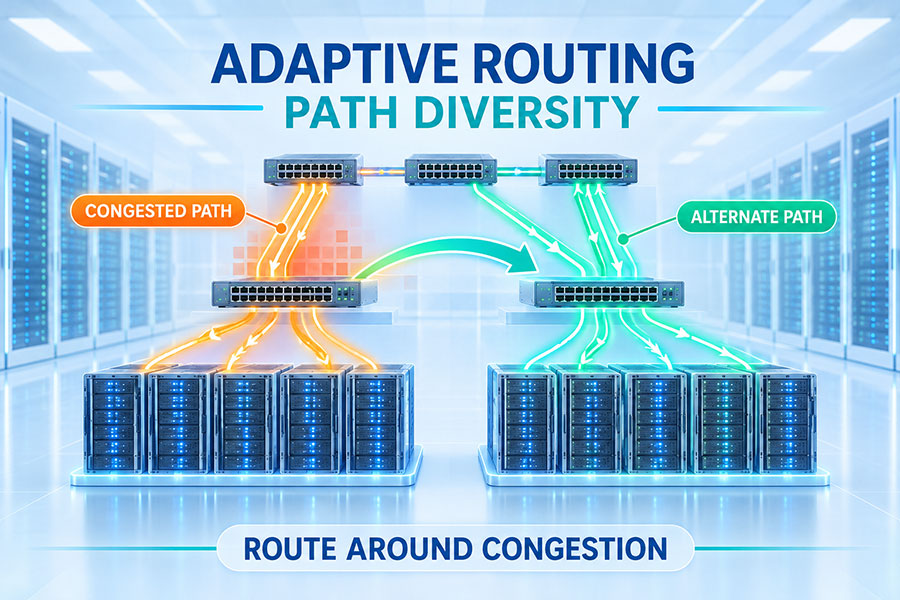
Adaptive routing can steer eligible traffic away from congested paths based on network conditions. It can improve path utilization when static hashing produces persistent imbalance, although its effectiveness depends on switching behavior, transport requirements and the communication pattern.
Path diversity is useful only when the available paths are genuinely independent enough to provide additional capacity. Shared upstream links, oversubscribed aggregation layers or common failure domains can limit the benefit of apparent path redundancy.
Congestion control
Congestion-control mechanisms regulate traffic injection or transmission behavior in response to network conditions. Their purpose is to prevent persistent queue buildup and reduce the chance that bursts overwhelm shared links. Tuning must account for workload patterns, feedback delay, link speed and the interaction between transport and switch behavior.
Capacity and buffer planning
Oversubscription, port allocation and buffer behavior should be evaluated against expected collective traffic. A fabric that performs well during isolated bandwidth tests may behave differently when many ranks start large transfers at similar times. Capacity planning should therefore include synchronized workload tests and realistic concurrent traffic.
9. RDMA, RoCEv2 and InfiniBand Considerations
RDMA enables direct data movement between application memory regions with reduced CPU involvement compared with conventional networking paths. This can lower communication overhead, but it does not make the network immune to congestion or tail latency.
In RoCEv2 Ethernet fabrics, end-to-end behavior depends on NIC capabilities, congestion control, switch configuration, routing and traffic engineering. Loss-management mechanisms and congestion feedback must be designed as a coordinated system rather than treated as isolated settings.
InfiniBand fabrics also rely on coordinated routing, congestion management and fabric configuration. Adaptive routing and multiple available paths can help distribute traffic, but actual results depend on the supported hardware, software and workload.
For both environments, it is important to distinguish transport-level behavior from collective-library behavior. A NIC may report healthy link conditions while the application still experiences slow collective completion due to rank skew, topology mapping or synchronization dependencies.
10. Overlapping Communication and Computation
Some training frameworks divide communication into smaller chunks and overlap data exchange with computation. This can reduce the amount of time during which a GPU waits for a complete communication phase. For example, gradient buckets may be communicated as they become ready rather than waiting until all gradients have been calculated.
Overlap can hide part of the communication time when the workload has sufficient independent computation. However, it does not remove the underlying network delay. If a delayed transfer lies on the critical path or prevents the next dependent computation from starting, the tail event remains visible in the iteration time.
Chunk size also matters. Smaller chunks can create more opportunities for overlap but may increase scheduling and protocol overhead. Larger chunks may improve transfer efficiency while exposing the application to longer periods of waiting for individual transfers. The best configuration depends on message size, GPU compute schedule, network bandwidth and software implementation.
11. Optical Connectivity and Physical Fabric Design
High-speed optical connectivity supports the bandwidth and reach requirements of large GPU clusters, particularly across racks and data-center network tiers. However, optical link speed alone does not determine collective tail latency. Queueing, routing, congestion, traffic distribution and endpoint behavior remain decisive factors.
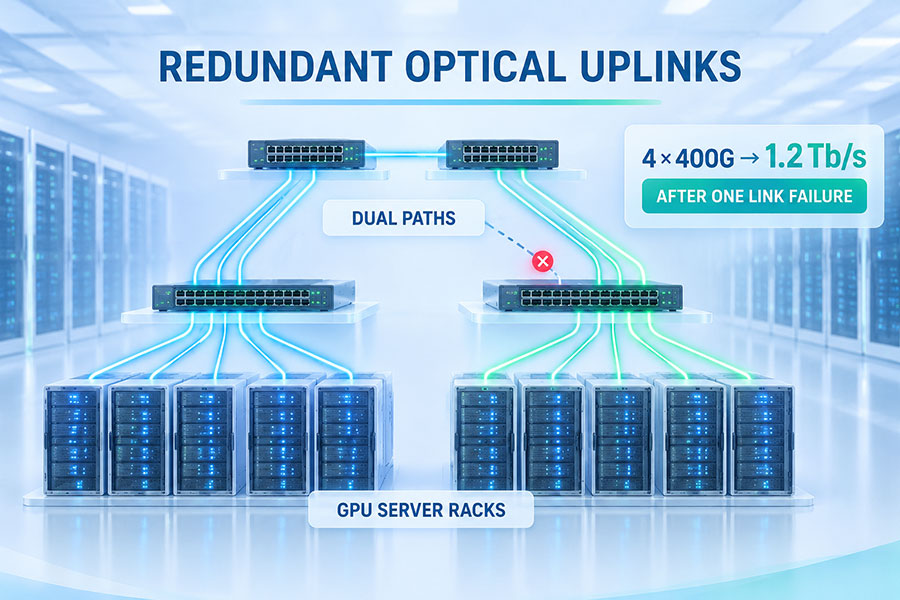
Physical path design should consider link capacity, port allocation, fiber routing, redundant uplinks and the separation of traffic across independent paths. When multiple optical links connect network tiers, their logical use by the routing and collective software should be consistent with the actual physical topology.
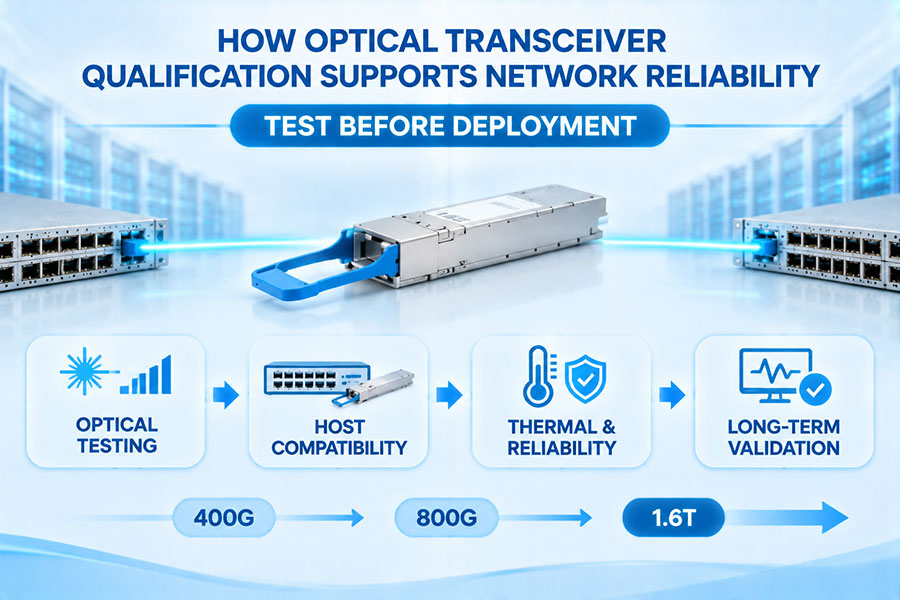
Transceiver selection should match the switch interface, lane configuration, fiber type, reach and power budget. Relevant options can be reviewed in the optical transceiver product category. Selecting a higher-speed module does not by itself resolve oversubscription or path imbalance; those issues require coordinated physical and logical network planning.
12. Tail-Aware Testing and Performance Evaluation
Benchmarking should reproduce the communication patterns and concurrency levels expected in production. A single-stream test or isolated link measurement cannot represent the behavior of a large collective running across many racks.
A useful evaluation process includes:
Baseline measurements: Record collective completion times under low-congestion conditions across representative message sizes and rank counts.
Concurrent traffic tests: Run multiple communication groups or background flows to expose shared-link contention.
Percentile analysis: Track P50, P95, P99 and, where sample volume supports it, P99.9 completion times.
Rank-level analysis: Identify which participants consistently finish late and whether the same paths or endpoints are involved.
Network telemetry: Correlate slow operations with queue occupancy, congestion signals, retransmissions, link utilization and port-level counters.
Application-level validation: Measure training iteration time, GPU utilization and total job completion time rather than relying exclusively on microbenchmarks.
Tests should also be repeated across different topologies, rank placements, message sizes and workload phases. A configuration that performs well for AllReduce may not provide the same tail behavior for All-to-All traffic.
13. Common Misinterpretations
Low average latency means low collective latency: A low mean can conceal rare but consequential delays that occur on the collective's critical path.
More bandwidth automatically removes tail latency: Additional capacity can reduce congestion, but poor path distribution, synchronization and endpoint delays may remain.
RDMA eliminates network delays: RDMA reduces certain data-movement overheads; it does not eliminate queueing, congestion, packet loss or transport recovery.
Adaptive routing always improves performance: Routing decisions must account for traffic patterns, path independence, packet ordering and transport behavior.
Every slow collective is a network problem: GPU scheduling, CPU contention, NIC processing and software synchronization can produce similar symptoms.
One benchmark represents every workload: Collective algorithms and traffic patterns vary substantially, so results must be interpreted in their test context.
14. Practical Design Priorities for AI Fabrics
Reducing collective sensitivity to tail latency requires coordinated decisions across compute placement, network topology, transport configuration and collective software. The following priorities provide a practical starting point:
Design the fabric around expected communication patterns, including AllReduce, ReduceScatter and All-to-All phases.
Provide sufficient uplink capacity and evaluate oversubscription under synchronized traffic conditions.
Use topology-aware rank placement and multipath strategies where supported by the network and software stack.
Configure congestion management consistently across NICs, switches and transport endpoints.
Monitor per-rank completion skew alongside network-level latency and congestion telemetry.
Evaluate collective algorithms and communication chunk sizes under realistic concurrency.
Measure training-step and job-level performance to confirm that network improvements translate into application benefits.
15. Conclusion
Collective communication exposes distributed AI workloads to delays that may be insignificant for an individual network flow but substantial when many ranks must coordinate. As cluster size and communication concurrency grow, tail latency, rank skew and congestion can become important constraints on GPU utilization and training efficiency.
Reliable performance depends on more than high link bandwidth or low average packet latency. Topology-aware communication, balanced multipath routing, effective congestion control, appropriate collective algorithms and cross-layer telemetry all contribute to more predictable completion times. Evaluating P95 and P99 behavior at both collective and application levels provides a more useful view of fabric performance than average latency alone.
For optical connectivity requirements in high-bandwidth data center networks, Contact C-LIGHT.
 >

 >
 >
 >
 >
 >
 >
 >